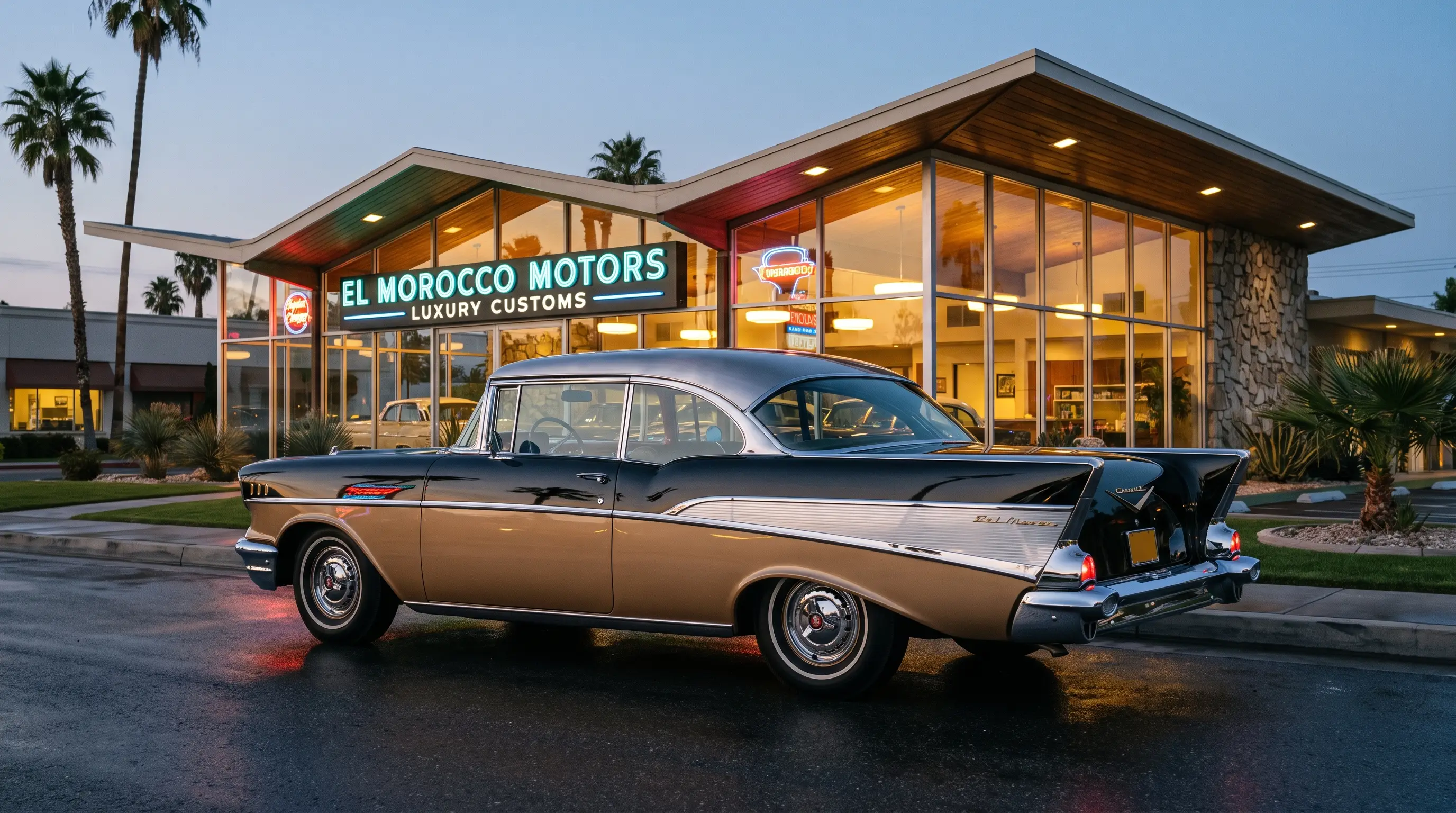
Most restyled cars from the 1950s aftermarket world were built to look faster or meaner than the factory intended. The 1957 Chevy El Morocco went a different direction entirely. It was built to look richer, dressing a Bel Air in borrowed Cadillac Eldorado Brougham styling cues and asking Chevrolet buyers to pay a premium for the illusion. It is one of the odder footnotes in Tri-Five history, a car that admits, right in its bodywork, that it wanted to be something it was not.
A Bel Air underneath, a Cadillac on top
The El Morocco began life as an ordinary Chevrolet, mechanically unchanged from the cars rolling off the regular assembly lines. Allender built the 1957 cars from a mix of Two-Ten hardtops and Bel Air convertibles, with the Bel Air-based cars forming the most desirable examples today. What set it apart was extensive bodywork performed after the fact by an independent coachbuilder, R. Allender & Company, the coachbuilding firm founded by Canadian businessman Reuben Allender, which reshaped the rear fender line, added distinctive fin-like extensions, and applied trim details lifted almost directly from Cadillac's flagship Eldorado Brougham. The result was a car that read, at a glance, as considerably more expensive than its Bel Air foundation actually cost.
This was not a subtle badge job. The rear quarter panels were genuinely reworked, giving the car a distinct silhouette from the standard Bel Air even at a distance. Buyers were, in effect, purchasing a custom coachbuilt exterior wrapped around entirely conventional Chevrolet mechanicals underneath, a formula that has always had a certain appeal for buyers who wanted the appearance of luxury without the luxury price tag or the ongoing cost of a Cadillac's more complex running gear.
Why a coachbuilder bet on a Bel Air
Allender's decision to build the El Morocco reflected a broader pattern in the 1950s American car market. Independent coachbuilders and small manufacturers regularly looked for ways to differentiate mass-produced cars for buyers who wanted something visually distinct without stepping up to a genuinely different, more expensive model line. The Bel Air was a natural candidate for this kind of treatment. It was already Chevrolet's top trim, well built, widely available, and stylish enough on its own to support an even more elaborate restyling job without looking absurd.
Production numbers for the El Morocco were extremely limited. Allender is reported to have sold between ten and twenty El Moroccos across the 1956 and 1957 model years combined, and for 1957 specifically, ten hardtop sedans, two hardtop coupes, and two convertibles are known to have been built, roughly a dozen cars total. That scarcity was baked into the business model from the start. This was never intended to compete with Chevrolet's regular output. It was a boutique product for a narrow slice of buyers willing to pay extra for genuine visual distinction.
A collector's puzzle wrapped in a Bel Air
For today's collectors, the El Morocco occupies an unusual position. It carries the mechanical simplicity and parts availability of a mainstream Bel Air, which makes ownership considerably more practical than owning a genuinely rare coachbuilt Cadillac. At the same time, its extreme rarity as a modified car creates real challenges around authentication, replacement bodywork, and establishing a clean provenance chain back to R. Allender & Company rather than a later, unrelated restyling.
Verifying an El Morocco's legitimacy has become its own specialized pursuit within Tri-Five collector circles. Fender stampings, factory paperwork, and cross-referencing against the small number of documented builds all factor into confirming a car's authenticity, since the underlying Bel Air platform makes a convincing fake technically straightforward to attempt, if not to fully justify to a knowledgeable buyer.
"The El Morocco is a documentation problem wearing a beautiful body. Every claimed example deserves the same scrutiny you would give a car worth ten times as much."
- Sarah Whitfield
What the El Morocco says about the Bel Air's reputation
There is a telling detail buried in the El Morocco's existence. A coachbuilder chose the Bel Air, specifically, as the foundation for a car meant to impersonate genuine luxury. That decision only makes sense if the Bel Air's underlying design was already considered strong enough to support the illusion. A weaker base car would have undermined the entire project no matter how much bodywork was applied on top of it. The El Morocco, in a strange way, is a period vote of confidence in the Bel Air's own styling, proof that contemporaries recognized how close the standard car already sat to something more expensive.
Readers wanting the broader context behind the Bel Air's design reputation during this stretch of the 1950s can find our complete history of the car's cultural rise, which helps explain exactly why a coachbuilder thought this particular model was worth the effort.
Other coachbuilders working the same idea
R. Allender & Company was not entirely alone in spotting the opportunity a well proportioned mainstream car like the Bel Air presented. Smaller coachbuilders and independent shops across the country experimented with similar restyling projects throughout the 1950s, some more successful than others, taking ordinary Fords, Chevrolets, and Plymouths and dressing them in borrowed luxury cues aimed at buyers who wanted distinction on a budget. Most of these projects vanished without much trace, undocumented conversions performed by shops that kept few if any records.
The El Morocco's relative survival as a documented, named project sets it apart from that broader, mostly forgotten category. Enough period advertising, dealer correspondence, and surviving examples exist to treat it as a genuine, researchable footnote in automotive history rather than pure rumor, even with production numbers that remain frustratingly imprecise. That documentation gap is itself informative. It tells us this was a serious, if small, commercial venture rather than a one-off custom job built for a single customer.
Comparing the El Morocco against these lesser-documented contemporaries also highlights just how specifically Allender targeted the Bel Air's existing strengths. Rather than trying to disguise a cheaper, less distinctive car, they chose a platform that was already handsome and simply pushed it further in a direction the factory had not gone. That is a meaningfully different project than slapping luxury trim on a car that needed the help to look presentable in the first place.
Insurance and appraisal specialists dealing with a claimed El Morocco face a similar challenge to collectors, since standard valuation guides built around mainstream Bel Air production simply do not account for a low-volume coachbuilt variant. Appraisals typically require a specialist familiar with the car's specific history, someone willing to physically inspect the bodywork modifications rather than rely on a general Tri-Five valuation chart.
Genuine El Moroccos rarely change hands, and when they do, the transaction tends to happen quietly among collectors who already know the car's story. For buyers more interested in the standard Bel Air experience without the added authentication headaches, there are plenty of honest options available to browse classic Air listings and find a car with a more straightforward paper trail. The El Morocco remains a fascinating outlier. Most Bel Air ownership does not need to be that complicated.