
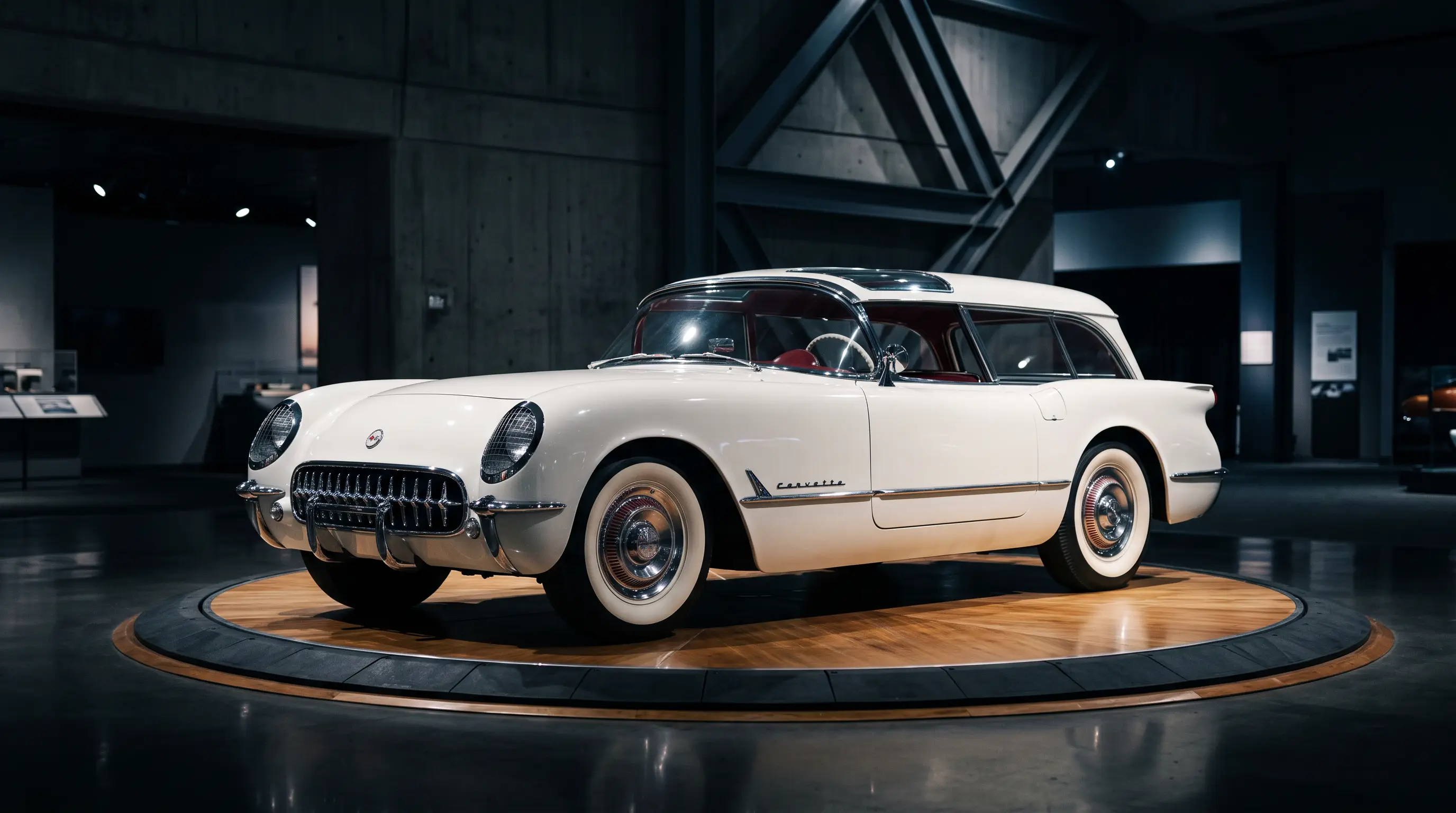
Most production cars start life as a sketch nobody outside a design studio ever sees. The Chevrolet Nomad started life on a rotating stage in front of thousands of people who had no idea they were looking at a Chevrolet at all. The nomad motorama concept that debuted in 1954 wore a Corvette front clip and Corvette proportions, and it took Chevrolet's own executives a beat to connect the dots between that show car and the family wagon sitting two model years away in the product plan. That is not how most cars get built. It is exactly how this one did.
Car Features
7 min read
The Nomad's Motorama Origins
The Nomad wagon began as a Corvette-bodied show car in 1954 before Chevrolet grafted the idea onto the Bel Air platform for production.
What Motorama actually was
General Motors ran its Motorama traveling show through the 1950s as a rolling spectacle, part auto show and part theater production, built to put dream cars in front of the public and gauge reaction before committing real money to production. Most Motorama concepts stayed exactly that, concepts, destined for the crusher or a warehouse once the tour wrapped. The 1954 show included a Corvette-based Nomad concept, a two door wagon riding on Corvette sheet metal up front, built specifically to see whether the public wanted a sporty wagon body style at all.
The public wanted it. Reaction to the concept was strong enough that Chevrolet's product planners decided the idea deserved a production life, just not on the Corvette platform it debuted on. Corvette volumes in the mid-1950s were too low and the fiberglass construction too specialized to support a wagon variant economically. So the concept's spirit, not its actual chassis, got transplanted onto the full size Bel Air platform for 1955, and the production Nomad was born from that graft.
From fiberglass concept to steel production car
Anyone who has spent time in a body shop knows that translating a show car into something you can actually build on an assembly line is where most concepts die. The Motorama Nomad had one job at the show, look sensational under lights for a few weeks. A production wagon has to survive a decade of grocery runs, winters, and teenage drivers. Chevrolet's engineers kept the parts of the concept that mattered most, the hardtop roofline, the raked windshield, and that ribbed tailgate treatment, and built everything underneath it to full size Bel Air standards instead of Corvette specialty-car standards.
That decision is why the production Nomad drives like a Chevrolet and not like a show piece. Same small block V8 options as the rest of the Bel Air lineup, same chassis, same basic maintenance routine any competent shop already understood. Chevrolet built roughly 8,400 Nomads for 1955, its highest production year of the three, before volume slid to around 7,900 in 1956 and about 6,100 in 1957. That is a low volume car relative to the standard wagons Chevrolet sold that year, and that scarcity traces directly back to its origin as a stretch assignment rather than a mainstream product plan.
Why the concept car origin still matters to buyers
I have had customers bring in Nomads expecting Corvette-spec parts because they read somewhere the car started life on a sports car chassis. It did not, not by the time it reached showrooms, and that distinction saves people money and confusion. Every mechanical component on a production Nomad interchanges with the standard Bel Air lineup. The Motorama connection is a styling and marketing story, not a parts sourcing story, and shops that do not know the difference will send a customer chasing Corvette components that were never under the hood to begin with.
Where the concept car pedigree does matter is resale value and collector interest. Buyers pay attention to origin stories, and a car that can trace its shape directly to a GM show stage carries a cachet that a purely in-house designed wagon would not have. That story gets told at every show the car attends, and it is part of why Nomad values have outpaced most other tri five wagons for decades. If you want the fuller mechanical and market picture, read the background we put together on how the wagon's whole lineage connects back to the broader tri five story.
"People assume a show car and a production car share more than they usually do. The Nomad kept the look and dropped almost everything else, and honestly that is the smarter way to do it if you actually want the thing to survive daily use."
- Mike Sullivan
How the concept toured before it ever reached a dealer
Motorama shows moved through several major cities each season, and the Nomad concept, along with the rest of that year's dream car lineup, traveled with it, drawing crowds who had never seen anything like it parked next to their family's plain steel wagon at home. That travel schedule meant Chevrolet's product planners got real time reaction from thousands of ordinary buyers across different markets, not just a single unveiling in front of company executives and a handful of journalists. The feedback loop that decision created is part of why the automaker felt confident greenlighting a production version so quickly after the concept toured, rather than letting the idea sit on a shelf the way plenty of well received show cars have over the decades.
By the time engineers started the real work of adapting the concept to the full size Bel Air platform, they were not guessing at whether the public wanted this car. They already knew. That certainty shows in how quickly the production Nomad reached dealers relative to how long some other Motorama-inspired ideas took to reach any kind of production reality, and it is a good reminder that the show car circuit was never just theater, it was market research with a much better soundtrack.
What the origin story tells you about buying one today
If you are shopping for a Nomad now, the Motorama story is worth knowing for one practical reason beyond trivia. It explains why the car looks the way it does relative to every other wagon Chevrolet built in the era, and it sets expectations for what parts you should and should not be hunting for. You are working with Bel Air mechanicals under a body that started as a sports car fantasy, which means engine and drivetrain work is straightforward and well supported, while trim and body panel work requires sourcing from Nomad-specific suppliers rather than the broader tri five parts market.
For anyone interested in a companion piece on why the wagon disappeared from the lineup as quickly as it arrived, our writeup on the car's short production run is worth a look too, since the same low volume numbers that make the Motorama story compelling are also what ended the car's run after just a few seasons. As for finding one in person, the market moves in small numbers and buyers who know what to look for tend to move fast when a clean example turns up, so if you are serious it pays to keep an eye on where you can shop classic Air listings rather than waiting for the perfect one to fall in your lap.
The Nomad is one of the rare cases where a concept car's promise actually got kept. Most show cars are forgotten within a year. This one ended up defining a body style that people are still trying to buy seventy years later.
Sources and notes
Related Reading

About the author
Mike Sullivan
Detroit-area muscle car enthusiast and restoration specialist with three decades of hands-on experience working on American iron.
Related Listings - Chevrolet Bel Air

Comments
Be the first to comment on this article.