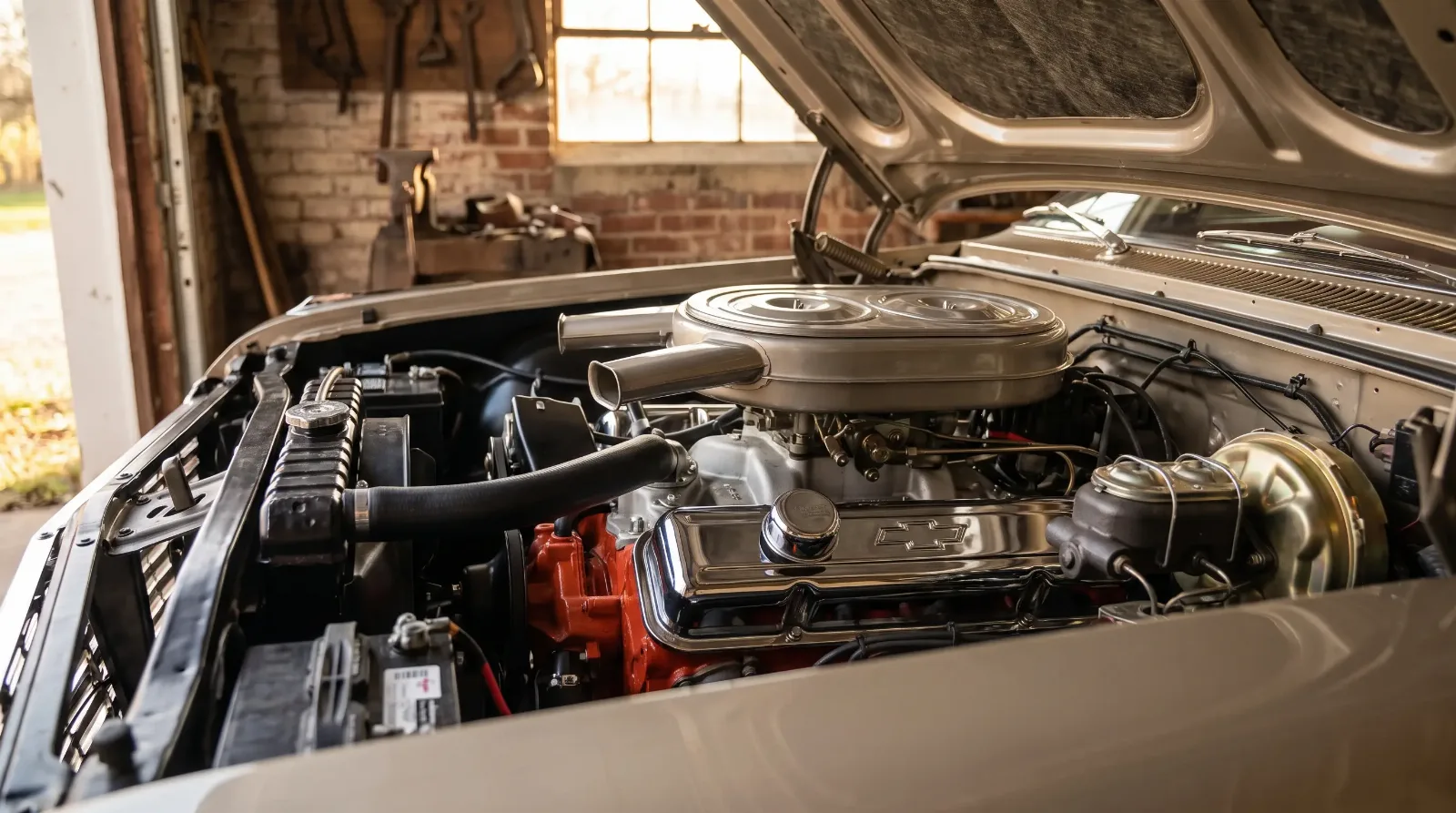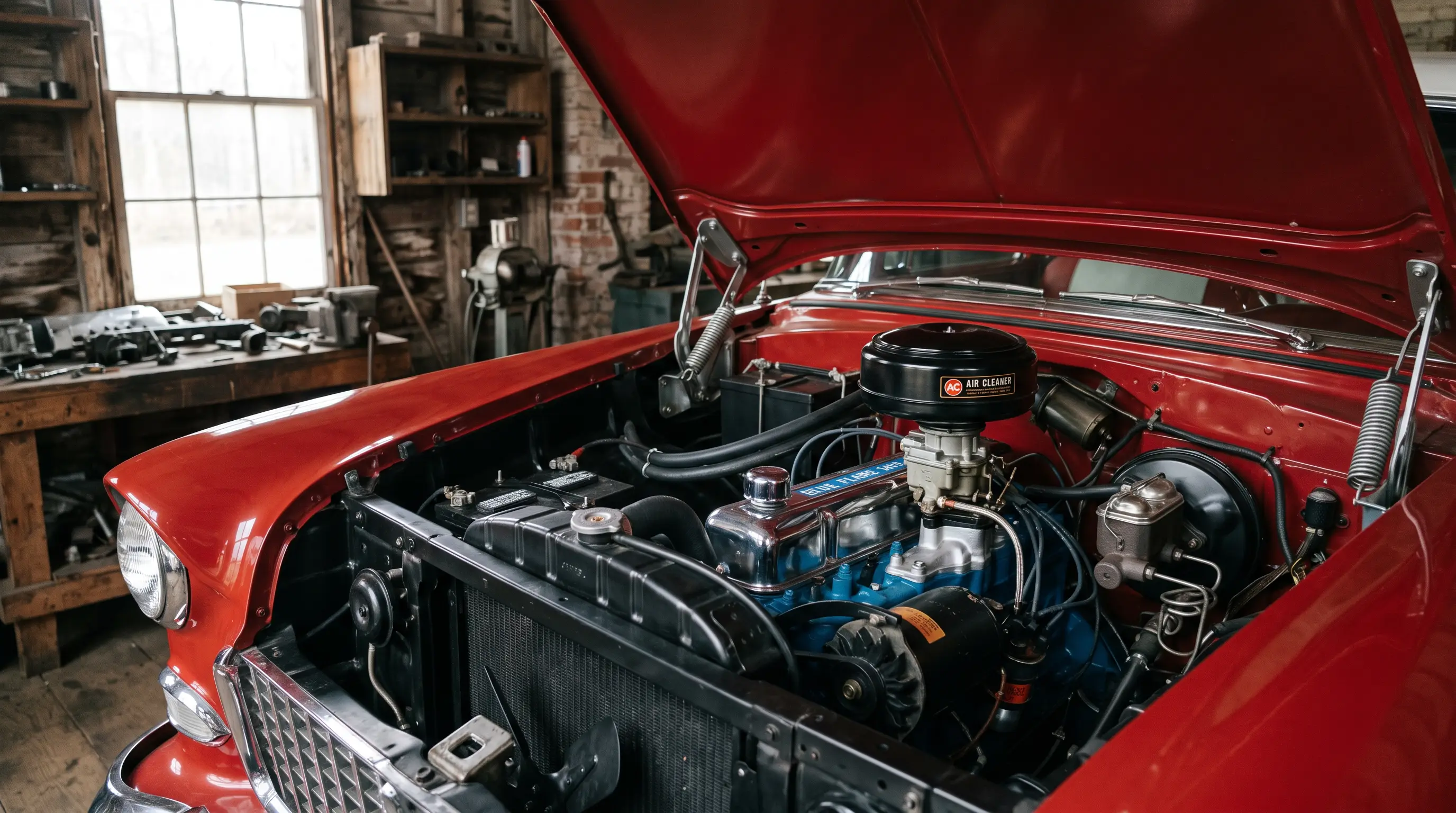
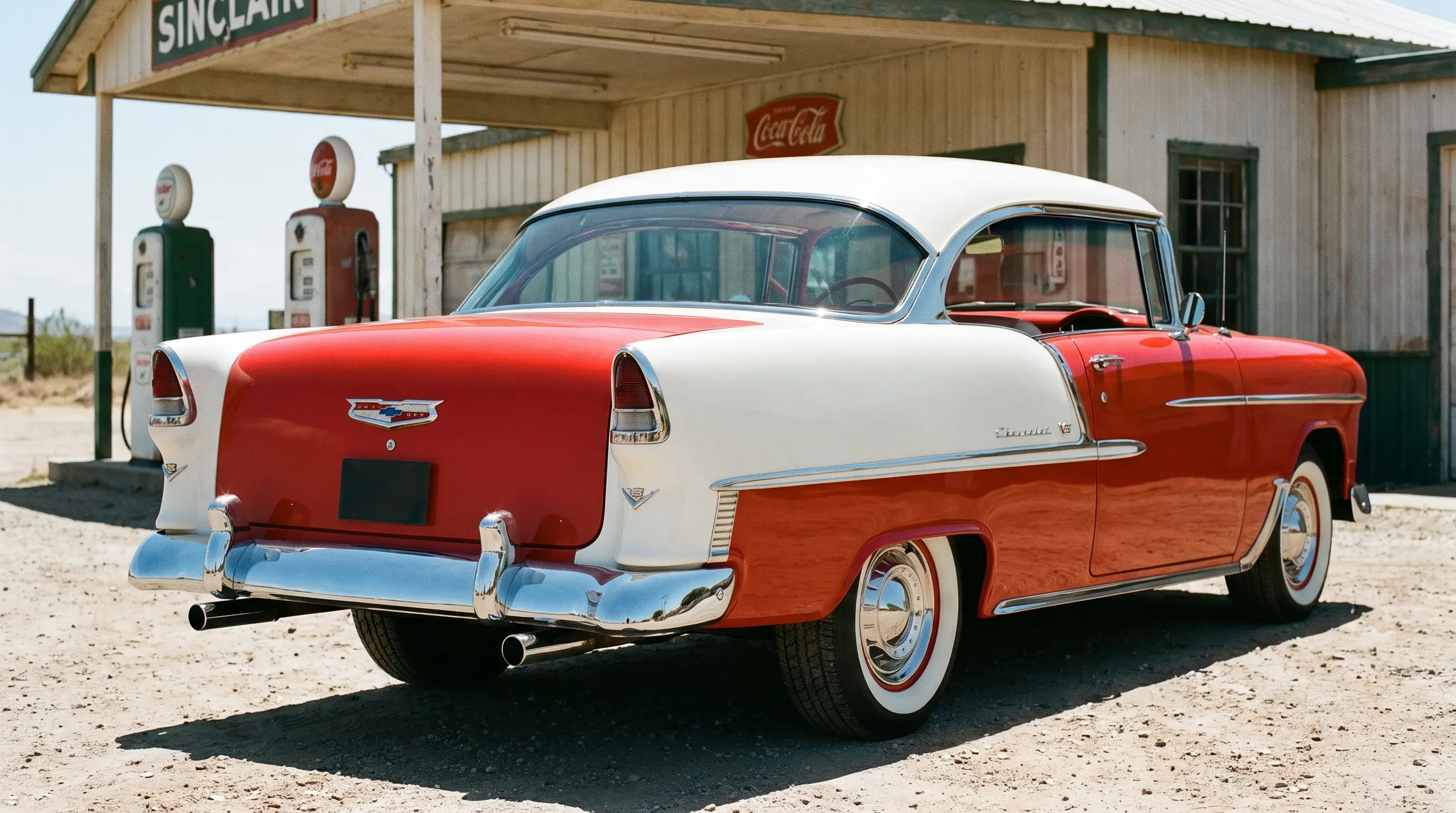
Eighteen more horsepower for the price of a four-barrel carburetor and a dual exhaust system. That is the entire chevy power pack pitch in one sentence, and it is why the option sold well from the moment Chevrolet offered it on the 1955 Bel Air. No fancy fuel injection, no unproven technology, just two straightforward bolt-on changes that turned a good engine into a noticeably better one.
The numbers, plain and simple
Base 265 V8: 162 horsepower with a two-barrel carburetor and single exhaust. Add the Power Pack option: a four-barrel carburetor and dual exhaust, and the number climbs to 180 horsepower. That is an 11 percent gain from two changes that did not touch the internal engine architecture at all. No new pistons, no new camshaft in the earliest version, just better breathing in and better breathing out. Simple engineering, real results.
| Configuration | Horsepower | Exhaust |
|---|---|---|
| Base 265 V8 | 162 hp | Single |
| Power Pack 265 V8 | 180 hp | Dual |
Why it worked
A two-barrel carburetor restricts airflow at higher RPM more than a four-barrel does, and a single exhaust system creates more backpressure than dual exhaust. Both restrictions cost horsepower specifically at the top of the rev range, where a driver actually feels the difference during a passing maneuver or a stoplight run. Power Pack removed both restrictions at once. That is why the gain felt bigger to drivers than the raw horsepower number suggests. It was not just more power, it was power delivered more freely across the whole rev range.
Chevrolet did not stop at one Power Pack tune either. As the engine family grew through 283 and later displacement, Power Pack-style four-barrel-and-dual-exhaust options followed along, each one delivering a similar proportional bump over the base carbureted engine of its era. The formula worked, so Chevrolet kept using it.
What it meant for regular buyers, not just racers
Drag strip racers loved Power Pack because it was a cheap, factory-warrantied way to add real horsepower without voiding anything. But most buyers who checked the option box were not racing anyone. They wanted a Bel Air that felt a little quicker merging onto a highway, a little more confident passing a truck on a two-lane road. Power Pack delivered exactly that kind of everyday improvement, and it did it without the added cost, complexity, or servicing headaches that came with the fuel-injected option further up the price list.
That accessibility is the real story here. Fuel injection made headlines. Power Pack made sales. A much larger share of 1955 and 1956 Bel Air buyers drove home with a Power Pack car than ever considered the fuel-injected option, simply because the price gap between base and Power Pack was small and the price gap to fuel injection was not.
"Power Pack is the option most people forget to talk about because it is not exotic. It is also the option that put real horsepower into more driveways than any fancier upgrade Chevrolet sold that decade."
- Dan Reeves
How to spot a genuine Power Pack car today
Dual exhaust exit points at the rear of the car are the visible clue, but they are easy to fake with an aftermarket exhaust system that was never factory Power Pack equipment. The real verification comes from the carburetor casting number and the intake manifold configuration, which should match Chevrolet's four-barrel Power Pack specification for the model year in question. A seller who cannot produce that level of detail is selling you a guess, not a documented fact.
Read where this started for the fuller picture of how the small block engine family evolved year over year, because Power Pack was not a one-time option. It reappeared in various forms across multiple displacement generations, and knowing which year's Power Pack configuration you are actually looking at matters for accurate valuation.
What Power Pack did to resale value in period
Used car buyers in the late 1950s already understood the difference between a base engine and a Power Pack car, and it showed up in resale prices almost immediately. A dealer taking a Power Pack Bel Air in trade could ask more for it than an equivalent base car, because word had already spread through owners, mechanics, and local racing circles that the option delivered real, noticeable performance without a reliability tax attached. That early market recognition is part of why Power Pack became such a common order code. Buyers were not just chasing a number on a brochure, they were responding to what other owners were telling them at gas stations and church parking lots.
That same dynamic plays out today at a different scale. A documented Power Pack car sells faster and for more money than an equivalent base-engine car in similar condition, and the gap has been remarkably stable for decades because the underlying appeal, more performance for a modest price, never really goes out of style with buyers.
Servicing a Power Pack setup decades later
The good news for current owners is that nothing about Power Pack requires exotic parts or specialized knowledge. A four-barrel carburetor rebuild is well within reach of any competent classic car mechanic, and dual exhaust components are widely reproduced by aftermarket suppliers who cater specifically to this generation of Chevrolet. That is a meaningful practical advantage over the fuel-injected option, which demands a much narrower pool of qualified specialists. Owning a Power Pack car means you can actually find someone to fix it in most parts of the country, not just at a handful of specialty shops.
Replacement carburetors, gaskets, and exhaust manifolds for this specific configuration remain in production from multiple aftermarket suppliers, which keeps ownership costs reasonable compared to engines built around rarer factory hardware. That is a small detail, but it adds up over years of ownership.
The bottom line
Power Pack turned 162 horsepower into 180 with two straightforward, well-proven changes, and it did it at a price point that put real performance within reach of an ordinary buyer, not just a dedicated enthusiast. That combination of accessibility and genuine mechanical improvement is why it remained a Chevrolet staple option for years after its 1955 debut. When you go looking at classic Air for sale listings, do not assume dual pipes automatically mean a documented Power Pack car. Verify the numbers, then decide what the premium is actually worth to you.
Eighteen horsepower does not sound dramatic written down on a spec sheet decades later. In 1955, it was the difference between an ordinary Bel Air and one that could actually hold its own against the competition on a public road, at a price nearly anyone cross-shopping the car could afford to check the box for. That is the entire case for Power Pack, and it still holds up.
Sources and notes
- 1955 Chevrolet Bel Air 265 V-8 Specs - Automobile Catalog
- Collector Car Corner: 1955 Chevy 265-V8 - The Spokesman-Review
- Chevrolet Small-Block Engine - Wikipedia
- Ranking the Top 5 Small Block Chevy Engines: The Original 265 - OnAllCylinders
- Chevy 265 V8 Engine Specs, Horsepower, Problems - Engine Facts
- 1955-1965 Chevrolet Small Block V-8 - Over-Drive Magazine