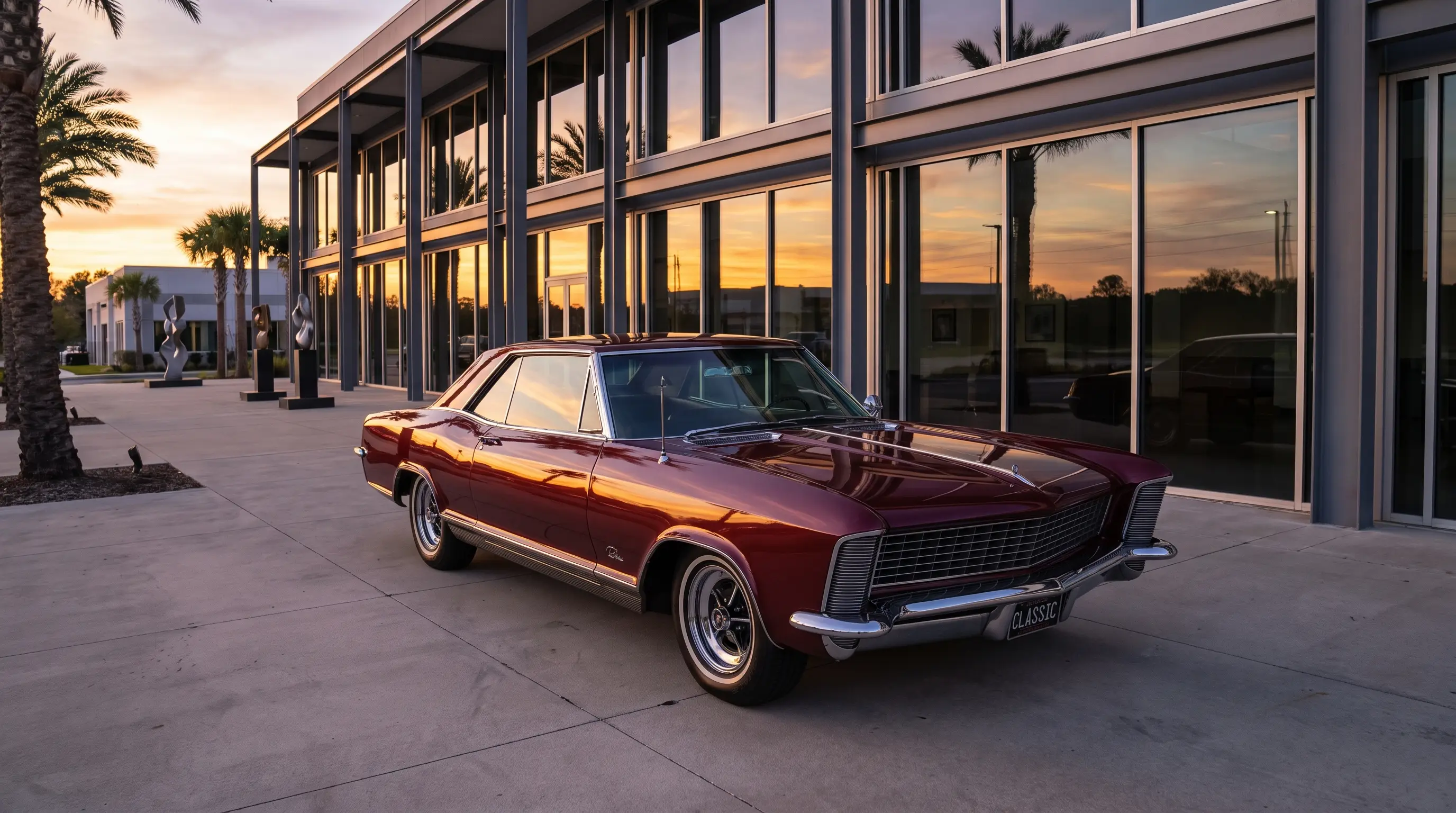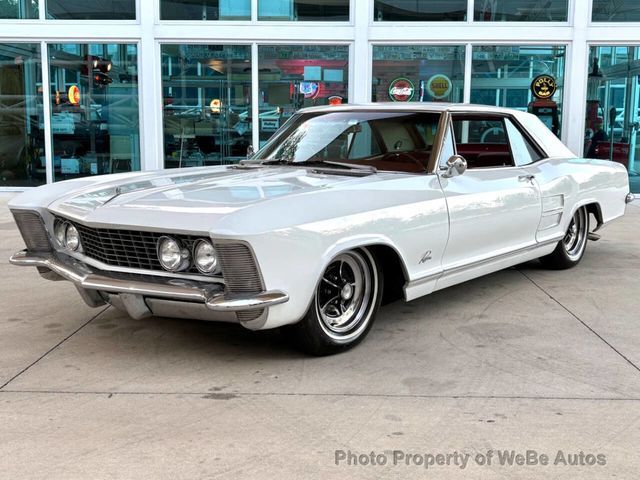
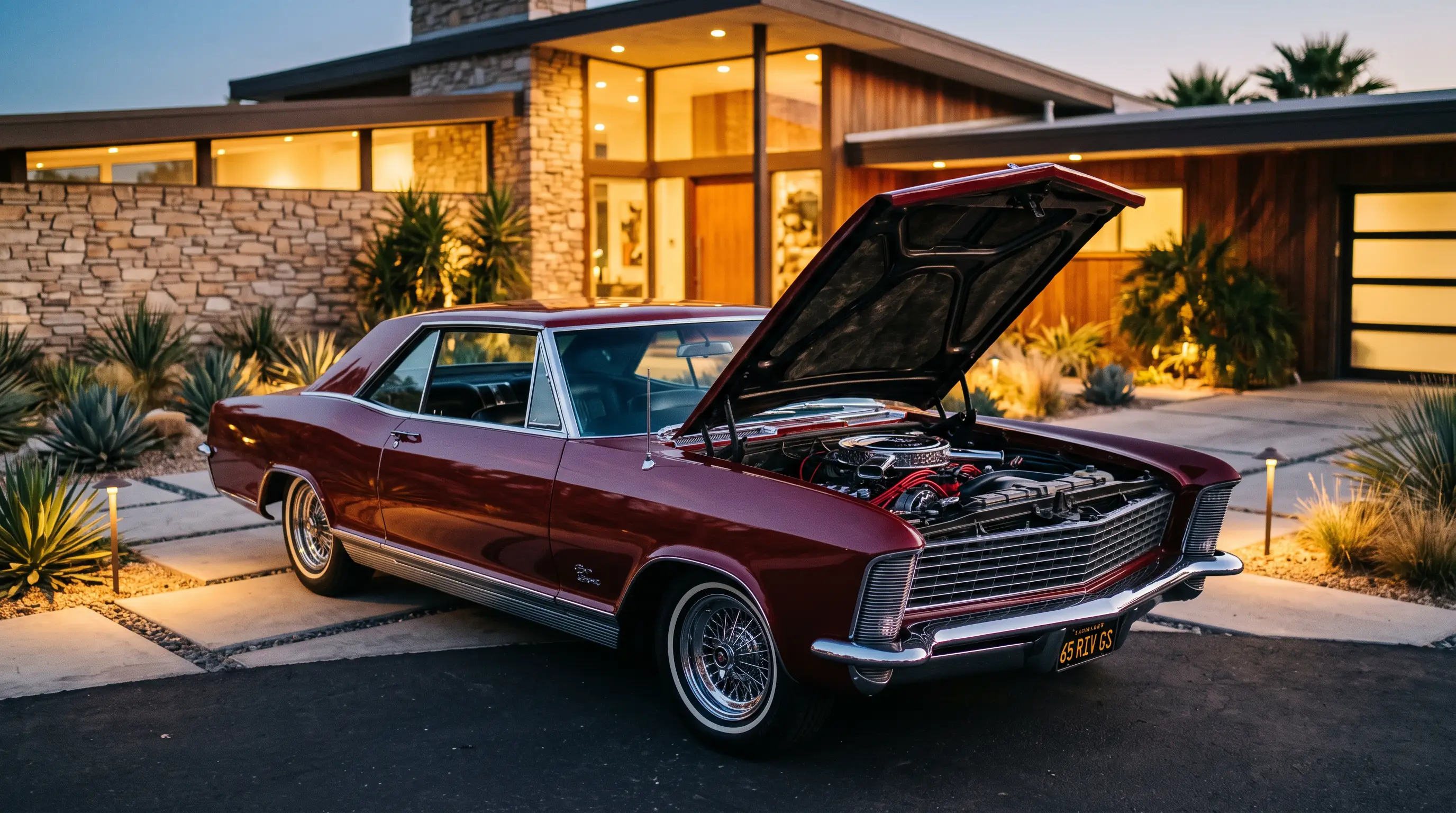
Here is the number that matters: 360 horsepower, dual quads, 425 cubic inches, factory rated, 1965 only. The buick riviera 1965 nailhead 401 425 character is not a mystery once you look at what each engine actually delivered instead of what people assume a "Nailhead" nickname implies. Buick built two Nailhead V8s for the 1965 Riviera lineup, and the difference between them is the difference between a comfortable cruiser and a car that could genuinely move when asked. Our our 1965 buick riviera retrospective covers the rest of what made the year significant.
Two engines, one basic architecture
The base engine was the carryover 401 cubic inch Nailhead, rated at 325 horsepower, the same fundamental unit that had powered the Riviera since 1963. The optional engine for 1965 was a new 425 cubic inch version, available with either a single four-barrel or the dual-quad setup used in the Gran Sport package, with the dual-quad configuration rated at 360 horsepower. Both engines shared the same basic Nailhead architecture: small valves relative to the bore, an unusual valve train geometry that traded high-rpm breathing for low-end torque, and a compact overall package that fit the Riviera's engine bay without forcing changes to the surrounding sheet metal.
The name Nailhead came from the valve heads themselves, small and upright compared to contemporary big-block designs from Chevrolet or Chrysler, resembling the heads of nails standing in a row when you looked down into an open valve cover. That geometry was never going to win a horsepower race against engines built to breathe at high rpm. It was not designed to. Buick built the Nailhead to make torque low in the rev range, exactly what a two-ton personal luxury coupe needed to feel effortless off the line, and exactly what its buyers actually wanted from the car.
What 425 cubic inches actually bought you
The jump from 401 to 425 cubic inches gave Riviera buyers a genuine, useful increase in low-end torque, not just a bigger number on a spec sheet. In practical terms, that meant a car that pulled harder from a stop and passed with less downshifting than the base engine required. The dual-quad version, reserved for the Gran Sport package, pushed that further, adding real throttle response on top of the torque increase. None of this turned the Riviera into a drag strip weapon. It did not need to be one. What it delivered was a coupe that finally had an engine matching the confidence of its styling, instead of a body that looked faster than the standard drivetrain could back up.
1965 Riviera engine lineup
| Engine | Displacement | Induction | Rated horsepower |
|---|---|---|---|
| Base Nailhead | 401 cu in | Single four-barrel | 325 hp |
| Optional Nailhead | 425 cu in | Single four-barrel | 340 hp |
| Gran Sport Nailhead | 425 cu in | Dual four-barrel | 360 hp |
Where the Nailhead falls short and why that is fine
People who expect the Nailhead to behave like a small-block Chevy or a Chrysler wedge motor at high rpm come away disappointed, and that disappointment says more about mismatched expectations than about the engine itself. The valve geometry runs out of breath before the rev counter gets anywhere near where a genuine high-performance engine of the era would still be pulling hard. Buick never claimed otherwise. This was an engine built for a specific job: move a heavy, comfort-oriented coupe with authority at low and mid-range speeds, the speeds where actual driving happens, not the speeds where a dyno sheet looks impressive.
Judged against that actual job, the Nailhead does exactly what it was designed to do, and the 425's extra displacement over the 401 makes that job noticeably easier without changing the car's fundamental character. It stays smooth, it stays quiet, and it delivers its power in a way that suits a personal luxury coupe far better than a peakier engine would have.
"People ask why Buick did not just build a bigger, faster-revving engine. Wrong question. The Nailhead was never trying to win that fight. It was built to make a two-ton coupe feel effortless, and the 425 does that job better than the 401 ever could."
- Dan Reeves
What this means for a buyer today
If you are cross-shopping first-generation Rivieras and engine choice matters to you, the 425 over the 401 is a real, meaningful upgrade, not a marketing distinction. It changes how the car feels from the driver's seat in a way the base engine cannot match, and the dual-quad Gran Sport version goes a step further still. None of that makes a base 401 car a bad buy. It just means you should know exactly which engine sits under the hood before you commit, since the difference is real and it is bigger than a lot of buyers assume walking in. The related story on how this fits into Buick's broader personal luxury strategy that same year is worth reading too, at a related story, and if you are ready to compare actual cars rather than spec sheets, there are Rivieras for sale now with both engine options represented.
The Nailhead's reputation inside Buick itself
Buick's own engineers were reportedly fond of the Nailhead precisely because it did its job without drama, a reputation that stood in contrast to some of the higher-strung big blocks other divisions were racing to build during the same years. General Motors in the mid-1960s had plenty of engines chasing horsepower figures for advertising purposes, and Buick largely sat out that particular contest with the Riviera's drivetrain. The 401 and 425 were built for a customer who wanted torque on tap and quiet running more than a number to brag about at a stoplight, and that philosophy shaped nearly every engineering decision made about the engine family across its long production life.
That reputation followed the Nailhead well past the Riviera's first generation. Buick kept variations of the design in production for years after 1965, a longevity that speaks to how well the basic architecture suited the kind of cars Buick built around it. The 425 in particular earned a following among owners who wanted genuine low-end authority without sacrificing the smooth, unstressed character that made the engine family a good match for a personal luxury coupe in the first place, and that combination is exactly why the 1965 lineup still gets singled out by people comparing engine options across the whole first generation.
Sound is part of the character too, and it is easy to overlook next to the horsepower figures. A Nailhead at idle has a distinct, low burble that comes from the unusual valve geometry and the engine's overall mechanical layout, quieter and less aggressive than a lot of contemporary big blocks from other manufacturers. Buyers cross-shopping a Riviera against a Thunderbird or a full-size performance coupe in period often commented on how much more refined the Buick sounded at a stoplight, a small detail that reinforced the car's personal luxury positioning without needing a single word of advertising copy to make the point.
Sources and notes
- Buick Riviera - Wikipedia
- 1965 Buick Riviera 401 V-8 Specs - Automobile Catalog
- 1965 Buick Riviera 425 V-8 Specs - Automobile Catalog
- 1965 Buick Riviera Gran Sport - Hagerty Valuation Tools
- A Detailed Look Back At The 1965 Buick Riviera - HotCars
- Dual Quads: 1965 Buick Riviera Super Wildcat - Barn Finds