
Walk any indoor show with me and you'll spot a candy job from across the hall. It has a depth flat paint never gets, a color that seems to sit under the surface instead of on top of it. Get closer and the metalflake takes over, throwing back a thousand tiny points of light when the car rolls under the lights. These two finishes carried the custom car scene through its wildest years, and they still separate a real show car from a driver with a nice single-stage coat. Understanding how they work tells you why a good candy or flake job costs what it costs, and why so many amateurs get it wrong.
Car Features
7 min read
Candy and Metalflake Paint Explained
Candy tints light over a reflective base; metalflake throws a thousand points of sparkle. How both finishes work and why they are so hard to master.
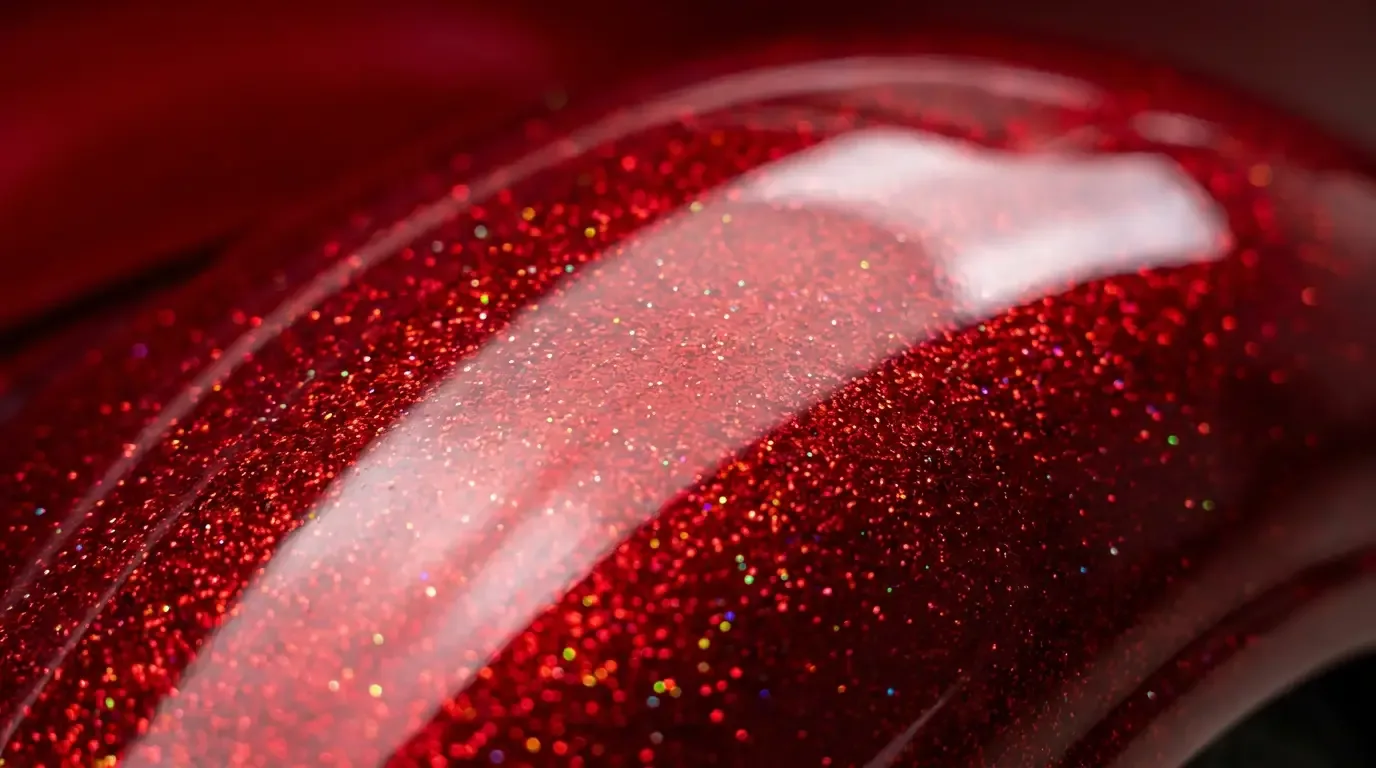
What candy paint actually is
Candy is not a color you spray straight from the can. It is a translucent, tinted coat you lay over a reflective base. The base does the shining. The candy tints the light on its way in and again on its way back out to your eye, which is why the color reads so deep. Think of it like stained glass with a mirror behind it. Light passes through the tint, bounces off the metallic or gold base underneath, and passes back through the tint a second time. That double pass is the whole trick, and it is what a solid color can never fake.
The base coat is usually a fine metallic, a silver, gold, or a bright metallic ground. Over that goes the candy itself, a resin loaded with transparent dye or transparent pigment. Candy apple red is the famous one, but the same principle gives you candy blue, candy tangerine, candy lime, and the rest. Because the tint builds with every coat, the color gets darker the more you spray. A light candy red looks like a rosy pink over silver, and a heavy one goes nearly black-cherry. Control lives entirely in your coat count and your consistency across the panel.
Why metalflake sparkles the way it does
Metalflake is a different animal. Instead of a fine metallic dust, you are spraying tiny flat squares or hexagons of aluminum or polyester film suspended in clear. Each flake is a little mirror. When they lie flat in the film and catch light from different angles, you get that hard, glittering sparkle that reads across a whole hall. The bigger the flake, the coarser and flashier the sparkle. Fine flake gives you a shimmer close to a rich metallic; big flake, the old bass-boat sized stuff, throws chunky points of light you can see from thirty feet.
Flake can go on its own for a straight sparkle finish, or it can live under a candy coat, which is where the magic really happens. Candy over flake gives you color depth and sparkle at the same time. The tint colors every one of those little mirrors, so a candy-over-gold-flake job lights up like it is full of tiny colored jewels. That combination is the signature of the high show-car era, and it is still the hardest kind of paint to do well.
The 1960s show-car era
Candy and flake belong to a specific moment. Through the late 1950s and into the 1960s, the indoor custom show circuit turned paint into the main event. Builders were chasing trophies under bright even lighting, where a finish gets judged inches from a judge's nose. Flat and simple would not cut it. Candy over flake, panel paint, cobwebbing, and wild multi-color lace work all came out of that pressure to have the loudest, deepest, most reflective car in the building.
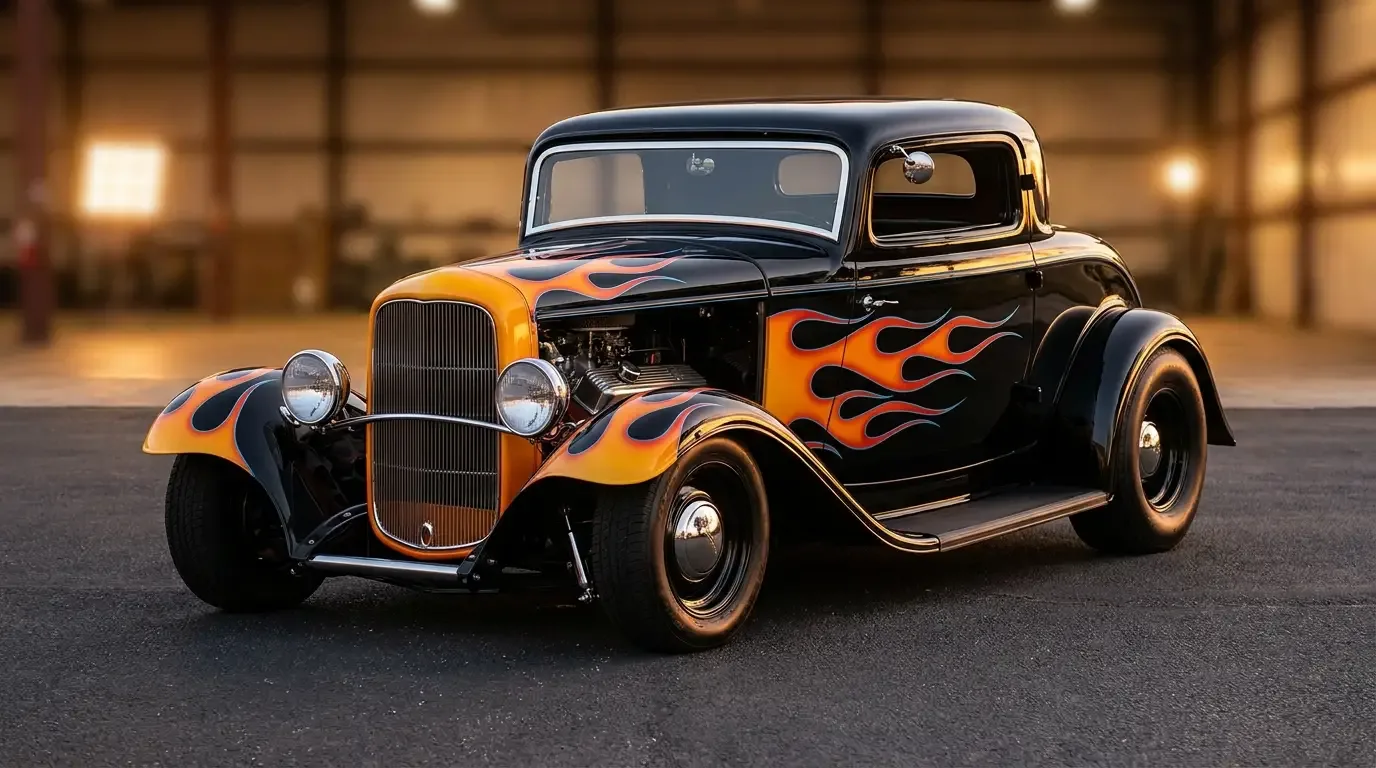
This was the world of the traveling Kustom shows, the airbrushed one-off show rods, and painters who became names in their own right. The finishes got so elaborate that the cars stopped being drivers and became rolling paint samples, trailered from show to show. A lot of the flames and scallop work of the era shared the same booths and the same painters, so the styles cross-pollinated. If you want the fuller picture of how these schemes fit together, our guide to Scallops and Classic Paint Schemes covers the graphic side that often ran alongside candy and flake, and the classic hot rod flames tradition came out of the same booths.
| Finish | How it works | Look | Difficulty |
|---|---|---|---|
| Candy | Translucent tint over a metallic or gold base; color builds with coats | Deep, glowing, saturated color with visible depth | High: coat consistency is unforgiving |
| Metalflake | Flat metal or film flakes suspended in clear | Hard, glittering sparkle that carries across a room | High: needs heavy clear and long sanding |
| Candy over flake | Candy tint laid over a flake base | Colored sparkle with depth, the show-car signature | Very high: both problems at once |
Why it is so hard to do right
Everything about these finishes punishes sloppiness. Candy is translucent, so it hides nothing. Every low spot, every sand scratch, every uneven coat shows straight through as a dark or light patch. On a solid color you can bury small sins under pigment. On candy you cannot. The prep has to be dead flat and the base coat has to be perfectly uniform before a drop of candy goes on, because any blotch in the base telegraphs right through the tint.
Coverage consistency is the killer. Since color depends on how many coats hit each spot, you have to spray the whole car with the exact same overlap and film thickness, edge to edge, or one door reads darker than the other. Complex shapes, edges, and recesses want to build up faster or slower than flat panels, so painters learn to feather and balance as they go. Flake adds its own headache: the flake edges leave the surface rough, so you clear heavily and then block-sand and re-clear until every flake is buried under glass. Skip that and the finish feels like sandpaper and dulls fast. It is slow, expensive work, and it is the reason a proper candy-over-flake job still commands real money in a top shop.
"Candy tells the truth on you. I've seen guys lay down a base that looked mirror-perfect, then the candy went on and every ripple I missed with the block was suddenly staring back at me. You don't paint candy. You earn it in the bodywork first, and then the color is just the reward."
Hector Morales
That is the honest reason these finishes still carry weight. Anybody can buy a spray gun. Almost nobody can lay a flawless candy over flake across a whole car and have it look the same in every light. When you see one done right, you are looking at years of learned control, not a color choice.
Sources and notes
- Period custom-car and hot-rod press coverage of the indoor show circuit and its painters
- Kustom kulture histories and builder interviews on the development of candy and metalflake finishes
- Automotive paint and refinishing references on translucent tint coats, metallic bases, and flake application
- Show and museum records documenting the 1950s–1960s custom show-car era
Related Reading
Have a
Classic Car
for Sale?
Reach thousands of serious classic car collectors across the US.
Sell It Here →
Are You a Classic Car Dealer?
List your full inventory and connect with targeted classic car buyers.
Join as a Dealer →

About the author
Hector Morales
East LA lowrider builder and lifelong member of the car-club scene, writing lowrider culture, hydraulics and custom paint from the inside.




Comments
Be the first to comment on this article.