
Ask ten guys at a show what a scallop is and half of them will point at a set of flames. They are not the same thing, and any painter who came up through the trade will tell you so. A scallop is a long, tapered teardrop or spear of color laid over a base coat, usually running back from the nose or the cowl and coming to a fine point. It is a shape, a layout, a discipline of tape and edge. It is one of the oldest tricks in the kustom book, older than the wild candy work that came later, and when it is done right it makes a car look like it is moving while it sits still.
Car Features
7 min read
Scallops and Classic Paint Schemes
Scallops are the oldest trick in the kustom paint book. Here is what they are, how they beat flames for control, and the taping craft behind them.
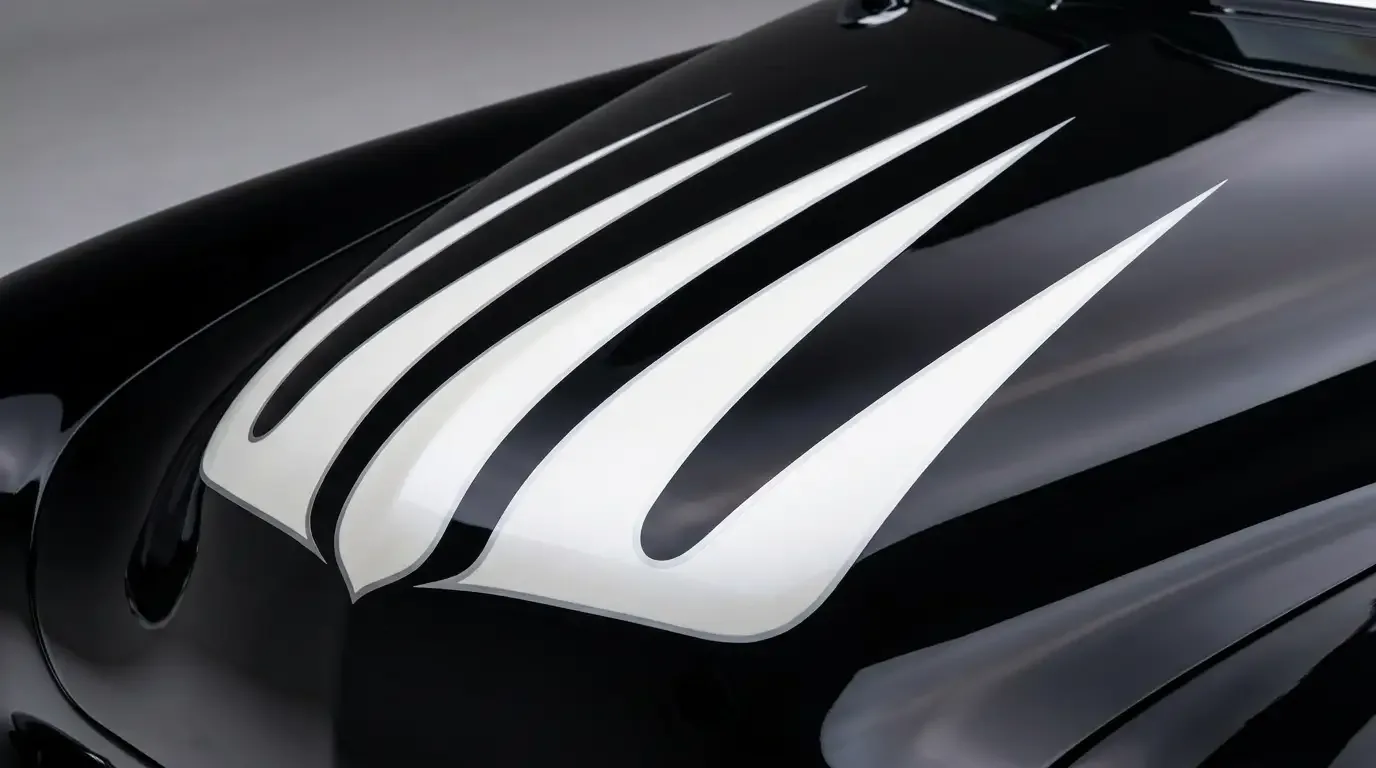
I have shot scallops on everything from a mild coupe to a full custom, and the ones that work all share the same thing: a clean layout, a crisp edge, and restraint. Too many points and the car looks busy. The good painters knew that a scallop was punctuation, not a paragraph.
What a scallop actually is
A scallop is a pointed panel of contrasting color that sits on top of the body color. Picture a long ice-cream cone shape, wide where it starts and narrowing to a needle point where it ends. On a typical layout you get a set of them fanning back over the hood, the cowl, and the door tops, all pulling toward the rear of the car. The color inside the scallop can be anything, but the classic move is a strong contrast: white scallops on a dark body, or a bright color over black.
The trick that separates a real scallop from a stripe is the taper and the point. A stripe has parallel edges. A scallop swells and then closes down to almost nothing, and that closing point is where painters earn their money. A soft or fat point ruins the whole look. Old-timers used to say you could judge a paint shop by how sharp its points were.
Scallops versus flames
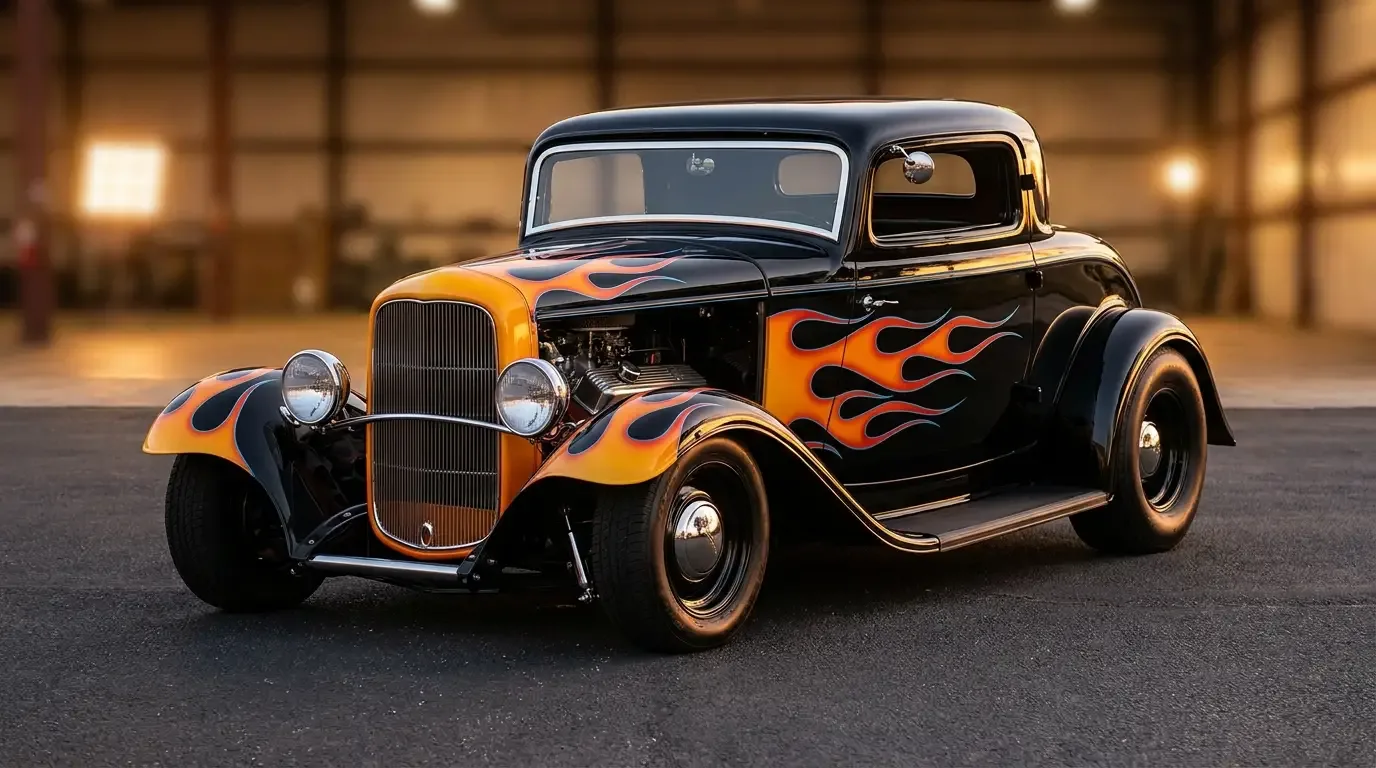
This is where people get tangled up, so let me lay it out plain. Flames are meant to look like fire licking back off the front of the car. They have curling tips, they overlap, they wrap around each other, and the whole point is chaos that reads as heat. A good flame job has movement and randomness in it. You want the eye to get a little lost.
Scallops are the opposite. They are geometric, controlled, and symmetrical side to side. Where a flame job wants to look organic, a scallop job wants to look engineered. You can read the layout at a glance. That control is exactly why some builders reach for scallops when they think flames have gotten too common. If you want the fire look instead, that is its own craft, and the way painters lay out hot rod flames is a different animal from the taping I am describing here.
| Feature | Scallops | Flames |
|---|---|---|
| Shape | Tapered points, geometric | Curling licks, organic |
| Symmetry | Usually matched side to side | Often free-flowing, less rigid |
| Edge | Single clean taper to a point | Overlapping tips and hooks |
| Feel | Controlled, fast, tidy | Hot, wild, aggressive |
| Layout method | Fine-line tape, mirrored | Fine-line tape, freehand curves |
Two-tone and panel paint
Scallops belong to a bigger family of layout paint that ruled the custom scene before candy and metalflake took over. The broadest member is the two-tone: one color on the body, a second on the roof or on a spear down the side. Factories did mild two-tones from the showroom, but customizers pushed them, sweeping the break line low and long to stretch the car out visually.
Panel paint is the next step. Instead of one big break, the painter tapes off a defined panel, often on the roof or the trunk, and shoots it a different color or a slightly different shade. Scallops, spears, and panels all live in the same world. They are all about using contrast and shape to change how the eye reads the metal. Done well, a low panel and a set of scallops can make a tall body look sleeker than any chop.
- Two-tone: a clean color break, usually body versus roof, run long to lengthen the car.
- Panel: a taped-off section shot in a second color, often the roof or deck.
- Scallops: tapered points overlaid on the base, pulling toward the rear.
- Spears: a single long tapered blade, the simplest cousin of the scallop.
All of it depends on paint that lays flat and even, which is why the shops that were good at scallops were usually good at everything. The same crews doing this layout work often moved into wilder finishes, and if you want to see where the trade went next, the story of Candy and Metalflake Paint Explained picks up right there.
The layout and taping craft
Here is the part nobody sees at the show. A scallop job is mostly tape. The spraying is the easy day. The layout is where a painter spends hours, and it is done almost entirely with fine-line masking tape, a steady hand, and a good eye.
The painter starts by finding the centerline and the key body lines, then lays out one side by feel, stepping back constantly to check the shape against the car's own curves. A scallop that ignores the body line looks pasted on. Once one side reads right, it gets measured and mirrored to the other side so the two match. Then comes backmasking and papering off everything that is not getting color, because overspray on a base coat means starting over.
"People think the magic is in the spray gun. It is not. It is in the tape. I have spent a whole day taping a set of scallops and twenty minutes shooting them. If your points are soft and your lines wander, no amount of clear is going to save it."
Jim Vasquez
Period versus modern
The old way was single-stage enamel or lacquer, taped by hand, with the scallop color often left with a visible paint edge you could feel with a fingernail. That edge was part of the look. Nobody buried it. The colors were the ones you could get, which is why so many period cars wear white or off-white scallops over dark bodies.
Modern shops shoot two-stage base-clear, then bury the whole layout under clear and block it flat so you cannot feel the edge at all. It looks glassier, and some people love it. Traditionalists think it looks too perfect and misses the point of a period build. Both are valid, they are just different eras talking. If you are building a car meant to look like it rolled out of 1958, a fingernail-catch edge and a period color palette will read right in a way that a mile-deep modern clear job never will.
Whichever road you take, scallops reward a car that already has good stance and clean bodywork under it. Paint hides nothing. Lay a crisp set of scallops over a straight body and you have one of the oldest and most honest looks in the hobby, the kind of finish that has been turning heads since the first customizers reached for a roll of tape.
Sources and notes
- Period hot-rod and custom-car press covering paint and bodywork technique.
- Kustom Kulture references on layout paint, striping, and finish history.
- Show and registry records documenting period versus modern custom paint.
- Working painter and builder interviews on taping and layout practice.
Related Reading
Have a
Classic Car
for Sale?
Reach thousands of serious classic car collectors across the US.
Sell It Here →
Are You a Classic Car Dealer?
List your full inventory and connect with targeted classic car buyers.
Join as a Dealer →

About the author
Jim Vasquez
Southern California hot rod and custom car builder with roots in the traditional kustom kulture scene.




Comments
Be the first to comment on this article.