
A hot rod either reads right or it reads wrong, and most people can tell the difference in about two seconds even if they can't say why. The proportions, the paint, the way the thing sits on the ground, all of it works together or none of it does. I've spent enough winters in a Milwaukee shop to know that getting the mechanical side sorted is the easy part. The look is where builders separate themselves. This is a walk through what actually makes a hot rod look like a hot rod, from the flames on the nose to the rubber on the pavement, and why the old rules still hold up.
Car Features
16 min read
Hot Rod Style: Flames, Paint and Stance
Traditional flames, candy paint, steelies versus mags, and the rake that makes a hot rod look fast standing still. A builder breaks down the look.
If you want the background on how these cars came to be, read the story of the hot rod first. What follows here is about the surface and the stance, the stuff that separates a real one from a fake one.
Flames: traditional versus realistic
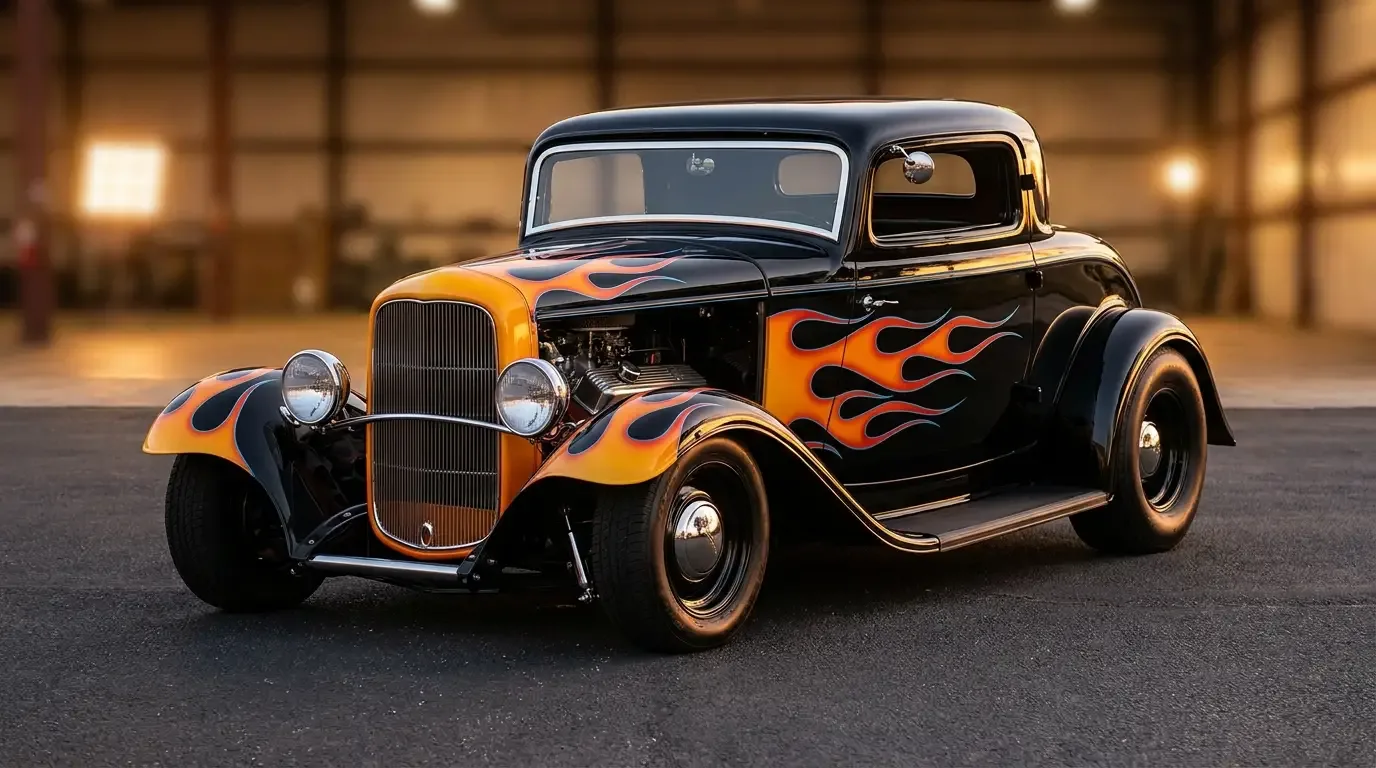
Flames are the oldest hot rod graphic there is, and they split into two camps that don't much like each other. Traditional flames, sometimes called hot rod flames or classic licks, are flat two-dimensional shapes. They start tight at the nose, lick back along the fenders, and taper into long thin tongues near the doors. The layout is stylized, not literal. Nobody thinks a car is actually on fire. The classic look uses a single base color, usually yellow into orange into red, with a hard pinstriped edge outlining every lick. That outline is what makes them pop, and skipping it is the fastest way to make flames look cheap.
The way a traditional flame job gets built matters as much as the colors. A good painter chalks or tapes the layout by hand first, walks around the car, steps back, and reworks the licks until they flow before a drop of color goes down. The color itself is usually laid wet-on-wet so the yellow fades into the orange and the orange into the red with no hard band between them, a blend the old-timers pulled with the spray gun and a steady hand rather than an airbrush. Then the whole job gets outlined, traditionally in a dark blue or black stripe pulled freehand around every tongue. That outline hides the ragged tape edge and gives the flames a crisp border that makes them jump off the panel. Skip the blend or skip the outline and the licks look like stickers.
Realistic flames came later, mostly out of the airbrush era. These use blends, drop shadows, and layered translucent color to make the fire look like it has depth and movement. Done by a real artist they can be stunning. Done by anybody else they look like a decal. My honest opinion, for what it's worth after all these years, is that traditional flames age better and suit a period build. Realistic flames belong on a different kind of car, and they date faster because they follow whatever airbrush trend was hot that decade. You'll also see variations that split the difference, like ghost flames sprayed a shade or two off the body color so they only show at certain angles, and seaweed or tribal flames that stretch the licks into long thin ribbons. Those are style choices, not upgrades, and the same rule applies to all of them: the layout has to flow or the whole thing falls apart.
The placement matters as much as the style. Flames should follow the body lines, not fight them. On a coupe they wrap from the grille shell over the hood and die out before the cowl. Run them too far back and the car looks busy. The best flame jobs know when to stop. There's also a question of how much of the car to cover. A short set of licks that just kisses the front of the hood reads clean and period-correct, while flames that chase all the way down the doors and into the quarters turn into a full-body graphic that needs the rest of the car to be dead simple to carry it. Match the ambition of the flames to the ambition of the car and it works. Mismatch them and the eye knows something is off even if the owner doesn't.
Pinstriping and scallops
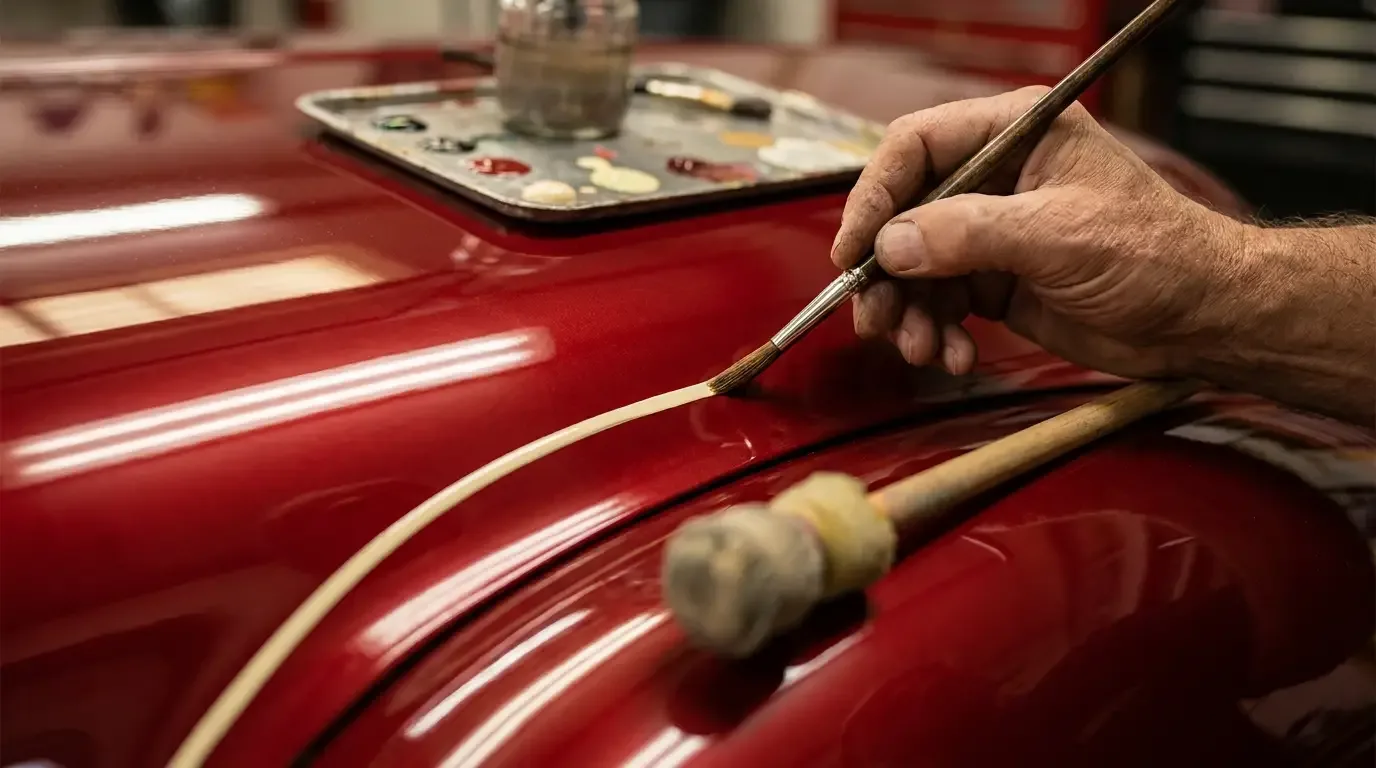
Pinstriping is the fine line work, usually done by hand with a long-bristled brush called a dagger or a sword. It's the detail that separates a finished car from a painted one. A good striper lays symmetrical lines freehand, no tape, no stencils, and the consistency of those lines is the whole trick. Von Dutch is the name everybody knows, and he's the reason striping became an art form on its own instead of just an edge treatment. On a hot rod you'll see striping outlining flames, framing the dash, accenting the deck lid, and sometimes standing alone as a small abstract design on the nose or trunk.
The technique is harder than it looks and it's why good stripers get paid what they get paid. The brush is loaded with a slow-drying enamel like the old One Shot lettering paint, then dragged in one continuous pull so the line stays a constant width from start to finish. A striper works the two sides of a hood or deck lid to match, often laying the left, then mirroring it on the right by eye, and any wobble or width change shows instantly against the paint. The classic Von Dutch move, the little abstract flourish of teardrops and crossed lines on a dash or a nose panel, is called a dagger design after the brush, and it's still the signature that tells you a real hand was on the car. Names worth knowing beyond Von Dutch run from Dean Jeffries, who apprenticed alongside him, to modern hands like Herb Martinez and the late Steve Kafka, all of whom kept the freehand tradition alive rather than reaching for a masking tape shortcut.
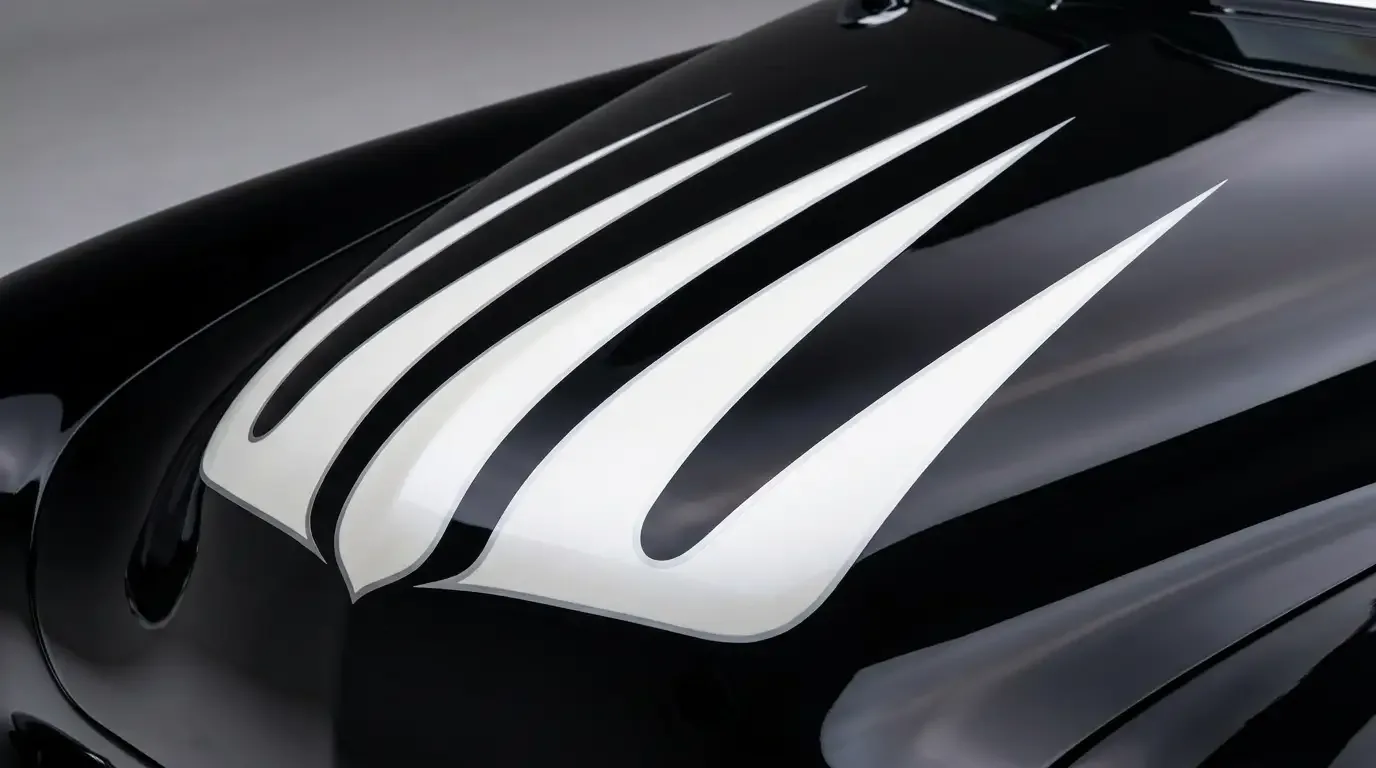
Scallops are the cousin of flames. Instead of licking tongues, scallops are long clean teardrop or spear shapes that sweep back from the front of the car. They're more restrained than flames and read as elegant rather than aggressive. A scallop job in two contrasting colors with a fine outline is one of the classiest looks you can put on a hot rod, and it takes real skill to lay out because the eye catches any wobble in a long straight sweep. The layout gets taped rather than freehanded, but the taping is the whole art, because a scallop that runs true has to follow the body line at a constant distance from the beltline or the fender edge for its full length. Painters often run a set of scallops off the headlights and another off the cowl so the shapes echo each other, and the tips get outlined in the same fine stripe as flames to sharpen the point. Kustom shops used scallops on everything from mild leadsleds to roof panels precisely because they dress a car up without shouting.
"I tell guys the same thing every time, and I've been saying it for thirty years: pay the striper what they ask and let them work. The lines are the last five percent, and they're the five percent everybody sees."
Gary Nowak
Candy, metalflake, and the deep paint jobs
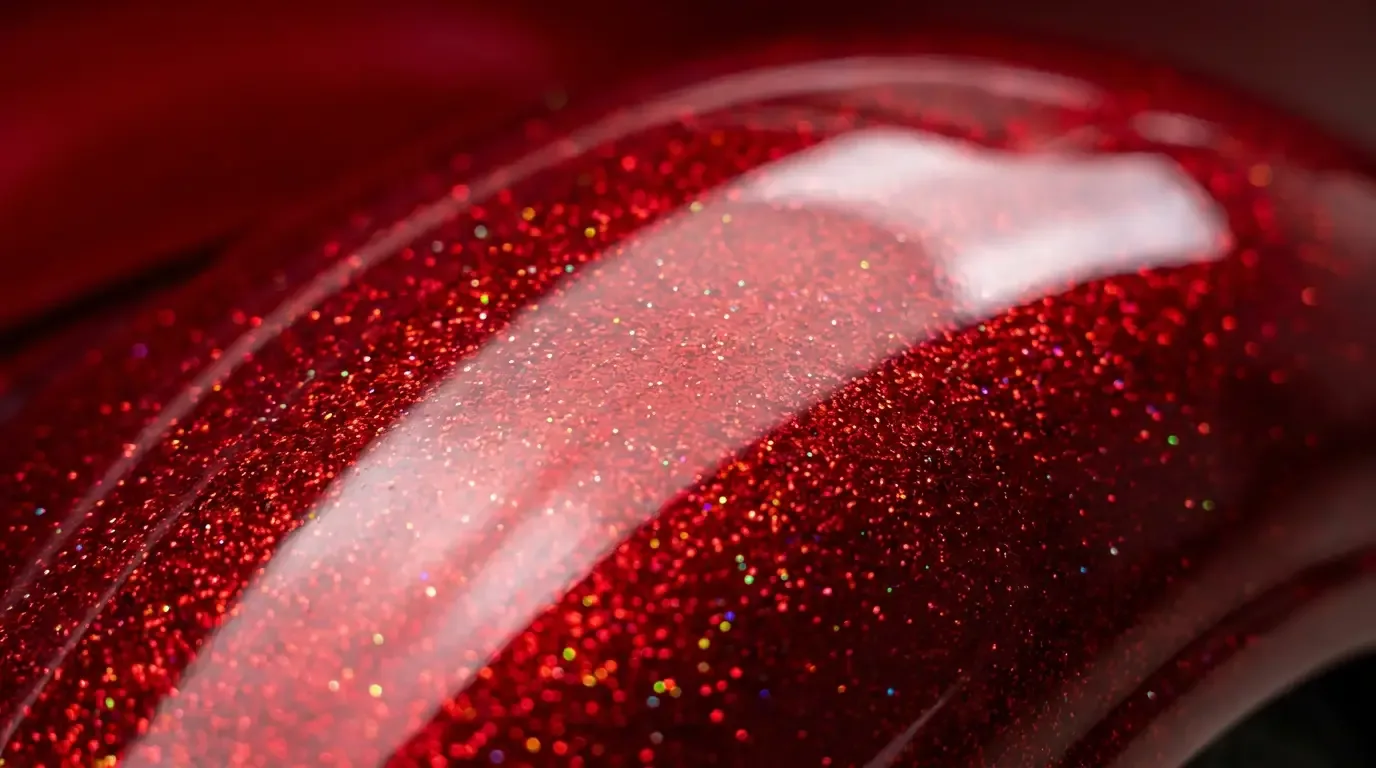
Paint is where the money goes and where the reputation gets made. A standard solid color is fine, but the paint that defines kustom kulture is the stuff with depth. Candy paint is a translucent color coat sprayed over a bright metallic or gold base. Light travels through the color, bounces off the base, and comes back out, which is why a candy apple red looks like it's lit from inside. It's also brutal to apply. Candy shows every mistake, and any unevenness in the coats leaves visible stripes and dark spots. This is not a garage rattle-can job.
The reason candy is so unforgiving comes down to how it builds color. Each coat of translucent toner deepens the shade, so the final color depends entirely on how many coats went down and how evenly. Spray one panel with six passes and the next with seven and you get a visible mismatch that no amount of clear will hide. A striped or blotchy result, what painters call mapping or tiger-striping, comes straight from an inconsistent gun pattern or a wrist that sped up on the second pass. The pros spray candy in slow, deliberately overlapping passes over the whole car in one session so every panel gets the same number of coats, then bury it under clear and color-sand it dead flat. The base underneath matters too. A candy over a silver metallic reads bright and lively, the same candy over a gold base goes warm and deep, and the same toner over a black base turns almost jewel-dark. That's why two cars in the same can of red can look nothing alike.
Metalflake is exactly what it sounds like, tiny flakes of metal or polyester suspended in a clear or tinted coat. Under sun it throws sparkle everywhere. The old show cars of the 1960s were buried in heavy flake, sometimes a dozen coats deep, then color-sanded flat and cleared until the surface looked a foot thick. Fashion has swung between subtle and heavy over the years, but flake never fully leaves. The flake itself comes in grades, from a fine micro-flake that reads almost like a shimmer to the big chunky flake that catches the light in distinct points, and the size you choose sets the whole character of the finish. The trick with heavy flake is that the flakes sit proud of the color coat and leave a rough, gritty surface, so it takes coat after coat of clear and hours of block sanding to bury the texture and get back to glass. That labor is why a proper flake job costs what it costs, and why the cheap ones feel like sandpaper when you run a hand across the roof.
| Finish | How it's built | Best on |
|---|---|---|
| Solid single-stage | Pigment plus clear, one color coat | Traditional resto-style rods, gloss black hot rods |
| Candy | Metallic base, translucent color, clear | Show cars, deep reds, purples, greens |
| Metalflake | Flake suspended in color or clear, sanded and cleared | Kustoms, roof panels, accent areas |
| Pearl | Base plus mica pearl coat, clear | Subtle color shift, kandy-adjacent looks |
Pearl sits in the middle ground and gets its own mention because it fools people. Instead of metal flake or translucent toner, pearl uses a mica or ceramic pigment that shifts color depending on the angle you view it from, so a white pearl flashes gold or green in the sun and a candy-adjacent pearl gives depth without the full commitment of a real kandy job. It's more forgiving to spray than candy, which is part of why it spread, but the good ones still get sprayed in even coats and buried in clear. On a traditional build pearl can look a shade too modern, so it lands better on a mild kustom than a stripped early rod. Whatever the finish, the clear and the sanding are what sell it. A mediocre color under deep, flat, hand-rubbed clear beats a great color under thin, orange-peeled clear every time, and that final block-and-buff stage is where the deep paint jobs earn their reputation.
Wheels: steelies, wires, and mags
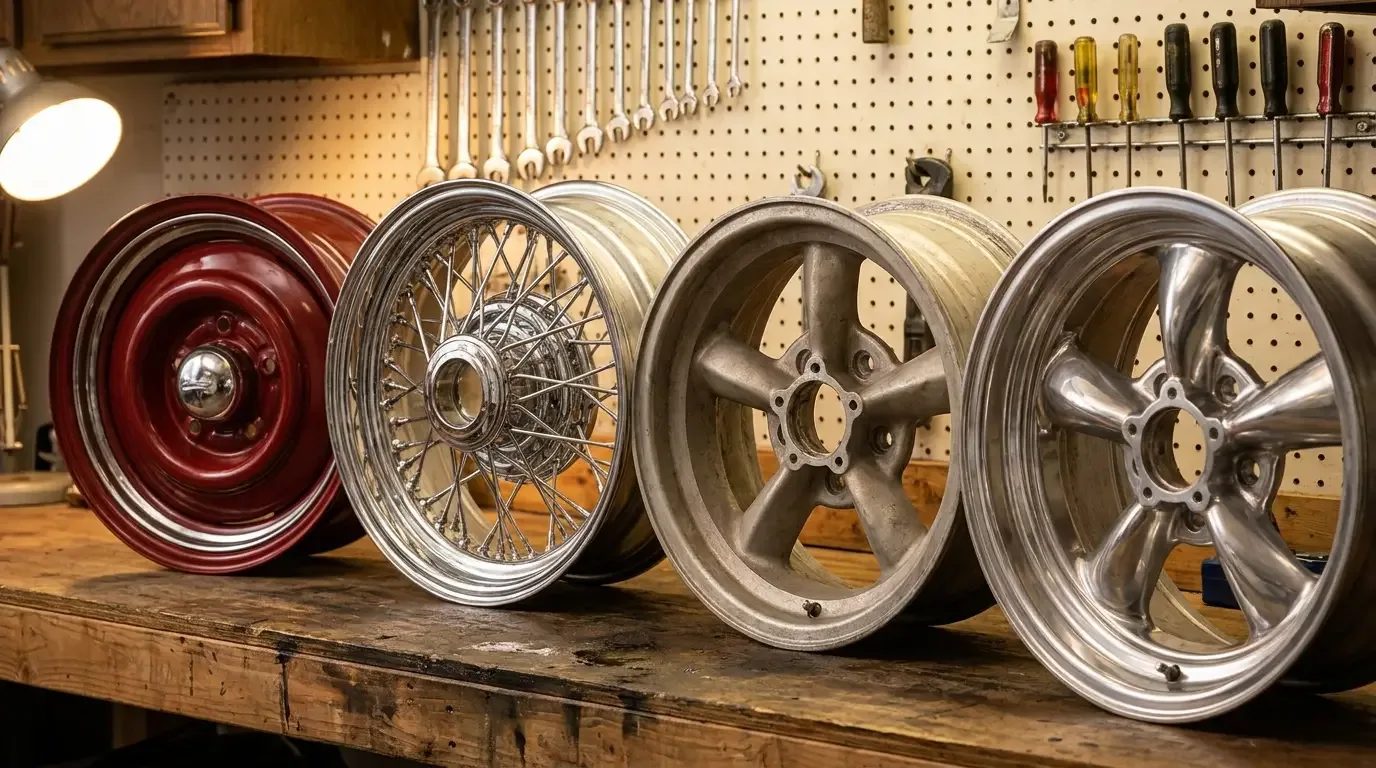
Nothing changes a car's whole character faster than the wheels. Get them wrong and it doesn't matter how good the paint is. There are three families that belong on a traditional hot rod, and each one sends a different message.
- Steelies. Painted steel wheels, usually body color or gloss black, capped with a small chrome hubcap and a beauty ring. The classic is a red steelie with a baby moon cap and wide whitewall tire. This is the period-correct look for an early rod and it never goes out of style. The details do the talking here: a plain smooth baby moon reads clean and understated, while a finned or ribbed cap adds a little flash, and running the wheel a shade wider than stock with the cap and ring is the trick that gives a fenderless highboy its no-nonsense stance.
- Wire wheels. Spoked wheels, chrome or painted, borrowed from the roadster and kustom world. They read as elegant and dressy. A set of chrome wires with wide whites suits a mild kustom better than a stripped-down highboy. There's real variety inside the family, from delicate 40-spoke wires to the knock-off style with a spinner cap, and the more spokes and chrome you add the dressier the car reads, which is exactly why they belong on a smooth leadsled rather than a raw-boned rod.
- Mags. Cast aluminum or magnesium wheels, five-spoke and slotted styles that came up in the 1960s. A polished five-spoke with a fat rear tire is the muscle-era hot rod look, more aggressive and later in period than steelies. The names carried weight then and still do, the Halibrand and American Racing Torq Thrust five-spokes being the ones that defined the look, along with slot mags and the smoothie styles that followed. A staggered setup, skinny mags up front and wide ones out back, doubles down on the drag-strip attitude these wheels were born with.
The tire is half the wheel. Wide whitewalls or blackwalls with a tall sidewall keep a car looking old. Modern low-profile rubber on a big-diameter wheel kills the period vibe instantly, no matter what else you did right. Bias-look tires, or radials made to look like bias-plies, are worth the money on a traditional build. The proportion between front and rear tire is its own decision, because the classic hot rod runs a skinny front and a tall, fat rear, a big-and-little setup that plants the drive wheels and helps set the nose-down rake. Match the whitewall width to the era too, since a wide two-inch white reads 1950s while a thin pinstripe white reads later, and the wrong width on the right car is a small tell that a sharp eye will catch.
Rake and stance: why it sits right
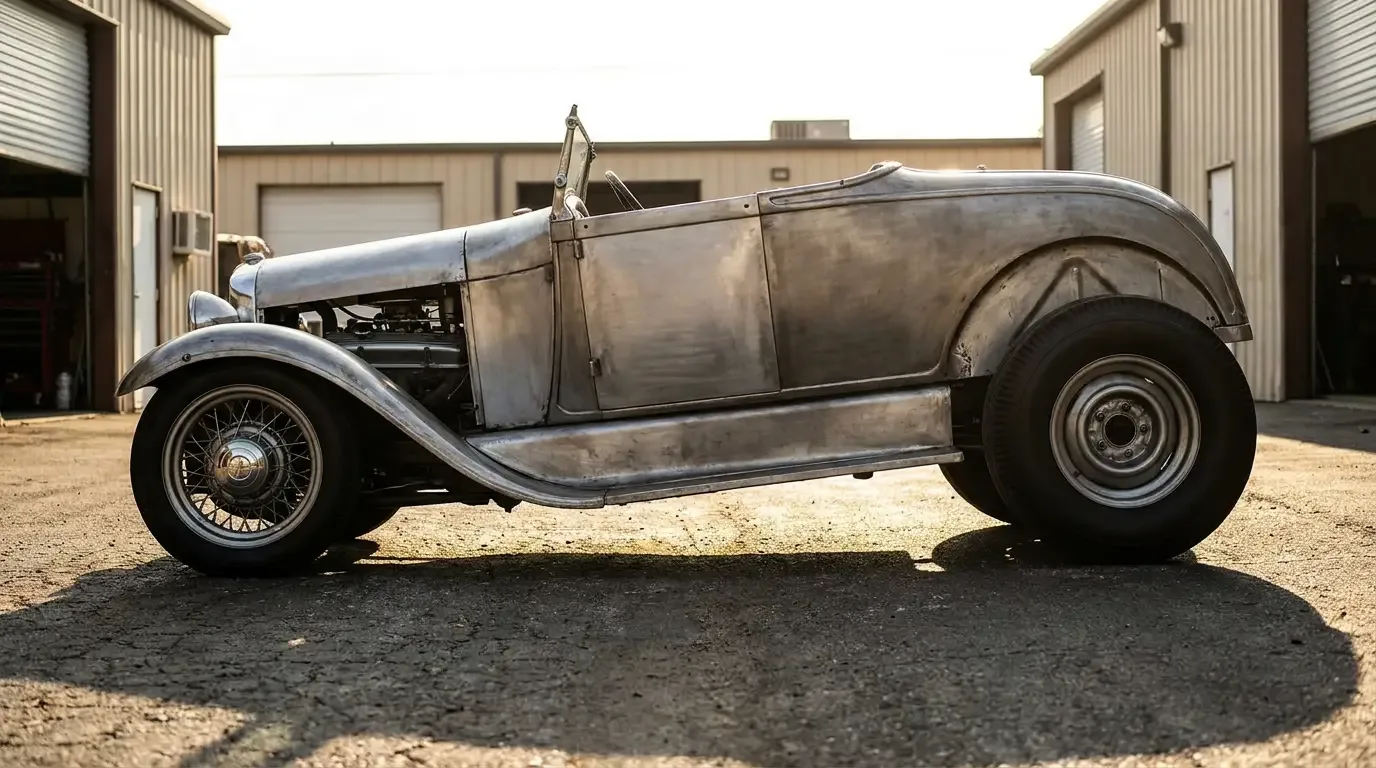
Stance is the single most important thing on this whole list, and it's the one people get wrong most often. Rake means the car sits lower in the front than the rear, nose down, tail up. That forward-leaning attitude is what makes a hot rod look like it's moving while it's parked. The classic recipe pairs a dropped front axle with taller rear tires, so the front tucks down and the back stands up. Get the rake right and even a plain car looks fast. Get it wrong, sitting level or nose-high, and the meanest engine in the world can't save it.
There's more than one way to get the nose down, and each leaves its own signature. A dropped tubular or forged I-beam axle lowers the front while keeping the traditional solid-axle look under an early rod, which is why purists reach for it. A monoleaf or reversed-eye spring buys another inch or two. Z-ing the frame, where the rails get notched and stepped at the front, drops the whole nose without changing the suspension geometry and is the old hot-rodder's move when a dropped axle alone won't get there. At the back, taller rear tires and the right spring rate lift the tail. The point is that rake is built into the chassis, not faked with a lowering block on one end, and a car set up properly still needs to steer and ride, so there's a limit to how far the nose can go before the geometry fights back.
There's a range here. A highboy roadster wants an aggressive rake and a real gap between tire and fender. A mild kustom wants the opposite, slammed low all around with the body close to the ground and very little rake. Both work because both are committed to a look. The cars that fail are the ones stuck in the middle, sitting on their factory ride height like nobody made a decision. Ride height is a decision, and a hot rod has to make it. The wheel-and-tire choice feeds right back into stance, which is why builders mock the whole thing up together, because a taller rear tire changes the rake as surely as a spring does, and the gap between tire and fender, what the old guys call the wheel-arch fill, tells you at a glance whether someone sweated the details or just bolted parts on.
Putting the look together
The reason some hot rods stop you cold and others don't come down to commitment and coherence. Every choice, flames or scallops, candy or gloss black, steelies or mags, has to point at the same idea. A traditional highboy with realistic airbrushed flames and chrome billet wheels is confused, and confusion reads as wrong even to people who couldn't name a single part. The cars that look right made a decision about what they are and followed it all the way through, from the outline on the flames to the air under the front tire. The whole thing hangs together as one statement, and you feel it the second you walk up.
That's why these cars still gather crowds. If you want to see the very best examples of the craft in one room, the grand national roadster show is where the top builders bring their finished work every year. And when you're ready to stop looking and start owning, browse the custom hot rods for sale to find a car that already reads right.
Sources and notes
- Period hot-rod and kustom press covering flame layout, pinstriping technique, and paint methods.
- Kustom kulture references documenting the work of California painters and show-car builders of the 1940s through 1960s.
- Show and registry records for period-correct wheel, tire, and stance conventions.
- Builder and painter interviews on candy, metalflake, and hand-striping practice.
Related Reading
Article
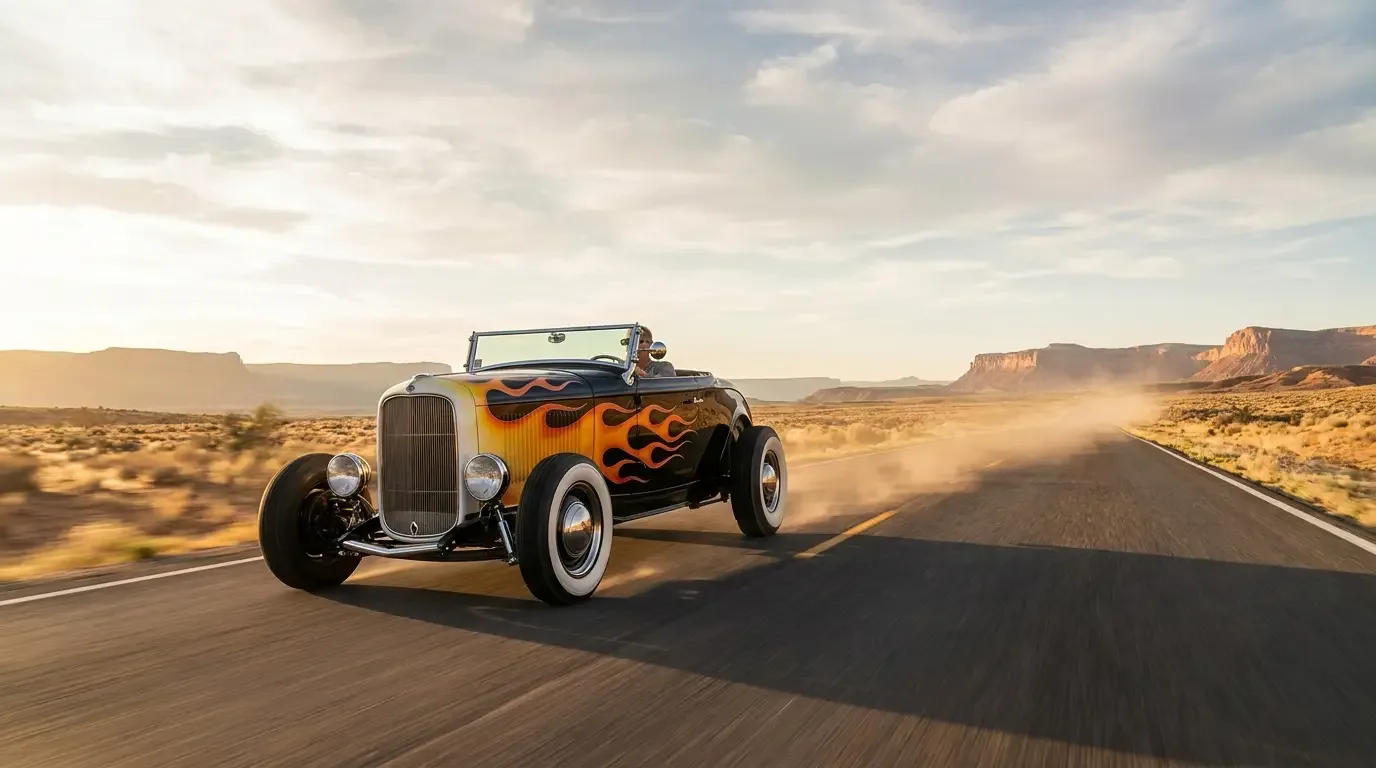
The Classic Hot Rod Story
Article
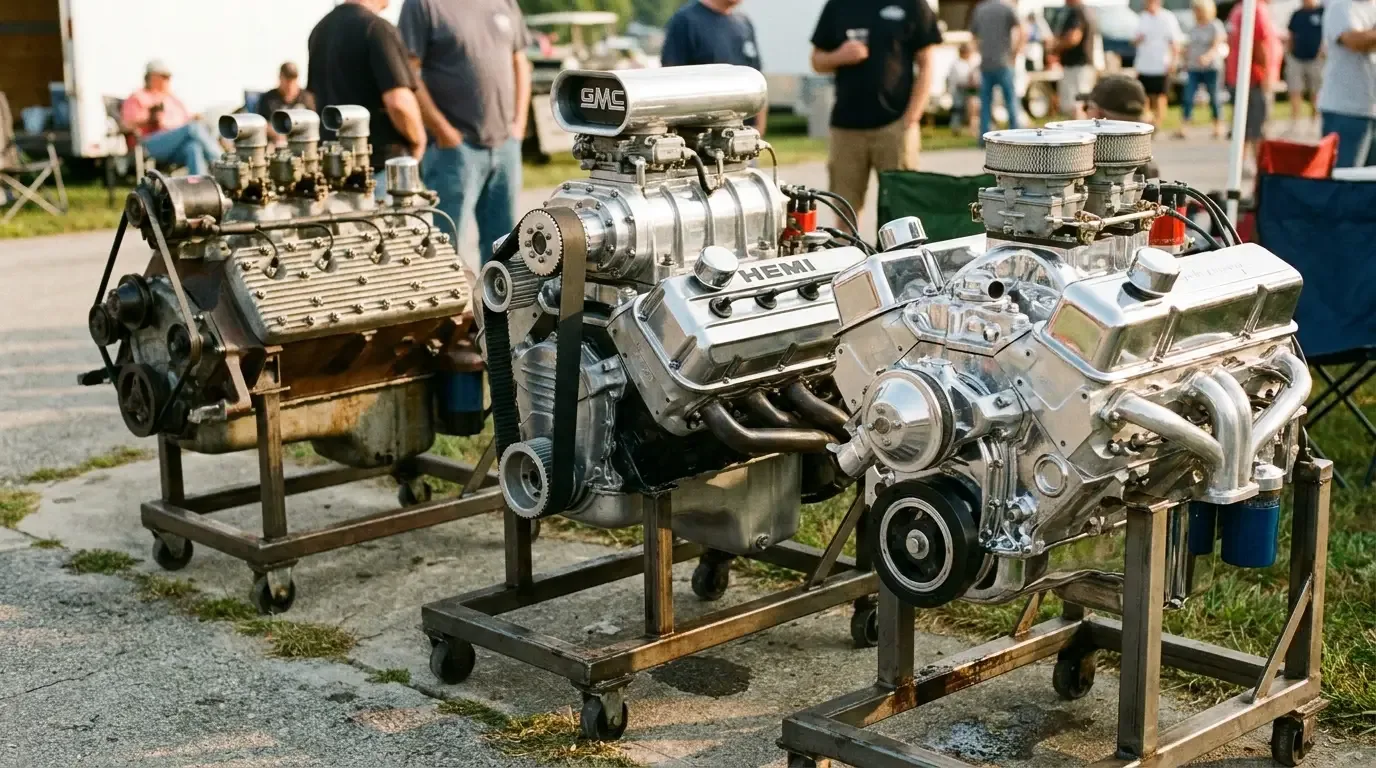
Hot Rod Engines: Flathead to Small-Block
Article
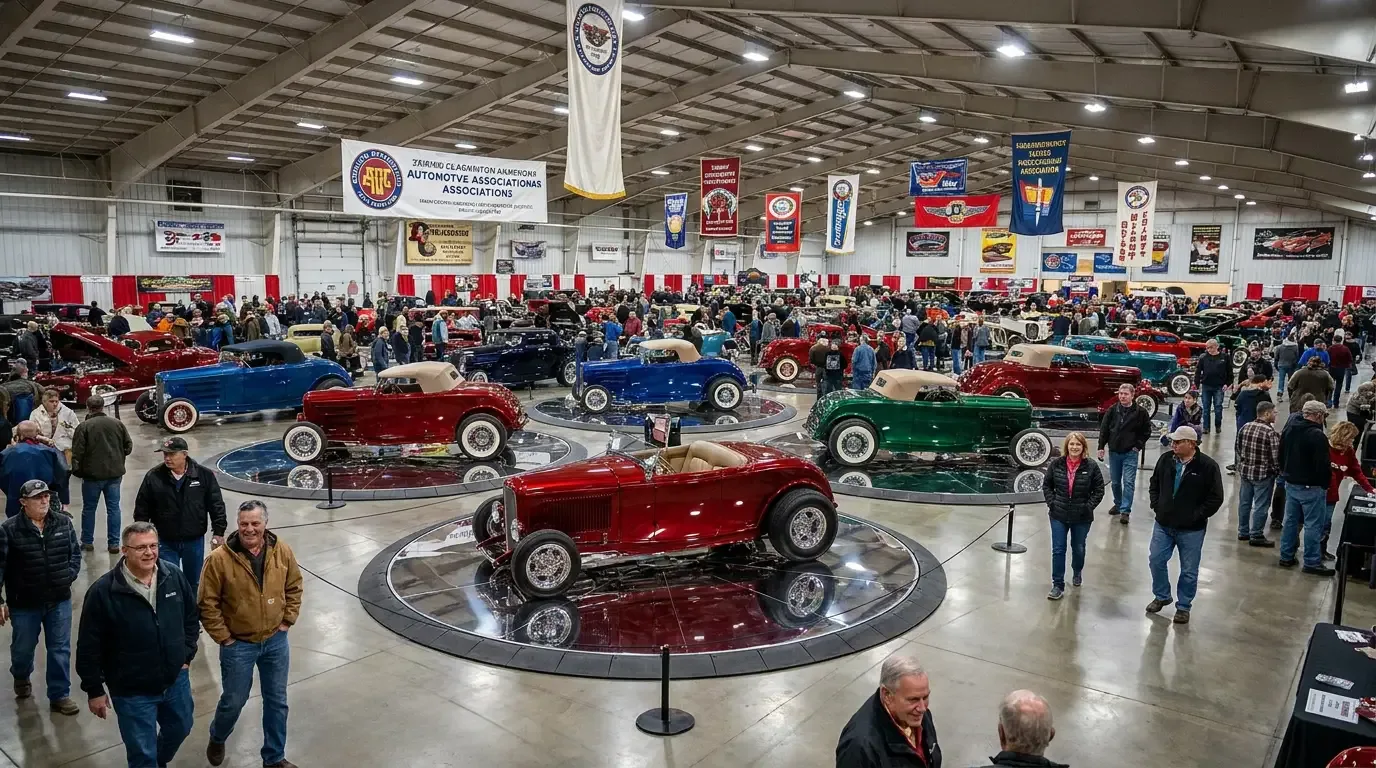
Hot Rod Culture and Shows
Article
Pinstriping and the Kustom Line Artists
Article
Candy and Metalflake Paint Explained
Article
Scallops and Classic Paint Schemes
Article
Hot Rod Wheels: Steelies, Wires and Mags
Article
Rake and Stance: Why Hot Rods Sit That Way
External
/hot-rods-for-sale
Have a
Classic Car
for Sale?
Reach thousands of serious classic car collectors across the US.
Sell It Here →
Are You a Classic Car Dealer?
List your full inventory and connect with targeted classic car buyers.
Join as a Dealer →

About the author
Gary Nowak
Lifelong Midwest rodder who has been building and driving traditional pre-war hot rods since the 1970s.
Comments
Be the first to comment on this article.