
Walk any serious hot rod show and you will find a crowd gathered not around an engine, but around a folding table where a man in a paint-stained apron is dragging a long-haired brush across a fender. No tape, no stencil, no undo. The line comes off the brush in one breath. That is pinstriping, the oldest and most personal mark a kustom car can wear, and it is what separates a painted car from a finished one.
Car Features
7 min read
Pinstriping and the Kustom Line Artists
The oldest and most personal mark a kustom car can wear: how freehand pinstriping works, where it started, and why the brush came back.
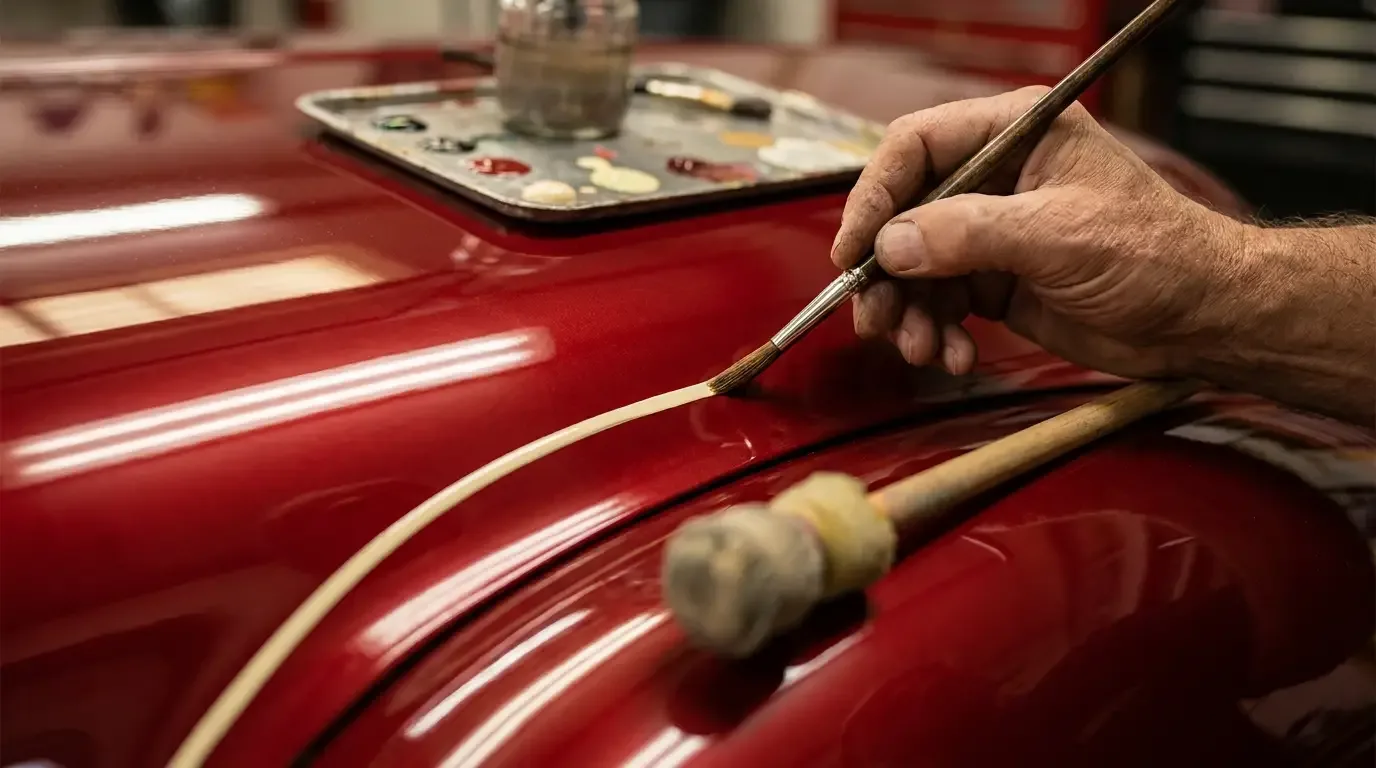
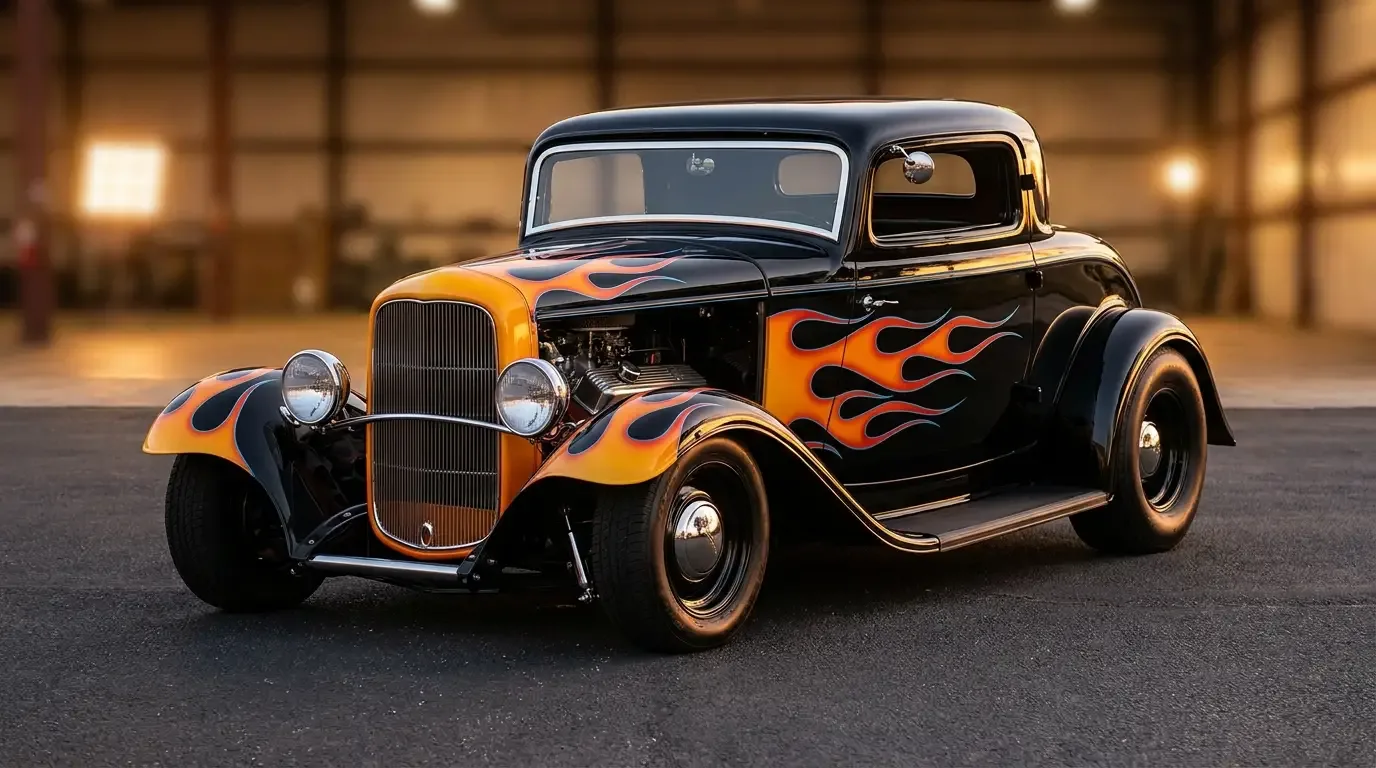
Pinstriping sits right alongside the wilder end of hot rod flames as the signature graphic language of the custom world. Flames announce the car from across the lot. Stripes reward the person who leans in close.
Von Dutch and the birth of the striped line
Modern pinstriping traces to one man more than any other: Kenneth Howard, who worked under the name Von Dutch. Working out of Southern California shops in the early 1950s, he took a decorative trade that had been used on carriages, bicycles and factory coachlines and turned it into a form of freehand art on hot rods and customs. The story most old-timers tell is that Von Dutch struck a line to hide a scratch or a flaw, a customer loved it, and the phone started ringing. Whether that is literal truth or shop legend, it captures the spirit. Striping was fix, flourish and signature all at once.
What made Von Dutch matter was not just the striping but the attitude. He drew a flying eyeball that became one of the most recognized symbols in kustom kulture. He was difficult, unpredictable and uninterested in doing the same thing twice, and that refusal to standardize is exactly why the work still looks alive. A generation of stripers learned by watching him or by studying photos of his panels. The tradition passed hand to hand, brush to brush, the way trades did before YouTube.
Brushes, paint and the tools of the trade
The gear is almost stubbornly simple, which is part of the appeal. A striper's kit fits in a small box, and the value is in the hands, not the hardware.
The brush is the whole game. Traditional striping brushes are called swords or daggers, with very long hairs, historically squirrel or synthetic blends, that hold a large reservoir of paint so a line can run the length of a fender without reloading. The long hair is what lets the striper pull a consistent width and a clean, tapered start and stop. Paint is traditionally a slow-drying oil enamel, often the classic lettering enamels the sign trade used, thinned to a specific consistency and worked on a palette. Slow dry time is a feature, not a flaw. It gives the line time to flow out flat and level itself before it sets.
| Tool | What it is | Why it matters |
|---|---|---|
| Striping sword / dagger brush | Long-haired brush, squirrel or synthetic | Holds enough paint to pull one long, even line |
| Lettering enamel | Slow-dry oil-based paint | Flows level, forgives small hand tremors |
| Palette | Card, tin or glass | Loads and shapes the brush before each pull |
| Mahl stick | Hand rest bridged over the panel | Steadies the striping hand off wet paint |
| Reducer / thinner | Solvent for the enamel | Tunes paint to the day's temperature |
The freehand craft
Here is the part that surprises people. Real pinstriping is done freehand, with no masking. The striper loads the brush, sets a hand, and pulls. The width of the line is controlled by how hard the brush is pressed and how it is rolled between the fingers as it moves. Symmetry, the near-perfect mirroring of a design from left to right, is done by eye and by muscle memory, not by measurement.
Old stripers will tell you it is more about breathing and body position than wrist action. You pull the whole line in one committed motion, moving your arm and shoulder, using the mahl stick to keep your hand off wet paint. Stop halfway and you leave a hitch in the line that shows forever. That is why a good striper practices thousands of lines on scrap and old panels before touching a customer's car. The confidence has to be built before the brush ever hits the paint.
"I tell young guys the same thing the old timers told me. You do not learn striping by talking about it. You pull ten thousand lines on a junk hood in your garage, and somewhere in there your hand quits shaking and starts listening. There is no shortcut, and everybody who tells you different is selling tape."
Jim Vasquez
Where the stripes go
Striping is not scattered at random. There is a grammar to it, and a good striper reads the car before loading a brush. The classic placements have held up for seventy years because they follow the lines the factory and the customizer already built into the body.
- Panel edges and body lines. Stripes trace the natural break of a fender, a hood or a deck lid, sharpening a line that is already there.
- Around lights, handles and emblems. Tight, symmetric striping frames headlights, taillights and door handles, treating hardware like the center of a small design.
- Dashboards and glove boxes. Inside the car, striping on a painted dash is a place a striper can get loose and show off, since it is seen up close.
- The centered "flourish." A symmetric abstract design, often on a deck lid, trunk or between the taillights, where the two halves mirror each other. This is the calling card.
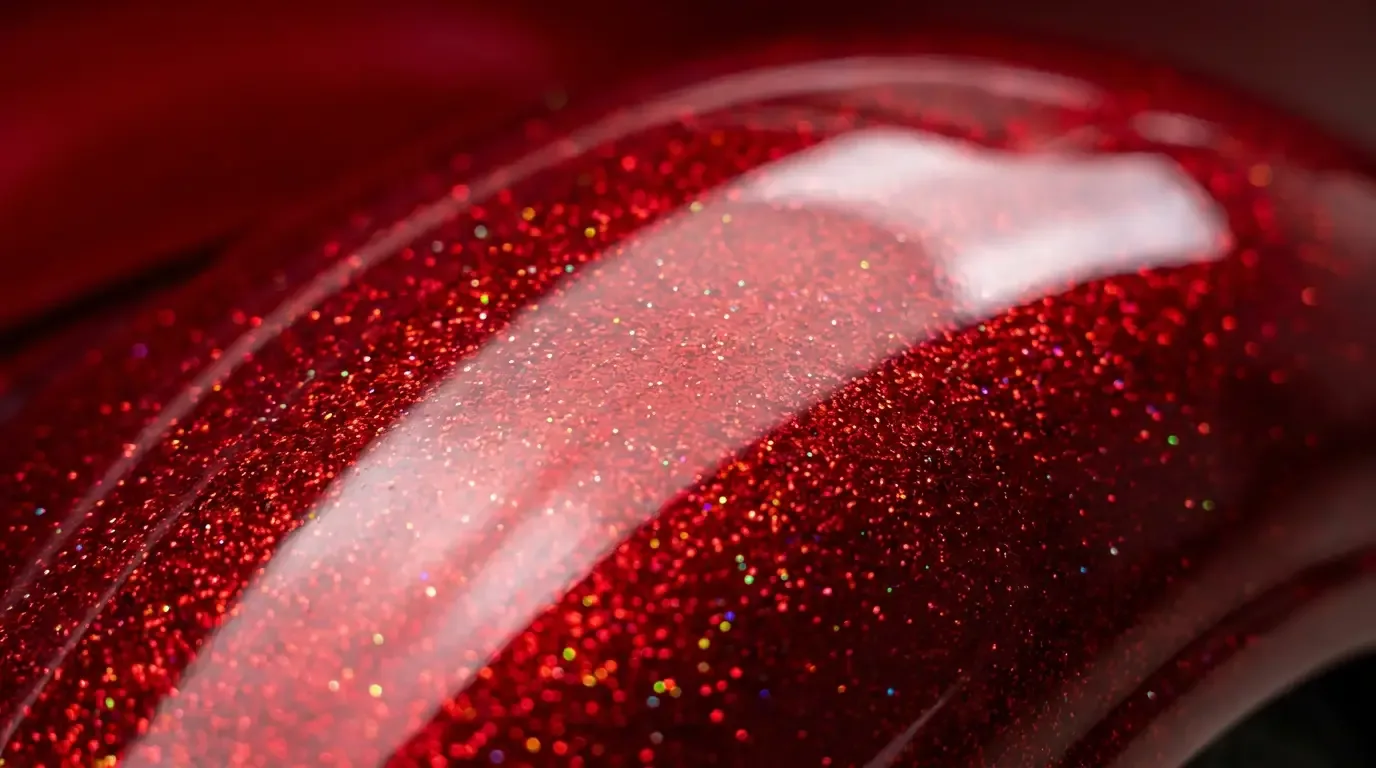
Striping also plays with the rest of the paint. It is often laid as an accent line at the edge of a set of flames or scallops, cleaning up the boundary between colors. If you are choosing paint directions for a build, it is worth understanding how striping interacts with deeper finishes, which is where Candy and Metalflake Paint Explained picks up the thread. Striping over metalflake, for instance, reads completely differently than striping over a flat single-stage color.
The revival
Pinstriping never fully died, but it faded through the 1970s and 1980s as vinyl tape stripes and factory graphics took over. What brought the brush back was the same traditional hot rod revival that reached back to the whole early era of the craft, the same cultural pull that runs through the hot rod story as a whole. Builders who wanted period-correct cars needed period-correct striping, and that meant a brush in a human hand, not a plotter.
Today there is a healthy community of working stripers who travel the show circuit, set up their tables, and stripe panels, toys, helmets and guitars for the crowd. Panel jams, where dozens of stripers each decorate a small board in an afternoon, have become their own tradition and a way the craft teaches itself forward. Prices for quality freehand striping vary widely by striper and by the size of the job, from a modest charge for a small accent to serious money for a full car by a name artist. The value is not just the paint. It is a hand-drawn mark that no two cars will ever share, which is the whole point of building a custom in the first place.
Sources and notes
- Period hot-rod and kustom press coverage of Southern California striping and paint work from the 1950s onward.
- Kustom kulture reference works and biographies documenting Von Dutch and the flying-eyeball motif.
- Show and panel-jam records from the traditional hot rod revival circuit.
- Working striper interviews and demonstrations on brushes, enamels and freehand technique.
Related Reading
Have a
Classic Car
for Sale?
Reach thousands of serious classic car collectors across the US.
Sell It Here →
Are You a Classic Car Dealer?
List your full inventory and connect with targeted classic car buyers.
Join as a Dealer →
About the author
Jim Vasquez
Southern California hot rod and custom car builder with roots in the traditional kustom kulture scene.
Comments
Be the first to comment on this article.