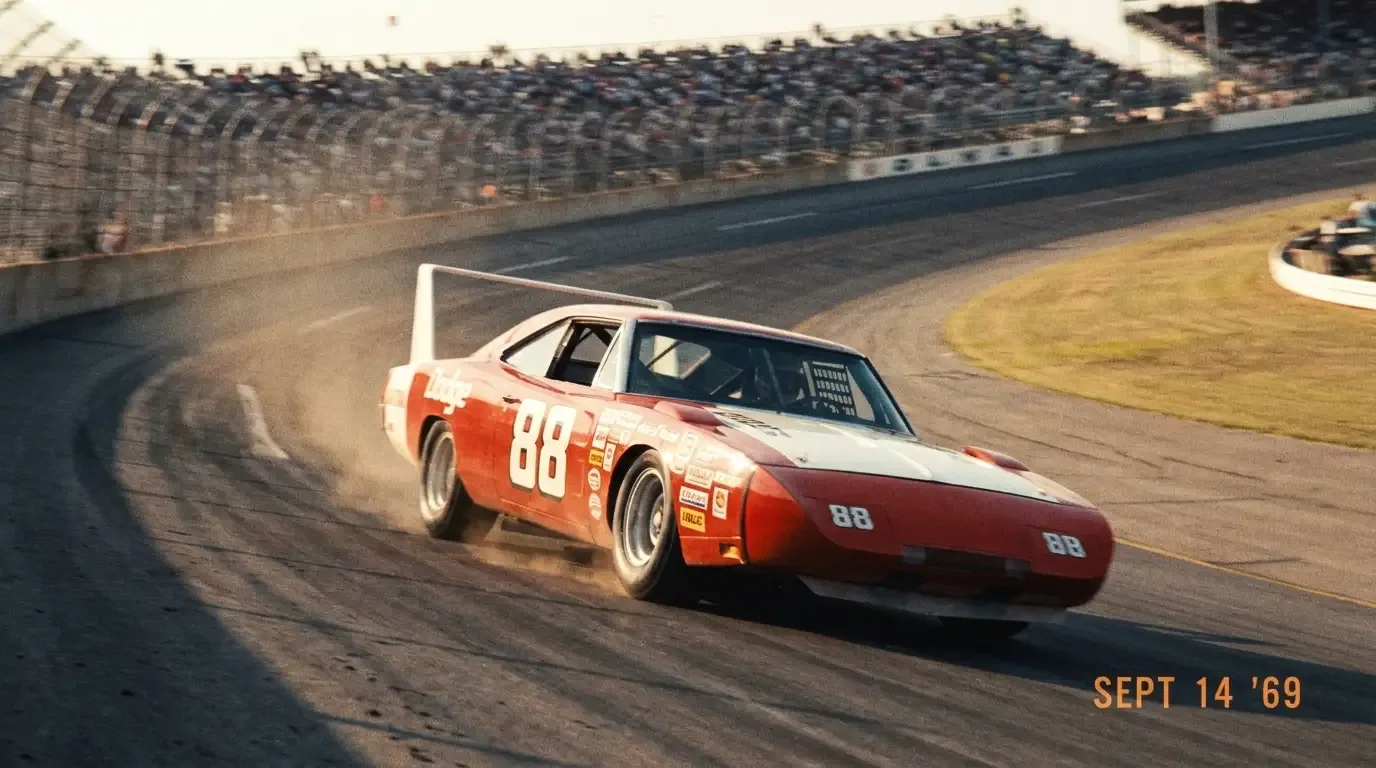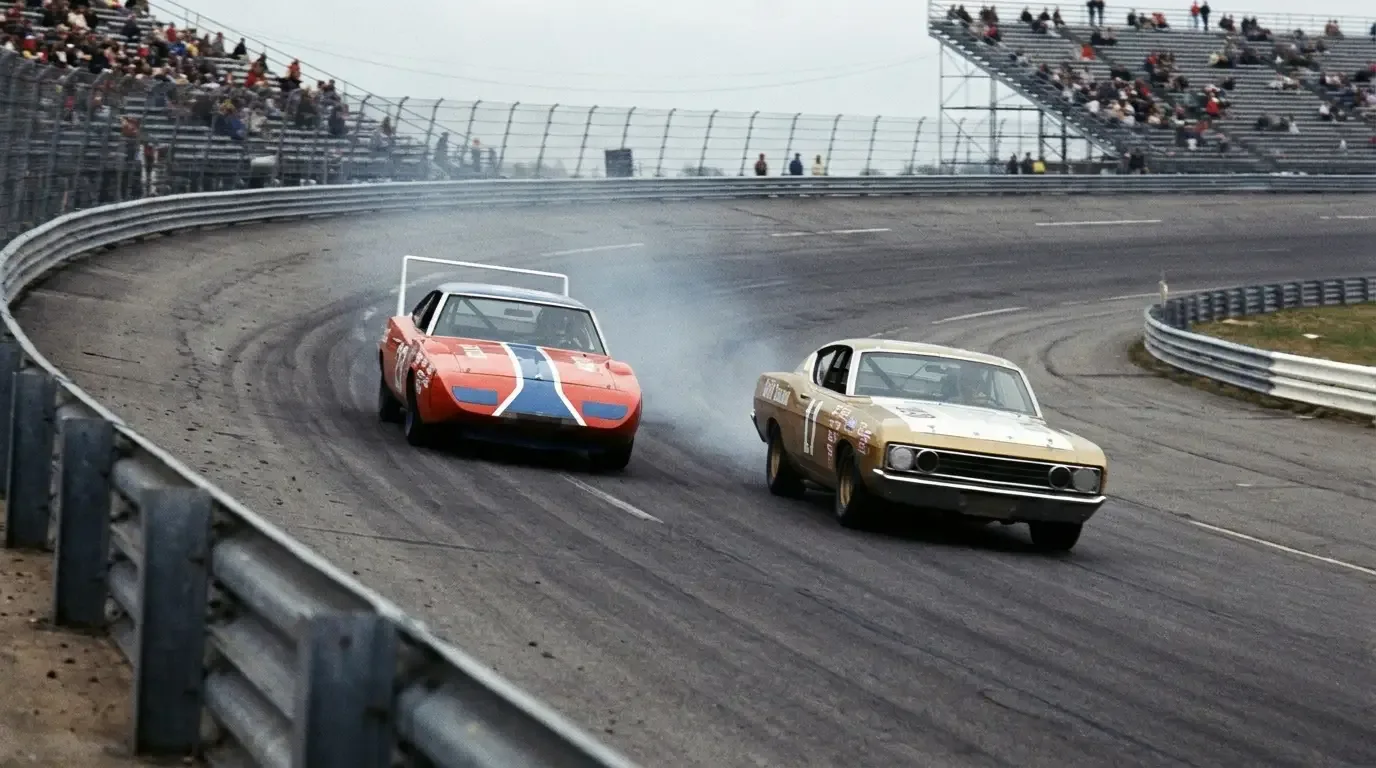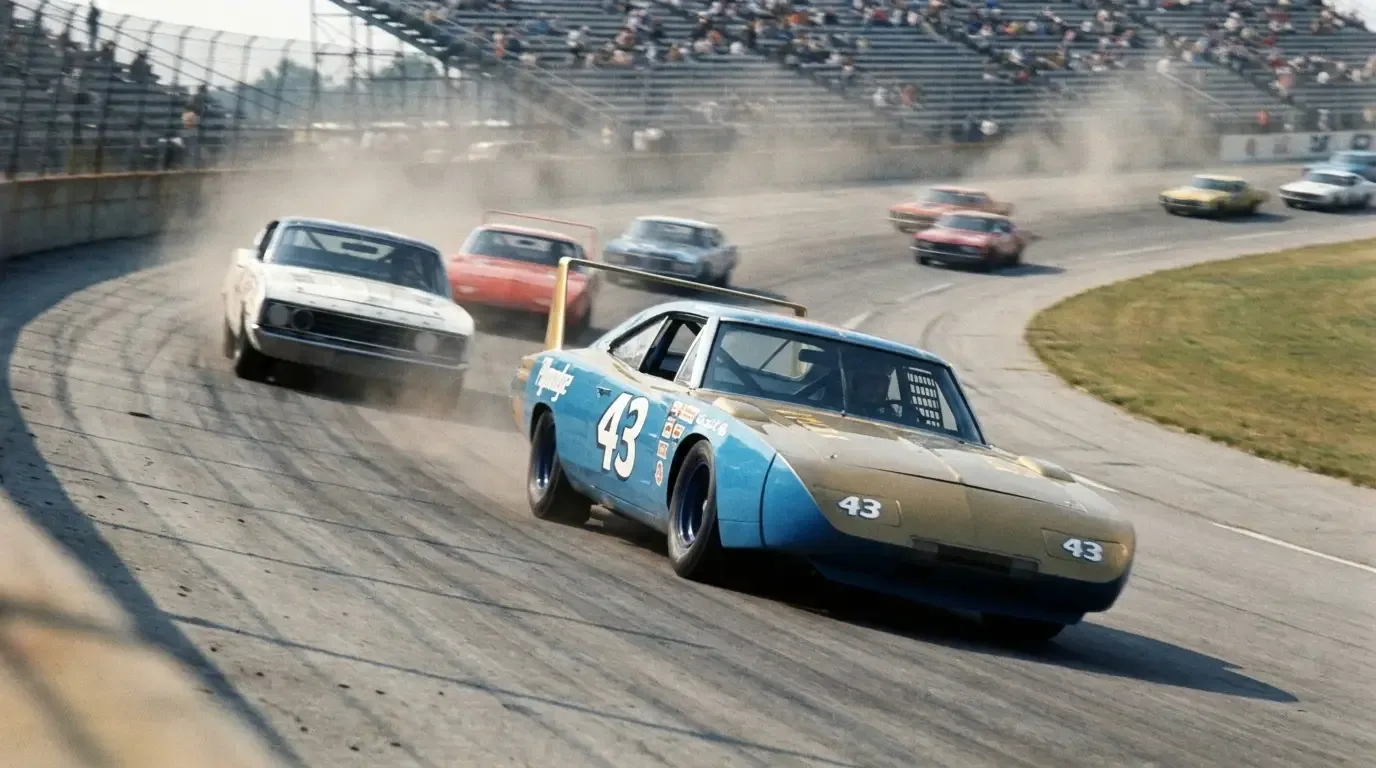
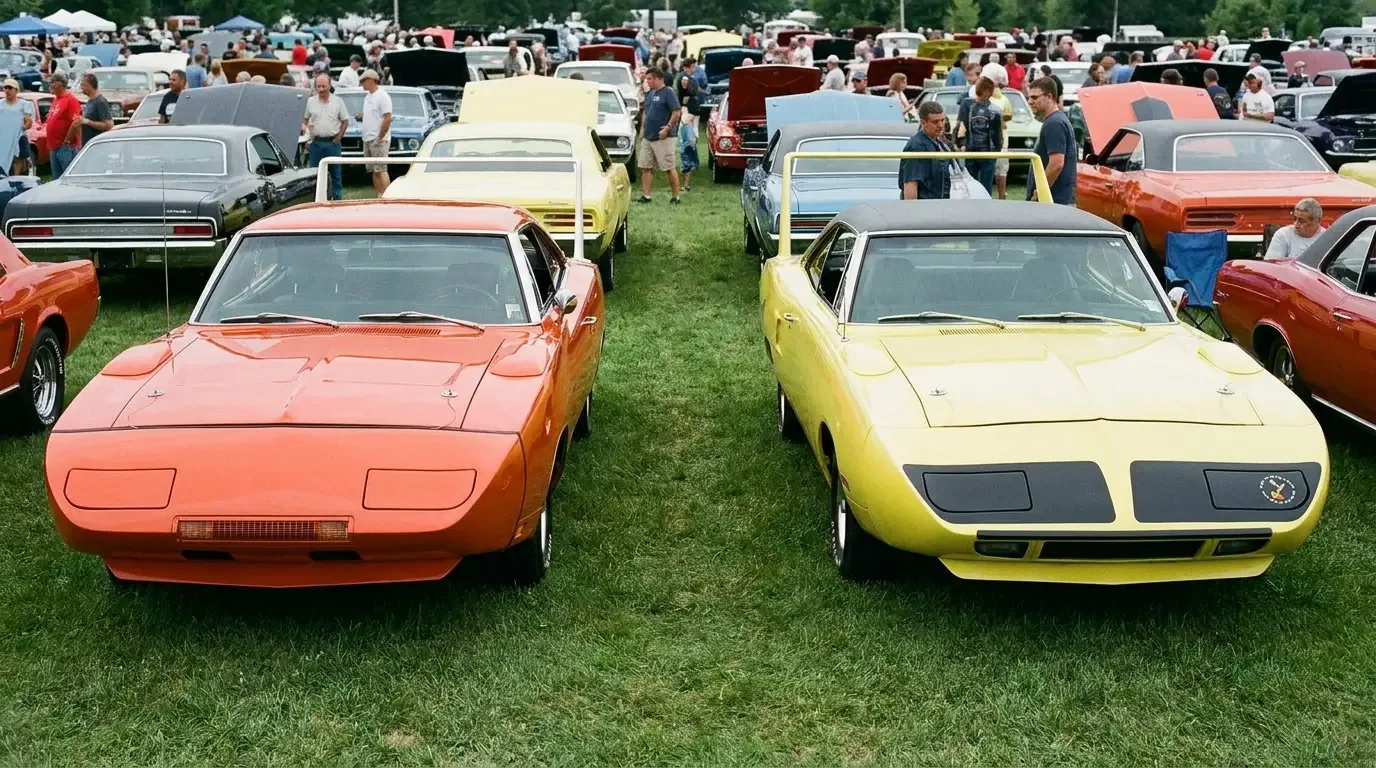
People talk about the Charger Daytona and the Plymouth Superbird almost interchangeably, and there is a reason for that. They are close relatives, built for the same purpose in the same wind tunnel, sharing engineering that Chrysler developed once and applied to two different divisions a year apart. But they are not the same car, and the differences matter more than casual conversation usually admits. The build records show a company refining an idea, not simply badge-engineering the same part twice.
Why Plymouth needed its own version
The Daytona arrived for the 1969 model year as a Dodge exclusive, built to homologate Chrysler's aero package for NASCAR competition. Plymouth's Road Runner and Superbird lineup did not get an aero car that year, which put Plymouth's NASCAR teams at a genuine competitive disadvantage against Dodge's own aero-equipped cars, let alone Ford's aero Torinos. Richard Petty, having left Plymouth briefly over unrelated business, was reportedly a factor Chrysler wanted back in a Plymouth for 1970, and giving Plymouth its own winged car was part of what brought that arrangement together. The Superbird existed to put Plymouth on equal footing with Dodge inside the same corporate family, not to compete against the Daytona.
"The build record matters. Not because it tells you everything, but because it's the factory's own account of what left the line."
— Tom Ramirez
What actually changed between the two cars
The Superbird's nose cone is longer than the Daytona's, a change driven by the Plymouth Road Runner's different front sheet metal requiring a different length of extension to achieve a similar aerodynamic result. The wing geometry differs slightly as well, tuned for the Road Runner's body rather than simply copied from the Charger. Underneath, both cars shared the same engine options broadly, 440 Magnum and 426 Hemi, and both were built through the same limited-run homologation process, with body shells sent out for the specialized nose and wing installation rather than completed on a standard assembly line.
Production numbers differ too. Chrysler built 503 U.S. Daytonas for 1969 against a considerably larger Superbird run, most often cited around 1,920 units for 1970 though estimates vary, reflecting NASCAR's homologation requirement climbing between the two model years as the sanctioning body tried to make these limited specials less exploitable as pure racing tools. That single fact, the same rulebook demanding more cars a year later, is a detail that gets lost when people treat the two cars as identical twins separated only by badge.
How the market treats the two cars differently
Despite the larger production run, the Superbird has historically commanded strong money at auction, in some cases exceeding Daytona prices, driven partly by the Richard Petty connection and partly by the car's cartoonish, more exaggerated styling becoming a pop culture touchstone in its own right. The Daytona tends to be regarded by purists as the more mechanically pure expression of the aero concept, being first, while the Superbird carries the marketing and motorsport narrative weight of Petty's return to Plymouth. Neither valuation logic is wrong, they are simply different stories being told about closely related engineering.
| Spec | Charger Daytona | Plymouth Superbird |
|---|---|---|
| Model year | 1969 | 1970 |
| Estimated production | 503 U.S. cars | ~1,920 (estimates vary) |
| Nose length | Approximately 18 inches added | Longer, tuned to Road Runner body |
| Key driver connection | Buddy Baker, Bobby Isaac | Richard Petty |
| Engines | 440 Magnum, 426 Hemi | 440 Magnum, 426 Hemi |
The Petty factor and why it changed everything for Plymouth
Richard Petty's move away from Plymouth after the 1968 season, driven by a dispute over engine rules that had nothing to do with aerodynamics, left the brand without its most recognizable driver heading into a period when Ford and Dodge were both fielding serious aero cars. Getting Petty back for 1970 required Plymouth to offer him a genuinely competitive car, and the Superbird was built in large part to make that possible. Petty's return, driving a Superbird, gave Plymouth a marketing story that Dodge's Daytona never had in quite the same way, a driver whose name was already synonymous with the brand coming back specifically because the car finally matched what he needed to compete.
That context explains a lot about why the Superbird gets remembered differently than the Daytona despite arriving from the same engineering program. It was not purely a racing tool the way the Daytona had been at its inception. It was also a statement about keeping Plymouth's biggest star in the fold, and that dual purpose shows up in how the car was marketed to the public, with more attention paid to Petty's involvement than Chrysler had given any single driver during the Daytona's launch a year earlier.
What buyers should verify before treating the two as equivalent
A common mistake among newer collectors is assuming Daytona and Superbird parts are interchangeable given how closely related the cars are underneath. They are not, at least not entirely. Nose cones, wing assemblies, and even some trim differ enough that a part sourced from one car will not correctly fit the other without modification, and any restoration shop that treats them as identical is likely to produce a car with subtle but noticeable inaccuracies. Buyers evaluating either car should confirm parts provenance matches the specific model, not just the general era, since reproduction suppliers sometimes market components as universal when they are not.
Both cars deserve to be understood on their own terms rather than as one story told twice. The full account of the Daytona's development and racing career, which set the stage for everything Plymouth did a year later, is covered in the Charger Daytona chapter, and the rule changes that eventually ended both cars' competitive careers are worth understanding in full, read more here for exactly how NASCAR brought the whole era to a close.
Sources and notes
- Wikipedia - Plymouth Superbird - confirmed the ~1,920 planned 1970 production, the longer refined nose, the Richard Petty connection, and NASCAR raising the homologation requirement for 1970.
- Wikipedia - Dodge Charger Daytona - confirmed the 503 U.S. Daytonas for 1969 and the 426 Hemi/440 Magnum engine options shared with the Superbird.
- Wikipedia - Dodge Charger (B-body) - confirmed the Daytona's 18-inch nose and Creative Industries conversion process.
- Wikipedia - Bobby Isaac - confirmed the Daytona's driver record program (Isaac, Baker) referenced against Petty's Superbird.
- Wikipedia - Talladega Superspeedway - context on the superspeedway both aero cars were built to conquer.