
It is ten o'clock on a Wednesday night in September 1976, and across the country television sets are warming up for a new ABC detective show. Three women work for a boss the audience never sees, and between the briefings and the disguises they drive. For a lot of people who grew up in front of those sets, the Charlie's Angels Mustang is part of the picture: a small striped hatchback at the curb, as much a member of the cast as the furniture in the office.
Car Features
8 min read
Charlie's Angels and the Cobra II
What the record shows about the Charlie's Angels Mustang: the 1976 Cobra II package, its stripes by year, and what a screen-car claim needs.
Memory is a generous archivist, though. This piece sets out what the record shows about the car, where it goes quiet, and what the Cobra II was when no camera was pointed at it. The show belongs to a long line of screen Mustangs, and the full story of that line runs through Bond films and car-chase classics. Here the focus stays on one show, one package and one set of stripes.
What the record shows about the Charlie's Angels Mustang
Start with what is solid. Charlie's Angels premiered on ABC on Wednesday, September 22, 1976, at 10:00 pm, and ran until June 24, 1981. Farrah Fawcett played Jill Munroe in the first season, 1976 to 1977, and returned in guest appearances between 1978 and 1980. The show went on the air just as the first Cobra II model year was ending, so the striped car on screen was still brand new to most viewers.
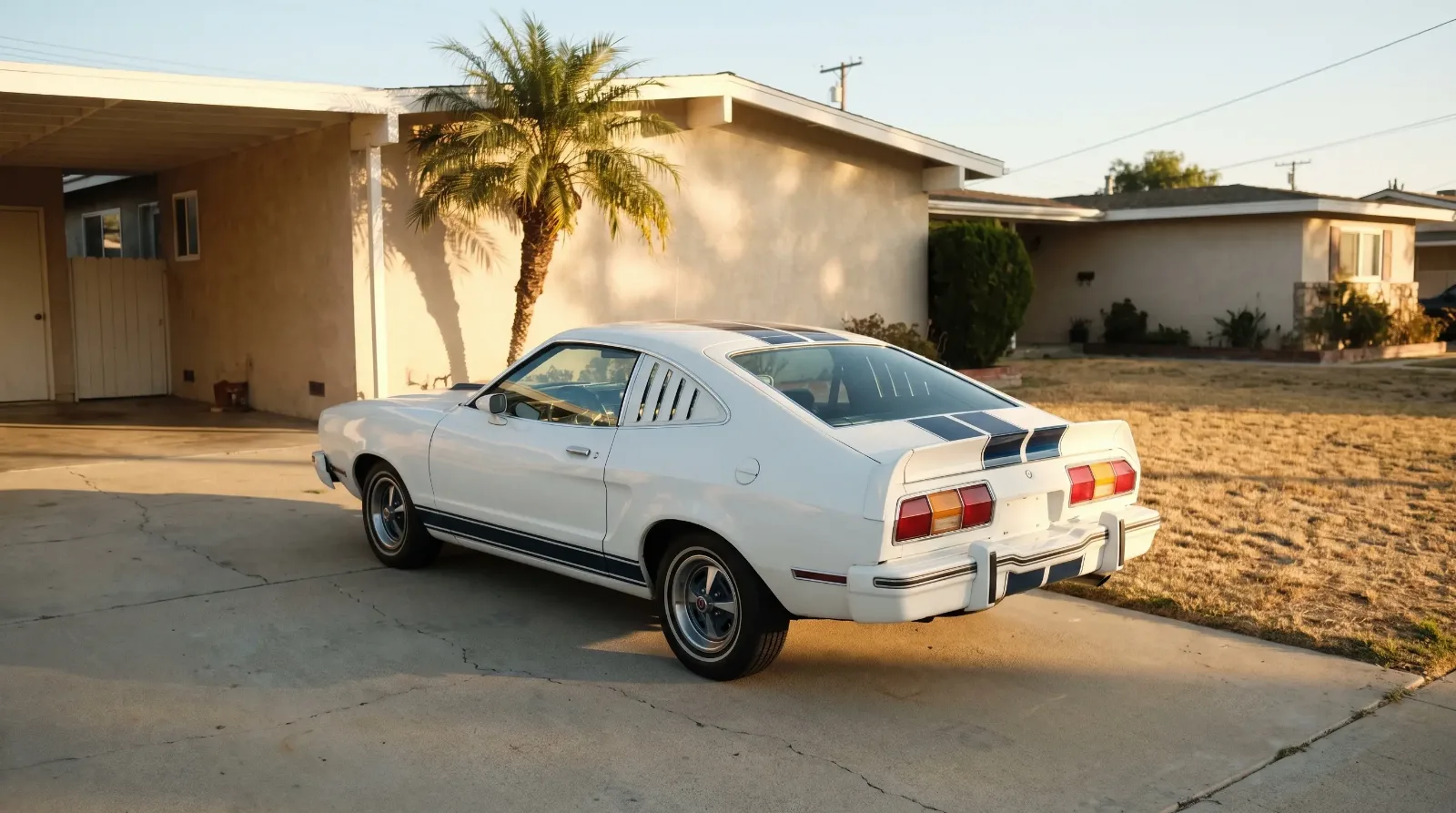
The car itself is on the record too. The Internet Movie Cars Database, which logs vehicles from screen captures, lists a 1976 Mustang Cobra II as a regular in the series, and its stills show a white car with dark blue over-the-top stripes, often parked at the curb beside a tan Mustang II and an orange Pinto. Car-history writers agree on who drove what: Jill Munroe had the Cobra II, Kelly Garrett a Mustang II Ghia with the Ghia Sports Package, and Sabrina Duncan a 1977 Pinto. When Fawcett left after one season, the Cobra II passed to Cheryl Ladd's Kris Munroe, Jill's younger sister in the story.
The cars were no accident of casting. Curbside Classic describes a deal Ford struck with producer Aaron Spelling to fill the show with Ford products, with Ford paying to place the cars, and ClassicCars.com tells the same story. What no one has shown in public is the paperwork: the contract, the VINs, or how many cars went through the studio over five seasons. Fans still argue over whether the 1976 car was later swapped for a newer one. White with blue stripes was a regular factory Cobra II combination for 1976, so the car on screen was, at the very least, a car any Ford dealer could order.
The Cobra II package Ford sold in 1976
The Cobra II was an appearance package, and it is worth being clear about that from the start. It was offered on the 2+2 hatchback only, with any engine on the order form, which in 1976 meant the 2.3 four, the 2.8 V6 or the 302 V8 that had come back to the line for 1975. The package changed none of the mechanicals. What it changed was the way the car looked standing still.
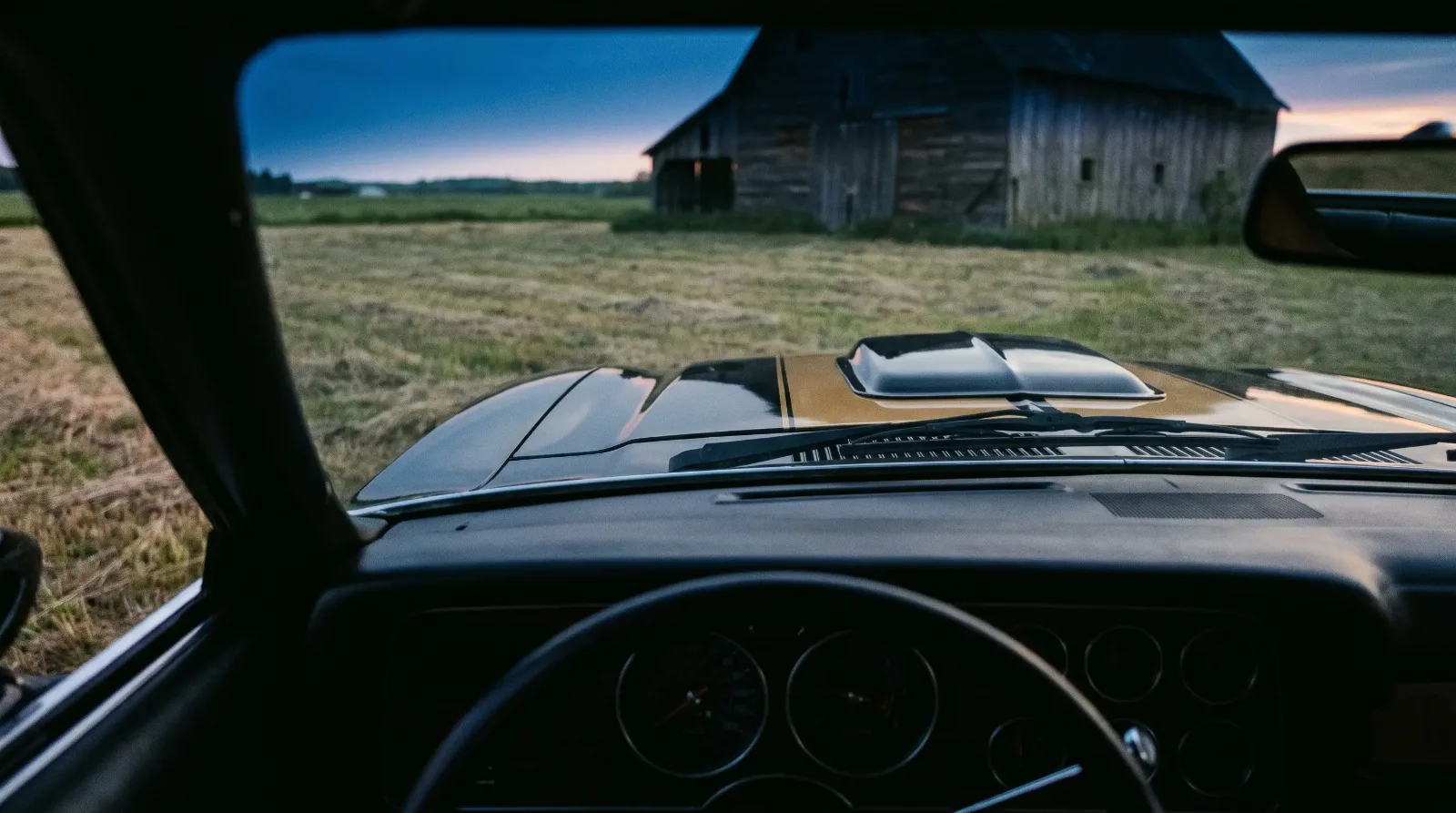
The list reads like a sketch of a race car drawn from memory: a black grille, a simulated hood scoop, front and rear spoilers, louvers over the quarter windows, dual stripes running over the top of the car, and cobra emblems on the front fenders. The look came from Jim Wangers, a former Pontiac man, and for 1976 his company, Motortown, applied the parts. Ford brought the work in-house for 1977 and 1978.
The 1976 package cost $325. Buyers could choose white with blue stripes, blue with white stripes, or black with gold. For 1977 Ford added white with red and white with green. The smaller Mustang II that wore all of this is covered here, in the story of the 1974 to 1978 cars, so I will leave the platform alone and stay with the stripes.
Dating a Cobra II by its stripes
The Cobra II changed its face partway through its life, and the changes are easy to read once you know them.
The first version, sold for 1976 and into 1977, wore the dual stripes and the original simulated scoop. Its sides carried a snake decal and small "COBRA II" lettering in a stripe low on the doors. For 1978, with the changes pulled forward to the middle of the 1977 model year, the scoop was reversed, the twin stripes gave way to a single wide one, the side stripe moved up to the middle of the doors with large "COBRA" lettering, and louvers went onto the hatch. A car with the single wide stripe and the big side lettering is a later car. A car with the twin stripes is an early one. Freeze the frame and the stripes tell you roughly when the car was built.
| Model year | Package price | Cobra II production | Look |
|---|---|---|---|
| 1976 | $325 | 25,259 | Dual over-the-top stripes, original simulated scoop, "COBRA II" lower door stripes; parts applied by Motortown |
| 1977 | $535 | 11,948 | Early look at first, revised look from mid-year; work done by Ford |
| 1978 | $677 | 8,009 (some sources: 4,049) | Reversed scoop, single wide stripe, "COBRA" side lettering, hatch louvers |
Read the production column as an estimate. Ford did not break out Cobra II sales at the time, so these figures are later enthusiast tallies. The 1976 total of 25,259 is repeated everywhere. For 1978 most tables give 8,009, but Old Cars Weekly and one registry page give 4,049, so treat that number as unsettled.
The order of events matters more than the exact totals. The package sold best in 1976, and that model year was nearly over by the time the show premiered. The 1977 count, built while the first season was on the air, fell by more than half. Some writers credit the show with a Cobra II sales boom; the numbers do not show one. The 1977 package cost $535 against $325 the year before, and the novelty had worn off.
The Cobra II also had company by 1978. That year Ford added the King Cobra, a V8-only edition with a deep front air dam, a big cobra decal on the hood and a "5.0L" scoop, and built 4,313 of them.
Why a television car mattered to Ford
The Mustang had been a creature of the media from the start. Its launch week was the week it made Time and Newsweek in 1964, and it never really stopped being news. A dozen years later the company was selling a very different car. The smaller, gentler Mustang II needed help looking the part.
The Cobra II was that help, and a prime-time series offered something no brochure could: a weekly glimpse of the car moving through ordinary streets with people the audience liked. Ford chose its casting with care: the flashy striped hatchback for Jill, the plush Ghia for Kelly, and the freshly facelifted Pinto for Sabrina, each one a current model a viewer could find at the local dealer. For a package that existed to be seen, that was ideal exposure.
"People do not remember the horsepower of the car on a television show. They remember who climbed out of it and how the light hit the stripes. That is why these stories outlive their paperwork, and why the paperwork matters so much."
Nora Beckett
What a screen-car story needs
Every famous television car eventually produces a few claimants, and the Cobra II has an easy look to copy. Stripes, a spoiler and a set of fender emblems will turn almost any Mustang II hatchback into something that resembles the car on the screen. Because white with blue stripes was a regular factory choice in 1976, a white Cobra II with blue stripes proves only that someone ordered that combination from the sheet.
That is not a theoretical worry. In 2019 a 1978 Cobra II offered for sale in Southern California drew attention as the Charlie's Angels car, and La Opinión reported that the seller himself described it as altered to look identical to the screen car. The same report noted that the whereabouts of the car Fawcett drove are unknown.
A car with a real connection to the show would need more than a resemblance: studio or production records, period photographs that tie a specific car to the set, and an ownership trail that holds together from the 1970s to now. It is the same standard any screen car should meet.
The show ended its run in June 1981, by which time the Mustang II was three model years gone and the Cobra name had moved on to the new Fox-body car. What remains is a picture many people carry without trying: a white hatchback with blue stripes, parked at the curb on a Wednesday night, waiting for someone to come out of the office and drive.
Sources and notes
- Curbside Classic: 1977 Ford Pinto, Sabrina Duncan's company car (the Angels' cars and Ford's deal with Aaron Spelling)
- ClassicCars.com Journal: the Charlie's Angels Pinto and the Mustang IIs
- Internet Movie Cars Database: 1976 Ford Mustang Cobra II in Charlie's Angels
- Wikipedia: Ford Mustang (second generation), Cobra II package and 1977 to 1978 changes
- MustangSpecs: 1976 Ford Mustang Cobra II, price, colors and production
- La Opinión (2019): a Cobra II sold as the Charlie's Angels car
Related Reading
Have a
Ford Mustang
for Sale?
Reach thousands of serious classic car collectors across the US.
Sell It Here →
Selling a classic? Here's how: the best sites to sell a classic car
Are You a Classic Car Dealer?
List your full inventory and connect with targeted classic car buyers.
Join as a Dealer →
#Ford Mustang
#mustang ii
#cobra ii
#1976 Mustang
#Charlie's Angels
#Mustang on TV
#Mustang in pop culture

About the author
Nora Beckett
Automotive features writer and photographer who tells the human stories behind the cars, from show fields to cross-country road trips.
Related Listings - Ford Mustang




Comments
Be the first to comment on this article.