
Stand near a dark 1969 SportsRoof at any Mustang show these days and wait. It will not take long before somebody walks up, points, and asks whether it is the John Wick Mustang. A film that opened in October 2014 did something few modern movies manage: it made a fifty-year-old Ford the most recognizable car in a new generation's head. People who had never heard of a Boss 429 learned the name from a revenge thriller.
Car Features
7 min read
John Wick's 1969 Mustang
The film calls it a 1969 Boss 429. The cars on set were 1969 Mach 1s. What the record shows about the John Wick Mustang and the real car behind it.
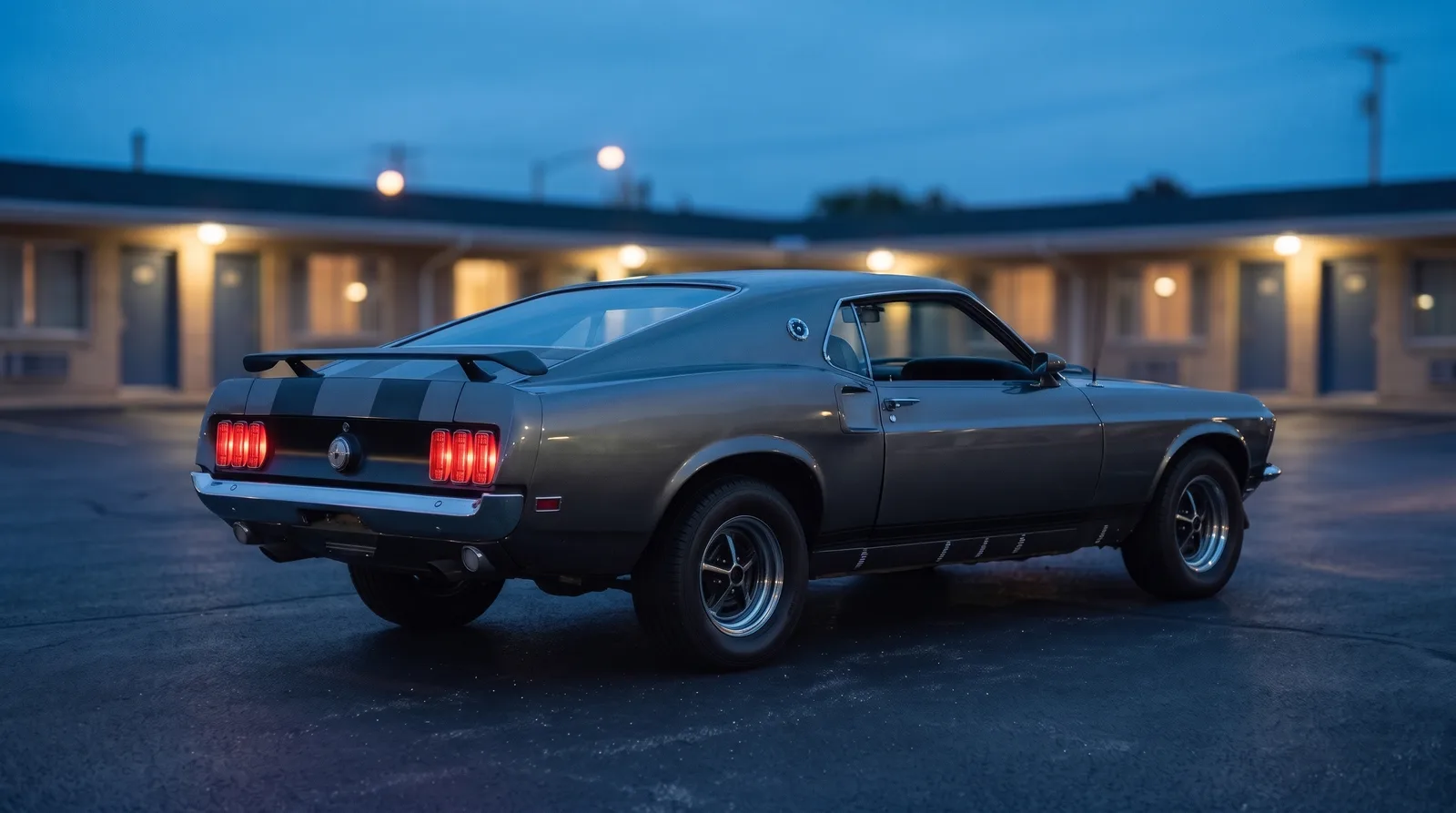
The car has a place in a long line, and the wider story of the Mustang on screen covers the rest of it. This piece stays with one question: what does the record actually show about the cars in John Wick, and how much of the legend survives contact with it?
What the John Wick Mustang is supposed to be
John Wick opened in the United States on October 24, 2014. Chad Stahelski directed it, with Keanu Reeves in the title role. The production ran on a budget of roughly $20 million to $30 million. It went on to take about $86 million worldwide, which is a healthy return for a film that was not sold as a blockbuster.
Inside the story, the car is named plainly. It is a 1969 Mustang Boss 429, and it matters to the plot for one reason: somebody wants it. Iosef Tarasov, played by Alfie Allen and the son of a crime boss named Viggo, steals it. That theft is the spark for everything that follows, and I will leave the rest of the film where it belongs, on the screen.
One small scene says a lot about how the filmmakers thought about the car. Iosef takes the Mustang to a chop shop run by a man named Aurelio, who recognizes it and refuses to touch it. The script uses the car the way a western uses a horse with a brand on it. Anyone who knows what it is also knows whose it is.
What was really in front of the camera
Here is the part that surprises people. The car the film calls a Boss 429 was played by 1969 Mustang Mach 1s. The production needed five cars, and all of them were expected to be destroyed in the course of filming.
That choice makes sense once you look at the numbers. Ford built 859 Boss 429s for 1969 and 499 for 1970. Nobody in their right mind sends cars from a run that small into a stunt sequence. The Mach 1, on the other hand, was the volume performance Mustang of 1969, with 72,458 built that year. A production that needs five matching cars and expects to wreck them goes looking for the model that exists in quantity.
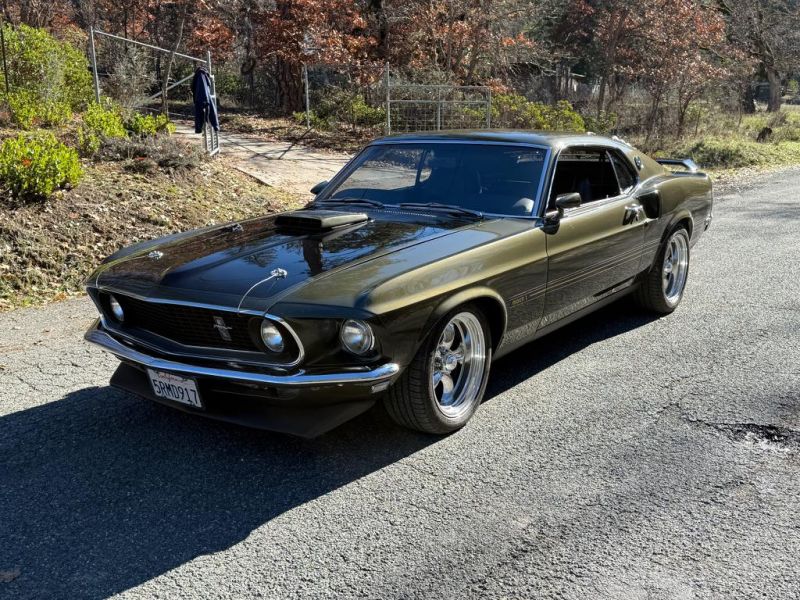
The on-screen cars wear a dark gunmetal gray with a pair of black rally stripes, and the factory Mach 1 side stripes are gone. That paint is a giveaway in itself, since none of the five colors offered on a 1969 Boss 429 was a gray. The two models share the same 1969 SportsRoof body, so a casual viewer would never spot the swap. Mustang people, of course, are not casual viewers, and the swap has been a talking point at shows ever since.
The real Boss 429 and why the script picked it
If you are going to give a hitman one car that tells the audience he has taste, the Boss 429 is a smart pick. It was never meant to be a volume car. Ford built it to homologate its new engine for NASCAR, which required at least 500 cars sold to the public, and the engine was designed to take on Chrysler's 426 Hemi.
The engine itself is the story. It used a semi-hemispherical combustion chamber that Ford called a "crescent" design, with aluminum heads. Ford rated it at 375 hp at 5,200 rpm and 450 lb-ft at 3,400 rpm, breathing through a 735-cfm Holley. Fitting it into a Mustang took real surgery, including reworked shock towers, and the installation was farmed out to Kar Kraft in Brighton, Michigan. Kar Kraft numbered the cars it built, from KK 1201 at the start to KK 2558 at the end.
A side-by-side look shows how far apart the film's car and the cars on set really were.
| Item | 1969 Boss 429 | 1969 Mach 1 |
|---|---|---|
| Role in the film | The car named in the story | The cars used on set |
| Purpose | NASCAR engine homologation | Showroom performance SportsRoof |
| VIN engine code | Z | Depends on engine fitted |
| Engine | 429 Boss V8, 375 hp, 450 lb-ft | 351 Windsor two-barrel standard; 351 four-barrel, 390 and 428 Cobra Jet optional |
| Engine installed by | Kar Kraft, Brighton, Michigan | Ford assembly line |
| 1969 production | 859 | 72,458 |
The price told the same story. The Boss 429 listed at nearly $5,000, and Sports Car Market gives its original list price as $4,798, a lot of money for a Mustang in 1969. It was a homologation special with a sticker to match, and that rarity is exactly why a film would name it and then not use one.
The 1969 Mach 1 that did the work
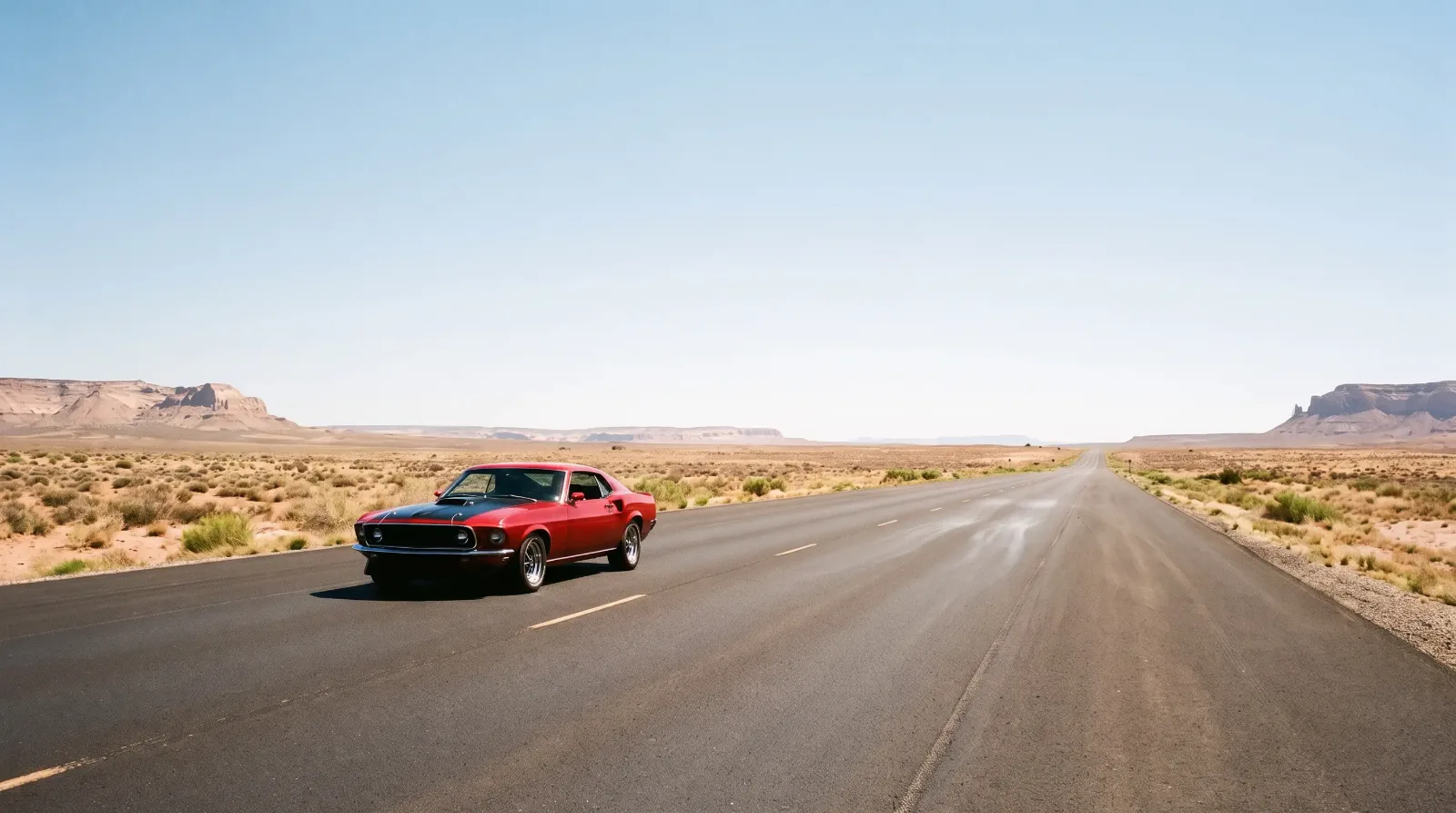
The Mach 1 deserves more credit than the trivia usually gives it. It was new for 1969, one of several models Ford introduced that year alongside the Boss 302, the Boss 429 and the Grande. It came only as a SportsRoof, Ford's new literature name for the fastback, and it wore the 1969 face with four headlamps, the only year a Mustang had them.
That 1969 body was longer than the 1968 car by nearly four inches, at 187.4 inches, on the same 108-inch wheelbase. It sat lower too. Those proportions are a big reason the car reads so well on film. A 1969 SportsRoof looks long and low and a little mean from almost any angle, and a director does not have to work hard to make it look dangerous parked in a dark garage.
In most films a Mustang lives in the background, a period car driven by a supporting character or parked at a curb to set the decade. John Wick flipped that. The Mach 1s standing in for a Boss 429 were the reason the plot moved at all. Ford sold 299,824 Mustangs for the 1969 model year, and in 2014 one fictional example became the most talked-about of the lot.
The sequel and why the car stuck
The car did not stay lost. In John Wick: Chapter 2, released in the United States on February 10, 2017, Wick goes after his Boss 429 Mustang and recovers it from a compound belonging to Abram Tarasov. That a sequel bothered to bring the car back at all tells you how much weight the filmmakers put on it.
"Most film cars are props with good paint. This one was a reason. The script could have handed him any fast car, and it picked the rarest Mustang of the year and then filled the set with Mach 1s so nobody had to wreck the real thing. That is a movie that respected the car more than it let on."
Patrick Walsh
Why did this one stick when so many screen cars fade? Part of it is that the film never explains the Mustang. It just treats it as obviously worth killing for, and audiences took the cue. Part of it is timing. The Mustang had been in films and on television for fifty years by 2014, from Bond's era to the Cobra II days of Charlie's Angels, but a younger audience had seen far fewer classic Mustangs in leading roles.
The effect shows up in the hobby. Lookalike 1969 SportsRoofs turn up at shows with their owners fielding the same question over and over, and plenty of people who would never have looked twice at a Mach 1 now know the difference between one and a Boss 429. If the film sent you looking, browsing the current crop of 1969 Mustangs for sale is a good way to see how many Mach 1s survived, and how few cars carry a Z in the VIN.
The honest summary is a short one. The story says Boss 429. The cars on set were Mach 1s. Both were real 1969 Mustangs, and between them they gave the model year a second life it did not need but clearly enjoyed.
Sources and notes
Related Reading
Have a
Ford Mustang
for Sale?
Reach thousands of serious classic car collectors across the US.
Sell It Here →
Selling a classic? Here's how: the best sites to sell a classic car
Are You a Classic Car Dealer?
List your full inventory and connect with targeted classic car buyers.
Join as a Dealer →

About the author
Patrick Walsh
Automotive journalist covering classic car shows, events, and the enthusiast community across North America.
Related Listings - Ford Mustang




Comments
Be the first to comment on this article.