
The blower looks great on a magazine cover. The showroom floor plan tells you the real story. In 1969, Chevrolet dealers had a Chevelle SS on one side of the lot and a Camaro SS or Z/28 on the other, both wearing small-block or big-block Chevy V8s, both aimed at a buyer with the same budget and the same itch. That is not a rivalry between two companies. That is a rivalry inside one building, and it is a more interesting fight than most of the cross-brand wars because both cars were pulling from the same parts bin.
Car Features
6 min read
Chevelle vs Camaro: A Family Rivalry
Same engine family, different missions: how the Chevelle SS and Camaro SS/Z28 competed inside Chevrolet's own showroom.
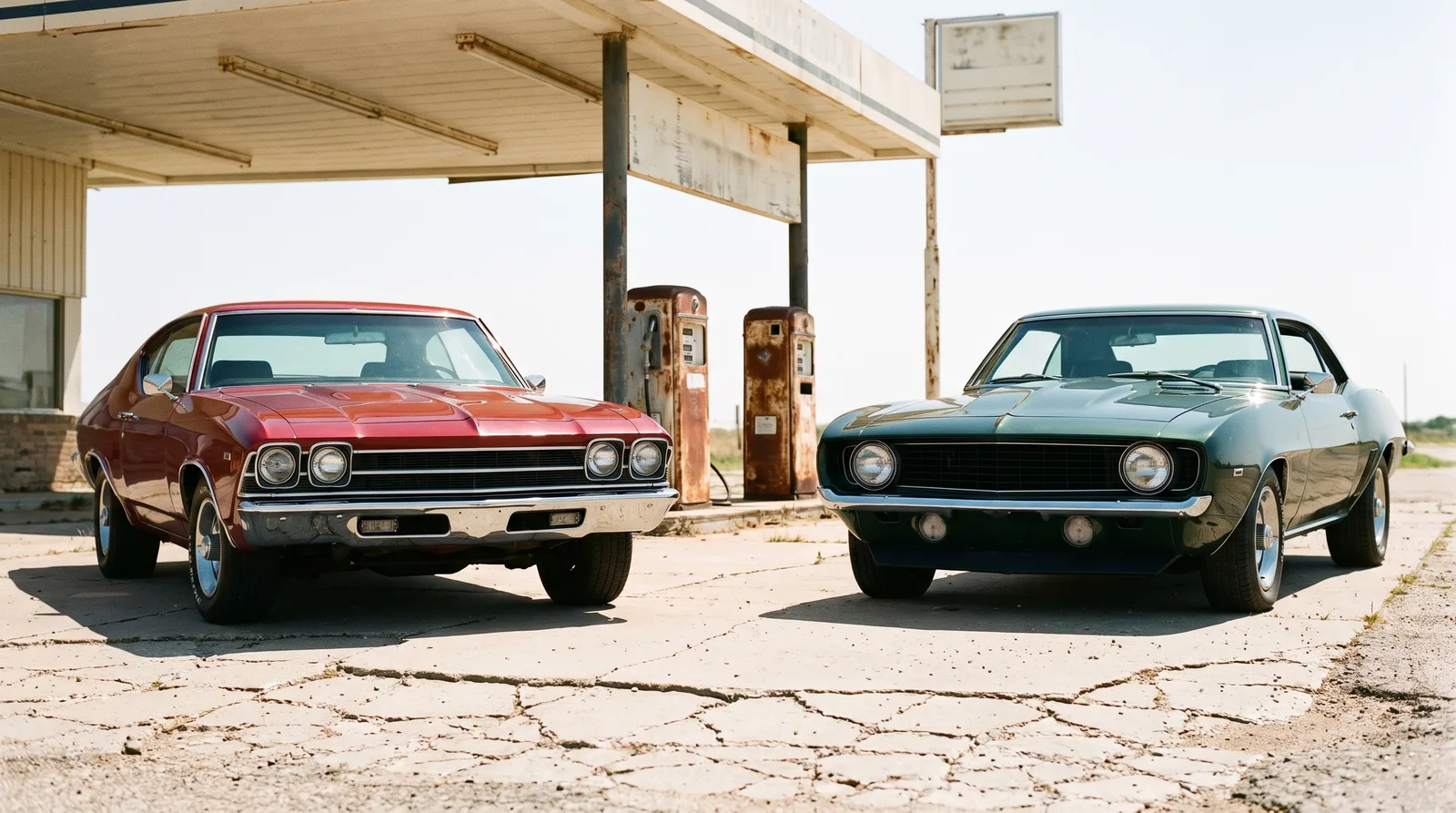
I build engines for a living, and the Chevelle-versus-Camaro argument comes down to a question a lot of magazine articles never actually answer: same displacement, same block, two completely different cars. Where does the advantage actually go, and why.
Two platforms, one engine family
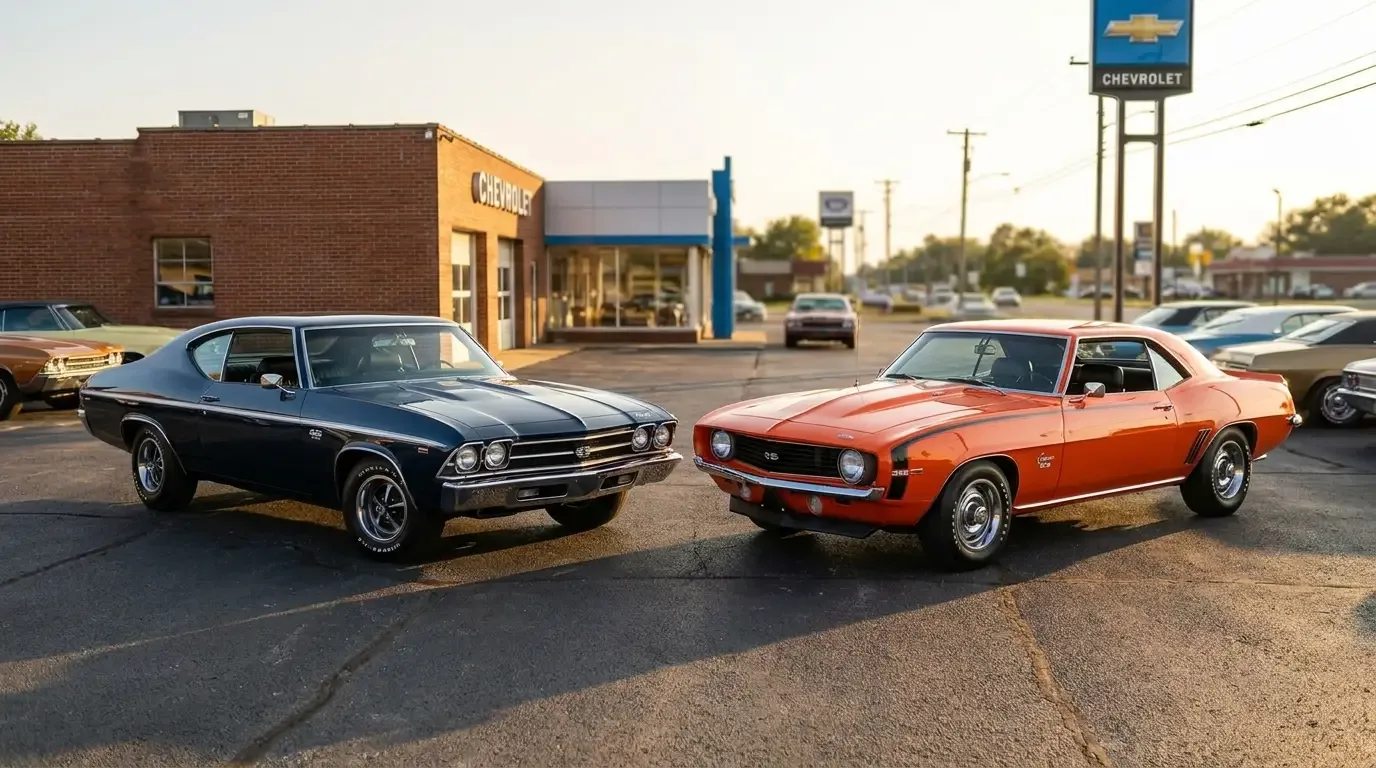
The Chevelle rode on GM's A-body platform, a mid-size intermediate chassis shared across Pontiac, Oldsmobile and Buick as well. The Camaro rode on the F-body, developed specifically to compete with the Ford Mustang in the pony car segment. Different wheelbase, different intended market, different weight distribution. But under the hood, both cars pulled from the same Chevrolet engine family: small-block 302, 327, 350 and big-block 396, 402 and 454 options showed up across both lineups depending on the model year.
That shared parts bin is why this rivalry never gets settled cleanly. A 1969 Camaro Z/28 with the 302 was built to rev and handle, chasing SCCA Trans-Am rules that capped displacement at 305 cubic inches. A 1969 Chevelle SS 396 was built to make torque off the line in a heavier car. Compare quarter-mile times between those two and you are comparing two different design briefs, not two competing answers to the same question.
Weight is the number that actually decides most of this
A big-block Chevelle SS typically carried a curb weight in the neighborhood of 3,600 to 3,800 pounds depending on options, while a comparably equipped Camaro SS ran lighter, closer to 3,350 to 3,550 pounds. That gap, often closer to one hundred to two hundred pounds on directly comparable trims but wider once you start adding options to the Chevelle, matters more than most bench-racing arguments give it credit for. Put the same 396 in both cars and the Camaro gets to sixty faster and through the quarter mile quicker, purely on the weight advantage, with the Chevelle clawing some of that back on straight-line stability and rear traction because of the longer wheelbase putting the power down cleaner off the line.
Neither car had a clean win across every configuration Chevrolet offered. The Chevelle's advantage showed up more in daily usability, back seat room, trunk space, ride quality on a longer wheelbase, none of which shows up on a dyno sheet but all of which mattered to somebody actually writing the check.
| Spec | Chevelle SS 396 | Camaro SS 396 |
|---|---|---|
| Platform | A-body, mid-size | F-body, pony car |
| Approx. curb weight | 3,600-3,800 lbs | 3,350-3,550 lbs |
| Wheelbase | Longer, four-door capable chassis | Shorter, two-door only |
| Intended rival | GTO, 442, GS | Mustang, Barracuda |
The Z/28 changes the argument entirely
The Z/28 package is the wrinkle that breaks a clean Chevelle-versus-Camaro comparison, because it was never built to fight the Chevelle SS in the first place. The high-revving small block, close-ratio gearbox and stiffened suspension were built for Trans-Am homologation, chasing road-course balance over straight-line torque. Put a Z/28 against a big-block Chevelle SS on a drag strip and the Chevelle usually wins on raw power. Put both cars on a road course and the argument flips hard the other way. That is not a flaw in either car. It is proof these two nameplates were never actually solving the same problem, even while wearing the same bowtie.
Gearing told a different story than displacement
Rear axle ratios did more to separate these two cars in the real world than the cubic-inch numbers ever did. A Camaro ordered with a 4.10 or 4.56 gear set turned into a genuine stoplight weapon, trading top-end speed for a launch that a heavier Chevelle simply could not match without an equally aggressive gear of its own. Chevrolet buyers ordering a Chevelle SS for daily use tended to spec a milder 3.31 or 3.55 rear end that kept highway RPM reasonable, which meant two customers walking out of the same dealership with two big-block Chevrolets could end up with cars that behaved nothing alike at the strip. This is the part of the rivalry that gets lost when people only compare base-model horsepower ratings side by side. The options list mattered as much as the engine choice.
What the numbers say now
Collector demand has treated these two nameplates very differently over the last two decades. A documented LS6 Chevelle commands serious money at auction, but Camaro Z/28 and COPO-code cars have pulled ahead of comparable Chevelles in overall market strength, driven partly by the Camaro's ongoing production into the modern era keeping the nameplate culturally alive in a way the Chevelle's discontinuation in 1977 did not. That is a marketing and continuity story more than a performance story, and it is worth knowing before you assume the auction results reflect which car was actually better in period.
Neither car needs to apologize to the other. If you want to compare Chevelle listings against Camaro pricing directly, the gap has narrowed and widened at different points depending on the market cycle, and right now both nameplates are strong enough that the choice comes down to what you actually want the car to do.
"Same engine family, same corporate parts catalog, completely different mission statement. That's what makes this one fun to argue about at a cruise night. It's not Chevy against somebody else. It's Chevy against itself, and both sides of that argument are right depending on what you're actually driving the car for."
Dan Reeves
Two nameplates, one family, no clean winner
The Chevelle and the Camaro were never really fighting each other the way the Chevelle fought the GTO. They were two answers to two different questions, built from the same corporate toolbox, sold out of the same dealership. If you want the full picture of how the Camaro nameplate carved its own path outside this family argument, the full Camaro story covers that ground in detail.
The family fight is one thing. The rivalry that crossed brand lines entirely, and actually got personal, is a different story, and that one is next: Chevelle vs Mustang.
Sources and notes
- Chevrolet L78: Wikipedia, rating history and applications
- HowStuffWorks: 1969 Chevrolet Camaro SS 396 profile
- HowStuffWorks: 1969 Chevrolet Chevelle SS 396 profile
- Team Chevelle forum: 1969 Chevelle SS 396 factory weight discussion
- 1968-1970 Chevrolet Chevelle SS 396: specs and history
- Chevrolet Camaro: Wikipedia, first-generation F-body and Z/28 Trans-Am homologation
Related Reading
Have a
Chevrolet Chevelle
for Sale?
Reach thousands of serious classic car collectors across the US.
Sell It Here →
Are You a Classic Car Dealer?
List your full inventory and connect with targeted classic car buyers.
Join as a Dealer →

About the author
Dan Reeves
Performance engine builder from North Carolina's motorsports corridor, focused on swaps, forced induction and making real, repeatable power.
Related Listings - Chevrolet Chevelle
Comments
Be the first to comment on this article.