
Every judged meet has one. He is on a creeper beside his own car with a flashlight in one hand and an inspection mirror in the other, reading the side of the engine block as if it owed him money. Sooner or later somebody asks what he is looking for, and the answer is always the same two things: a casting number and a date. Learning to read classic Mustang date codes, and the part numbers cast beside them, is the cheapest education in the hobby, because the iron has been telling the truth since the day it left the foundry.
Car Features
8 min read
Casting Numbers and Date Codes on a Classic Mustang
How to read Ford casting numbers and classic Mustang date codes on blocks, intakes and sheet metal, and what a date can and cannot prove.
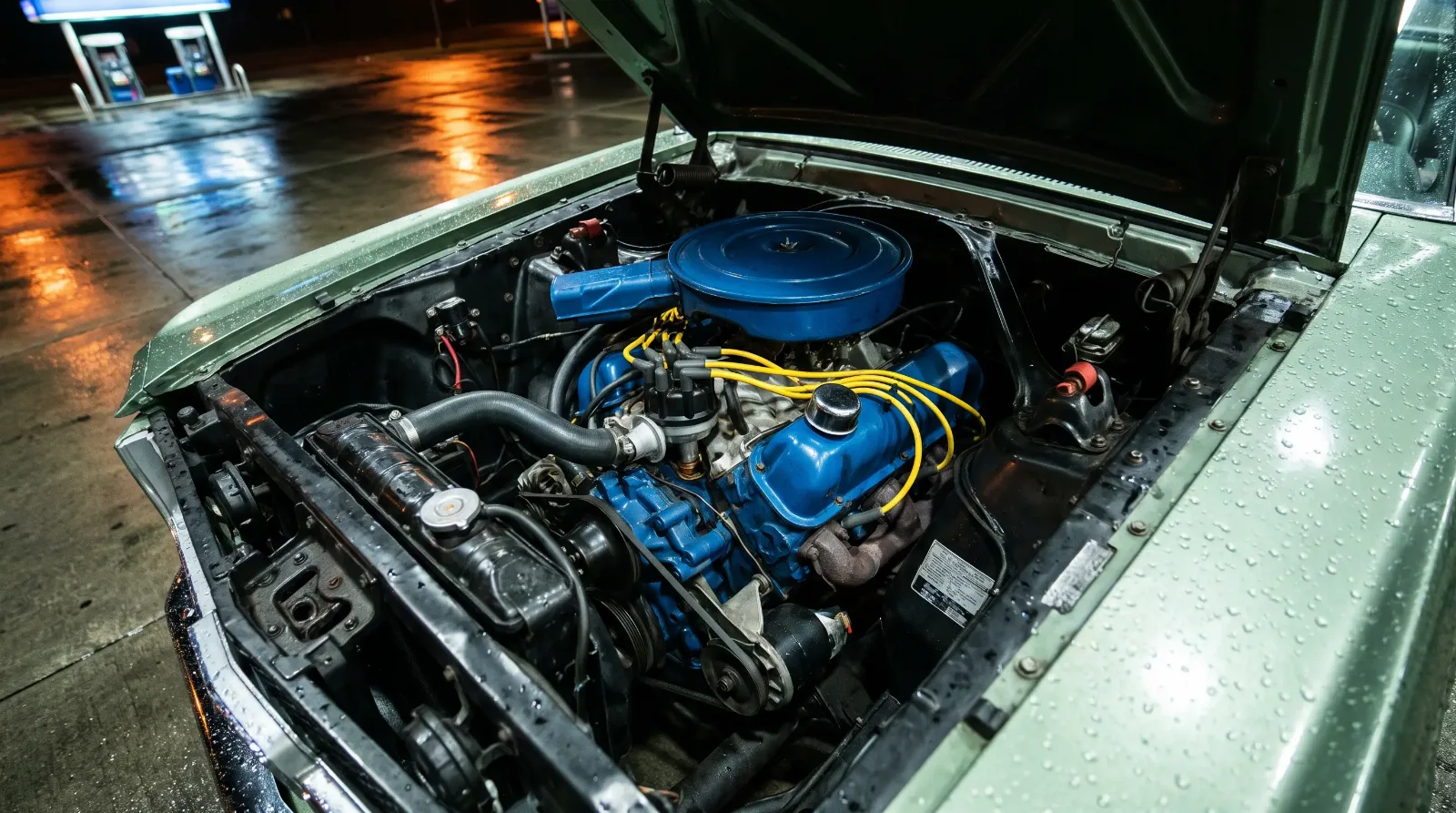
This piece is about the raised and stamped markings on the parts themselves: blocks, heads, manifolds, housings and sheet metal. The VIN, the door plate and the build paperwork are separate subjects, and the wider job of identifying a classic Mustang starts with them. Down here it is just you, a rag, a good light and a handful of characters in cast iron.
How a Ford part number is put together
Ford's engineering numbers follow one pattern, prefix, base and suffix, and once you have it you can read most of what is under the hood. Take C8AE-6881-A. The prefix is the first four characters, the base number is the group in the middle, and the suffix is the letter at the end.
The prefix does most of the talking. The first letter is the decade: C for the 1960s, D for the 1970s, E for the 1980s. The digit after it is the year inside that decade, so C5 means 1965 and D0 means 1970. The third character names the car line the part was engineered for. Z is Mustang, A is the full-size Ford or Galaxie, O is Fairlane and Torino, D is Falcon and S is Thunderbird. The fourth character is the engineering group: E for engine, C for chassis, P for automatic transmission, and Z for Ford service parts. Put those together and C5ZZ reads as a 1965 Mustang service part.
The base number tells you what the part is. A 6015 is a cylinder block and a 9425 is an intake manifold. The suffix letter is the engineering version: A for the first release, later letters for each revision, so an M marks the thirteenth version of that part. That is why two intakes with the same prefix and base can still be different castings.
Here is the first surprise for a new owner. A Mustang is full of parts that never had a Z in the third spot. Ford engineered engines for its bigger car lines and shared them across the range, so an A or an O on an engine casting is no cause for alarm. The intake on a 1971 351 Cleveland car reads D0AE-9425-L, a full-size Ford engine number, and it is correct. The prefix records where the engineering release came from, not every car that ended up wearing the part.
Casting number, part number and the date beside them
Two markings get confused at every swap meet. The casting number is the one molded into the part, and it identifies the casting: C8OE-6015-A on a block, for example. The service part number is what the parts counter sold, and that is where the Z in the fourth position turns up. The two do not have to match, and a part that left a dealer's shelf rather than the assembly line is one of the first things a careful judge sniffs out.
The date code is a separate marking again, and it answers a different question. The casting number says what the part is. The date code says when that particular piece was poured. The distinction matters because a casting number could stay in production for more than a year, which is exactly why the foundries kept a second set of month letters in reserve. A casting number alone puts a part in a family of years. Only the date code puts it on a day.
Reading classic Mustang date codes on castings
A casting date code has three pieces: a year digit, a month letter and a day. 9B7 is February 7, 1969. The months run A through M with the letter I left out, so September is J. The code carries only the last digit of the year, and the decade comes from the casting number beside it. A 9 next to a C-series number means 1969. The same 9 next to a D-series number would mean 1979.
There is a wrinkle. When a part stayed in production past its first twelve months, the month letters could switch to a second alphabet, N through Z with O left out. So an N is a January and a Z is a December, in the second year of that part's run. Read the month first, then ask which year of the part's run it belongs to.
| Month | First-year letter | Second-year letter |
|---|---|---|
| January | A | N |
| February | B | P |
| March | C | Q |
| April | D | R |
| May | E | S |
| June | F | T |
| July | G | U |
| August | H | V |
| September | J | W |
| October | K | X |
| November | L | Y |
| December | M | Z |
Does the date make sense for the car?
Here is the worked example that settles most bench-racing. A D0AE-9425-L intake on a 351 Cleveland with a code of 0L27 was cast on November 27, 1970. On a 1971 car that is exactly what you want to see. The part was poured, machined and shipped ahead of the car being put together, and its date sits comfortably before the build date on the door data plate. A part dated after the car left the plant did not come with the car. That is the one rule with no exceptions.
The reverse is not proof of anything, and this is where friendships get tested. A casting dated right for the car can still be a used part from a sister car, pulled at a salvage yard decades later. Dates rule parts out; they cannot rule a car in. That is why experienced judges look at the whole set, block, heads, intake, exhaust manifolds and bellhousing, and want the dates to fall into a believable order ahead of the build date rather than one perfect code on one part.
"I have watched a whole tent full of people argue over one engine for an hour, and the argument ended when somebody wiped off the intake and read the date out loud. A casting date will never tell you a car is original. It will tell you, very politely, when a part is not."
Wayne Coburn
Stronger evidence exists for the engine itself. From the 1968 model year, as federal safety rules took hold, Ford stamped a shortened VIN (model year, plant code and the six-digit serial) on engines and transmissions, usually at the back of the block on the driver's side. Before that, mostly high-performance engines got one. The stamps were struck by hand, so a faint or missing one is not automatically a red flag, but a matching stamp ties an engine to a specific car in a way no date code can.
Stamped codes on sheet metal and smaller parts
Sheet metal plays by different rules. Stamped panels carry a numeric month and day, a plant letter and a shift number, and no year at all. A code like 4 15 B2 reads April 15, plant B (Buffalo), second shift. With no year in the code, these stamps only mean something in context. They have to fit before the car's build date and agree with the panels around them, and on their own they will not tell you which model year a fender was made for.
The body carries more than date stamps. Ford left identification on the structure in places a restorer rarely sees, which is where buck tags and hidden VINs come in, and those are the markings that tie a shell to its own history. Casting and stamp dates are supporting witnesses. Good ones, though: nobody at the foundry had a reason to fudge them.
The man on the creeper is not being fussy. He is collecting the small, honest facts a car picks up on its way down the line, and once you can read them yourself, the arguments at the next meet get shorter.
Sources and notes
- Fordification: Ford engineering numbers and casting date codes
- MustangTek: Ford date code decoding, castings and sheet-metal stamps
- MustangTek: decoding Ford casting and part numbers
- MustangSpecs: deciphering Ford part numbers and date codes
- Pine Bluff Commercial: matching numbers on Fords and the partial VIN stamp
Related Reading

Have a
Ford Mustang
for Sale?
Reach thousands of serious classic car collectors across the US.
Sell It Here →
Selling a classic? Here's how: the best sites to sell a classic car
Are You a Classic Car Dealer?
List your full inventory and connect with targeted classic car buyers.
Join as a Dealer →
#mustang identification
#Ford Mustang
#classic Mustang
#mustang restoration
#casting numbers
#date codes
#Ford part numbers

About the author
Wayne Coburn
Longtime Corvette owner, judge and club figure who knows the cars, the records and the people behind them.
Related Listings - Ford Mustang






Comments
Be the first to comment on this article.