
One letter. On a 1965 to 1973 Mustang, a single character in the VIN tells you which engine Ford bolted in at the plant. A K means a 271 hp Hi-Po. A T means a 200 cubic inch six. Mustang engine codes are the fastest way to separate a real performance car from a nice-looking one, and also the easiest place to fool yourself, because Ford reused the letters. An R in 1969 and an R in 1971 are not the same engine. Read the year first, then the letter.
Car Features
7 min read
Classic Mustang Engine Codes: A, C, K, R, S and the Rest
Every 1964½ to 1973 Mustang VIN engine letter decoded, with ratings, years, and the reused letters that trip people up.
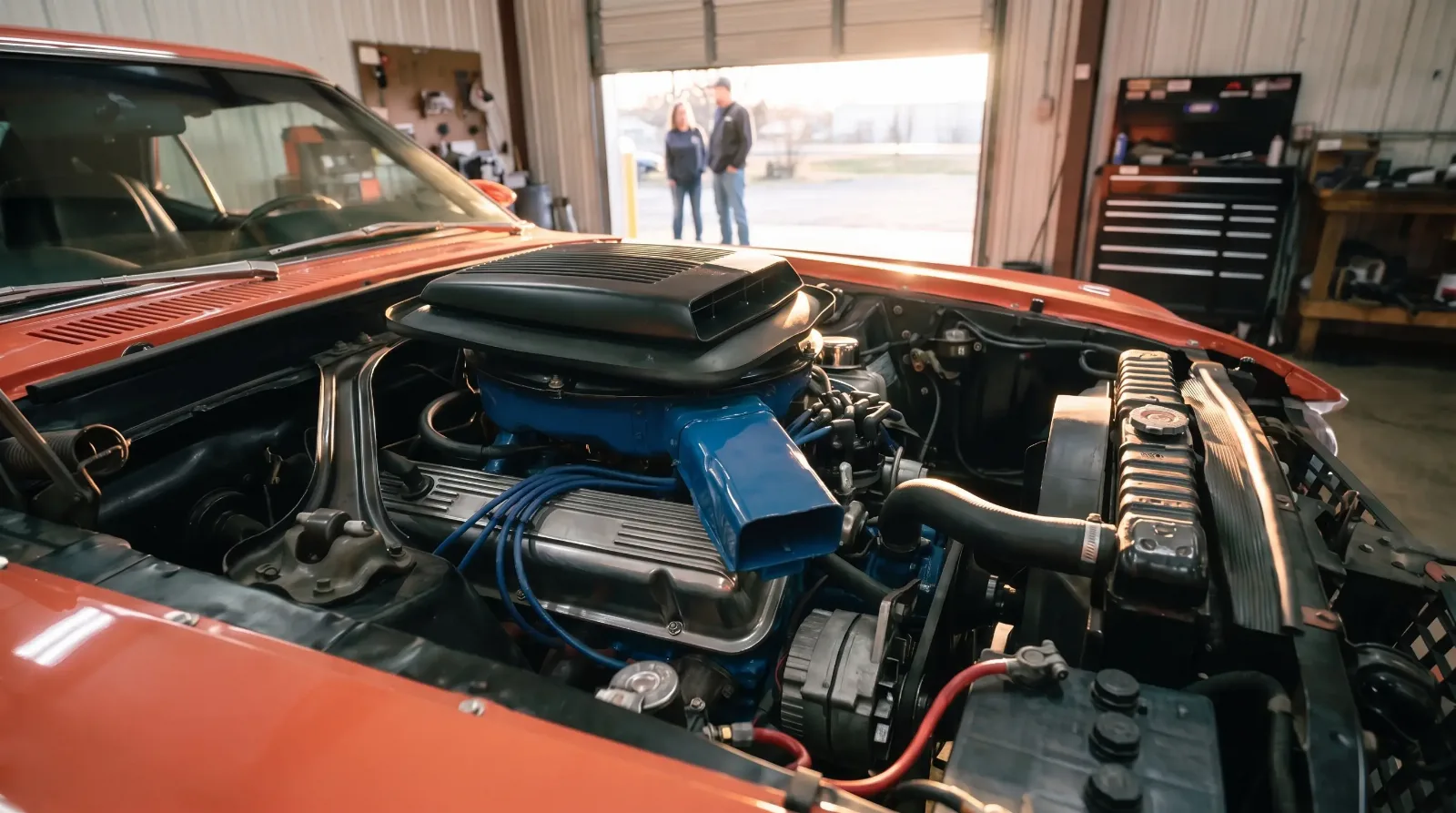
This is the decoder for that letter: what each one meant, in which years, and what the engine was rated at when it left the factory. It is one piece of a bigger job, and our Mustang identification guide covers the rest of the paperwork.
Where the engine code sits in the VIN
From 1965 through 1973 the Mustang VIN is 11 characters. The first digit is the model year. The second is the assembly plant. The next two are the body code. The fifth character is the engine. The last six are the serial number. Take 7T02C164054: 1967, Metuchen, fastback, C-code 289 two-barrel. That fifth position is the one that matters here.
Every 1964½ car carries a 5 as its first digit, the same as a 1965, so the year digit will not tell you whether a car is early or late. The engine letter sometimes will. The U, F and D codes never appear on a 1965 model-year car, so a 5-prefixed VIN carrying one of them is an early build by definition.
Ratings below are SAE gross through 1971. For 1972 Ford switched to SAE net, and the numbers drop hard. The engines did not lose that much. The measuring method changed. Do not compare a 1971 figure with a 1972 figure and draw conclusions.
Mustang engine codes from 1964½ to 1967
The first Mustangs came with a short list. The base engine was the 170 six, code U, rated at 101 hp. The first V8 was the 260 two-barrel, code F, at 164 hp. Above it sat the D-code 289 four-barrel at 210 hp and the K-code Hi-Po at 271 hp.
For the 1965 model year proper, Ford cleaned it up. The T-code 200 six replaced the 170 at 120 hp. The C-code 289 two-barrel, 200 hp, became the base V8. The A-code 289 four-barrel made 225 hp. The K stayed on top at 271 hp and 312 lb-ft, on solid lifters. In 1967 the S-code 390 four-barrel arrived, 320 hp and 427 lb-ft, the first big-block in a Mustang.
One practical rule falls out of this. The 1965 and 1966 GT Equipment Group was only available with the four-barrel 289, the A or the K. A C, T or U-code car cannot be a factory GT. The body can wear every GT part in the catalog. The VIN still says what it says.
The 1968 to 1973 codes, letter by letter
From 1968 the list grows fast. Small-blocks got bigger, big-blocks got meaner, and the Boss cars arrived with their own letters. The table lists the letters in the main 1964½ to 1973 decoder tables, with the years each meaning applies.
| Code | Engine | Model years | Rated output |
|---|---|---|---|
| U | 170 six, 1-bbl | 1964½ | 101 hp |
| T | 200 six, 1-bbl | 1965-70 | 120 hp (115 hp in 1968-69) |
| L | 250 six, 1-bbl | 1969-73 | 155 hp (1969); 145 hp (1971) |
| F | 260 V8, 2-bbl | 1964½ | 164 hp |
| F | 302 V8, 2-bbl | 1968-73 | 210 hp; 140 hp net (1972) |
| D | 289 V8, 4-bbl | 1964½ | 210 hp |
| C | 289 V8, 2-bbl | 1965-68 | 200 hp (195 hp in 1968) |
| A | 289 V8, 4-bbl | 1965-67 | 225 hp |
| K | 289 Hi-Po, 4-bbl | 1964½-67 | 271 hp |
| J | 302 V8, 4-bbl | 1968 | 230 hp |
| X | 390 V8, 2-bbl | 1968 | 270 hp |
| S | 390 V8, 4-bbl | 1967-69 | 320 hp (325 hp in 1968) |
| W | 427 V8 | 1968 | 390 hp |
| R | 428 Cobra Jet | 1968 | 335 hp |
| Q | 428 Cobra Jet | 1969-70 | 335 hp |
| R | 428 Cobra Jet Ram Air | 1969-70 | 335 hp |
| H | 351 V8, 2-bbl | 1969-73 | 250 hp (240 hp in 1971); 177 hp net (1972) |
| M | 351 V8, 4-bbl | 1969-71 | 290 hp (1969); 300 hp (1970); 285 hp (1971) |
| G | Boss 302 | 1969-70 | 290 hp |
| Z | Boss 429 | 1969-70 | 375 hp |
| Q | 351 Cobra Jet | 1971-73 | 280 hp (1971); 266 hp net (1972) |
| R | Boss 351 | 1971 | 330 hp |
| C | 429 Cobra Jet | 1971 | 370 hp |
| J | 429 Cobra Jet Ram Air or Super Cobra Jet | 1971 | 370 hp (375 hp as SCJ) |
| R | 351 HO | 1972 | 275 hp net |
A few rows need a note. The H and M codes covered two different 351s. In 1969 they were Windsors. For 1970 the Cleveland took over, with the four-barrel M-code rated at 300 hp, though some early 1970 cars still got the Windsor. In the main decoder tables the letter did not change, so the VIN alone will not tell you which 351 a 1970 car was built with. The W-code 427 shows up in the 1968 decoder tables at 390 hp; how many Mustangs, if any, actually left the line with it is still an open question. Treat a W-code claim as something to prove, not something to accept.
The Boss cars are where the letters earn money. G for the Boss 302, 290 hp. Z for the Boss 429, 375 hp. R for the 1971 Boss 351, 330 hp, of which 1,806 were built. If you want the details on what each package added beyond the engine, that is a separate story. Here the point is narrower: the letter is the first thing to check, and on these cars it is the first thing a forger changes.
"The engine code tells you what Ford put in the car. It does not tell you what is in the car now. Those are two different questions, and the second one costs a lot more to answer."
Dan Reeves
Reused letters: why the year comes first
Ford did not retire letters. It recycled them, and that is where most decoding mistakes start. R is the worst offender. It meant the 428 Cobra Jet from 1968 to 1970, the Boss 351 in 1971 and the 351 HO in 1972. Three different engines, three different cars. The 1972 351 HO was built only 398 times, all at Dearborn, and it shares a letter with a Boss.
The others follow the same pattern. F was a 260 in 1964½ and a 302 two-barrel from 1968. C was a 289 two-barrel through 1968 and the 429 Cobra Jet in 1971. J was a 302 four-barrel in 1968 and the Ram Air 429 Cobra Jet, Super Cobra Jet included, in 1971. Q was the 428 Cobra Jet without Ram Air in 1969 and 1970, then the 351 Cobra Jet from 1971. Read any of those without the year digit and you can be off by 100 hp or more.
Even the published tables do not always agree. One 1970 fact sheet prints P for the 428 Cobra Jet and X for the 351 Windsor two-barrel, where the main decoder tables use Q, R and H. Another table lists the 1970 H-code as a four-barrel at 250 hp, which is a typo: 250 hp is the two-barrel rating. When a decoder disagrees with itself, check a second one.
The VIN letter is also only half the evidence. It says what the car was built with. Whether the engine in it today is that engine is a separate check, done on the block itself through its casting and date codes. A K-code VIN over a C-code block is a K-code car with the wrong engine. That matters to the next owner, and it should matter to you.
After 1973: Mustang engine codes move
The Mustang II kept a single-letter code with a much shorter menu: Y for the 2.3 four, Z for the 2.8 V6 and F for the 302 V8. Note the Z. In 1970 it meant a Boss 429. A few years later it meant a V6. The letter by itself proves nothing.
From the 1981 model year, federal rules standardized the 17-character VIN, and the engine code moved to the eighth position. On Fox and SN95 cars the useful ones are A for the carbureted 2.3 four of the early 1980s, F for the 5.0 (1985), M for the 1986 5.0 HO with fuel injection, E for the 5.0 HO from 1987 to 1993 and T for the 1994 GT. The 4.6 SOHC GT shows X or W from 1996 to 1998, depending on which plant built the engine. V marks the 1998 Cobra's DOHC 4.6, and 4 is the 3.8 V6. The tenth character gives the year, which you still need: same rule, new position.
That is the whole system in one line. Year first, then the letter, then the block. Skip a step and the numbers lie to you. For how it all fits together across the classic Mustang years, the engine code is only one chapter.
Sources and notes
Related Reading


Have a
Ford Mustang
for Sale?
Reach thousands of serious classic car collectors across the US.
Sell It Here →
Selling a classic? Here's how: the best sites to sell a classic car
Are You a Classic Car Dealer?
List your full inventory and connect with targeted classic car buyers.
Join as a Dealer →
#Ford Mustang
#428 Cobra Jet
#Boss 429
#K-code
#classic Mustang engines
#Mustang engine codes
#Mustang VIN

About the author
Dan Reeves
Performance engine builder from North Carolina's motorsports corridor, focused on swaps, forced induction and making real, repeatable power.
Related Listings - Ford Mustang
Comments
Be the first to comment on this article.