
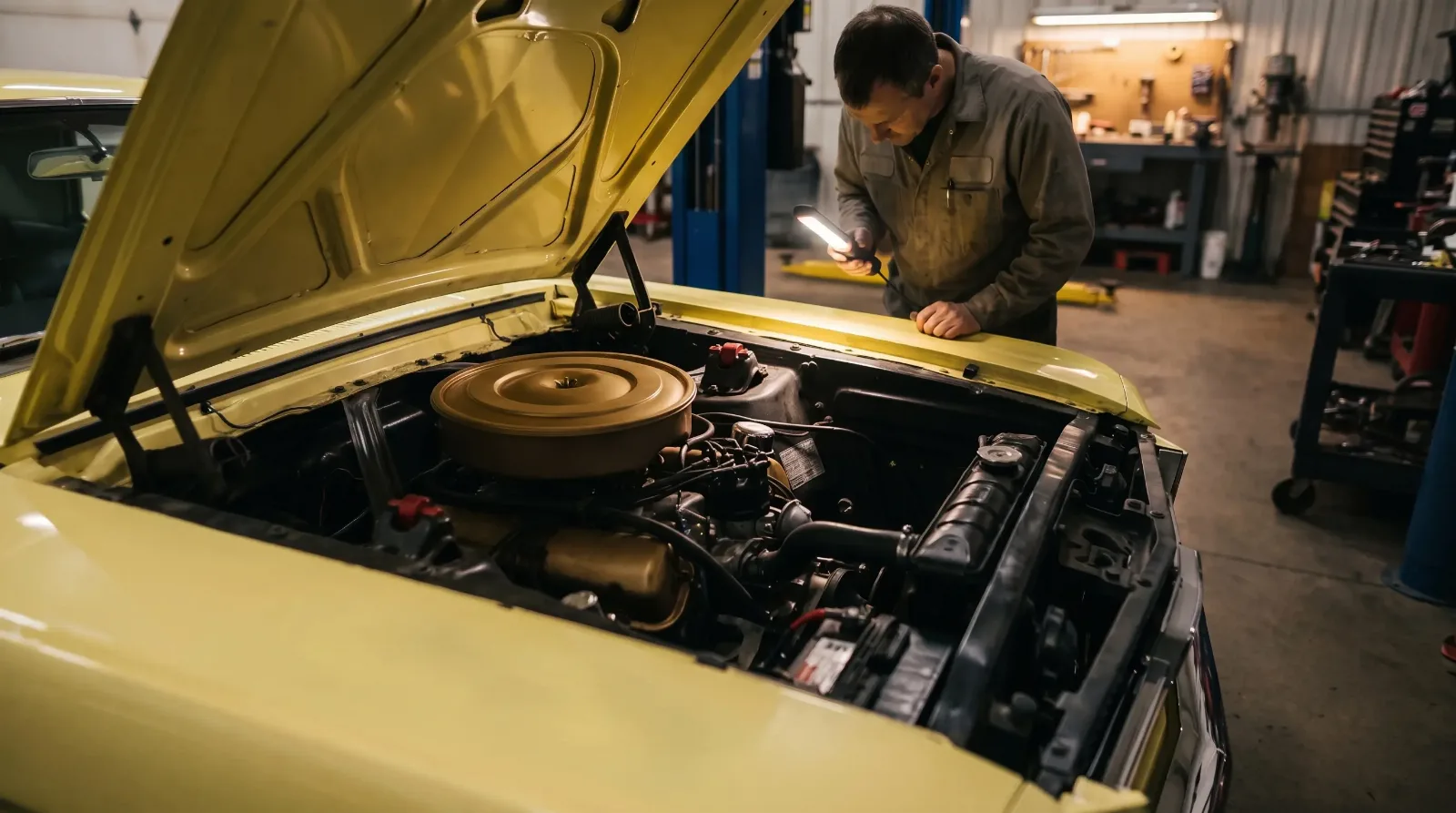
Every club has a member who can tell you a car's whole history from across the parking lot, and every club has a quieter one who waits until the hood is up. I have watched the quiet one win more arguments. He reaches past the battery with a flashlight, wipes a patch of inner fender with his thumb, and reads the numbers Ford stamped there for its own people. Between those hidden stamps and the Mustang buck tag some cars still carry on the radiator support, the factory left more clues than most owners ever find.
Car Features
8 min read
Buck Tags and Hidden VINs: Where Ford Left the Clues
Where to find the Mustang buck tag and the hidden VIN stamps Ford left on aprons, supports and drivetrains, and what they can prove.
The public numbers are the VIN under the hood or on the dash and the tag on the door, and reading those is a job for a classic Mustang VIN decoder. This piece is about the other set: the marks that were never meant for the buyer, where to look for them, and what they can and cannot settle once the bench racing starts.
What a Mustang buck tag is
The name comes from the assembly line. A "buck" is the jig a body sits in while it is being built, and the buck tag is a small stamped metal tag that rode on the body through the plant. Restorers on the 1971 to 1973 Mustang forums say it went on in the bare-metal stage, before paint. It told the line what it was building: year, plant, body style, engine, paint and some of the options. The Cougar club's tech library says assemblers read the tags to know where to drill the body. It was a work order in metal, and nobody at Ford expected a customer to read it.
On 1971 to 1973 Mustangs, owners report the tag on the radiator support beside a headlight bucket, held by a single screw, and an owner poll on 7173Mustangs.com found it on both sides. Read the way those owners decode it, a tag opening with "2F" means 1972 and Dearborn, 63R is the body code, and engine, paint and option codes follow. Kevin Marti's tag book is the usual key for the rest. The radiator support is also one of the first panels replaced after a front-end hit, so a missing tag proves nothing by itself.
The VIN everyone can see
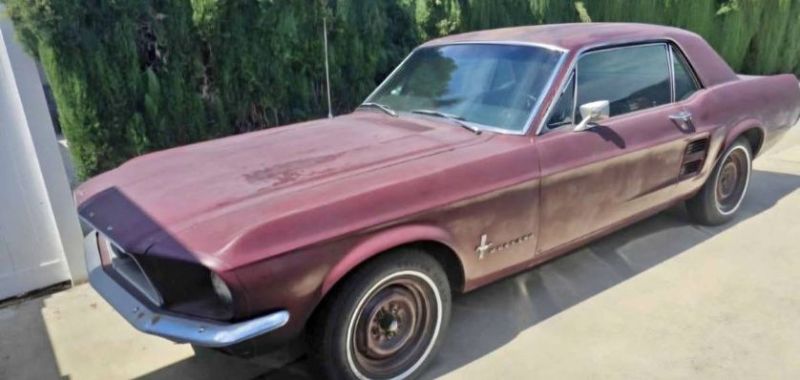
The hidden numbers only mean something against the public one. Through 1967 the VIN is stamped on top of the driver-side fender apron under the hood. From 1968 it moved to the top of the dash, where you read it through the windshield.
The first-generation VIN runs 11 characters: a year digit, a plant letter, a two-digit body code, an engine letter and a six-digit serial. Take 7T02C164054. That is a 1967, built at Metuchen, a fastback, with the C-code 289 two-barrel. The letter in second place is the plant code, F for Dearborn, R for San Jose and T for Metuchen, and the engine letters have a history of their own, covered here. Write it on a card before you crawl under anything.
Hidden VINs on the 1965 to 1968 cars
This is where the flashlight earns its keep. On 1965 and 1966 cars, owners and restorers report the number stamped in two more places besides the public apron stamp: on the radiator support, and toward the rear on top of the passenger-side inner apron, where the fender hides it. That last one is the prize: out of sight with the fender on, it often outlasts decades of fender benders and parts swaps.
For 1967 and 1968, owners point to the inner apron by the shock tower, on one side or both, with the passenger side the more common. Greg Zyla's long-running Cars We Remember column describes Ford's hidden VIN the same way: on top of one or both shock towers, or on the inner apron, usually under the fender. I will be straight with you: this map comes mostly from owners comparing notes, not from a Ford document. Treat the locations as places to look, not as a rule that fails a car when one comes up empty.
The radiator support stamp carries the same caution as the buck tag. A replacement support will carry someone else's number or none at all. That is a repair, not a crime. What should stop you is a stamp that is present and disagrees with the public VIN, or a patch of metal where a stamp ought to be that looks freshly ground, filled or welded.
One trap catches newcomers. The number on the door tag is not the legal VIN, and the tag is riveted to a door, which can be swapped in an afternoon. A door tag that disagrees with the apron tells you about the door before it tells you about the car.
| Where to look | Years | What is there | How firm the record is |
|---|---|---|---|
| Top of the driver-side fender apron | 1965 to 1967 | Public VIN, stamped | Well documented |
| Top of the dash, through the windshield | 1968 on | Public VIN | Well documented |
| Radiator support, passenger inner apron under the fender | 1965 to 1966 | Stamped VIN | Owner reports |
| Inner apron or shock tower, often under the fender | 1967 to 1968 | Stamped VIN | Owner reports, period column |
| Rear of the engine block, transmission | 1968 on | Partial VIN | Period column |
| Radiator support near a headlight bucket | 1971 to 1973 | Buck tag | Owner reports |
Partial VINs on the engine and transmission
From the 1968 model year, Ford also stamped a partial VIN on the drivetrain: on most engines at the back of the block on the driver's side, and on a pad on the transmission case. Zyla gives the format as model year, plant letter and the six-digit serial, stamped by hand, so faint, doubled or mis-struck digits turn up on honest cars. Before 1968, Ford generally did this only on high-performance engines. Zyla ties the change to the 1966 federal safety act and the parts recalls it made possible. I have heard other reasons argued at club meetings and have not seen a Ford document that settles it.
What the stamp does settle is simpler. A block from those years with a partial VIN that agrees with the car is strong evidence the two left the plant together. A block with no stamp, or with a stamp that disagrees, is a question to put to the seller, not a verdict. Engines were replaced under warranty, blown up at the drag strip and swapped in driveways for decades.
What the stamps prove, and what they do not
Hidden numbers are good at one thing: tying sheet metal and iron to one specific car. They say nothing about options, color or how the car was ordered. For that you need paper, and it is thinner than people expect. The Henry Ford holds no Mustang assembly records at all. Its guidance sends owners back to the data plate and to build sheets found under carpet or seats.
Marti Reports, drawn from Ford's production database, cover 1967 and later cars. There is no Ford build data for 1965 and 1966. On a 1965 or 1966 Mustang, the metal is most of the evidence there is. Even later, a Marti Report lists factory options only; it cannot say whether the car in front of you is the car it describes. The hidden VINs connect the two.
"The tag on the radiator support tells you what Ford meant to build. The stamp under the fender tells you whether this is the car it built. When both agree with the public VIN, I stop arguing and start listening to the owner's stories."
Wayne Coburn
So the order of work never changes. Read the public VIN, compare every hidden stamp the car still has with it, and look for the buck tag on cars that should carry one. Then go to the paper, once the metal has told you which car the paper belongs to.
Sources and notes
Related Reading

Have a
Ford Mustang
for Sale?
Reach thousands of serious classic car collectors across the US.
Sell It Here →
Selling a classic? Here's how: the best sites to sell a classic car
Are You a Classic Car Dealer?
List your full inventory and connect with targeted classic car buyers.
Join as a Dealer →
#mustang identification
#Ford Mustang
#classic Mustang
#mustang restoration
#Mustang VIN
#buck tag
#hidden VIN

About the author
Wayne Coburn
Longtime Corvette owner, judge and club figure who knows the cars, the records and the people behind them.
Related Listings - Ford Mustang



Comments
Be the first to comment on this article.