
Mustang concept cars from the first generation get lumped together as show-stand fluff. Look at how they were built and they split into two camps. Some were sales tools: a production body with the bumpers pulled, a new nose and a paint job, rolled out to warm up the crowd. Others were real cut-and-weld work, with wheelbases shortened, engines moved and roofs chopped. Ford's Advanced Design group under Gene Bordinat worked up 13 Mustang concepts in the early 1960s alone, and the 1962 two-seater gets most of the attention. These are the cars that came after it, from 1963 to 1970. How the production shape itself was drawn is the full story told elsewhere; here the subject is the show cars, and what the craftsmanship on each one tells you.
Car Features
8 min read
Mustang Concept Cars, 1963–1971: Mustang II Concept, Shorty, Mach 1 and Milano
From the 1963 Mustang II concept to the 1970 Milano: how Ford's early Mustang show cars were built, who built them and where they went.
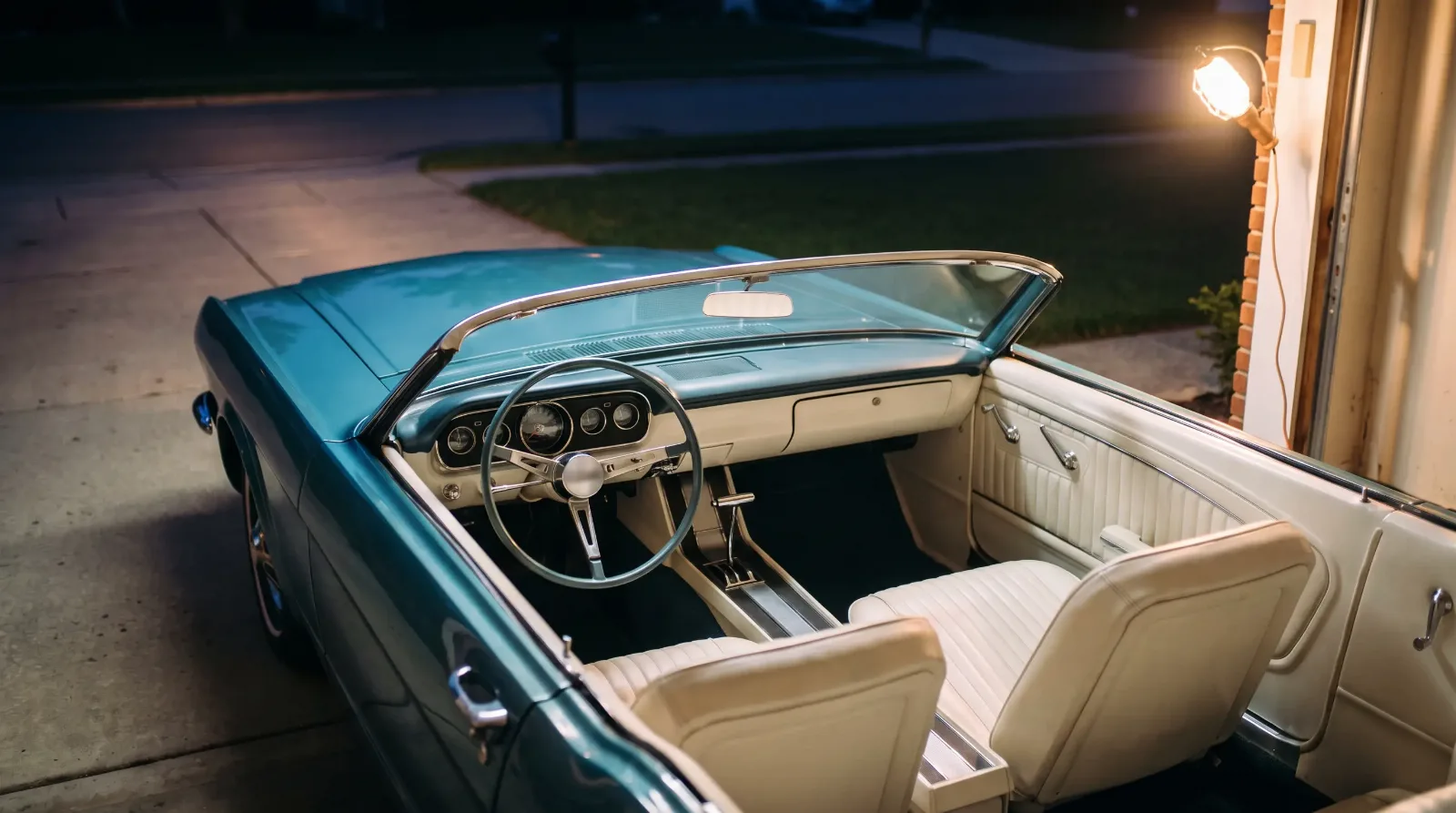
The 1963 Mustang II concept: a production body in show clothes
The second Mustang show car debuted at Watkins Glen in October 1963, the weekend of the United States Grand Prix. Sources split on whether it was the 5th or the 6th. It started life as a pre-production Mustang body. Dearborn Steel Tubing did the fabrication, John Najjar did the restyle, and the project carried the internal designation X 8902-SB-208. Before it was the Mustang II, it was called Cougar.
The work was the kind any custom shop would recognize. The bumpers came off. The headlamps and grille were reworked. The roof was made removable, and the car was finished in white with blue stripes. The proportions moved too: 108 in wheelbase, 186.6 in overall, 48.4 in tall, about 5 in longer and 3 in lower than the production car. That last number is the one a builder notices. Three inches lower on the same basic body changes the whole stance.
What stayed matters as much as what changed. The side sculpting stayed, and so did the tri-bar taillights. Ford was not hiding the real car here. It was previewing it, six months before the New York World's Fair launch, dressed up enough to look exotic and close enough to production that nobody would be disappointed in April. Power came from a 289 HiPo V8 rated at 271 hp. The car has belonged to the Detroit Historical Society since 1975, and it came out in public again at the 2024 Carlisle Ford Nationals.
Allegro and the Shorty: two directions off the same idea
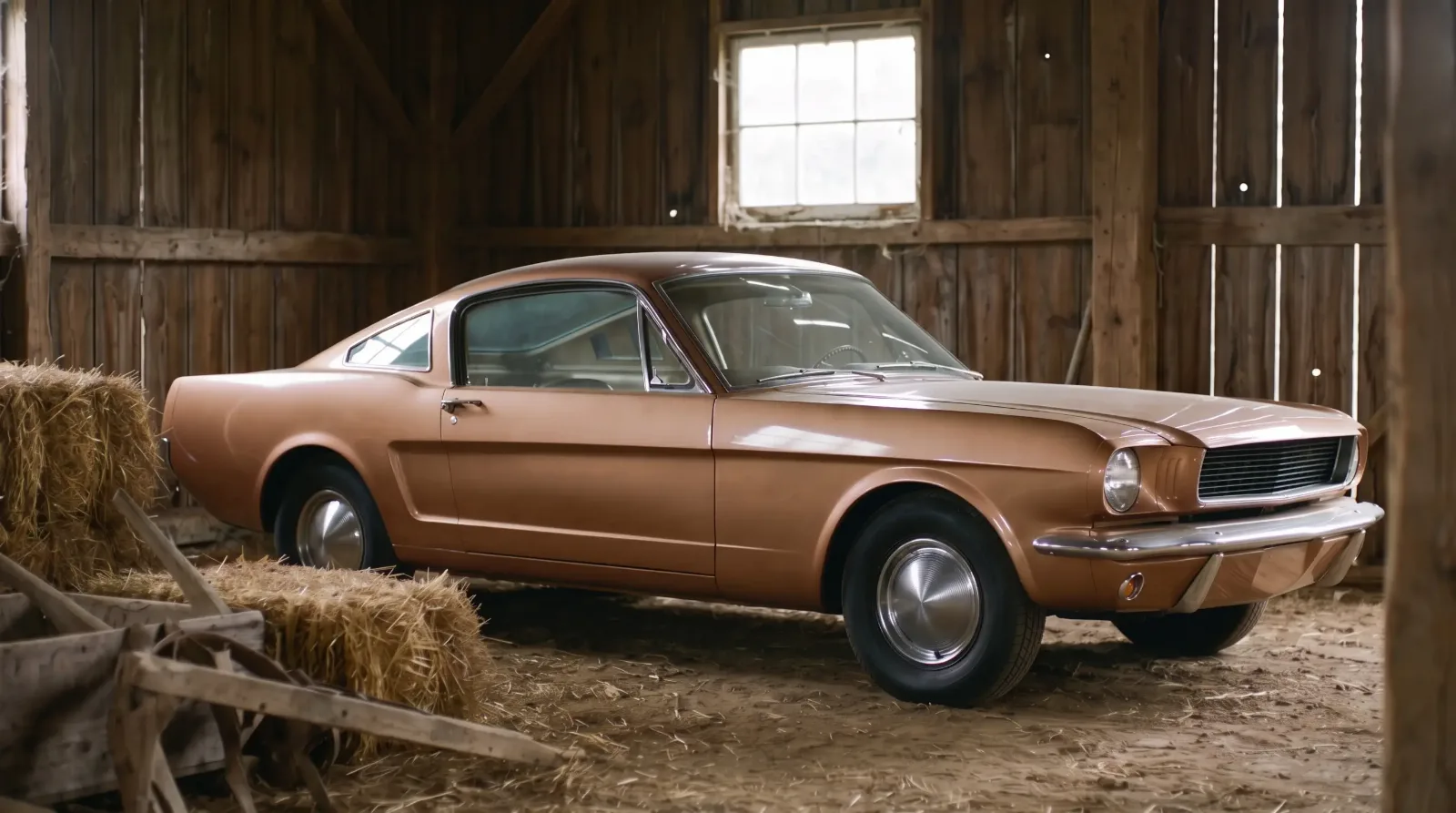
The Allegro went the other way from the Mustang II concept. It began in 1962 as the Avventura 2+2, drawn by Don Richard DeLaRossa, and was reworked into a two-seater. It sat on Falcon underpinnings with a 100 in wheelbase, about 169 in of length and a 49 in height, and it had no running engine. It was shown to the press in Dearborn on August 27, 1963, in Candy Apple Red, and appeared at the New York World's Fair in April 1964. In 1967 Bordinat's styling staff reworked it again as the Allegro II, a topless two-seat roadster in metallic gold. A pushmobile, in other words, and a pretty one, but you learn more about the era's thinking from it than about building cars.
The Shorty is the opposite: a running car and a serious piece of work. Officially the Mustang III, it was designed by Vince Gardner and built by Dearborn Steel Tubing with Ford Marketing's approval. They took the 10th prototype chassis, cut 16 in out of the wheelbase, and laid a fiberglass body over everything from the firewall back. On a unitized car that is not a weekend job. Taking 16 in out of a 108 in wheelbase leaves 92 in, and every panel behind the doors has to be redrawn to make the shorter car read as finished instead of chopped. Under the hood was an F-code 260 V8 bored out to 302 cu in.
The Shorty toured with the Ford Custom Car Caravan and appeared in Motor Trend in June 1964. It was built in 1964 and titled as a 1965, VIN 5S08F100009. When Ford was done with it, the car was headed for the crusher, and Gardner took it on May 2, 1965, to save it. It surfaced at Amelia Island in 2013 and crossed the block at RM's Fort Lauderdale sale in 2015 for $511,500.
"Anybody can pull bumpers and paint stripes on a show car. Cutting 16 inches out of the middle of a unibody and making it look like it left the factory that way, that is the hardest kind of work there is. Gardner's car is the one in this group I would want to stand next to with the hood up."
Jim Vasquez
Mach 1 and Mach 2: racing ideas on show stands
The mid-decade concepts are the murkiest in the group, and the paperwork is thin. The Mach 1 was a two-seat fastback with a chopped roof, prepared by Ford designers in late 1966 to preview styling ideas for the 1969 model year, and it made the auto show rounds from late 1966 into 1967, the Detroit show included. Flip-open racing fuel caps sat in the rear pillars, oversized scoops in the flanks, and the sloping tail opened as a hatchback. Ford's own sketch called for a 427 V8 with four carburetors; I have not seen anything that proves one was ever fitted. For the 1968 show season the designers gave it a new front end that borrowed from the 1963 Mustang II concept. Some accounts count two separate Mach 1 cars, the first dated 1965, and others describe one car with two noses. The sources are weak on both sides, so treat that part as provisional until someone finds the Ford release.
The Mach 2 is better documented and more radical. Kar Kraft built it with a 289 V8 mounted behind the seats on a floorpan derived from the Mustang's, on a 107.3 in wheelbase. The most detailed account counts three, two red street cars and one white race car; other histories mention two complete cars. Jerry Morrison was the primary designer, Bud Magaldi did the exterior and Bob Huzzard was the design engineer. It was shown in 1967, at the Chicago Auto Show in March by one account and at the Detroit show by another. Its fate is the sad part. The race car was crushed, and the two red cars were lost after Kar Kraft closed in late 1970. Nobody I trust can tell you where any of them are now, and the same goes for the Mach 1 cars.
Moving the engine behind the driver is a different car, not a modified Mustang. The Mach 2 was Ford asking out loud whether the pony car could go the way of its racing program. The answer, for the production line, was no.
The 1970 Milano and the shape of the 1971 car
The Milano debuted at the Chicago Auto Show in February 1970, and it is the one that most clearly told you what was coming. It was painted Ultra-Violet, a deep purple, and stood 43 in high, 7 in lower than a stock car. The headlamps were hidden, the fastback roof ran almost flat to the tail, and it seated two. I have not found a source that names the designer, which is a shame, because the proportions are confident work.
The long nose and that flat rear deck previewed the 1971 fastback. The Milano's influence also reached Australia, where it showed up in the 1974 Falcon XB coupe. And it closed a chapter: there was no new Mustang concept after it until the RSX in 1980. Its current whereabouts, like the Mach cars', are not documented in anything I have seen.
What the Mustang concept cars got right
Line them up and a pattern shows. The cars that were straight sales tools, the Mustang II concept and the Milano, previewed the production shape honestly and set the public up for what Ford was about to sell. The cars that went further from production, the Allegro, the Mach 2, were exercises in where the company might go and mostly did not. The Shorty sits in its own spot: a marketing car built with real metalwork, and the one whose paper trail, VIN included, runs all the way to an auction catalogue.
| Concept | Shown | Builder or designer | Power | Where it went |
|---|---|---|---|---|
| Mustang II concept | Oct 1963, Watkins Glen | Dearborn Steel Tubing | 289 HiPo V8, 271 hp | Detroit Historical Society since 1975 |
| Allegro | Aug 27, 1963, Dearborn press preview | Don Richard DeLaRossa (design) | No running engine | Reworked as the 1967 Allegro II |
| Mustang III "Shorty" | 1964, Ford Custom Car Caravan | Dearborn Steel Tubing (Vince Gardner design) | 260 V8 bored to 302 cu in | Saved by Gardner in 1965; sold in 2015 |
| Mach 1 | Late 1966 to 1967 shows; new nose for 1968 | Ford Advanced Design | 427 V8 planned in sketches; fitment not documented | Not documented |
| Mach 2 | 1967, Chicago or Detroit (sources differ) | Kar Kraft | 289 V8, mid-mounted | Race car crushed; street cars lost after 1970 |
| Milano | Feb 1970, Chicago Auto Show | Designer not documented | Not documented | Not documented |
My take, for what it is worth: the concepts that went furthest from the showroom are the ones builders still talk about, and the ones that stayed closest did the job Ford paid for. Both kinds earned their keep. Placed beside the production cars, they show how the company kept testing ideas in public, and that habit is a big part of how the first-generation car got its look.
Sources and notes
- The Henry Ford: The 1963 Mustang II, a not-so-missing link
- RM Sotheby's: 1964½ Ford Mustang III Shorty factory prototype
- ClassicCars.com Journal: 1966 Ford Mustang Mach 1 concept cars
- Dean's Garage: Ford's Mustang Mach 2
- Mac's Motor City Garage: Mid-engine Mustang, the 1967 Ford Mach 2
- Car Design News: Ford Mustang Milano (1970)
Related Reading
#Ford Mustang
#mustang design
#concept cars
#Mustang II concept
#Mustang Shorty
#Mach 2
#Milano
#Dearborn Steel Tubing

About the author
Jim Vasquez
Southern California hot rod and custom car builder with roots in the traditional kustom kulture scene.
Related Listings - Ford Mustang
More in Car Features

Comments
Be the first to comment on this article.