
Ask what the Mustang I concept 1962 car shares with the Mustang that reached showrooms on April 17, 1964, and the honest answer is short: the name, and the reaction it drew. Almost nothing mechanical carried over. The concept was a mid-engine, aluminum-bodied two-seater that weighed 1,544 lb. The production car was a four-seat Falcon derivative. The little roadster still matters, because it is the first time Ford put the word Mustang on a car and let the public look at it. If you want the whole arc of the model, start at the beginning. This piece stays with one car and with what the records actually say about it.
Car Features
8 min read
The 1962 Mustang I Concept: The Two-Seater That Started It
A mid-engine aluminum two-seater with a German V4: what the records say about the 1962 Mustang I concept, and why it never reached a showroom.
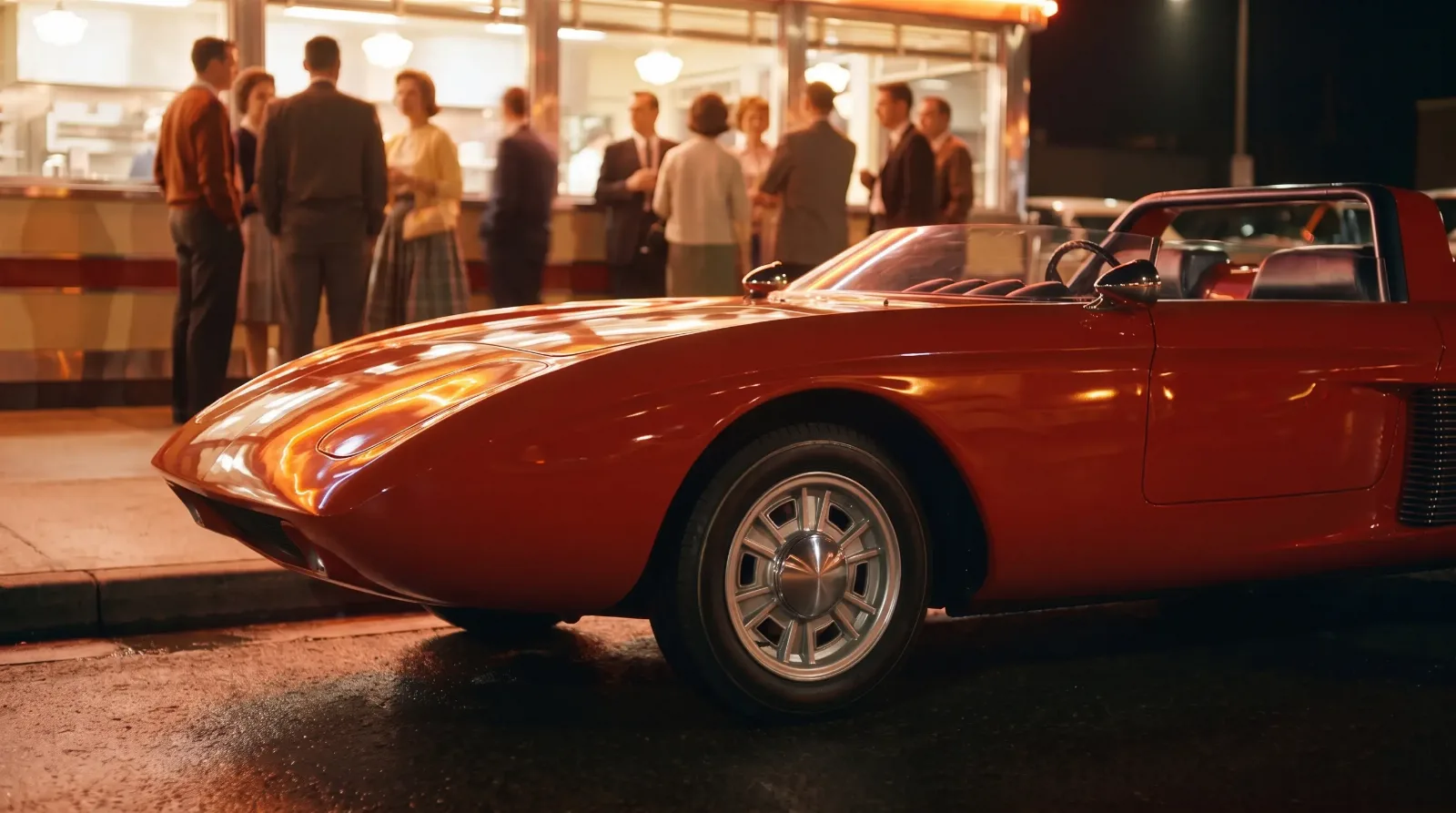
What Ford actually built in 1962
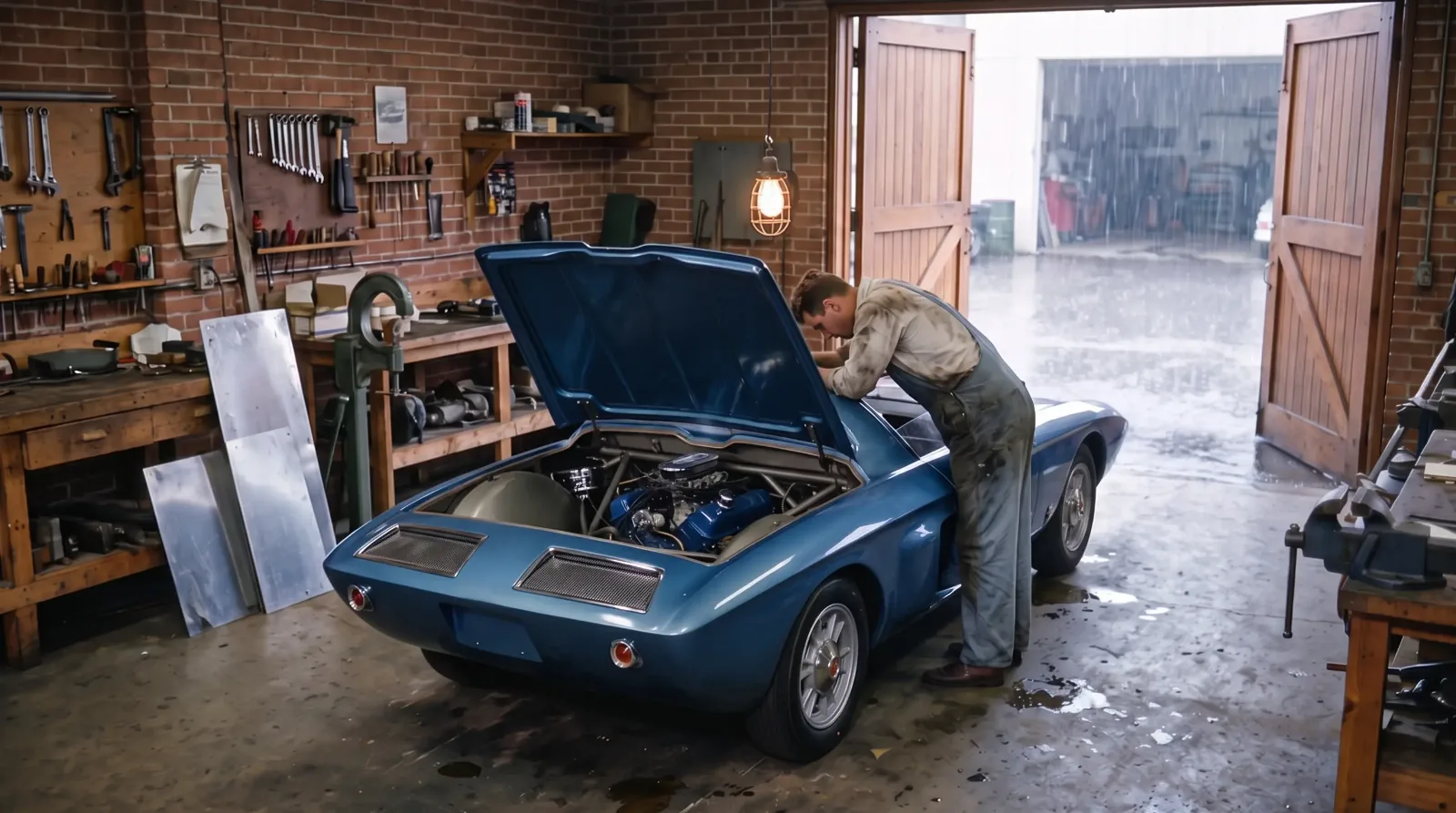
The project ran through Gene Bordinat's design office. Roy Lunn was the product planner and lead engineer; he had come to Ford from Aston Martin and would later work on the GT40. Herb Misch was project engineer. John Najjar, an executive stylist, proposed the name, and his inspiration was the P-51 Mustang fighter of the Second World War. Philip T. Clark worked on the design. Those are the names the documentation supports. Magazine retellings add others, and some credits drift between this car and the production program.
The construction is what separates the Mustang I from a styling buck. The body is stressed aluminum over a tubular steel space frame, built by Troutman and Barnes in Culver City, California, who received the body molds in early June 1962. Underneath were four-wheel independent suspension, front disc brakes and rack-and-pinion steering, hardware closer to a European sports racer than to anything on a Ford dealer's floor that year. Behind the two seats sat a German Ford 60-degree V4 of 91 cu in (1.5 liters), driving through a four-speed transaxle.
That engine has a history of its own. It came out of the Cardinal small-car project, the American name for the program that became the Taunus 12M in Germany. Ford halted Cardinal in the United States with about $35 million already spent and written off. In a sense the Mustang I put a piece of that canceled program to work in a car meant only to make people talk.
The build took about 100 days and was finished in August 1962. Ford made two cars: one running car and one non-running fiberglass mock-up for display. Most short histories mention only one, so keep the second in mind when a period photograph does not quite match the car in the museum today.
Mustang I concept 1962 specifications
The museum record and the main secondary sources agree on most of the core numbers. Where they differ, it is by a whisker: the rated engine speed appears as 6,400 rpm in one and 6,500 rpm in another, and the height varies by two tenths of an inch.
| Item | Mustang I (1962) |
|---|---|
| Layout | Mid-engine, two seats |
| Engine | German Ford 60-degree V4, 91 cu in (1.5 L) |
| Output (road tune) | 89 hp, single carburetor |
| Output (track tune) | 109 hp, two Weber two-barrels |
| Peak power rpm | 6,400 to 6,500 (sources differ) |
| Compression | 11:1 |
| Transmission | Four-speed transaxle |
| Structure | Stressed aluminum body, tubular steel space frame |
| Chassis | Four-wheel independent suspension, front discs, rack-and-pinion |
| Wheelbase | 90 in |
| Length / width | 154 in / 61 to 62 in |
| Height | 39.4 in over the roll bar (some sources 39.2 in) |
| Weight | 1,544 lb |
| Body builder | Troutman and Barnes, Culver City, California |
| Build | About 100 days, completed August 1962; one running car, one fiberglass mock-up |
The two outputs reflect two states of tune on the same 11:1 engine. The road version used a single carburetor and made 89 hp; the track version wore two Weber two-barrels and made 109 hp. Performance figures are thinner on the ground, and they do not agree. One secondary account credits the track-tuned car with a 0-60 time under 10 seconds and a top speed over 100 mph; another gives 11.1 seconds for the 89 hp road car. Accounts of Gurney's run at Watkins Glen put him anywhere from just over 100 mph to about 120 mph, and 118 mph is the figure most often repeated. The museum record lists no performance figures at all. I would not hang anything on those numbers until someone produces a timed record.
Watkins Glen and the public test
The car made its public debut on October 7, 1962, at the United States Grand Prix at Watkins Glen, New York. Dan Gurney drove it around the circuit, and it was demonstrated again that month at the Pacific Grand Prix at Laguna Seca. People ask how many laps Gurney turned. I don't know, and I have not found a document that says.
The choice of venue tells you more than a lap count would. Ford took a small, quick, European-style two-seater to a road-racing crowd, the most sports-car-minded audience it could find in America, and let the name sit on the car in front of them. Read that way, the Watkins Glen weekend looks less like a product preview and more like a public test of a word. It is one of the early chapters in the Mustang phenomenon, written a year and a half before any customer could buy one.
The timing is the part that gets lost. Bordinat had set Ford's styling studios against each other that summer, and the full-size clays were reviewed on August 16, 1962. The design that won came from Joe Oros's Ford studio, from Gale Halderman's sketch, and it was chosen in late summer. Henry Ford II approved the program in September 1962. So by the time Gurney took the Mustang I out at Watkins Glen, the shape of the production car was already settled, and it looked nothing like this one.
Why the two-seater never reached a showroom
The Fairlane Committee's brief for the production car was specific: four seats, a usable trunk, a weight under 2,500 lb, a base price under $2,500, and a launch at the New York World's Fair in April 1964. The Mustang I beat the weight target with room to spare. It missed every other line. It had two seats, and nothing about a mid-engine aluminum car on a space frame suggests a sticker under $2,500.
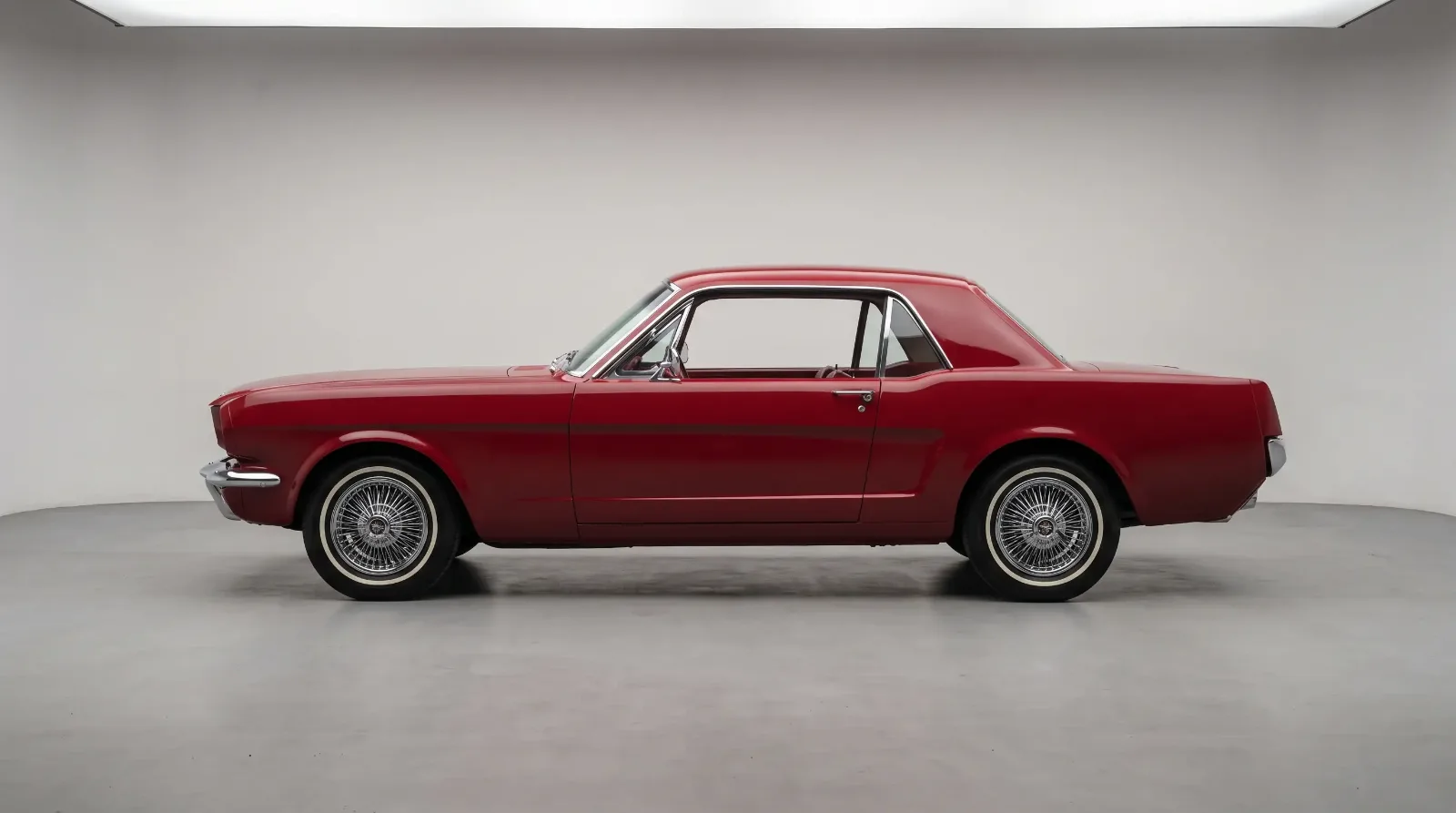
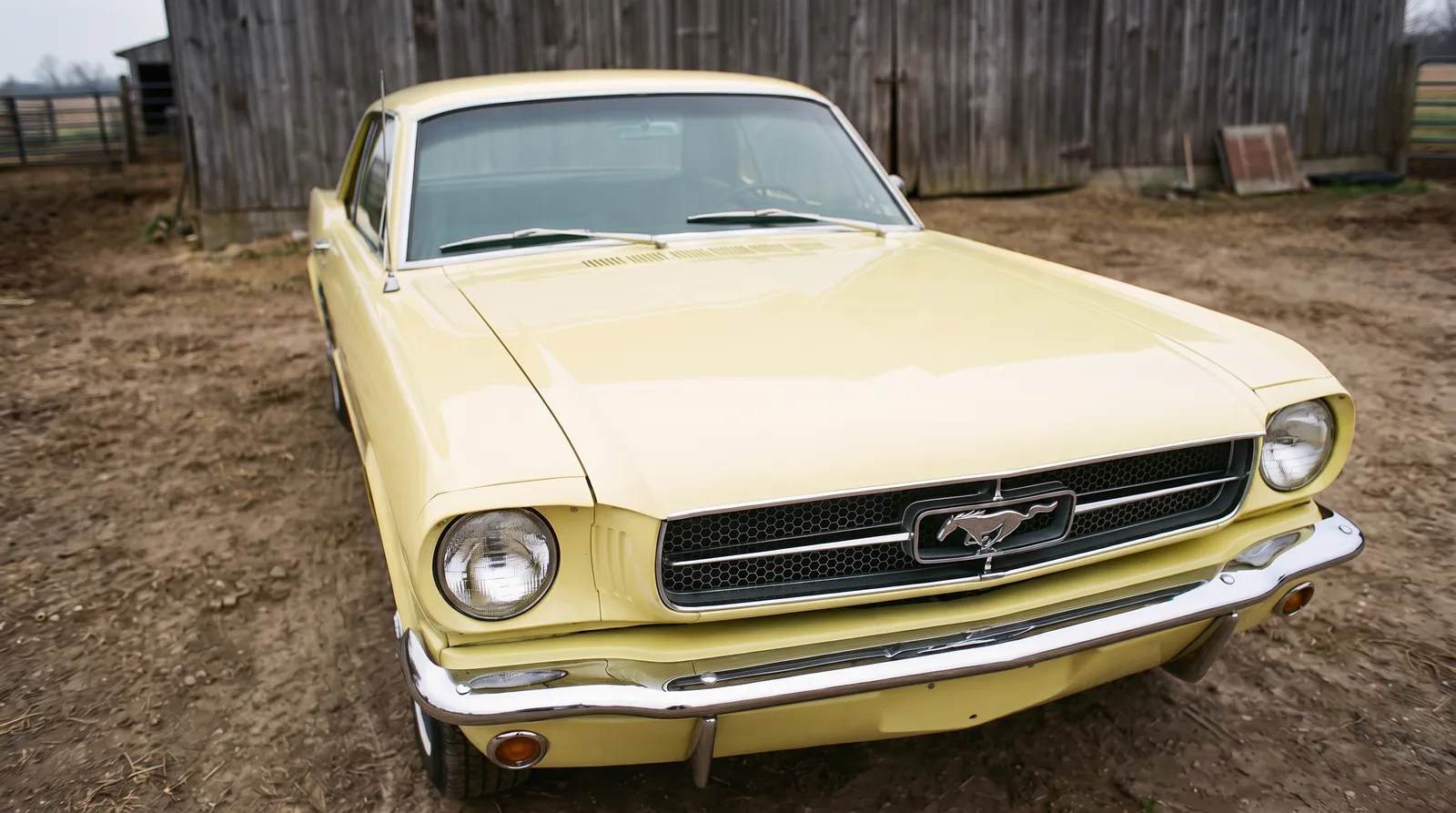
There is an irony in the committee's own research. Among the findings was a stack of letters asking Ford to bring back the two-seat Thunderbird. The committee read the same market and still chose four seats, and the sales numbers proved it right. The production car used Falcon and Fairlane chassis, suspension and drivetrain parts on the unitized 1964 Falcon platform, which spared Ford an estimated $400 million in clean-sheet development. Its wheelbase was 108 in, 18 in longer than the concept's. It went on sale at $2,368 for the hardtop.
You will read that the production planners disliked the concept, sometimes with a quotation attached. I have not seen a primary document that settles how anyone felt about it, and I would treat those lines with care. The brief settles the outcome on its own terms. A two-seat mid-engine car could not meet it.
"People call the Mustang I the first Mustang. On the name, fair enough. On the hardware, it belongs to a different family. The 1964½ car descends from the Falcon, not from this aluminum roadster. The Mustang I tested an idea in public; the production car was decided in a review room in August 1962."
Tom Ramirez
Ford kept using show cars to warm up the name. In October 1963 a second Mustang concept appeared at Watkins Glen, this time built on a pre-production body with the real car's side sculpting and taillights, and that is where the concepts that followed pick up the thread. The second car is the one that actually previewed the shape customers bought.
Where the Mustang I lives now
Ford gave the car to The Henry Ford in 1974. It is catalogued as object 74.57.1, a gift of Ford Motor Company, and it is displayed in the Driving America exhibit at the Henry Ford Museum. That means the primary record is still attached to the object: anyone who wants to check a dimension or a credit can start from the museum's own file rather than from a magazine summary.
Stand in front of it and the scale is the first surprise. At 154 in long and under 40 in tall at the roll bar, it is a small car, closer in feel to a period sports racer than to anything Ford sold. The second surprise is how little of it you can trace forward into the 1964½ car. The name went forward. So did the idea that a Mustang should feel quick and a little bit special. The engineering stayed behind. For how the shape customers actually bought was drawn, the wider story of Mustang design and styling picks up where this car leaves off.
Sources and notes
Related Reading
#Ford Mustang
#mustang design
#concept cars
#The Henry Ford
#Mustang I
#1962
#Watkins Glen
#Roy Lunn

About the author
Tom Ramirez
Corvette researcher and historian based in Bowling Green, Kentucky. Two decades documenting Corvette production history from original factory records.
Related Listings - Ford Mustang


Comments
Be the first to comment on this article.