
For a stretch of the 1950s and 1960s, the convertible sat at the top of the American luxury range. A drop-top Cadillac, Lincoln, or Imperial was the car you bought when you wanted everyone to see who was driving. Then, over about a decade, the open luxury car quietly vanished. By 1976 the last full-size American convertible had left the line, and the body style that once defined boulevard glamour was gone from domestic showrooms entirely. The decline was slow, and the reasons were more tangled than the popular story allows.
Car Features
6 min read
The Slow Fade of the Land Yacht Convertible
How the American luxury convertible faded by 1976, from air conditioning and vinyl roofs to the rollover rule that never came.
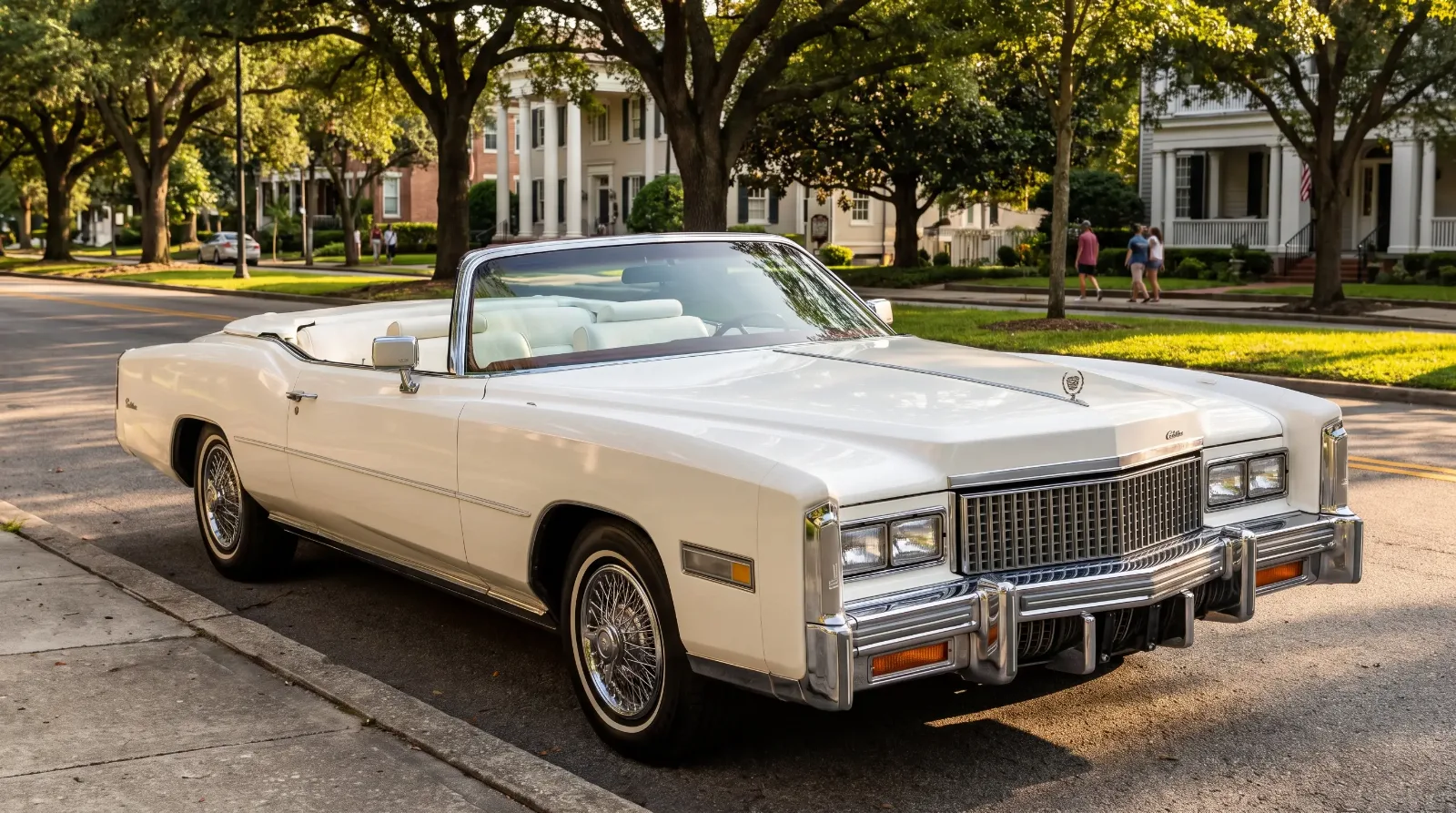
The convertible did not die because buyers suddenly hated open air. It faded because a stack of separate pressures, technical, regulatory, and cultural, all pushed the same direction at once. Understanding why is part of understanding the era of the land yacht, because the closed, insulated, vinyl-roofed coupe that replaced the convertible was in many ways the opposite idea of luxury.
The convertible at its peak
In the early 1960s the luxury convertible was a serious volume product, not a novelty. Cadillac sold the Series 62 and later Eldorado convertibles in real numbers. Lincoln's four-door Continental convertible, with its rear-hinged back doors, became one of the defining American cars of the decade and appeared in the presidential fleet. Chrysler and Imperial offered open cars near the top of their ranges. The convertible carried a price premium and a prestige premium, and buyers paid both.
What made these cars work as luxury objects was also what made them difficult. A convertible needs extra structure to make up for the missing roof, which adds weight and cost. The folding top mechanism, power-operated on any luxury car, was complex and prone to leaks and failures. On a land yacht already stretching past eighteen feet, the engineering compromises stacked up. As long as the prestige justified them, the compromises were accepted. When the prestige began to shift elsewhere, the math changed.
Why the open car fell out of favor
Three forces did most of the damage. The first was air conditioning. As factory air went from a rare option to a near-standard fitting on luxury cars through the 1960s, the core appeal of the convertible weakened. A buyer could now have a cool, quiet, sealed cabin in August without lowering anything. The closed car had solved the problem the convertible used to solve, and it did so without wind noise, without a leaking top, and without the sun.
The second was the vinyl roof and the personal luxury coupe. Detroit had found a new way to sell exclusivity, the formal closed roofline dressed in textured vinyl, opera windows, and a padded top that suggested a convertible without being one. This look came to dominate luxury styling in the early 1970s, and it pulled buyers and marketing dollars away from the genuine open car.
The third was fear of federal safety regulation. Through the early 1970s the industry widely expected the government to impose rollover crash standards that a convertible could not easily meet. That specific rollover standard was never actually enacted, but manufacturers planned as if it would be, and several used the looming rule as the stated reason to drop convertibles from their lineups. The threat did the work whether or not the rule ever arrived.
There was a quieter fourth factor too, which was simple economics. Convertible volumes had been sliding for years, and a low-selling body style that needs unique structure, its own tooling, and a complex power top is expensive to keep in production. Once the prestige argument weakened, the accountants had an easy case. A body style that costs more to build and sells less every year does not survive a boardroom for long, and the convertible had both problems at once.
The order in which they disappeared
The luxury convertible did not vanish all at once. Each maker dropped its open car on its own timeline as the case for building it collapsed. The rough sequence looks like this, and it shows how quickly a whole body style can leave the market once the momentum turns against it.
| Marque | Last full-size convertible (era) | Notes |
|---|---|---|
| Lincoln Continental | 1967 | The four-door convertible with rear-hinged doors ended here, after the 1967 model year |
| Chrysler / Imperial | Early 1970s | Chrysler's full-size convertible ended around 1971 |
| Buick / Oldsmobile / Pontiac | 1975 | GM's B and C-body convertibles wound down mid-decade |
| Cadillac Eldorado | 1976 | Marketed as the last American convertible |
The exact final years vary by source and by how strictly you define "full-size luxury," so treat the table as the shape of the decline rather than a precise registry. The pattern is what matters. Within a few model years the luxury convertible went from a normal part of every range to a thing nobody offered.
"The convertible didn't lose an argument. It lost its purpose. Once a sealed cabin could be cool and silent on the worst day of summer, the open car became a sacrifice dressed as a treat, and the vinyl-roofed coupe offered the same status with none of the leaks."
Sarah Whitfield
What the decline means for collectors now
The scarcity created by that abrupt exit is exactly what makes these cars interesting today. A luxury convertible from the final years, particularly a 1976 Eldorado, has a built-in "last of its kind" story that the closed cars cannot claim. The Bicentennial white examples in particular have traded on that narrative for decades. Values reward documented, original open cars, and they punish tops that have been poorly replaced or bodies that have flexed and cracked from the missing roof structure.
If you are drawn to one, buy on condition and provenance rather than the legend. The top mechanism, the frame, and the floors are where these cars hide their expenses. The romance of the last American convertible is real, but so is the cost of restoring one that has been sitting with a leaking top for thirty years. The way these cars actually felt to drive, roof up or down, is its own subject, covered in next: How Land Yachts Actually Drove.
Related Reading
Have a
Classic Car
for Sale?
Reach thousands of serious classic car collectors across the US.
Sell It Here →
Are You a Classic Car Dealer?
List your full inventory and connect with targeted classic car buyers.
Join as a Dealer →

About the author
Sarah Whitfield
Third-generation classic car collector specializing in pre-war American and European coachbuilt automobiles. Researcher and concours enthusiast.
Comments
Be the first to comment on this article.