
Park a Highland Green fastback at any car show and give it twenty minutes. Somebody will walk up, look at the color, look at the wheels, and ask the question that has followed this car since 1968: did Steve McQueen drive in Bullitt, or was it all stuntmen? I have heard it argued across folding chairs and over open hoods more times than I can count, and the two camps almost never budge. One side says McQueen did every foot of that chase himself. The other says he barely touched the wheel.
Car Features
8 min read
Did Steve McQueen Really Drive the Bullitt Chase?
McQueen drove the close-ups. Loftin, Ekins and Janes took the dangerous runs, and Hickman drove the Charger. Here is who did what in 1968.
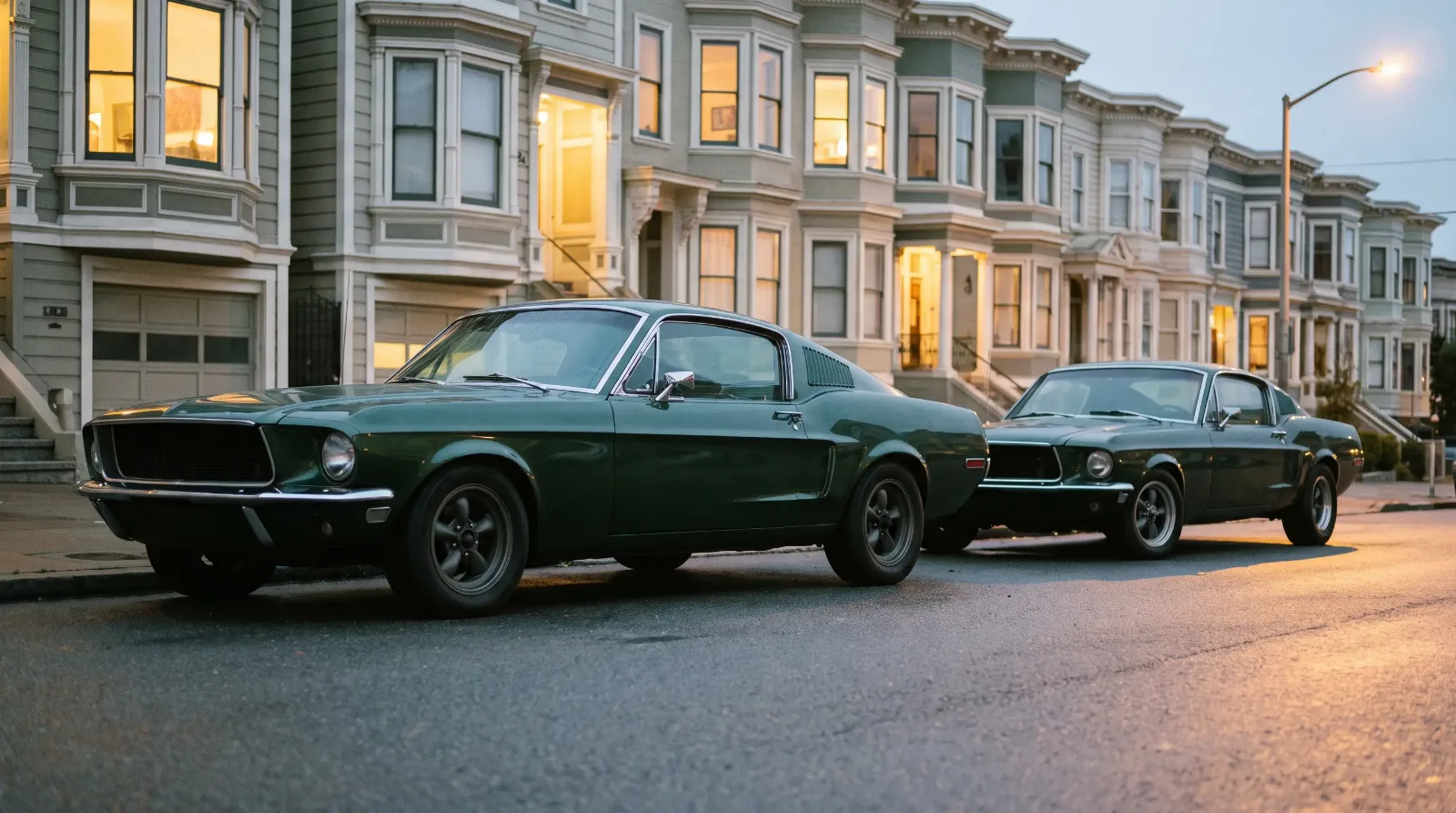
Both camps are wrong, and the real answer is better than either version. It belongs with the myths that follow these cars, because the story most people tell is a cleaned-up copy of what the production accounts actually say. The car is real, the chase is real, and McQueen really was behind the wheel. Just not for all of it.
The short answer: some of it, not all of it
According to the accounts of the production, McQueen drove the Mustang for the close-up shots. Those are the moments where the camera can see his face through the windshield or over his shoulder, where the audience needs to believe the star is the one fighting the car. The faster and more dangerous driving went to professionals. Carey Loftin, the film's stunt coordinator, was one of them. Bud Ekins and Loren Janes were the others. On the other side of the chase, the Dodge Charger was driven by Bill Hickman.
That split was the normal way to make a studio picture in 1968. A production has every reason to keep its lead actor out of the riskiest shots, and Bullitt followed the usual pattern. What makes this film different is that McQueen was in the car often enough, and close enough to the action, that the line between his driving and his doubles' driving is hard to see on screen. That blur is exactly where the legend grew.
So the honest version is a shared credit. McQueen drove. Professionals drove. The finished chase is a mix of both, cut together so smoothly that most viewers never notice the handoffs.
Who drove what in the Bullitt chase
Here is the roster as the production accounts give it. I have kept each line to what the record supports and nothing more.
| Person | Role in the chase |
|---|---|
| Steve McQueen | Drove the Mustang for the close-up shots |
| Carey Loftin | Stunt coordinator; drove high-speed and dangerous sequences, including the Mustang when the Charger hits the gas station |
| Bud Ekins | Drove high-speed and dangerous sequences; performed the motorcycle crash in front of the skidding truck |
| Loren Janes | McQueen's regular stunt double; drove high-speed and dangerous sequences, by his own account including the Taylor Street hill jumps |
| Bill Hickman | Drove the Dodge Charger |
| Max Balchowsky | Modified the Mustangs' engines, brakes and suspension |
Loren Janes left the most detailed account of his own part. He put himself in the Mustang for the jumps down Taylor Street, and he said McQueen was behind the wheel for about 10% of what you see on screen: the close-ups, not the shots that could have killed him. The drivers' memories do not line up perfectly, though. Janes recalled that Ekins did some early driving only until he could get there, and that those scenes were cut. Ekins remembered driving the car down Chestnut Street. I would rather show you that disagreement than smooth it over. That is a habit worth keeping whenever a movie car is involved, because film lore fills gaps faster than any other kind.
Bill Hickman's name is worth a second look, too. Three years after Bullitt, on the set of Diamonds Are Forever, the stunt driver first hired for a ramp jump wrecked several cars. With one car left, the production brought in Hickman, and he did the jump in a single take. That tells you the level of driver who was sitting in the Charger, keeping pace with the Mustang through San Francisco.
Two Mustangs, two jobs
The production used two cars, and their jobs line up neatly with the driving question. Both were 1968 Mustang GT fastbacks in Highland Green, both with the S-code 390 four-barrel big block rated at 325 hp and a four-speed manual. Their VINs were 8R02S125558 and 8R02S125559, which is why people who follow this story refer to them simply as '558 and '559.
Before filming, Max Balchowsky reworked the engines, brakes and suspension on both. Then they were split by role. Car '558 was the stunt car, the one doing the hard work in the high-speed sequences. Car '559 was the close-up car, the Mustang McQueen drove on camera. If you want to know where McQueen sat, follow '559. If you want to know where the stunt drivers earned their pay, follow '558. Janes later insisted there were three Mustangs and three Chargers, with spares kept in case of damage, but the two VINs above are the cars the record documents.
The wheels that every show-field expert points at were American Racing Torq Thrusts, an aftermarket wheel and never a factory Mustang option. Among all the famous Mustangs that have worked in front of a camera, this pair stands out because the hero car and the stunt car had separate, documented jobs. Most movie cars do not leave a paper trail that clean.
Did Steve McQueen drive in Bullitt, or did the editing do it?
Here is the part that keeps the argument going. The chase runs close to ten minutes, with the pursuit itself lasting 9 minutes and 42 seconds, and it covers ground from the Mission District out to Brisbane, south of the city. The Charger side of the chase used two Dodge Chargers with the 440 Magnum, so the opposing car had a stunt spare too. The film was released on October 17, 1968.
Frank P. Keller won the Academy Award for editing Bullitt, and in my view his cutting is the main reason the driving question exists at all. A close shot of McQueen working the wheel, followed by a wide shot of a fastback at speed, reads to the eye as one continuous drive. The audience fills in the rest. That is good filmmaking, and it also means you cannot settle the question by watching the movie. You have to go to the production record.
There is a pattern here, and Bud Ekins sits right in the middle of it. Five years before Bullitt, Ekins was McQueen's double for the motorcycle fence jump in The Great Escape (1963). That stunt gets the same treatment as the Bullitt chase: people want it to be McQueen, and for one famous moment it was his friend instead. On Bullitt, Ekins was back, both behind the wheel of the Mustang for some of the dangerous driving and on the motorcycle that goes down in front of the skidding truck.
Why the half-answer is the better story
I understand why people want the clean version. "McQueen did it all" fits on a T-shirt. "McQueen did the close-ups while Loftin, Ekins and Janes handled the dangerous runs, and Hickman drove the Charger" does not. But the longer version is the one that respects everybody who made that ten minutes of film, and it takes nothing away from McQueen. He was in the car, at speed, on real San Francisco streets.
"McQueen's driving is in that chase, and so is the work of men whose faces you never see. I like the movie more for knowing that, not less. The best car stories usually have more people in them than the poster does."
Patrick Walsh
The two cars went their separate ways after filming, and their later lives follow the same split. Car '558, the stunt car, turned up in Mexico in 2016. Car '559, McQueen's close-up car, was bought by Robert Kiernan for $6,000 in 1974 and stayed with the Kiernan family until it crossed the block at Mecum in Kissimmee, Florida, on January 10, 2020. It hammered at $3.4 million, or $3.74 million with fees, the most paid for a Mustang at public auction as of that sale. The car that carried the star brought the headline money. Fitting, in a way.
The lesson carries well beyond one movie. Mustang history is full of stories that got shortened on their way into legend, and the fix is always the same: read the record before repeating the folklore. That goes for a movie car, and it goes for something as dry as the 1993 rating cut. So the next time someone at a show asks whether McQueen really drove that chase, you can give them the true answer. Yes, he did. And so did several other very good drivers.
Sources and notes
- Bullitt (film), Wikipedia: drivers, the two Mustangs, chase route and release
- Jalopnik: Loren Janes's account of the Bullitt chase
- Hagerty UK: the making of the Bullitt chase
- Bud Ekins, Wikipedia
- Motorcycle Hall of Fame: Bud Ekins biography
- ClickOrlando (AP): Bullitt Mustang sells for $3.74 million at Mecum Kissimmee
Related Reading
Have a
Ford Mustang
for Sale?
Reach thousands of serious classic car collectors across the US.
Sell It Here →
Selling a classic? Here's how: where to sell your classic car online
Are You a Classic Car Dealer?
List your full inventory and connect with targeted classic car buyers.
Join as a Dealer →
#Ford Mustang
#bullitt
#Steve McQueen
#1968 Mustang GT 390
#mustang myths
#mustang in film
#Bud Ekins

About the author
Patrick Walsh
Automotive journalist covering classic car shows, events, and the enthusiast community across North America.
Related Listings - Ford Mustang
Comments
Be the first to comment on this article.