
Between the 1992 and 1993 model years, 20 horsepower vanished from the Mustang 5.0 spec sheet. The GT and LX 5.0 went from 225 hp and 300 lb-ft to 205 hp and 275 lb-ft. Nothing on the car announced it. No new badge, no new engine code. The 1993 Mustang horsepower drop happened on paper first, and owners have been arguing about how much of it happened anywhere else ever since.
Car Features
8 min read
Why Ford Cut the Fox Body 5.0's Rating in 1993
The 1993 Mustang 5.0 went from 225 hp to 205 hp on paper. What the rerating changed, what it did not, and why owners still argue.
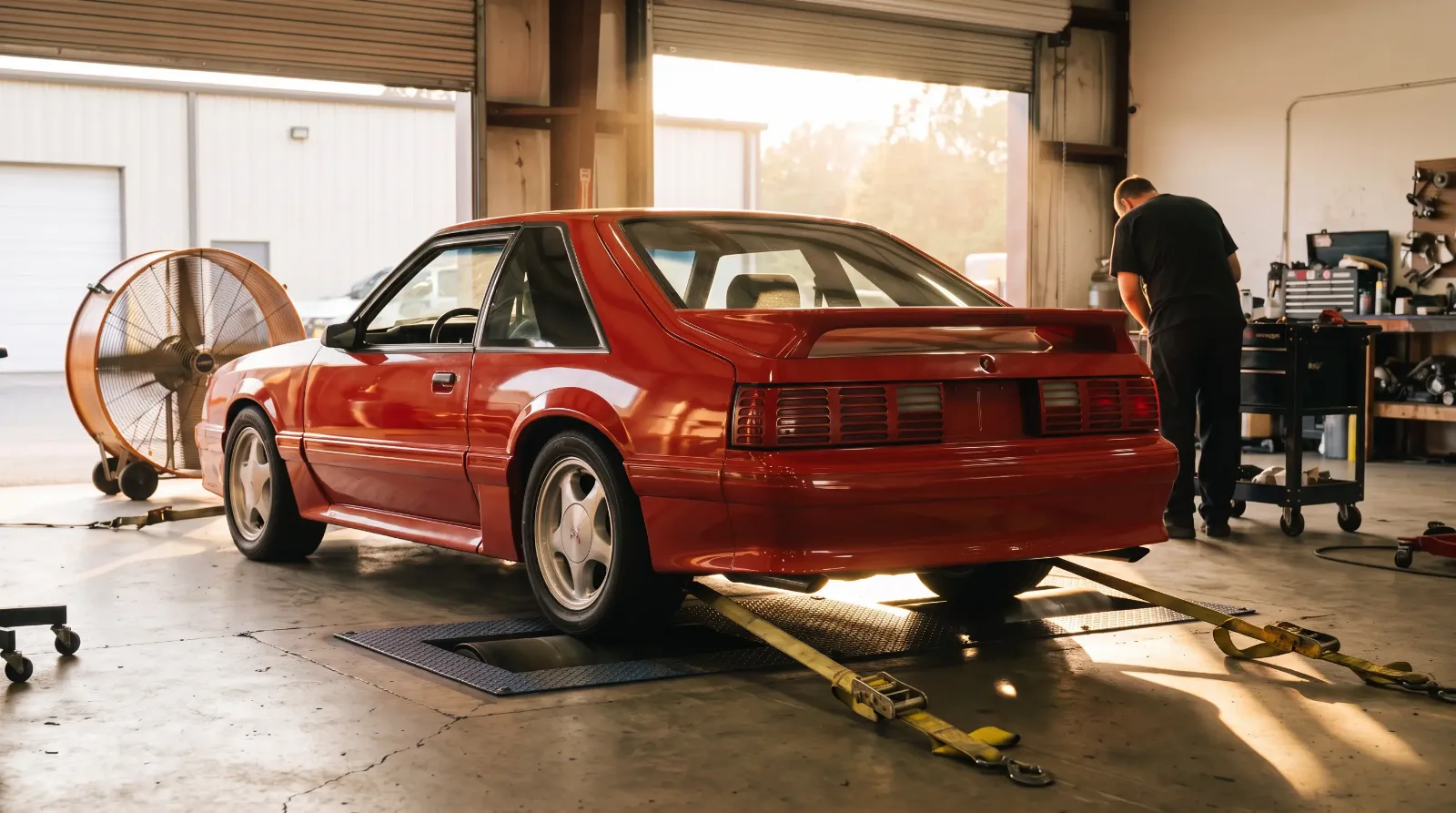
Most of that argument runs on feelings. This piece runs on the ratings, the one explanation on record, and what a dyno can and cannot settle. It is one of several Mustang numbers that get repeated without their context, and the full story covers the others.
What the 1993 Mustang horsepower drop actually was
The 5.0 HO held one rating for six straight model years. From 1987 through 1992 Ford listed it at 225 hp and 300 lb-ft, SAE net. For 1993 the same engine in the GT and the LX 5.0 was rerated to 205 hp and 275 lb-ft. That is 20 hp and 25 lb-ft off the window sticker, a little under 9 percent of the horsepower figure.
Ford did not sell the 1993 car as having a new engine, and the changes on record are small ones. That matters. A real 20 hp loss usually has one part you can point to. The 1993 change has a short list of minor ones and a statement about accuracy.
In context the number looks stranger still. Here is how the 302 was rated across the Fox years and into the next car.
| Model year | 5.0 setup | Rated hp (net) | Rated torque (net) |
|---|---|---|---|
| 1982 | 2-bbl carburetor | 157 | 235 to 240 lb-ft |
| 1983 | Holley 4-bbl | 175 | n/a |
| 1985 | 4-bbl, last carbureted 5.0 | 210 | n/a |
| 1986 | Sequential EFI | 200 | n/a |
| 1987 to 1988 | EFI, speed-density | 225 | 300 lb-ft |
| 1989 to 1992 | EFI, mass-air | 225 | 300 lb-ft |
| 1993 GT and LX 5.0 | EFI, mass-air, rerated | 205 | 275 lb-ft |
| 1993 SVT Cobra | GT-40 heads, Cobra intake | 235 | 280 to 285 lb-ft |
| 1994 to 1995 GT | 5.0 HO in the new body | 215 | 285 lb-ft |
Read down the horsepower column. On paper, the 1993 fuel-injected 5.0 sat below the 1985 carbureted engine. Nobody who drove both believed that. Which tells you the problem was never really the engine. It was the number.
The explanation on record
The account that gets cited says the new figure was simply more accurate. It gives three supporting points: the older ratings predated the mass-airflow system, the cam profile changed slightly, and hypereutectic cast pistons went into all 302s for 1993. That account comes from a single reference. I have not seen Ford's own statement from the time, so treat it as the best explanation available, not a proven one. Take the three points one at a time.
The rating predated mass air. This is the strongest of the three, and the table backs it up. The 225 hp figure arrived in 1987 on a speed-density car. Ford switched the 5.0 to mass-air metering for 1989 and kept printing 225 through 1992. If the rating was never retested on the mass-air engine, then the 1993 number is the first one taken on the engine as it was actually being built. That is not a cut. That is an audit. The record does not say how the original 225 was measured, so I am reading the logic here, not quoting a test.
Minor cam changes. Small cam revisions do move power, but "minor" is the word on record, and minor changes rarely account for 20 hp at the crank by themselves. That is a judgment from experience, not a published figure.
Hypereutectic pistons. From 1987 the 5.0 HO ran forged aluminum pistons with valve reliefs. The 1993 switch to hypereutectic cast pistons is real, and it is the change that matters most to anyone building one of these engines. But piston material on its own does very little to peak output on a stock motor at stock timing. Where it shows up is abuse: boost, nitrous, detonation. A hypereutectic piston wants more care when you push it.
Add it up and the most likely reading is that most of the 20 hp is measurement and a small slice may be hardware. I have not seen a controlled test that splits the two cleanly.
Why owners took the cut personally
Timing made it worse. The 1993 model year was the last of the Fox platform, and the 5.0 was the reason most buyers chose a Fox in the first place. The cheap V8 hero went into its final season with a smaller number than it had carried for six years. You can trace how the engine earned that reputation in our Fox Body guide.
Then Ford put a second number right next to it. The new SVT Cobra came out the same year with GT-40 heads, a Cobra upper intake, its own cam, larger injectors and a 65 mm throttle body, rated at 235 hp. That is 30 hp over the regular GT on the sticker. Ten of that 30 is just the old 225 rating coming back on a car with better heads. The rest is the parts. To a GT owner reading the brochure, though, it looked like Ford had taken power away from his car and handed it to a more expensive one.
The next car did not help the mood. The 1994 SN95 GT kept a 5.0 HO and was rated at 215 hp and 285 lb-ft. Higher than 1993, lower than 1992. Different body, rated on its own. People still lined the three numbers up and saw an engine getting weaker every year.
Paper horsepower versus the dyno
A horsepower rating is a document. It describes one engine, on one test setup, under one set of rules, at one point in time. It does not update itself, and a carryover engine is not necessarily retested every time the brochure is reprinted. That is how a 1987 number ended up describing a 1992 car with different metering.
A chassis dyno is a different instrument. It measures at the wheels, after the transmission, driveshaft and rear axle take their cut, and the result moves with the weather, the tire pressure and the operator. That is why a wheel number from one shop and a crank rating from Ford can never be compared directly. The only fair test is two cars on the same dyno, same day, same operator, same fuel. Owners have run that comparison on 1992 and 1993 cars plenty of times, but those results live in forum threads and shop logs, not in any controlled study I can cite, so I will not put a number on it here.
The same gap between the sticker and the rollers later ran the other way. Ford advertised the 1999 SVT Cobra at 320 hp, dyno tests showed roughly 285, and the company halted sales of unsold cars and recalled the ones already sold. That episode, told in the 1999 Cobra recall, is the mirror image of 1993. In 1999 the rating promised more than the engine made. In 1993 it may simply have stopped promising more than the engine made.
"Ford took 20 horsepower off the sticker and nobody has ever shown me where it came out of the engine. If your 1993 runs slower than your buddy's 1992, check the tune, the tires and the gear before you blame the brochure. The one change I do care about is the pistons, and that only matters once you start adding boost."
Dan Reeves
What the rerating means for a 1993 5.0 today
For an owner, the 205 hp figure is mostly trivia with one practical edge. Since the engine code is the same from 1987 through 1993, the model year and the parts inside are what separate a 1992 engine from a 1993 one. If the car still has its original short block and you are planning a blower or nitrous, find out what pistons are in it before you set the timing. That is the real difference between the years, and it is a durability question, not a horsepower one.
For the history, the 1993 cars matter because they were the end of the line. Ford built 114,228 Mustangs for the 1993 model year across every body style and trim, 4,993 SVT Cobras among them, before the Fox platform gave way to the SN95. The rerating is part of that last chapter, worth knowing if you are reading up on 1993 Mustangs. It changed what the sticker said. The evidence that it changed what the car did is thin, and nobody has produced better.
Sources and notes
- Ford Mustang (third generation), Wikipedia: 1987 forged pistons, 1993 rerating and the stated reasons
- Ford Mustang SVT Cobra, Wikipedia: 1993 Cobra and the 1999 recall
- MustangSpecs: 1993 Ford Mustang ratings and production
- MustangSpecs: 1987 Ford Mustang, the 225 hp 5.0 HO
- MustangSpecs: 1985 Ford Mustang, the last carbureted 5.0
- MustangSpecs: 1994 Ford Mustang GT 5.0 rating
Related Reading


Have a
Ford Mustang
for Sale?
Reach thousands of serious classic car collectors across the US.
Sell It Here →
Selling a classic? Here's how: sell my classic car
Are You a Classic Car Dealer?
List your full inventory and connect with targeted classic car buyers.
Join as a Dealer →

About the author
Dan Reeves
Performance engine builder from North Carolina's motorsports corridor, focused on swaps, forced induction and making real, repeatable power.
Related Listings - Ford Mustang






Comments
Be the first to comment on this article.