
Ask anybody who has rebuilt a Ford from the 1920s what wore them out, and the answer is rarely the engine. It is the wheels. Wood rots, spokes loosen, rims rust where nobody looks. The jump from the Model T's wooden artillery wheels to Model A wire wheels was one of the plainest signs that Ford had moved on, and it still decides how much work, and money, an old Ford needs before it rolls safely down a road in 2026.
Car Features
7 min read
From Wood Spokes to Wire Wheels: Early Ford Wheels
How Ford went from wooden artillery wheels on the Model T to steel-spoke wire wheels on the Model A, and what that means for owners today.
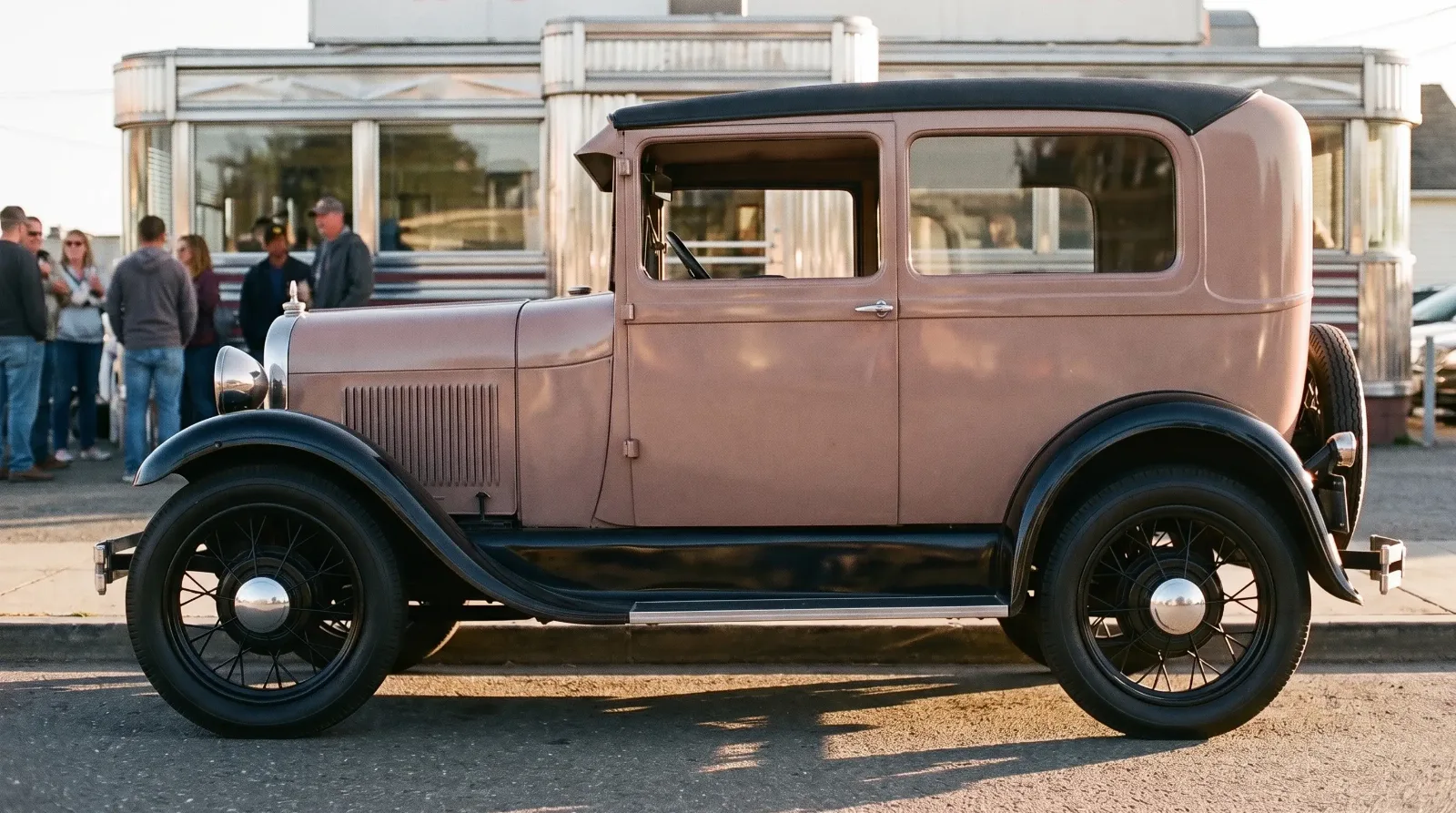
This is the wheel story only. The wider changeover from one car to the next is covered here, so we will stay down at hub level, where the grease and the trouble live.
Wooden artillery wheels on the Model T
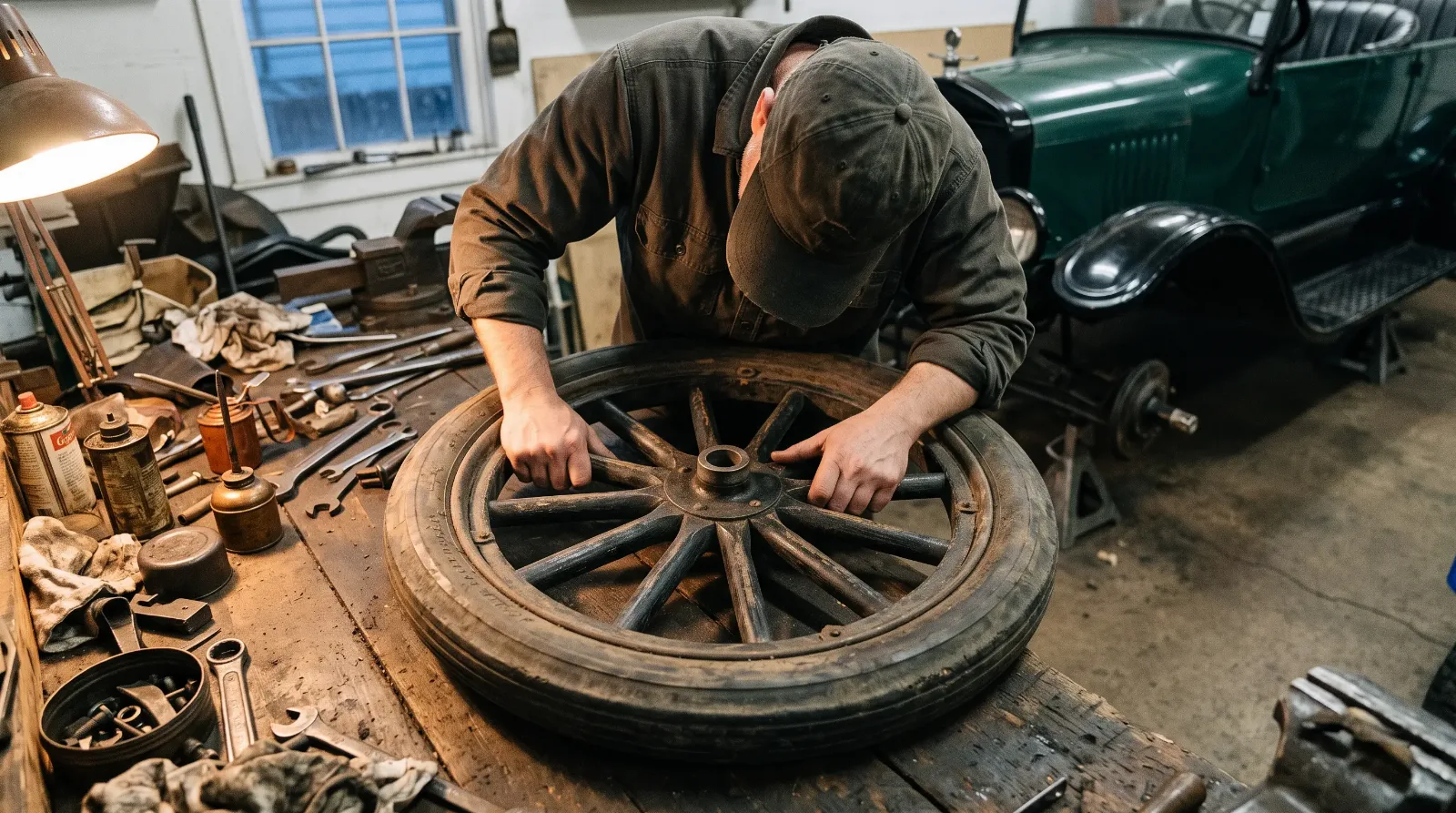
For most of its life the Model T rolled on wooden artillery wheels. That was the standard fitment, and it was a sound choice for its day. Wood was cheap, wheelwrights knew how to work it, and a wooden spoke flexes a little on a rutted farm lane instead of cracking. The spokes ran from a hub out to a felloe, and a steel rim carried the tire.
The tires were clinchers: 30 x 3 in front and 30 x 3.5 at the rear, run at around 60 psi. A clincher holds to the rim by its beaded edge. On the early cars the rim stayed on the wheel, so a flat meant prying the tire off right there on the road shoulder, patching the tube, and pumping it back up by hand. Owners of the time did a lot of that.
Wood has one real weakness. It moves with the weather. Spokes dry and shrink in a hot summer, swell in a wet one, and a wheel that sat in a damp barn for forty years will often have spokes that rattle in the hub or rot at the felloe. Any wooden Model T wheel on a car you plan to drive needs a careful look before you trust it.
Demountable rims and the 1919 change
The first big improvement came for the 1919 model year, when Ford offered an electric starter, first on the sedans, together with demountable rims. The starter brought a battery and a generator into the picture, a shift we cover from the electrical side in magneto to battery.
The demountable rim mattered more on the road shoulder. The wheel stayed bolted to the car; only the rim came off, with the tire still mounted on it. Carry a spare rim with an inflated tire, and a flat became a job of minutes instead of an afternoon. The wood stayed. Ford was not ready to give up the artillery wheel, only to stop making owners wrestle tires off it.
Balloon tires and steel spokes, 1925 to 1927
By the mid 1920s the competition had moved and Ford had to follow. Balloon tires arrived in 1925, sized 4.40 x 21 (reproductions are often sold today as 4.40/4.50 x 21). A balloon runs a bigger air volume at lower pressure, so it soaks up bumps the narrow clinchers passed straight into the frame. It also pointed toward a smaller wheel diameter, which is where Ford would go next.
For 1926 and 1927 Ford offered steel welded-spoke wheels on the Model T. They were an option, not the standard, and wood stayed on plenty of cars right up to the end of production. Ford also listed wire wheels in colors that dressed up the last Model Ts: Straw, Casino Red Orange and Emerald Green. The surviving references do not pin down exactly when each color was offered, so treat any claim of "correct for 1926" or "correct for 1927" with some care when you see one at a swap meet.
Those late steel-spoke Ts are the bridge. They told buyers what the next car would ride on before the next car existed.
"A wooden wheel will tell you it is dying if you listen. It creaks, it loosens, it goes soft at the felloe. A steel spoke just sits there until it rusts through behind the rim, and that one you have to go looking for."
Robert Halloran
Model A wire wheels, 1928 to 1931
When the Model A arrived, Ford made steel-spoke wire wheels standard, and gave every car five of them, the fifth carried as the spare. The 1928 and 1929 cars used a 21 inch wheel with 4.50 x 21 tires. The 1928 standard equipment list named the five steel-spoke wheels right alongside the starter, the gas gauge and the speedometer, so this was no longer an extra.
The welded steel wheel bolted to the hub, which made changing a whole wheel the normal way to fix a flat. Behind it sat something the Model T never had: four-wheel mechanical drum brakes, rod operated. The drums were 11 inches inside diameter, stamped steel on steel hubs from 1928 to 1930, and cast iron from 1931.
For 1930 Ford cut the wheel from 21 inches to 19 and widened the tire section from 4.50 to 4.75. The smaller wheel brought the whole car down, rode better, and suited the lower, longer 1930 restyle. That 19 inch wheel carried on through 1931.
| Car and years | Standard wheel | Tire size | Notes |
|---|---|---|---|
| Model T, early cars | Wooden artillery | 30 x 3 front, 30 x 3.5 rear clinchers | About 60 psi |
| Model T, 1919 on | Wooden artillery | Clinchers | Demountable rims arrive with the starter, sedans first |
| Model T, 1925 on | Wooden artillery | 4.40 x 21 balloon | Balloon tires introduced |
| Model T, 1926 to 1927 | Wood, or optional steel welded spoke | 4.40 x 21 balloon | Colored wire wheels listed |
| Model A, 1928 to 1929 | Five steel-spoke (wire) wheels | 4.50 x 21 | Spare included |
| Model A, 1930 to 1931 | Steel-spoke, 19 in | 4.75 x 19 | Lower car, better ride |
One thing to keep straight: Ford's first car of 1903 was also called the Model A, and it has nothing to do with these wheels. If you need the difference between the two, read this piece.
Buying and restoring early Ford wheels today
The parts picture is good for both cars, which is one reason these Fords stay affordable to keep running. Reproduction tires in the period sizes are made, and the Model A club judging guidelines ask for steel-spoke wheels and correct tires on a car presented as original. A 21 inch Model A wheel on a 1931 car, or a 19 inch wheel on a 1928, is the kind of mismatch judges notice and buyers should too.
On a Model T with wood wheels, the money goes into spokes. Loose spokes can sometimes be tightened, but rotten ones have to be replaced, and that is a specialist job. On a Model A, the questions are rust and straightness: rust inside the rim and at the spoke welds, and a wheel that has been bent and tweaked back. Neither problem is rare. Neither is a reason to walk away from an otherwise honest car, as long as the price reflects it.
The short version is this. The Model T started on wood because wood was what the country knew, and it ended its run with steel spokes as an option. The Model A took that option and made it the rule. Every Model A on the road today still rides on that decision, and every owner who has trued a wheel or chased a rusted spoke weld knows what it costs to keep it that way.
Sources and notes
- Mac's Motor City Garage: Tin Lizzie's last stand, the 1926 to 1927 Model T
- Longstone Tyres: Ford Model T tyre sizes, clinchers to 4.40 x 21 balloons
- The Henry Ford: 1919 Ford Model T sedan, starter and demountable rims
- Ford Garage: 1931 Model A front brake drums
- MAFCA: Model A judging procedures
- Wikipedia: Ford Model T
Related Reading

Have a
Ford Model T
for Sale?
Reach thousands of serious classic car collectors across the US.
Sell It Here →
Selling a classic? Here's how: where to sell your classic car online
Are You a Classic Car Dealer?
List your full inventory and connect with targeted classic car buyers.
Join as a Dealer →

About the author
Robert Halloran
Texas-based classic truck enthusiast with decades of experience buying, restoring, and writing about American pickups from the 1940s through the 1980s.
Related Listings - Ford Model T




Comments
Be the first to comment on this article.