
Ford used the name Model A twice, a quarter of a century apart, and the two cars have almost nothing in common beyond the badge. The Ford Model A of 1903 was the company's first production car: a small two-cylinder runabout built on Mack Avenue in Detroit within weeks of the company's founding. The Model A that most people mean arrived in December 1927 as a 1928 model, a four-cylinder car built to replace the Model T. Auction catalogs, museum labels and search engines mix them up often enough that the difference is worth setting down precisely. This article describes the 1903 car, compares it with its namesake, and looks at what can and cannot be said about why Ford used the name again.
Car Features
6 min read
The Other Model A: Ford's 1903 Car and the 1928 Revival of the Name
Ford's first production car was a 1903 Model A with two cylinders and 8 hp. How it compares with the 1928 car, and what we know about the name's return.
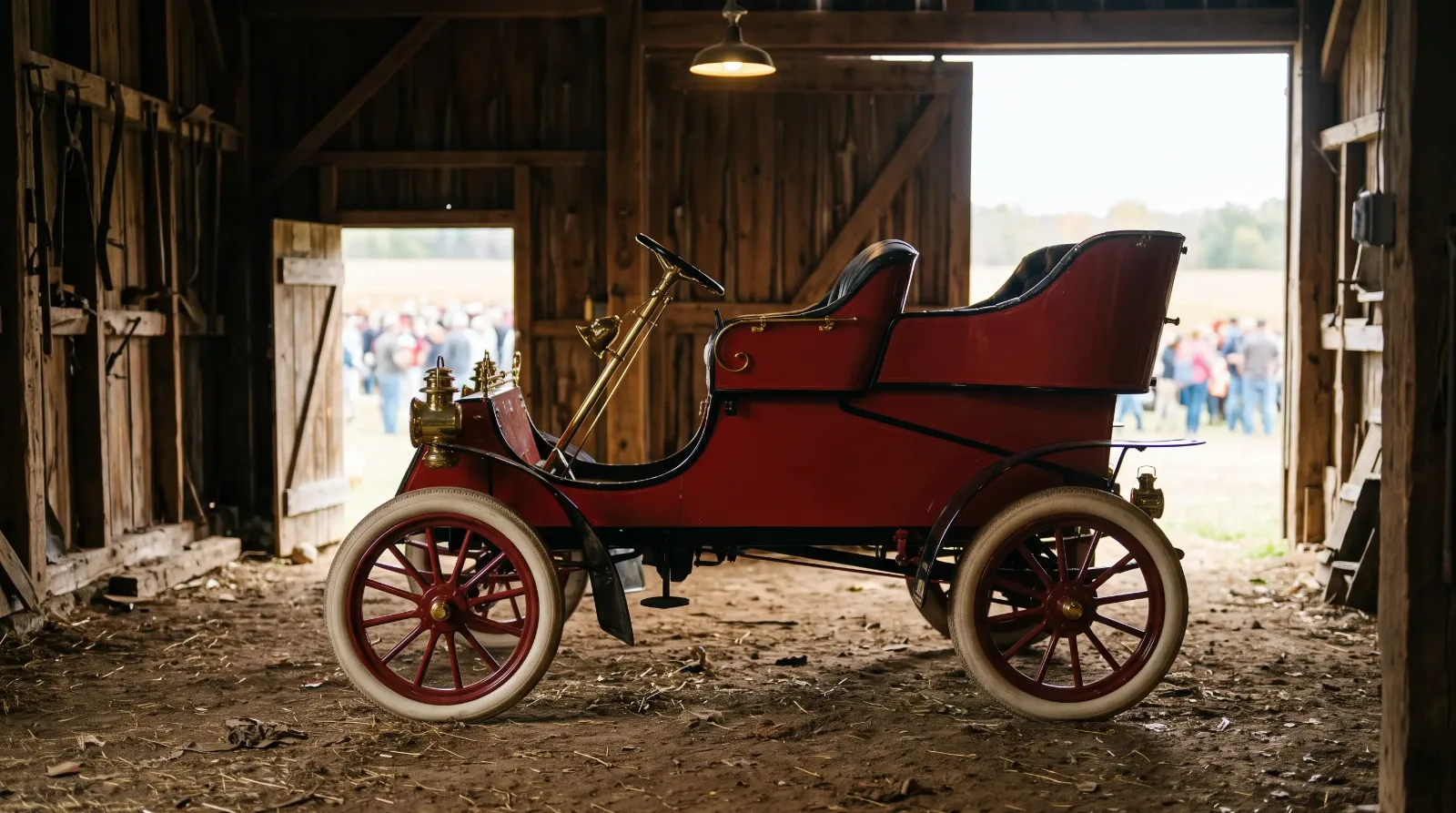
Ford's first production car: the 1903 Model A
Ford Motor Company was incorporated in Detroit on June 16, 1903, with $28,000 in cash from twelve investors, among them John and Horace Dodge. The company had a car to sell almost at once. In mid-July 1903 Ernst Pfennig, a Chicago dentist, paid in full for a Model A, and Ford counts him as its first customer; the car reached him later that month. By then the company had $223.65 left of its starting capital, which makes that first sale less a milestone than a rescue.
The car itself was simple, even by the standard of its year. It used a horizontally opposed two-cylinder engine of 1,668 cc (101.8 cubic inches) rated at 8 hp, driving through a two-speed planetary transmission. The wheelbase was 72 inches, the weight about 1,240 pounds, and the top speed about 28 mph. The base runabout cost $750, and a rear-entry tonneau, which added seating for two passengers behind the driver, cost $100 more. For 1904 the runabout went to $800 and the tonneau car to $900, and an updated Model AC had 10 hp.
About 1,750 were built at Mack Avenue across 1903 and 1904. That is a small number set against what came later, but it carried a new company through its first year.
The 1903 car beside the 1928 Ford Model A
Put the two cars side by side on paper and the gap between them is the whole history of the company's first quarter century. The 1928 Model A had a 200.5 cubic inch four-cylinder L-head engine rated at 40 hp at 2,200 rpm, five times the output of the 1903 car. It had a three-speed sliding-gear transmission in place of the planetary gearbox, four-wheel mechanical brakes and a full instrument panel.
| Item | 1903 Ford Model A | 1928 Ford Model A |
|---|---|---|
| Engine | Flat-twin, 101.8 cu in | L-head inline four, 200.5 cu in |
| Rated power | 8 hp | 40 hp at 2,200 rpm |
| Transmission | Two-speed planetary | Three-speed sliding gear |
| Wheelbase | 72 in | 103.5 in |
| Base price | $750 runabout | $385 Roadster (f.o.b. Detroit) |
| Built | About 1,750 (1903 to 1904) | About 4.85 million (1927 to 1932) |
The price line is the one that stops people. The 1928 Roadster listed for less than the 1903 runabout, and it was a far larger and more capable car. That is the Model T's moving assembly line showing up in the arithmetic. The planetary line is telling too. The 1903 Model A and the Model T both used a two-speed planetary transmission; the 1928 Model A was the car that finally abandoned it. On paper the first Model A has more in common with the Model T than with the car that took its name.
The instrument panel makes the same point from the driver's seat. The 1928 car put a speedometer, an ammeter, a gas gauge, the ignition switch and a dash lamp on a central panel. For how that arrangement changed in 1930 and 1931, see our piece on the dashboard. The 1903 car offered nothing comparable.
Why the name came back in 1927
Here precision matters more than a good story. No statement from Henry Ford or the company explaining the choice has turned up in the sources this article relies on. The usual explanation is that reusing the first letter of the alphabet signaled a clean start, and a deliberate echo of the company's first car. That reading is reasonable. It is an interpretation, though, not a quotation, and it should be presented that way.
What the record does show is the size of the break. Ford announced the end of the Model T on May 25, 1927, and shut its plants in early June; about 60,000 workers lost their jobs during the changeover. Production of the new car began on October 20, 1927, and the public introduction followed on December 2, 1927. The Model T had run for nineteen years. Whatever Ford intended by the name, the new car needed to read as something other than another Model T, and a name from the very start of the alphabet did that job. The wider Model T to Model A story covers what engineering changes backed it up.
"A name is a piece of evidence like any other. The badge on the 1928 car tells us Ford wanted a fresh start. It does not tell us that anyone at Ford said so, and we should not put words in their mouths."
Sarah Whitfield
Telling the two Model As apart in 2026
For collectors the confusion has a cost. A 1903 Model A rear-entry tonneau sold for $264,000 at RM Sotheby's Hershey auction in 2012. A restored 1928 Tudor sold for $15,000 at Mecum in 2016. A search for "Model A price" will return both, often on the same page. The 1903 car belongs to the small world of brass-era survivors, judged on originality and provenance one car at a time. The 1928 to 1931 car is one of the most numerous antiques there is, with its own clubs and a 590 page restoration guide.
The quickest test is visual. The 1903 car is a short open runabout on a 72 inch wheelbase with two cylinders, and the tonneau is an add-on at the rear. Any car with a four-cylinder engine under a long hood, a 103.5 inch wheelbase and doors on the body is the later Model A. In documents, look at the year first and the letter second. An auction catalog that says "Model A" without a year, or a parts listing that calls a 1928 component "early Model A," needs a second look.
The two cars bracket Ford's first quarter century: the one that kept a new company alive, and the one that replaced the most famous car it ever built. For where the second Model A went from there, read our Model A history. For both cars and the Model T between them, here is the full picture.
Sources and notes
- Wikipedia: Ford Model A (1903 to 1904)
- Ford: down to its last $223, a doctor helped revive Ford Motor Co.
- RM Sotheby's Hershey 2012: 1903 Ford Model A rear-entry tonneau, chassis 30
- Wikipedia: Ford Model A (1927 to 1931)
- Mac's Motor City Garage: December 2, 1927, the Model A Ford is introduced
- History.com: last day of Model T production at Ford
Related Reading



Have a
Ford Model A
for Sale?
Reach thousands of serious classic car collectors across the US.
Sell It Here →
Selling a classic? Here's how: compare the places to sell classic cars
Are You a Classic Car Dealer?
List your full inventory and connect with targeted classic car buyers.
Join as a Dealer →

About the author
Sarah Whitfield
Third-generation classic car collector specializing in pre-war American and European coachbuilt automobiles. Researcher and concours enthusiast.
Related Listings - Ford Model A
More in Car Features
Comments
Be the first to comment on this article.