
On May 26, 1927, Henry and Edsel Ford drove the fifteen millionth Ford off the line at Highland Park, and the Model T was all but finished as a US product. On December 2, 1927, the public got its first look at the new Model A. The model T vs model A question is usually answered with a horsepower figure, but the records show a longer list: almost nothing mechanical carried over, the factory moved, and the company spent half a year building next to nothing. This article walks through what changed, part by part, and where the popular version of the story drifts from the paperwork. For the full arc of both cars, from the 1908 launch to the end of the A, see the bigger picture.
Car Features
11 min read
From Model T to Model A: What Ford Changed in 1927
Model T vs Model A, part by part: the 1927 shutdown by date, the new engine, pedals, brakes, glass and colors, and what the records show.

Why the Model T had to go in 1927
The production figures tell the story more plainly than any memoir. Ford built 1,817,891 cars in the United States in 1923, the peak year. By 1926 the count had fallen to 1,368,383. In 1927, with the line stopped in May, it was 356,188. Those are the Nevins and Hill figures for Ford cars only; a Ford Production Department table dated August 3, 1927, gives a slightly higher 399,725 Model Ts for the year, because it counts production differently. Either way the direction is the same.
The pressure came from Chevrolet. General Motors president Alfred P. Sloan bet that Model T owners would trade up for comfort, features and style, and in 1927 that bet paid. Chevrolet sold more than one million cars that year and passed Ford for first place. Its Capitol Series AA came in seven body styles priced from $525 to $745, and the $695 two-door Coach carried about a quarter of the volume. Against that, a 1927 Model T runabout listed at $360. It was cheap, and it still was not selling.
Edsel Ford, company president since the end of the 1910s, had pushed for a replacement for years. He urged styling changes on the T in 1923 and again in 1925, and he was repeatedly overruled. Henry did eventually allow colors back on the T, but a paint chip was not going to close a gap that large. The discontinuation was announced on May 25, 1927, one day before the fifteen millionth car came off the line.
The 1927 changeover, by the dates
The shutdown is the part of the story most often told loosely, so the dates are worth setting down in order.
Highland Park built its last Model T on May 26, 1927, and US branch plants finished days later. The factories shut in early June. The last Model T built anywhere came out of Ford's plant in Cork, Ireland, in December 1927. Henry Ford hand-stamped the first Model A engine, number A-1, on October 20, 1927. Ford's own release dates the start of Model A production at the River Rouge complex to October 27, 1927, after what it called a three-month retooling shutdown. The public introduction followed on December 2, 1927.
That gives two honest answers to the question of how long Ford was down. Counted from the last Highland Park car to the public debut, it was about six months, which is the figure most histories use. Counted the way Ford counted it, from the plant closure to the restart of production, it was much shorter. Neither number is wrong. They measure different things.
What both numbers hide is how deep the hole was. Cram's Automotive Reports for November 19, 1927, counted 550 Ford cars built in one week, against 20,000 in the same week of 1926. Chevrolet built 6,682 that week. The commonly repeated figure of about 60,000 people out of work during the changeover comes from a secondary source, and a different source attaches the same number to the 1931 Rouge closing, so it is safer read as "tens of thousands" until a primary record turns up.
The move itself was a change too. The Model T had been a Highland Park car since 1910. Model A assembly went to the River Rouge complex, and Highland Park was left with tractors and trim work.
Model T vs Model A, spec by spec
Laid side by side, the two cars share a maker, a four-cylinder L-head layout and transverse leaf springs. Most of the rest is new. The table uses the standard period figures; horsepower on both is the gross brake rating of the day, not a modern net number.
| Item | Model T (1908 to 1927) | Model A (1928 to 1931) |
|---|---|---|
| Engine | 177 cu in L-head inline-4 | 200.5 cu in L-head inline-4 |
| Bore x stroke | 3.75 x 4.0 in | 3.875 x 4.25 in |
| Rated power | 20 hp | 40 hp at 2,200 rpm |
| Torque | 83 lb-ft | 128 lb-ft at 1,000 rpm |
| Compression | 3.98:1 (most engines) | 4.3:1 (1928 head), 4.22:1 (1929 to 1931) |
| Ignition | Flywheel magneto, trembler coils, timer | 6-volt battery, generator, coil, distributor |
| Cooling | Thermosiphon, no water pump | Water pump on the cylinder head |
| Lubrication | Splash, no oil pump | Oil pump plus splash |
| Transmission | 2-speed planetary, pedal-shifted | 3-speed sliding gear, floor shift |
| Service brakes | Transmission band (right pedal) | Four-wheel mechanical drums |
| Shock absorbers | None from the factory | Houdaille hydraulic |
| Wheelbase | 100 in | 103.5 in |
| Curb weight | 1,200 to 1,650 lb | 2,265 to 2,465 lb |
| Top speed | About 40 to 45 mph | About 60 to 65 mph |
One caution on the torque line: Mac's Motor City Garage lists the Model A at 120 lb-ft rather than 128. The top speeds are also estimates, not road tests. No period magazine test of a stock Model T has turned up, and figures for the A range from about 60 mph to a Motor Sport recollection that it "approached 70 mph when new."
Under the hood: twice the power, none of the parts
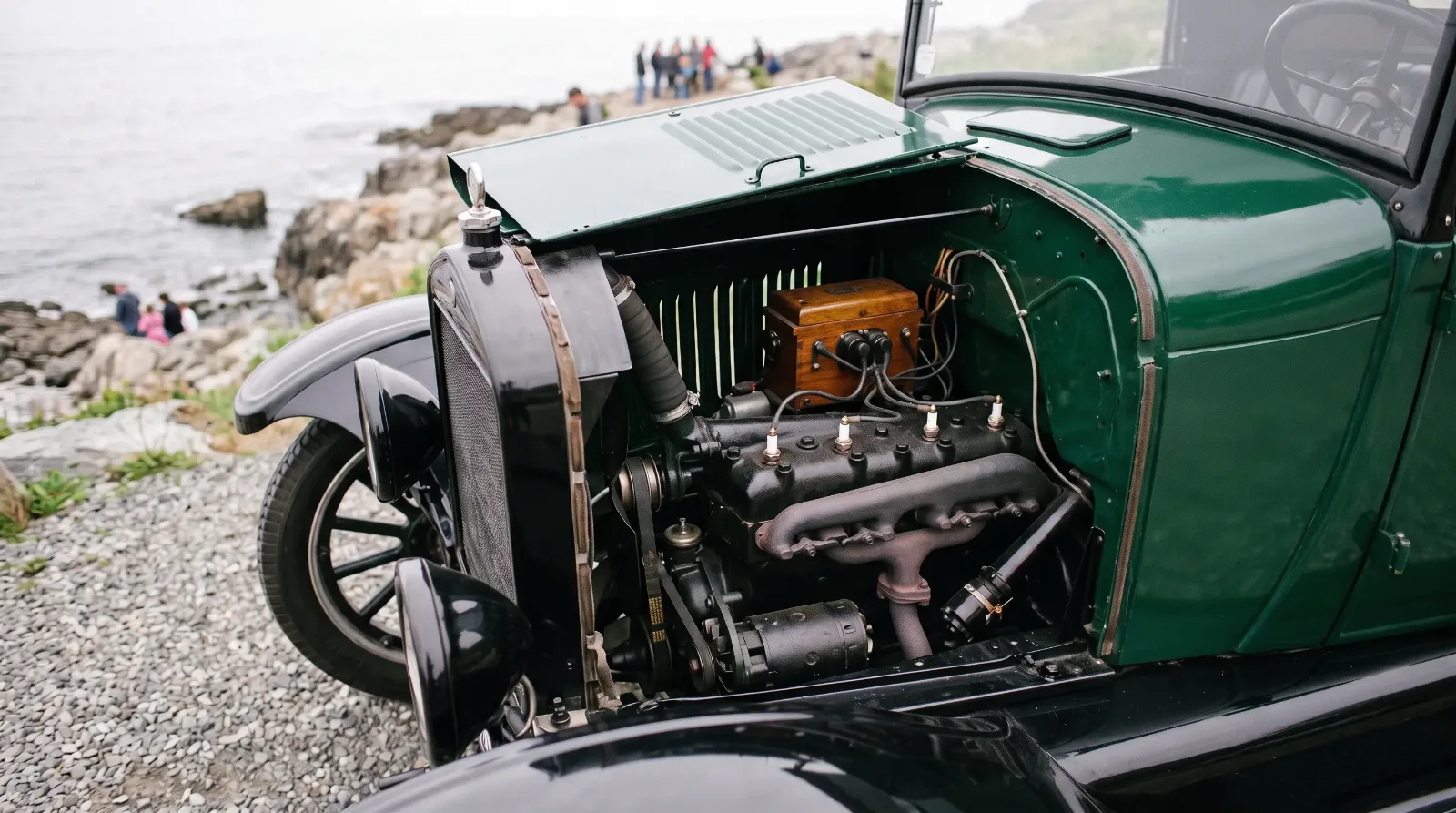
The headline is simple. The Model A made 40 hp, about twice the Model T's 20, from an engine that grew from 177 to 200.5 cubic inches. Harold Hicks and Laurence Sheldrick were chiefly responsible for the design, and by Charles Sorensen's account Edsel Ford spotted a deficiency in the intake manifold whose fix gave a real power gain. That is the kind of detail that gets lost when the A is described as a bigger T engine. It was not. No engine parts interchange between the two.
The systems around the engine changed as much as the block. The T made its spark with a magneto built into the flywheel, sixteen magnets and sixteen coils, feeding trembler coils through a timer on the camshaft. The magneto could run the ignition and, from 1915, the headlights, but it could not charge a battery. The A went to a 6-volt battery, a generator and a breaker-point distributor, the layout most owners of later cars would recognize.
Cooling and oiling followed the same path. Apart from the earliest cars of 1909, the T used thermosiphon cooling with no water pump; hot water rose to the radiator and cooler water sank back. The A added a centrifugal pump on the cylinder head. The T had no oil pump at all and shared its oil with the transmission. The A used a pump to lift oil to the valve chamber, then gravity to the main bearings and splash to the rods. The fuel tank settled too: the T carried its 10 gallons under the front seat until 1926, while every Model A had a cowl tank with a gauge on the dash.
"People call the Model A an updated T. Check the parts books and you will find the two cars do not share an engine part. Ford did not revise the T in 1927. It replaced it."
Tom Ramirez
Pedals, gears and four-wheel brakes

For a driver in 1928, the biggest change was not under the hood. It was at their feet.
The Model T had three pedals that did jobs no other car's pedals did. The left pedal pressed in gave low gear, held halfway gave neutral and released gave high, provided the hand lever was forward. The center pedal was reverse. The right pedal tightened a band inside the transmission, which was the T's service brake. The hand lever, pulled back, held the clutch in neutral and set the rear-wheel emergency brake. The throttle was a hand lever at the steering wheel. It worked, and millions learned it, but nobody coming from another make could drive one without a lesson.
The Model A adopted the arrangement most American drivers already knew: clutch on the left, brake in the center, accelerator on the right, a floor starter button and a floor gearshift. Behind it was an unsynchronized three-speed sliding-gear transmission with a single reverse in place of the planetary. Ford historians credit Edsel with persuading his father to accept both the sliding-gear box and four-wheel brakes, two points Henry had resisted.
The brakes themselves were four-wheel mechanical drums, rod-operated, with 11-inch drums on the 1928 to 1931 cars. For a car that could run roughly 20 mph faster than its predecessor and weighed several hundred pounds more, that was not a luxury. Houdaille double-acting hydraulic shock absorbers, a feature found earlier on Lincoln and Pierce-Arrow, came standard. The T had none from the factory.
Bodies, glass and color: the Edsel touch
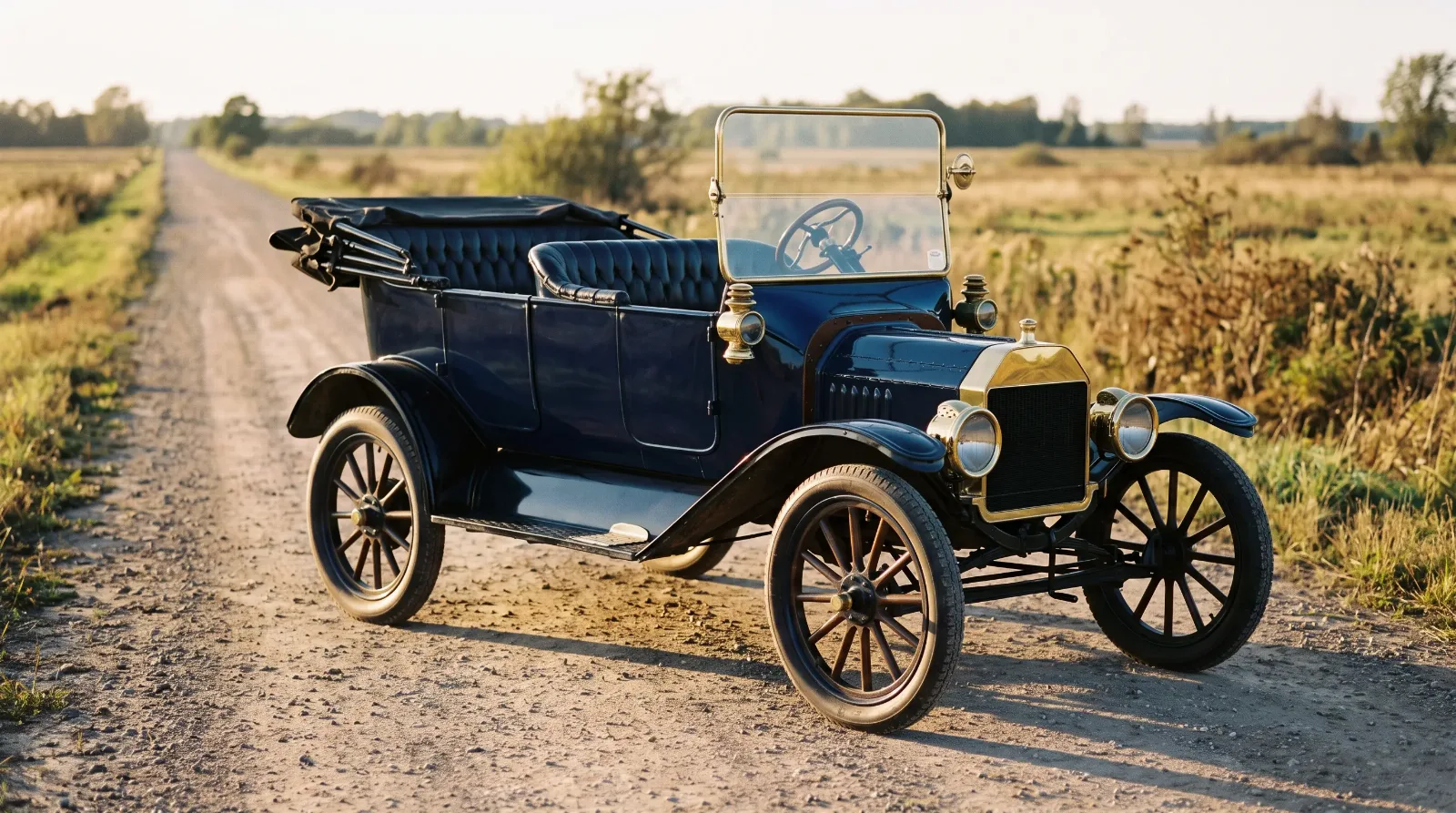
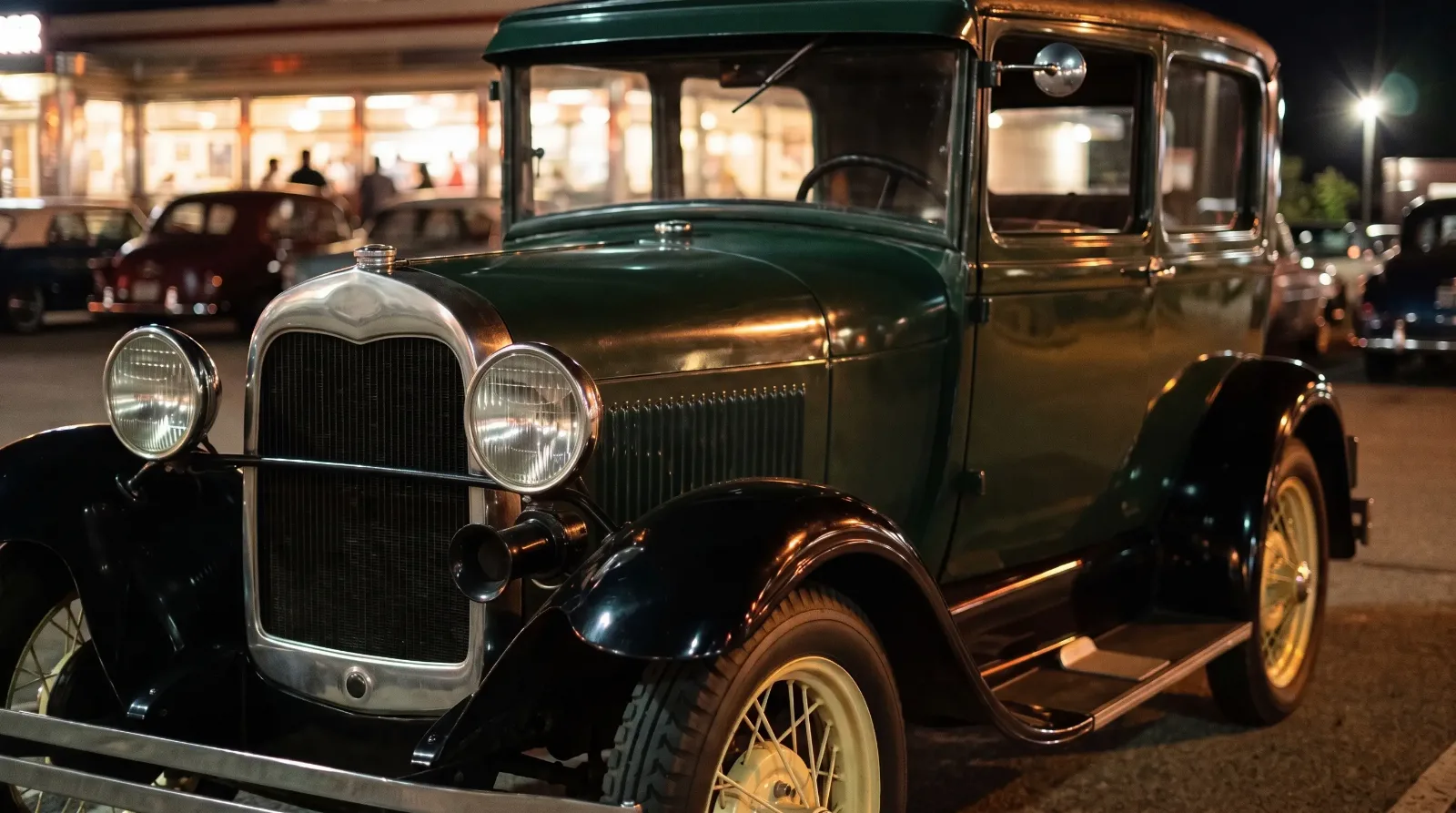
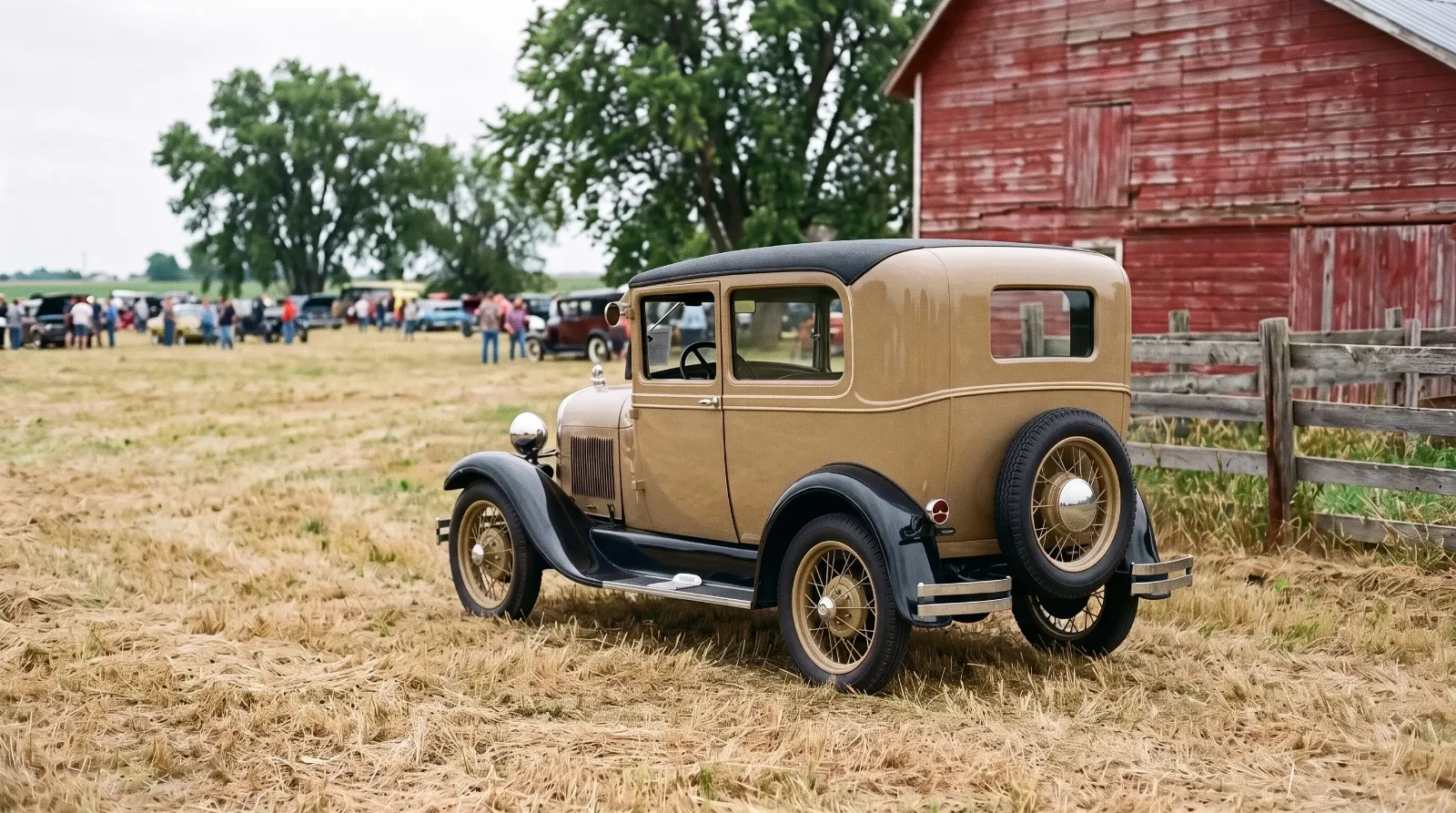
The Model T had been sold in black only from 1914 to 1925. The Model A launched in four standard colors, and its look was directed by Edsel, who developed the body with Joe Galamb, the engineer who had led the design of the T. With Ford owning Lincoln since 1922, the new car was quickly nicknamed a "baby Lincoln." The 1928 factory list ran from $385 for the Roadster to $570 for the Fordor, f.o.b. Detroit, which put the A squarely against the Chevrolet it was built to beat.
The equipment list read like a rebuttal of every Model T joke postcard. A 1928 Model A came standard with a starter, five steel-spoke wheels, a dash light, a mirror, a windshield wiper, a gas gauge, a stop and tail light, a speedometer, tools and pressure grease-gun lubrication. The electric starter had been an option on the T from 1919 and standard only by 1926. The A also brought laminated safety glass to the low-price market as standard in the windshield. Ford's heritage account says Edsel pushed for it after a friend was badly cut in a 1926 accident. The careful claim is the windshield on a low-price car, not every window and not the first car of any kind.
Tires changed too. The early A rode on 4.50 x 21 tires on wire wheels, and for 1930 Ford moved to 19-inch wheels with 4.75 section tires, which lowered the car and improved the ride. Those running changes, and the body styles that came with them, are covered in the Model A years.
What the change bought Ford
The records show the gamble paid, for a while. Ford retook the sales lead from Chevrolet with the Model A, and Ford built 4,830,806 production engines between October 1927 and November 1931, passing one million by February 1929. Total Model A production is usually given as 4,858,644 across all body styles worldwide, through March 1932. Chevrolet answered in November 1928 with a 194 cubic inch six rated at 46 hp, six more than the A, and was back on top in 1931.
Seen from the records, the 1927 changeover was less a model update than a reset. Ford gave up its best-selling car, its home factory and half a year of output, and came back with a car that drove like everyone else's and was built somewhere new. The Model B and the 1932 V8 followed, which is a separate story. If you want to see how the first-year cars hold up today, browse 1928 Model A Fords for sale and compare what you find against the factory list above.
Sources and notes
- Ford heritage release: Model A production begins at the Rouge (archived)
- WardsAuto flashback: Cram's Automotive Reports, November 1927
- Model A Ford Club of America: history of the Model A
- Model A Ford Club of America: original new-car prices
- The Henry Ford: Model A safety glass
- Wikipedia: Ford Model A (1927 to 1931)
Related Reading
Article
Ford Model T and Model A: The Complete Story of Henry Ford's Cars, 1908 to 1931
Article
How the Model T and Model A Engines Worked: From 20 to 40 Horsepower
Article
Ford Model A History: The 1928 to 1931 Car That Saved Ford

Article
December 1927: The Week America Lined Up to See the Model A

Article
Edsel Ford and the Styling of the Model A

Article
Henry vs Edsel: The Family Fight Behind the Model A
Article
Model A vs Chevrolet: The Four Against the Six
External
/ford/model-a/1928
Have a
Ford Model T
for Sale?
Reach thousands of serious classic car collectors across the US.
Sell It Here →
Selling a classic? Here's how: the best sites to sell a classic car
Are You a Classic Car Dealer?
List your full inventory and connect with targeted classic car buyers.
Join as a Dealer →

About the author
Tom Ramirez
Corvette researcher and historian based in Bowling Green, Kentucky. Two decades documenting Corvette production history from original factory records.
Related Listings - Ford Model T
Comments
Be the first to comment on this article.