
A fellow at a swap meet once tried to sell me on his GMC Caballero like it was some kind of undiscovered gem nobody else had ever heard of. I let him finish his whole pitch before I told him it was just an El Camino wearing GMC badges, and his face fell about six inches. That is the thing about this whole segment, and it is something I try to explain to every newer member who joins the club thinking the story begins and ends with just two nameplates. Once El Camino and Ranchero proved cartrucks could sell, half of Detroit and a couple of overseas manufacturers decided they wanted a piece of the idea too, and most people at the show that day had never heard the full guest list.
Car Features
7 min read
Beyond the Big Two: The Cartrucks They Inspired
From the badge-engineered GMC Caballero to the Subaru BRAT and the Dodge Rampage, here is the full family tree the El Camino and Ranchero inspired.
Chevrolet's own twin brother
The closest imitator to the El Camino was not a competitor at all, it was practically family. GMC sold a badge-engineered version alongside its truck lineup, first called the Sprint and later renamed the Caballero, built on the exact same platform with only cosmetic differences to separate it from its Chevrolet cousin. GMC dealers wanted a piece of the cartruck market too, and rather than engineer something new, General Motors just handed them a lightly restyled El Camino to sell under a different badge. It is the automotive equivalent of two brothers wearing the same jacket to different parties and hoping nobody notices. Where this started gets into how the Chevelle platform underneath both of these cars came together in the first place, if you want the mechanical backstory.
The compact imitators nobody saw coming
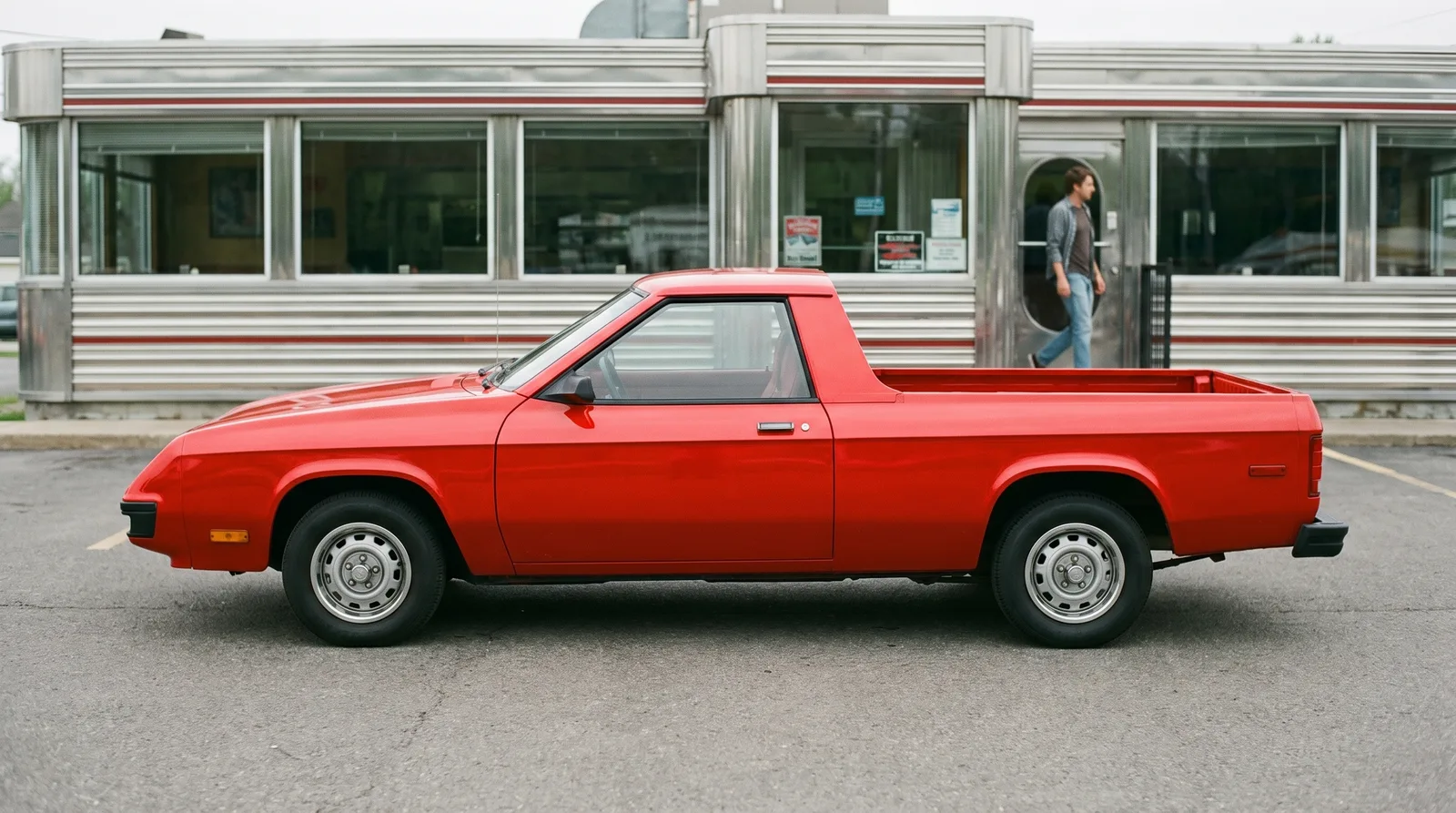
By the late 1970s and into the 1980s, the fuel crisis had changed what American buyers wanted, and a new wave of smaller cartrucks tried to catch the leftover interest in the El Camino and Ranchero formula without the big-block baggage. Dodge answered with the Rampage, sold from 1982 through 1984, and Plymouth sold a nearly identical version called the Scamp for the 1983 model year only, both built on the front-wheel-drive Omni-derived L-body platform and aimed at buyers who wanted the concept without the fuel bill of a full-size car underneath it.
Volkswagen brought its own compact entry with a pickup version of the Rabbit, built in small numbers for the American market and about as far from a muscle-era El Camino in spirit as you could get, though it chased the exact same basic idea, a car platform doing truck duty. Subaru went further still with the BRAT, a small all-wheel-drive cartruck famous for its factory rear-facing jump seats bolted right into the bed, a feature Subaru added specifically so the vehicle would qualify as a passenger car and dodge the 25 percent chicken tax tariff on imported light trucks, though safety regulators eventually made those bed seats unworkable and Subaru dropped them in the model's later years, a quirk that gave the BRAT a personality none of its rivals could match.
I owned a Rampage for about two years back in the club's early days, bought cheap off a fellow member who wanted the garage space more than the car. It was a genuinely fun little thing, quick enough for its size, easy on gas in a way neither the El Camino nor the Ranchero could ever pretend to be, and it drew a crowd at shows purely because nobody expected to see one. That is the strange fate of most of these smaller imitators. They were often better suited to how people actually used a car day to day than the muscle-era giants that inspired them, and yet almost nobody remembers them the same way.
The ancestor that started the whole idea
None of this happens, on either side of the Atlantic, without Australia getting there first. The coupe utility concept, a sedan up front with a load bed grafted onto the back, traces to Ford Australia, where designer Lewis Bandt released the first version in 1934, reportedly built in response to a farmer's wife who wrote asking for something she could drive to church on Sunday and use to haul pigs the rest of the week. Holden built its own version of the idea for decades afterward, and the basic Australian ute concept is the direct ancestor of everything Detroit eventually built on this side of the ocean, including both the El Camino and the Ranchero.
The overseas cousins that never crossed the ocean in numbers
It is worth remembering that Australia never stopped building coupe utilities the way America did. Holden and Ford Australia both kept producing ute versions of their sedans for decades after Detroit had walked away from the segment entirely, and those cars developed their own devoted following completely separate from anything happening with the El Camino or Ranchero. A handful made their way to American shores through grey-market imports and enthusiast shipping over the years, curiosities that club members occasionally trailer in just to show newcomers what the whole family tree actually looks like. Standing next to one of those next to a genuine El Camino makes the family resemblance obvious in a way that photographs never quite capture.
Why nobody else ever really caught up
Here is what strikes me looking back at that whole roster of imitators. None of them built the kind of lasting cultural reputation that the El Camino and, to a lesser degree, the Ranchero managed to build. The GMC version never escaped its cousin's shadow. The compact entries from Dodge, Plymouth, Volkswagen, and Subaru all came and went within a few years, interesting footnotes rather than lasting icons, remembered fondly by a small dedicated following but never approaching the collector following of the two original American nameplates.
"Every one of these imitators has a story worth telling at a club meeting, but none of them ever built the following that the original two did. Sometimes being first, and sticking with it the longest, is worth more than being clever."
- Wayne Coburn
Chevrolet eventually tried its own spiritual successor decades later with the SSR, a retro-styled convertible pickup that borrowed the basic cartruck concept and wrapped it in modern sheet metal, though it never approached El Camino or Ranchero sales volumes and lasted only a few model years before Chevrolet quietly let it go. It is proof that the idea itself never fully died, even after both original nameplates were long out of production, but it also proves how hard it is to recapture something that original El Camino and Ranchero buyers got almost by accident, simply by being first and staying in the fight the longest. If any of this history has you wanting the real thing instead of a footnote, go find a classic El Camino and skip straight to the nameplate that actually stuck around, wrote the longest chapter of this whole family tree, and outlasted every imitator that tried to copy its homework.
Sources and notes
Related Reading

About the author
Wayne Coburn
Longtime Corvette owner, judge and club figure who knows the cars, the records and the people behind them.
Related Listings - Chevrolet El Camino




Comments (1)
W
Wes Hollingsworth
5 days ago
Wayne, my brother-in-law drove a GMC Caballero for twenty years and swore it was a different animal. Was it, under the hood?
V
VintageVolvoVal
5 days ago
Not really, as far as I know. Same platform as the El Camino, with the GMC nose and trim doing the separating. For what it's worth, my neighbor's Caballero rolled past two hundred thousand miles on its original engine, so your brother-in-law was right that it was tough.
W
Wes Hollingsworth
4 days ago
Well now, that settles a twenty-year argument at the Thanksgiving table, and not in his favor. Same truck, different nose. I'll let him keep believing it, though. A man's entitled to think his rig is special, even when the paperwork says otherwise.