331 cubic inches. That is the number that matters when you talk about the 1950s Cadillac engine, and it is the number that made the Eldorado possible in the first place. Cadillac's overhead-valve V8, introduced for the 1949 model year and carried straight into the first Eldorado of 1953, was not the biggest engine in Detroit. It was the smartest one. Short stroke, high compression, low weight. Everything else in the luxury field was still running on prewar thinking.
The engine before the Eldorado existed
Cadillac's engineers, led by Ed Cole and Harry Barr, threw out the old L-head design in 1949 and built a compact, high-compression V8 that weighed about 200 pounds less than the flathead it replaced. Displacement was 331 cubic inches, output was 160 horsepower, and the compression ratio started at 7.5:1 at a time when most domestic V8s were running closer to 6.5:1 or lower. That gap is the whole story of the 1950s Cadillac engine. Higher compression meant more power from the same fuel burn, and Cadillac got there first among the full-size luxury makers.
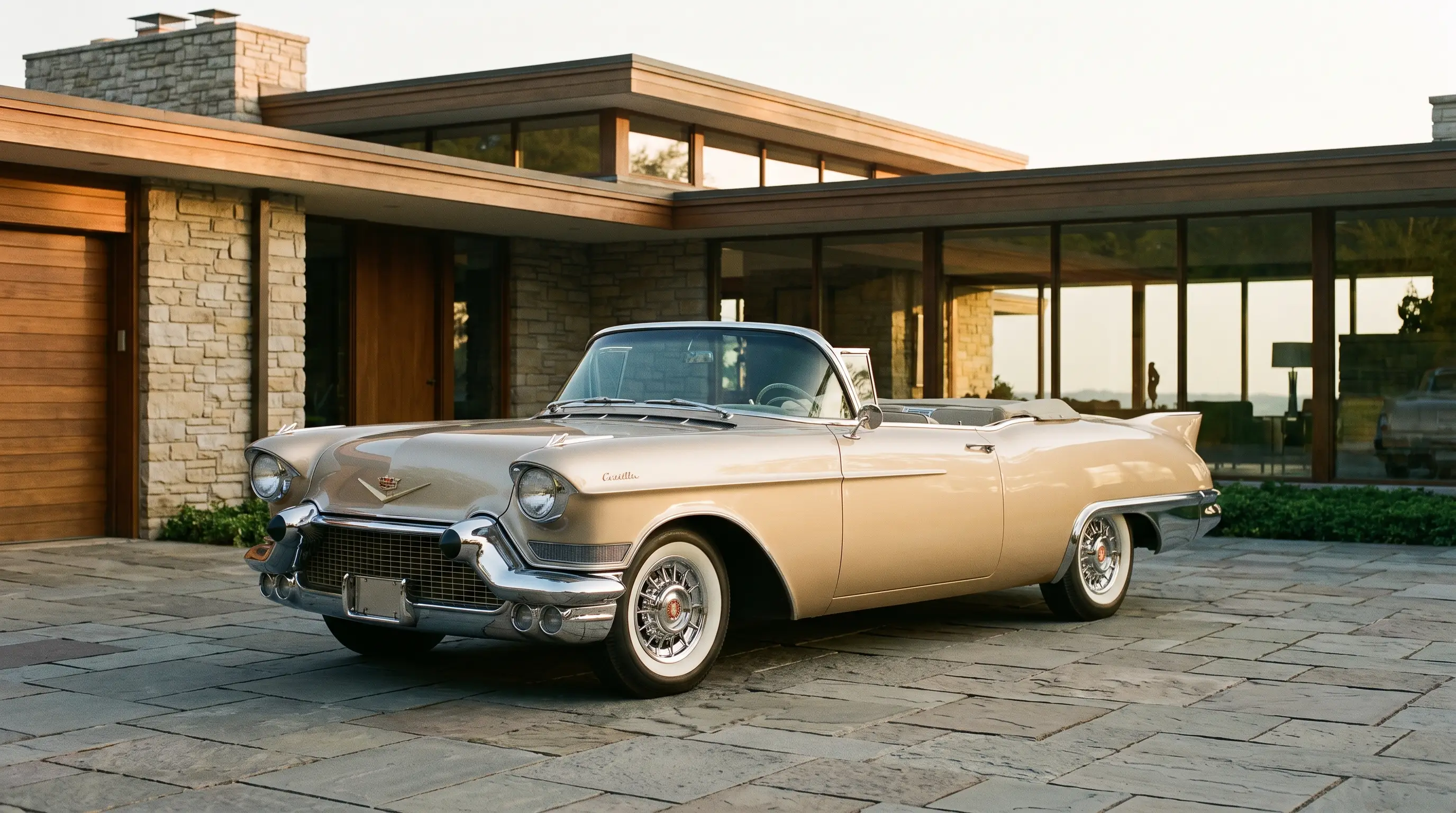
When the Eldorado convertible launched in 1953 as a limited, hand-finished halo car, it used this same 331 block, tuned with a four-barrel carburetor and a higher compression ratio than the standard Series 62. Output climbed to 210 horsepower that year. It was not a separate Eldorado engine. It was the best version of the engine Cadillac already had, dressed up for the car built to sit at the top of the lineup.
Compression kept climbing through the decade
Every year from 1953 to 1959, Cadillac pushed the compression ratio higher as fuel quality and metallurgy allowed. By 1957 the ratio was up around 10:1 in some applications, a number that would have destroyed an engine from a decade earlier. Horsepower on the Eldorado's dual-quad setup reached 325 by 1957 and 345 by 1959, the peak tailfin year, when the Eldorado's 390 cubic inch V8 ran a Tri-Power setup of three two-barrel carburetors exclusive to the Eldorado line. None of that came from bigger displacement alone. The 331 grew to 365 cubic inches for 1956, but the real gains were compression and breathing.
The pattern is consistent across the decade: Cadillac treated compression ratio as the lever, not cubic inches. That is a different philosophy than what Chrysler or Lincoln were doing at the time, and it is why the 1950s Cadillac engine gets cited so often as the template for the modern American V8.
Why high compression mattered more than horsepower numbers
Buyers in 1953 were not comparing spec sheets the way people do now. They noticed how the car pulled off the line and how quiet it stayed at highway speed. High compression delivered both. A 331 or 365 cubic inch Cadillac V8 built torque low in the rev range, which is exactly what a two and a half ton convertible needs to feel effortless. Low-compression engines from that era had to be revved harder to make comparable power, and they ran hotter doing it.
The trade-off was fuel. High-compression engines demanded premium gasoline with enough octane to resist knock, and that requirement shaped how Cadillac marketed the car. Eldorado buyers were told, correctly, that this was not an economy purchase. Fuel cost was a footnote next to the price of the car itself, which started around $7,750 in 1953, more than double a standard Series 62 convertible.
"People love to argue about horsepower numbers from this era, and half the figures got rounded up by the marketing department anyway. The number that actually tells you something is the compression ratio. That is where Cadillac was genuinely ahead of everybody else in 1953, and it stayed that way for most of the decade."
- Dan Reeves
The rest of Detroit was slow to catch up
Lincoln stayed on lower compression ratios into the mid-1950s and it showed on the road. A stock Lincoln of 1954 needed more throttle and more revs to keep pace with a Cadillac carrying the same passenger load. Chrysler's Hemi V8, introduced in 1951, was a genuinely strong engine, but it was heavier and more expensive to build than Cadillac's compact overhead-valve design, and that cost difference mattered when GM was pricing the Eldorado to compete on both performance and profit margin.
Packard, the one true rival Cadillac had in the prestige field going into the decade, never solved the problem at all. Packard's straight-eight held on years past its usefulness, and by the time Packard finally fielded its own V8 in 1955, Cadillac had already banked six years of high-compression development and three rounds of horsepower increases. That head start is a big part of why Packard folded as an independent automaker before the decade ended, while Cadillac kept building Eldorados straight through it.
None of this happened by accident. Cadillac's engineering staff treated the 1950s Cadillac engine program as a rolling project, with a new compression target set almost every model year and octane requirements published so dealers could tell buyers exactly what fuel grade to run. That kind of year-over-year discipline is unusual even by today's standards, and it explains why the Eldorado could credibly claim to be the fastest car in its class for most of the decade despite carrying more chrome and more weight than anything else on the lot.
What changed by the end of the decade
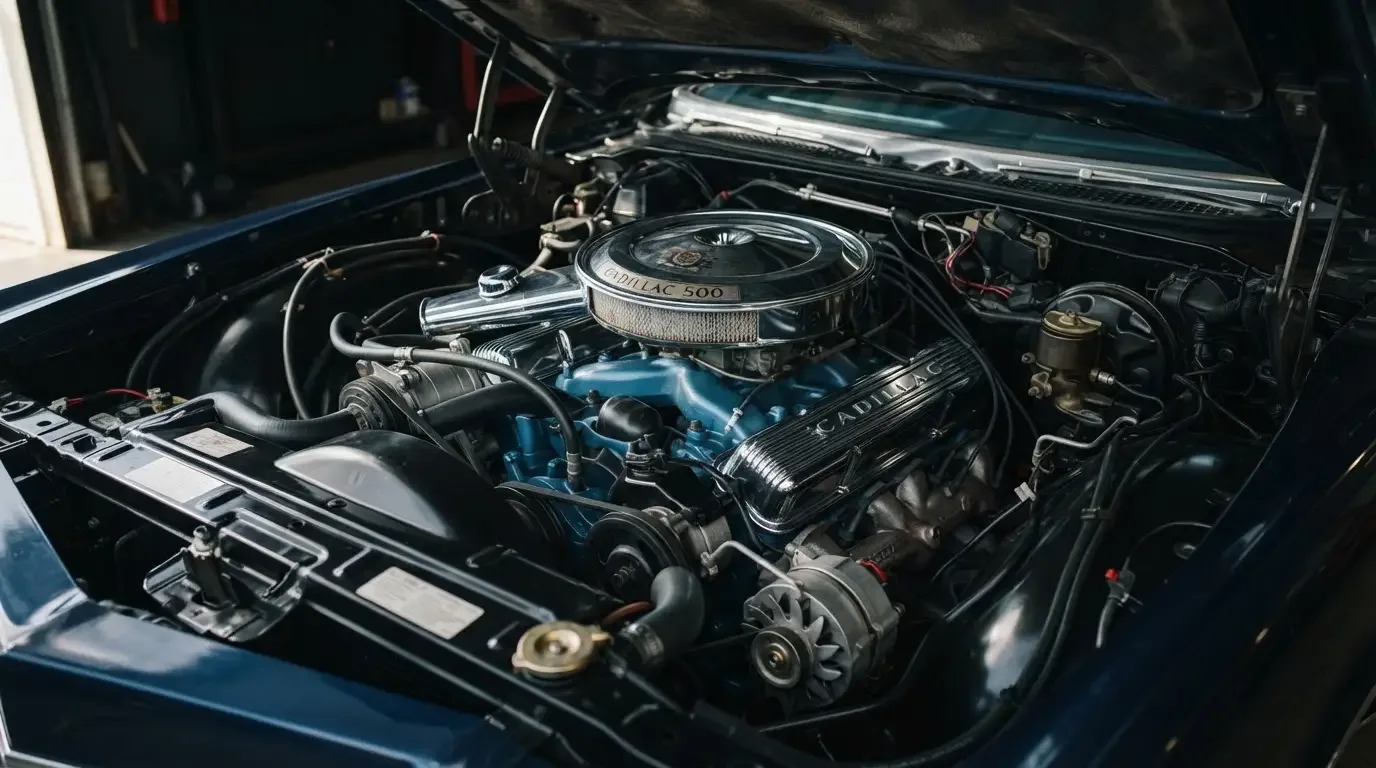
By 1959 the 1950s Cadillac engine had grown to 390 cubic inches, its final displacement before the 1960s redesign, and compression had reached the point of diminishing returns on pump gasoline. The next real jump came with the 429 in 1964 and eventually the 500 cubic inch V8 in 1970, a much bigger engine built for a much bigger car. Anyone who wants the whole picture on how Cadillac's engines evolved from this high-compression 1950s foundation into the biggest V8 ever put in a production car should look at that later chapter directly.
What stays true across both eras is the engineering instinct. Cadillac's team in the 1950s figured out that raising compression ratio was cheaper and more effective than simply making the engine bigger, and that lesson carried through decades of Eldorado development even as the cars themselves changed shape completely.
The numbers that hold up today
| Model year | Displacement | Compression ratio | Horsepower |
|---|---|---|---|
| 1953 | 331 cid | 8.25:1 | 210 |
| 1956 | 365 cid | 9.75:1 | 305 |
| 1957 | 365 cid | 10:1 | 325 |
| 1959 | 390 cid | 10.5:1 | 345 |
Original engines from this run survive today mostly in cars that were stored dry and rebuilt properly, since high-compression engines from the 1950s do not tolerate ethanol-blended pump gas without some attention to the valve seats. Anyone shopping in this era should ask directly about engine history before assuming a running car is a correct car. For buyers who want to see what is currently available, you can shop classic Eldorado listings and compare engine and compression details car by car.
The bottom line on the 1950s Cadillac engine is simple. It was not the biggest V8 of its decade, but it was the one that proved higher compression beat bigger displacement, and every Eldorado that followed, all the way through the 500 cubic inch land yacht era, built on that same idea.
Sources and notes
- Cadillac V8 engine history, Wikipedia
- 1949-1960 Cadillac V-8 Facts and Specifications, Over-Drive Magazine
- Eldorado 1953-66 Specifications, The Cadillac Database
- 1953 Eldorado Special Sport Convertible Facts, The Cadillac Database
- 1953 Cadillac Eldorado, Hagerty Valuation Tools
- 1959 Cadillac Eldorado Biarritz, Supercars.net