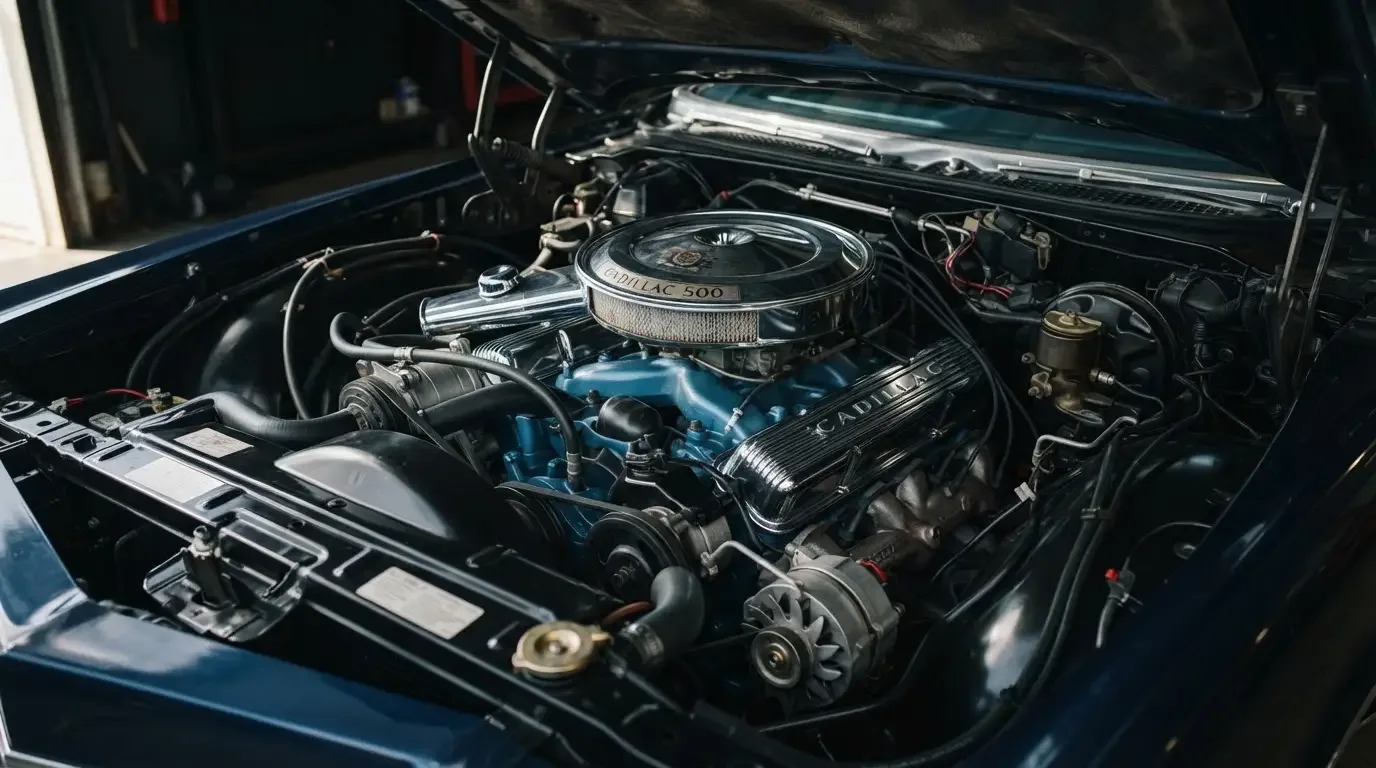
The cadillac 500 emissions decline is the story of an engine that never got physically weaker but was made to look that way on paper, year after year, until it was retired. The 500 cubic inch V8 that debuted in the 1970 Eldorado at 400 gross horsepower ended its production run in 1976 rated at a fraction of that figure, and almost none of the difference came from changes to the engine's basic hardware. It came from the rules around it.
The first blow: gross to net ratings
The single biggest drop in the 500's published output happened in 1972, when the American auto industry switched from gross horsepower ratings to net ratings. Gross figures were measured on a bare test stand engine with no accessories, no exhaust, and no real-world drag. Net figures measured a fully dressed, running engine exactly as installed in the car. The 500's block, heads, and internals barely changed between 1971 and 1972, yet the number on the window sticker fell sharply simply because it was being measured honestly for the first time. Buyers who did not understand the change assumed Cadillac had detuned the engine. In large part, they had not; they had just started telling the truth about it.
Then came real detuning
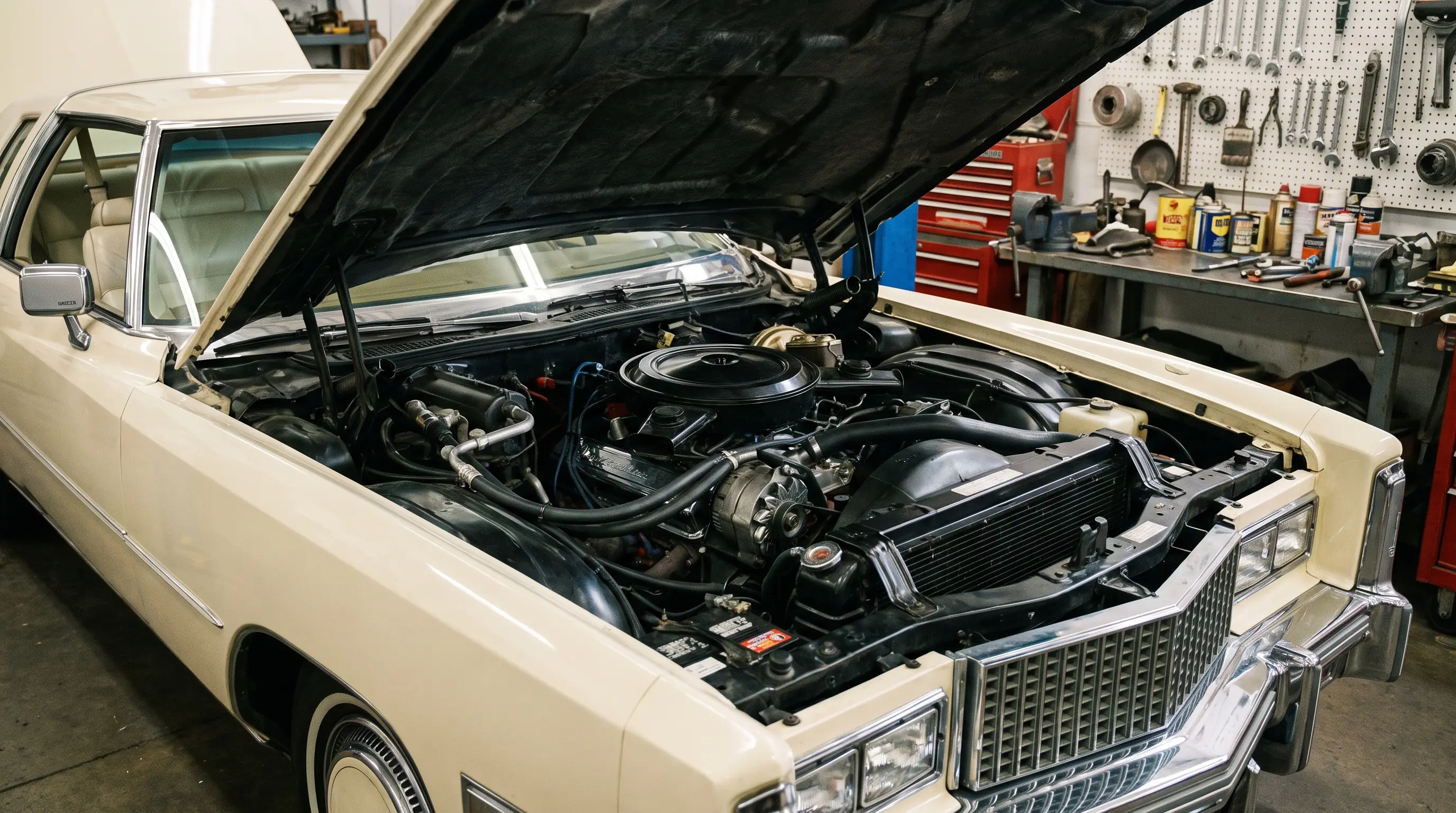
The honest measurement was only the beginning. Actual output reductions followed as emissions equipment piled onto the engine through the mid-1970s. Compression ratios dropped to accommodate lower-octane unleaded fuel, which the Environmental Protection Agency phased in to protect the catalytic converters arriving in 1975. Exhaust gas recirculation systems, required to reduce nitrogen oxide emissions, ate into throttle response and low-end power. Air pumps added parasitic drag. Ignition timing was retarded from factory settings that had once been tuned purely for performance. Each change was small on its own. Stacked together across five years, they added up to a genuinely less powerful engine, not just a more honestly measured one.
| Year | Rating System | Approx. Horsepower |
|---|---|---|
| 1970 | Gross | 400 |
| 1972 | Net | 235 |
| 1975 | Net, catalytic converter | 210 |
| 1976 | Net | 190 |
Why Cadillac kept the engine anyway
Given how much power the 500 lost through the early 1970s, it is fair to ask why Cadillac did not simply replace it sooner. The answer is that displacement was still doing useful work even at reduced output. A big, low-stressed engine turning modest rpm could meet emissions targets more gracefully than a smaller engine forced to work harder for the same result, and Cadillac's buyers were not shopping for outright performance in the first place. A quieter, lower-output 500 in 1976 could still deliver the effortless, unhurried driving character the Eldorado had always promised, even if it could no longer back that character up with genuinely big numbers.
The engine's final years
By 1976, the 500's last year in the Eldorado, the engine bore little resemblance in output to the car that had introduced it. Cadillac replaced it for 1977 with a smaller, lighter 425 cubic inch V8 as part of an industry-wide downsizing effort that touched nearly every full-size American car. The 500 did not disappear because it had failed. It disappeared because the entire era of oversized, low-compression, torque-first V8s was ending, and Cadillac, like every other manufacturer, was moving toward smaller displacement paired with better engineering rather than simply asking a huge engine to survive under an ever-tightening set of restrictions.
"Nobody broke the 500. Regulation just kept asking it to do less with the same amount of iron, year after year, until there wasn't much left to ask for."
- Emily Chen
How dealers and buyers reacted at the time
Cadillac dealers in the early 1970s faced an awkward sales conversation that had nothing to do with anything the company had actually done wrong mechanically. Customers who had shopped a 1970 or 1971 Eldorado and remembered the 400 horsepower figure would return a year or two later, see a much lower number on a new car's window sticker, and assume the engine itself had been weakened. Dealers had to explain the gross-to-net switch on the showroom floor, a conversation that did little to reassure buyers who simply saw a smaller number and drew the obvious, if incomplete, conclusion. Cadillac's own advertising did not always help; some early 1970s materials continued to lean on displacement and torque figures precisely because those held up better under the new measurement standards than the horsepower number did.
By the mid-1970s, the conversation had shifted again. Buyers increasingly understood that every domestic manufacturer was dealing with the same net rating and emissions pressures, which took some of the sting out of Cadillac's declining numbers specifically. The 500 was not falling behind its competition during this period; the entire industry was moving through the same regulatory squeeze at roughly the same pace, which is part of why the engine survived as long as it did despite its shrinking output.
Reading a 1970s 500 correctly today
Anyone comparing horsepower figures across the 500's production run needs to account for both changes, the 1972 measurement switch and the real mechanical detuning that followed, or the numbers will not make sense. A 1970 car and a 1976 car share an engine block, a displacement figure, and a basic architecture, but they do not share a driving character. The full arc of that engine, from its record-setting debut through this slow decline, is covered in read the background on the 500 cubic inch V8. Buyers interested specifically in a strong-running, less emissions-choked example can find a classic Eldorado currently for sale and compare model years directly.
A cautionary chapter, not a failure
The 500's emissions-era decline is not really a story about a bad engine. It is a story about an entire category of American V8 running into a regulatory environment it was never designed for, and Cadillac choosing to keep the engine running rather than abandon it outright. That decision bought the 500 six more years of production after 1970, even as its numbers steadily shrank, and it left behind a genuinely instructive record of exactly how much an engine's real-world character can change without a single physical redesign.
Sources and notes
- Cadillac V8 engine - Wikipedia
- Go Big or Go Home: Cadillac's 500 Cubic-Inch V8, 1970-76 - Mac's Motor City Garage
- Cadillac 500 V8: What Made The Brand's Largest Engine So Interesting - Jalopnik
- This 8.2-Liter Cadillac V8 May Be Emission Legislation's Greatest Casualty - CarBuzz
- The Cadillac 500 Cubic Inch V8 Was GM's Last Classic Big Block - DrivingLine