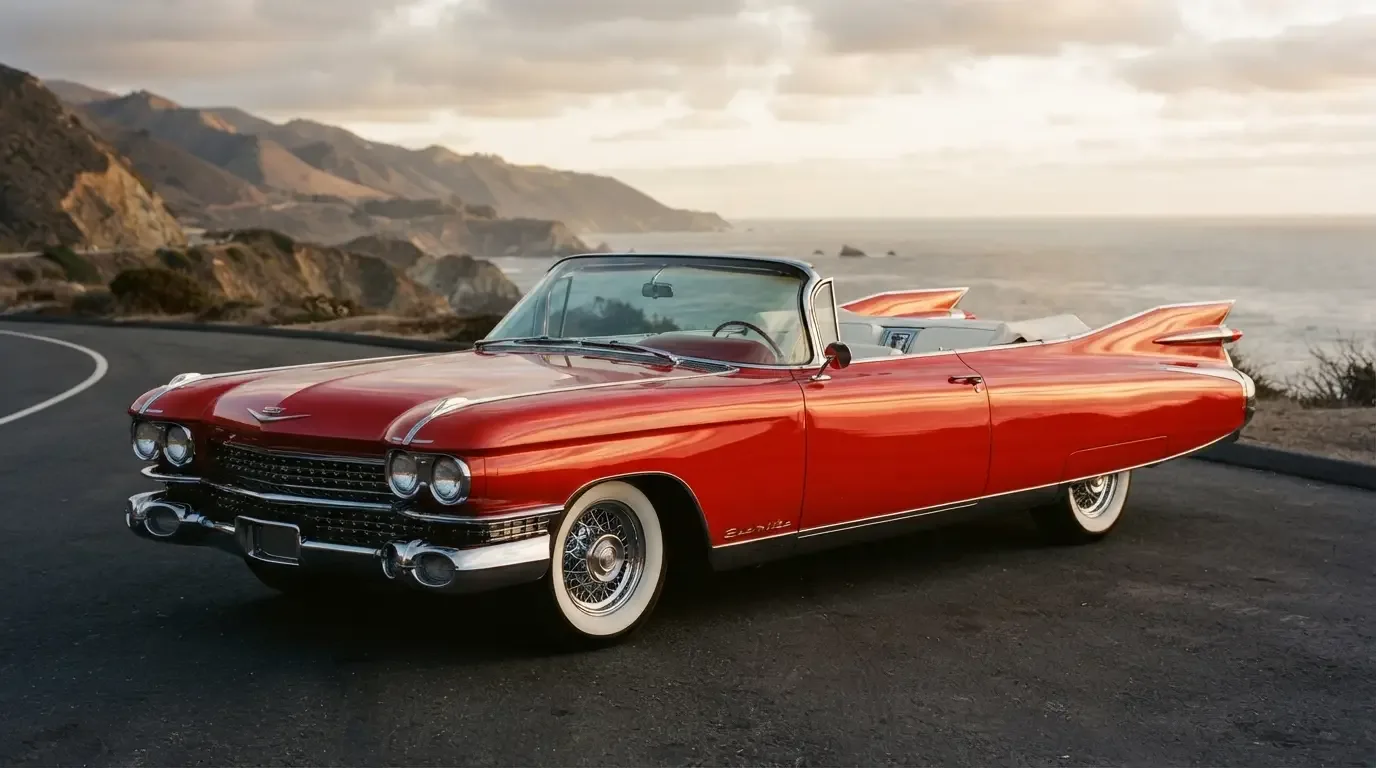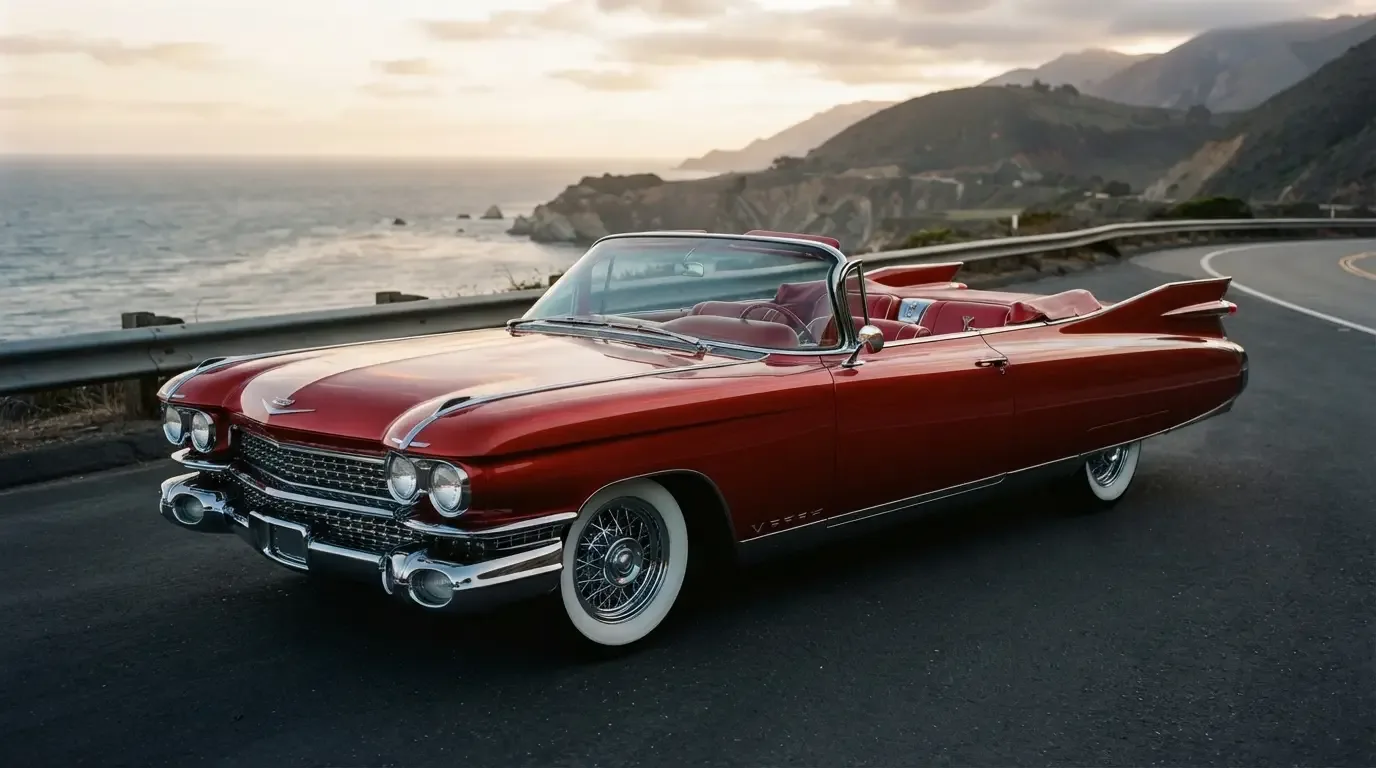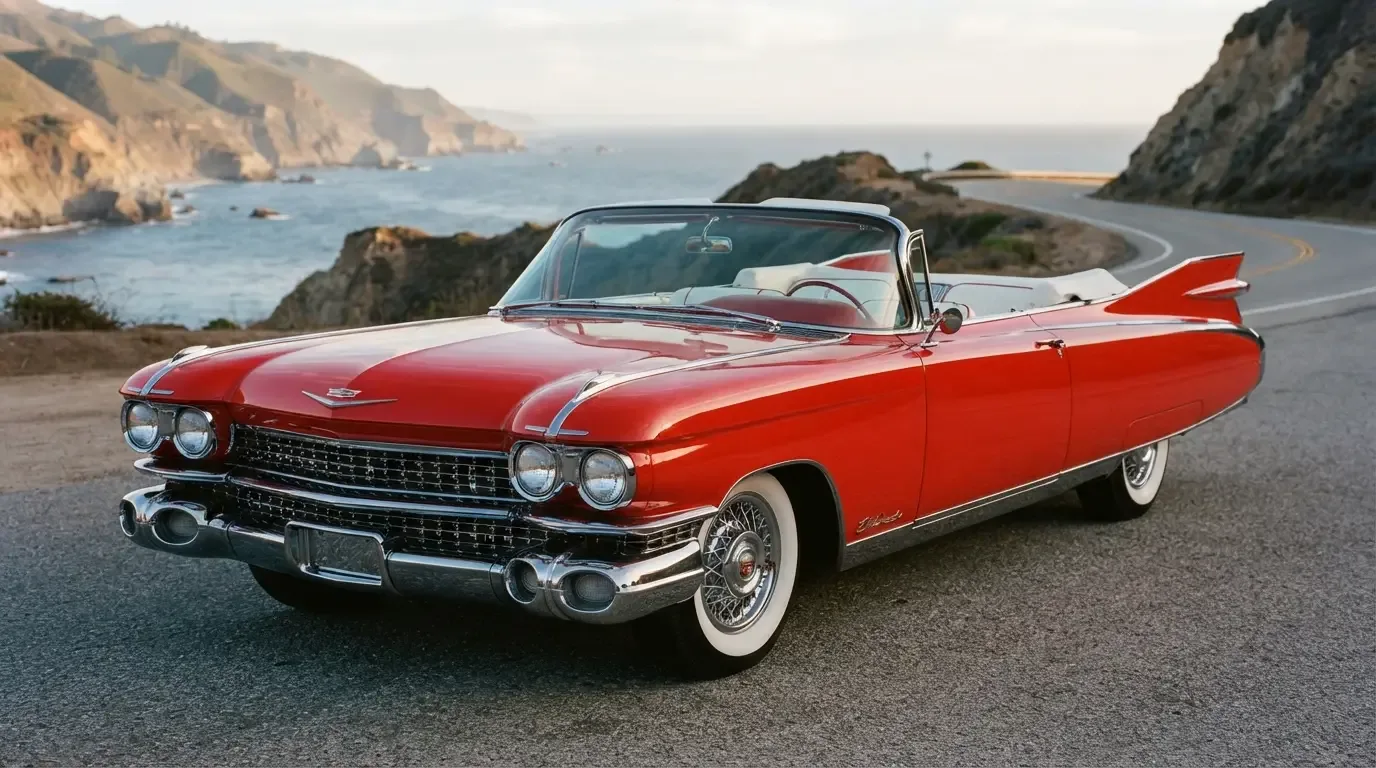
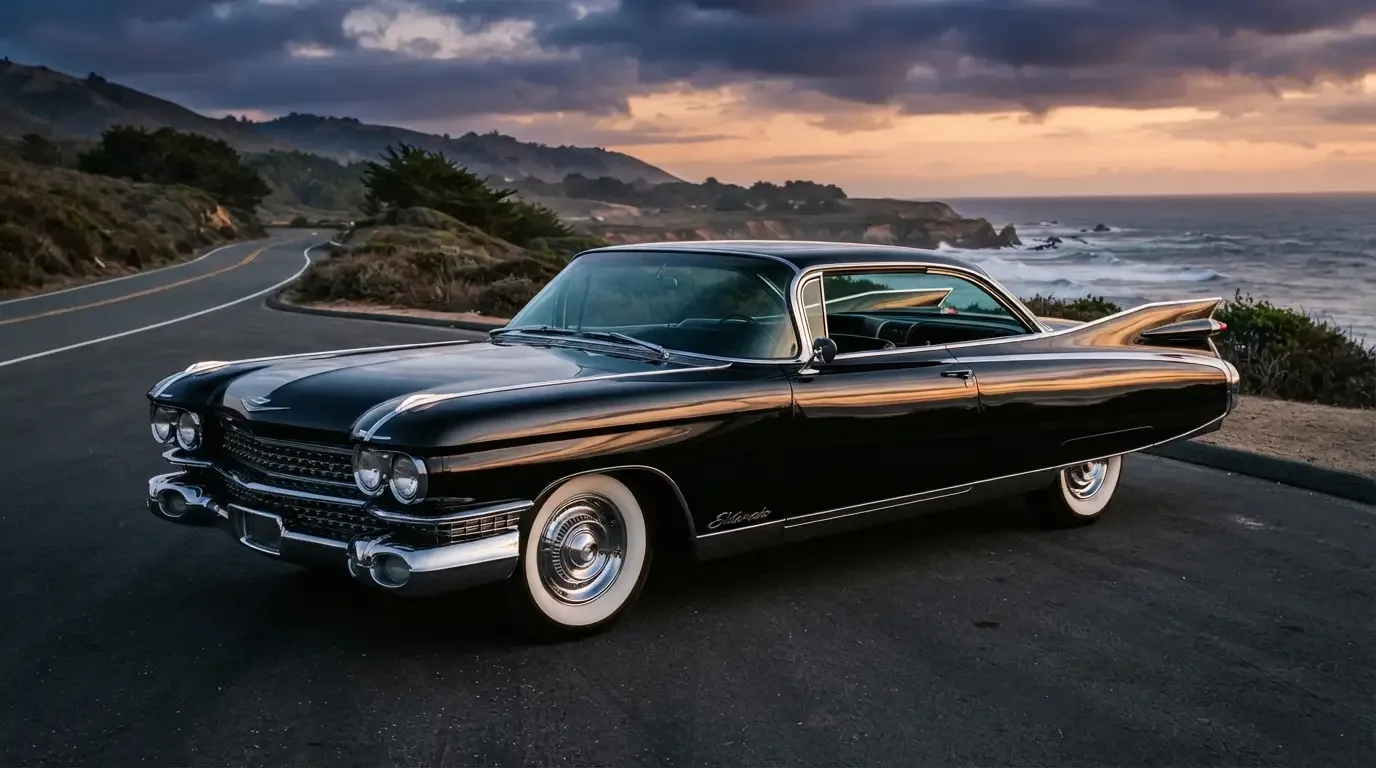
The 1959 Eldorado Seville is the hardtop half of the most photographed Cadillac model year in the marque's history, and it is also the one buyers and even some cataloguers get wrong most often. Where the Biarritz took the top down, the Seville kept a fixed roof and a formal greenhouse, and that single difference in body configuration is why factory records treat the two as distinct production runs rather than trim levels of one car. If you want the wider setup, read the background on the 1959 range before diving into the Seville specifically.
What separated the Seville from the Biarritz
Both cars rode the same 130-inch wheelbase and wore the same rocket-age sheet metal front to back, but the Seville was built around a pillarless hardtop roofline with a wraparound rear window that gave the cabin a glassed-in, almost aeronautical feel. Cadillac's production paperwork listed the Seville under its own body style number, separate from the convertible Biarritz and separate again from the four-window and six-window Sixty Special sedans that shared the Eldorado name for marketing purposes but not the specialty-car construction underneath. The Seville used the same 390 cubic inch V8 rated at 345 horsepower that powered the rest of the Eldorado lineup, along with the Eldorado-specific triple two-barrel carburetor setup that was not standard equipment on lesser Cadillac series that year.
The distinction mattered on the factory floor because the Seville and Biarritz were assembled in far smaller numbers than the mainstream Series 62 and Sixty Special cars, using body shells that required more hand finishing around the roof pillars, the wraparound glass, and the brushed stainless steel roof insert that was unique to the hardtop body. That roof insert is one of the easiest ways to spot a genuine Seville today, since it was not something buyers could delete or substitute.
Production numbers and what they tell you
Cadillac's total 1959 Eldorado output split across the Seville hardtop and Biarritz convertible bodies, with the Seville accounting for the larger share of the two despite being the less commonly discussed of the pair in enthusiast circles today. Total Eldorado Seville production for 1959 is consistently documented at 975 units, with the convertible Biarritz built in somewhat larger numbers at 1,320 units, figures that are well established across auction houses and marque references.
What the low volume tells a researcher is straightforward: this was never intended as a high-volume car. The Seville and Biarritz sat above the standard Eldorado-badged Sixty Special sedans in both price and exclusivity, and Cadillac treated them as image leaders for the entire 1959 lineup rather than as a mainstream product line competing on volume with Buick or Oldsmobile's own hardtop coupes.
| Spec | 1959 Eldorado Seville |
|---|---|
| Body style | Pillarless two-door hardtop |
| Wheelbase | 130 inches |
| Engine | 390 cu in V8, tri-carb |
| Horsepower | 345 hp |
| Roof treatment | Brushed stainless insert |
| Production | 975 units |
How the Seville fits into the wider 1959 story
Cadillac's 1959 range is remembered today almost entirely for its fins and its dual bullet taillights, and rightly so, but the Seville is where those design elements were arguably at their most balanced. The fixed roofline gave the car a longer, more continuous beltline than the convertible, so the fins read as a natural extension of the body rather than an appendage bolted onto an open car. Collectors who focus purely on the Biarritz because of its convertible top sometimes miss that the Seville's proportions were, in the eyes of many period road testers, the more resolved design of the two body styles.
The Eldorado name itself had already carried three years of specialty-car pedigree by 1959, tracing back to the original 1953 limited-edition convertible, and the Seville designation was new for the hardtop body that year, distinguishing it from the four-door and six-window Eldorado Brougham that Cadillac had also fielded in the mid-1950s. Anyone researching the full arc of the nameplate should find the piece on why the 1959 model in particular became so iconic worth a look too, since the Seville's design choices are part of that answer.
Reading the factory records correctly
One correction worth making here: some enthusiast forums conflate the "Eldorado" and "Eldorado Seville" names as if Seville were simply a trim package on any 1959 Eldorado. It was not. The factory build sheet, the body style number, and the dealer order guide all treated Seville as its own body configuration, distinct from Biarritz and from the four-door Eldorado Brougham that had been discontinued after 1958 as a Cadillac-built car. Getting this straight matters for valuation and for authenticity, since a car titled or advertised loosely as "Eldorado" without specifying Seville or Biarritz leaves out information a serious buyer needs before ever looking at a VIN tag.
"People assume Eldorado was one car with two roof options. It was never that casual on the factory paperwork. Seville and Biarritz were tracked, ordered, and built as separate specialty bodies, and that distinction is exactly why the production numbers for each one are so different."
- Tom Ramirez
For anyone shopping today, that documentation gap is also where the buying risk lives. A Seville with clean, matching factory records is a meaningfully different proposition than one where the body style was assumed rather than confirmed. Those researching the market can shop classic Eldorado listings to see how big a difference correct documentation makes to asking prices across the 1959 range.
Options, colors, and how a Seville was ordered
A 1959 Eldorado Seville buyer was not simply picking a body style off a lot. These cars were largely built to order through Cadillac's specialty car process, with a color and trim combination selected from a palette that ran wider than the standard Series 62 offering. Air conditioning, power everything, and the Autronic Eye automatic headlight dimmer were among the items a Seville buyer could specify, and because the car already sat at the top of the Cadillac price list, dealers rarely built one stripped of its available convenience equipment. That build-to-order pattern is part of why surviving cars show real variation in trim and color even within a single model year, and why two Sevilles from the same month can look meaningfully different inside the cabin.
Paint and interior selections were recorded on the factory build sheet along with the body style number, and those two pieces of paper together are what a documentation-minded buyer wants to see before taking a Seville's originality claims at face value. A repainted or retrimmed car is not automatically suspect, since many Sevilles have been refinished at some point across sixty-plus years of ownership, but a car with its original build sheet still attached to the glovebox or fender apron is a meaningfully stronger find than one without.
Why the Seville still holds up
Six and a half decades later, the 1959 Eldorado Seville remains a useful benchmark for how far American car design pushed in a single model year, and it does so without needing the top-down drama of the Biarritz to make its case. The fixed roof, the wraparound glass, and the stainless insert all read as considered design decisions rather than styling flourishes, and that is a large part of why factory historians treat the Seville as every bit the equal of its convertible sibling, production numbers and forum chatter notwithstanding.
The name itself would go on to a second life a decade later on a very different Cadillac, but that later Seville owes its cachet in no small part to what this 1959 hardtop established: that a fixed-roof Cadillac could be just as much a flagship statement as an open car, provided the proportions, the details, and the build quality were treated with the same seriousness. For a factory historian, that is the real legacy of the 1959 car, regardless of which body style gets the magazine covers.