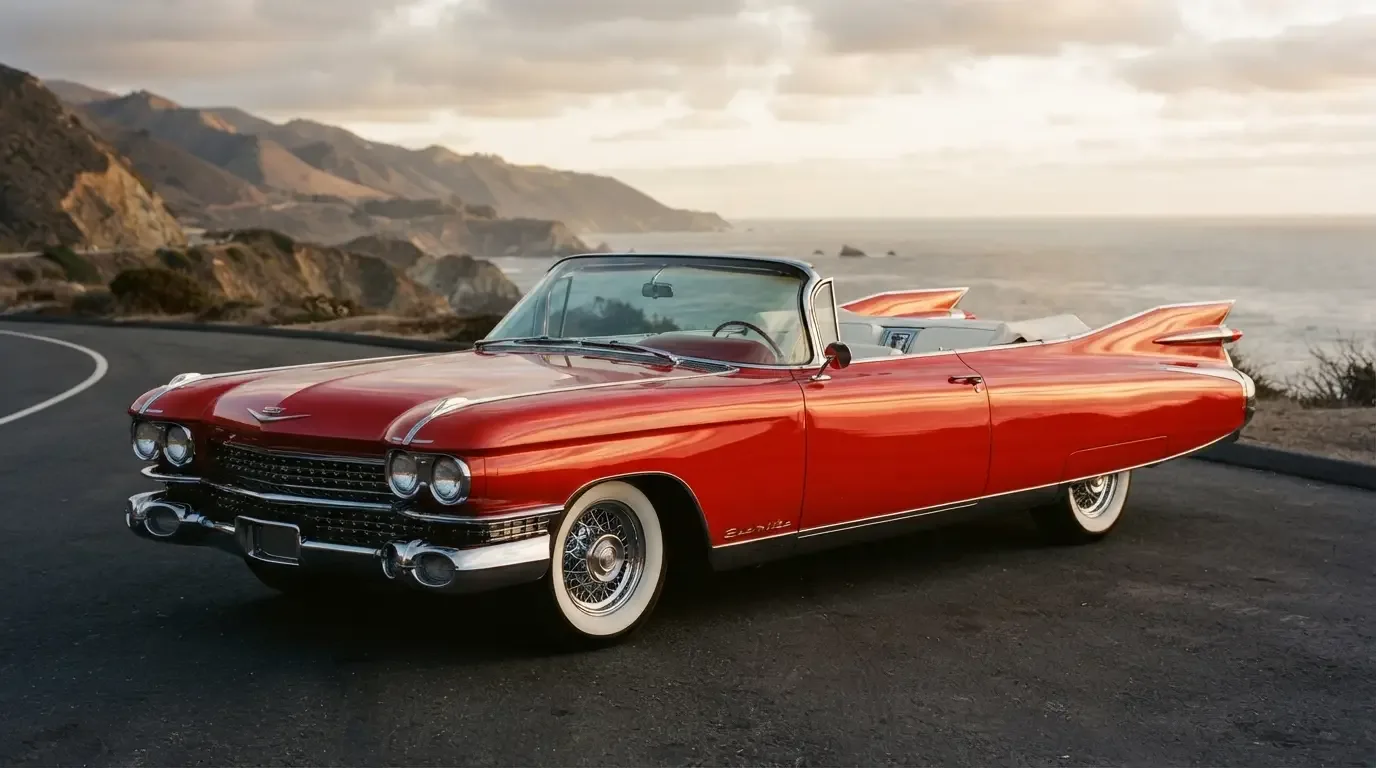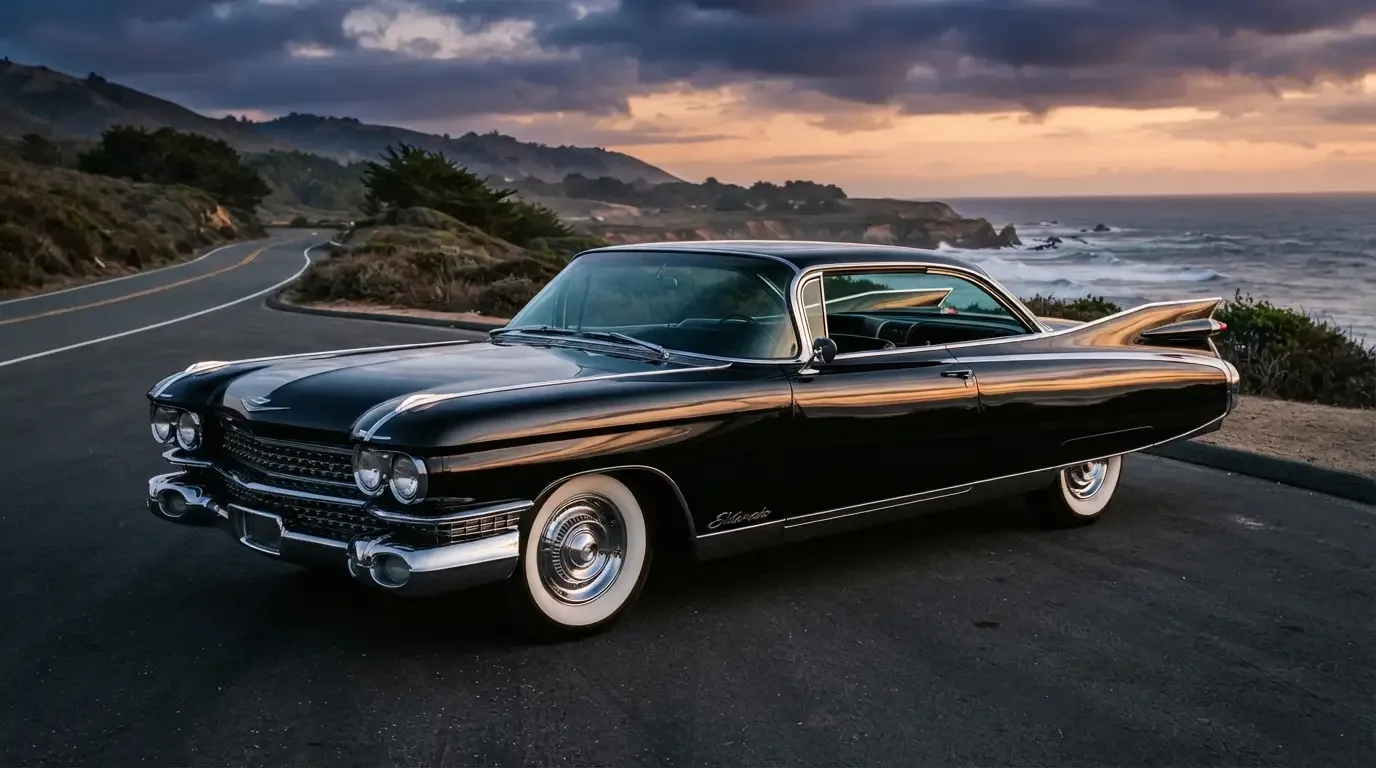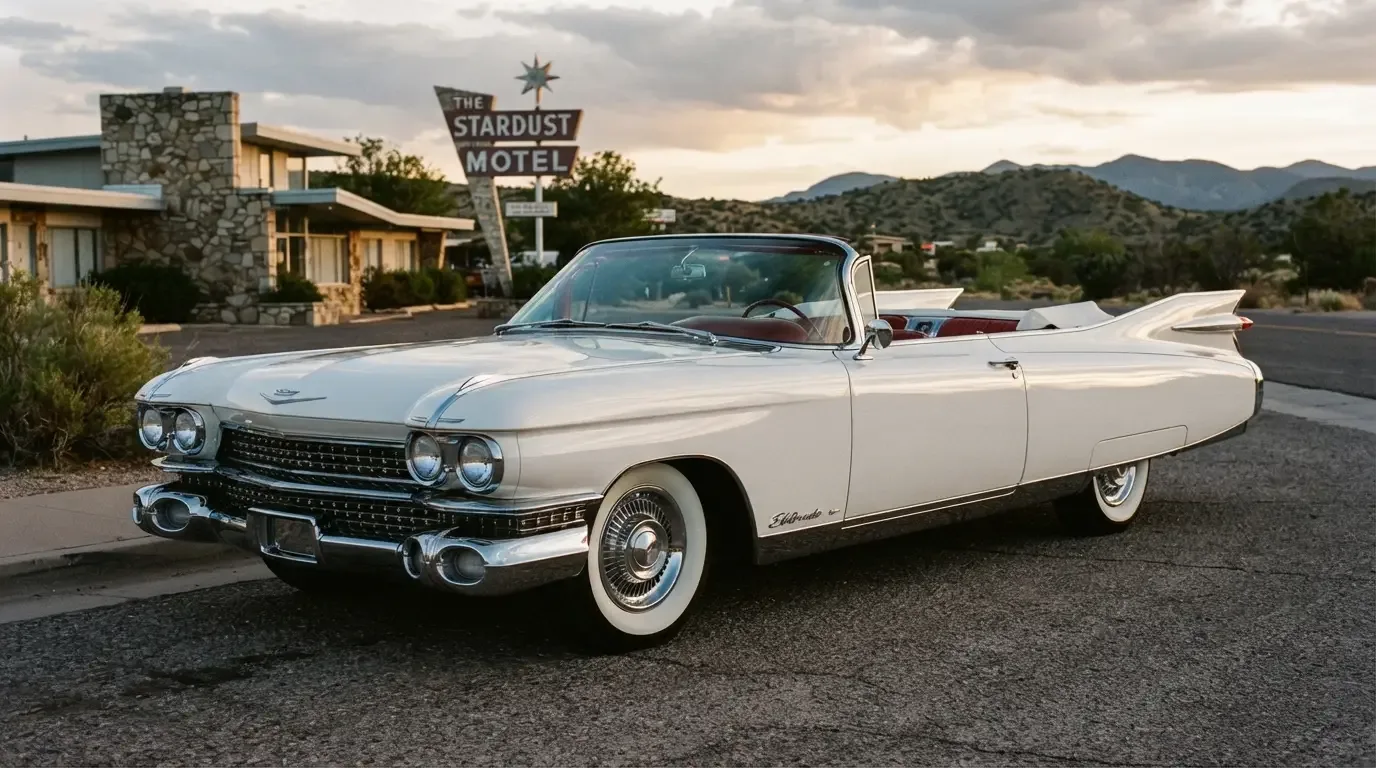
Ask a room of collectors to name one Cadillac, and the 1959 Eldorado wins more often than not. It is not the rarest Cadillac, nor the fastest, nor even the one with the most technically interesting engineering of its decade. What it has is a design so complete in its execution that it became shorthand for an entire era of American car culture, and understanding why the 1959 Cadillac Eldorado reached that status requires looking past the fins to the choices that put them there. For more on the 1959 cadillac eldorado as a model year, the fuller record fills in details this piece treats more selectively.
The fins were the end of an argument, not the start of one
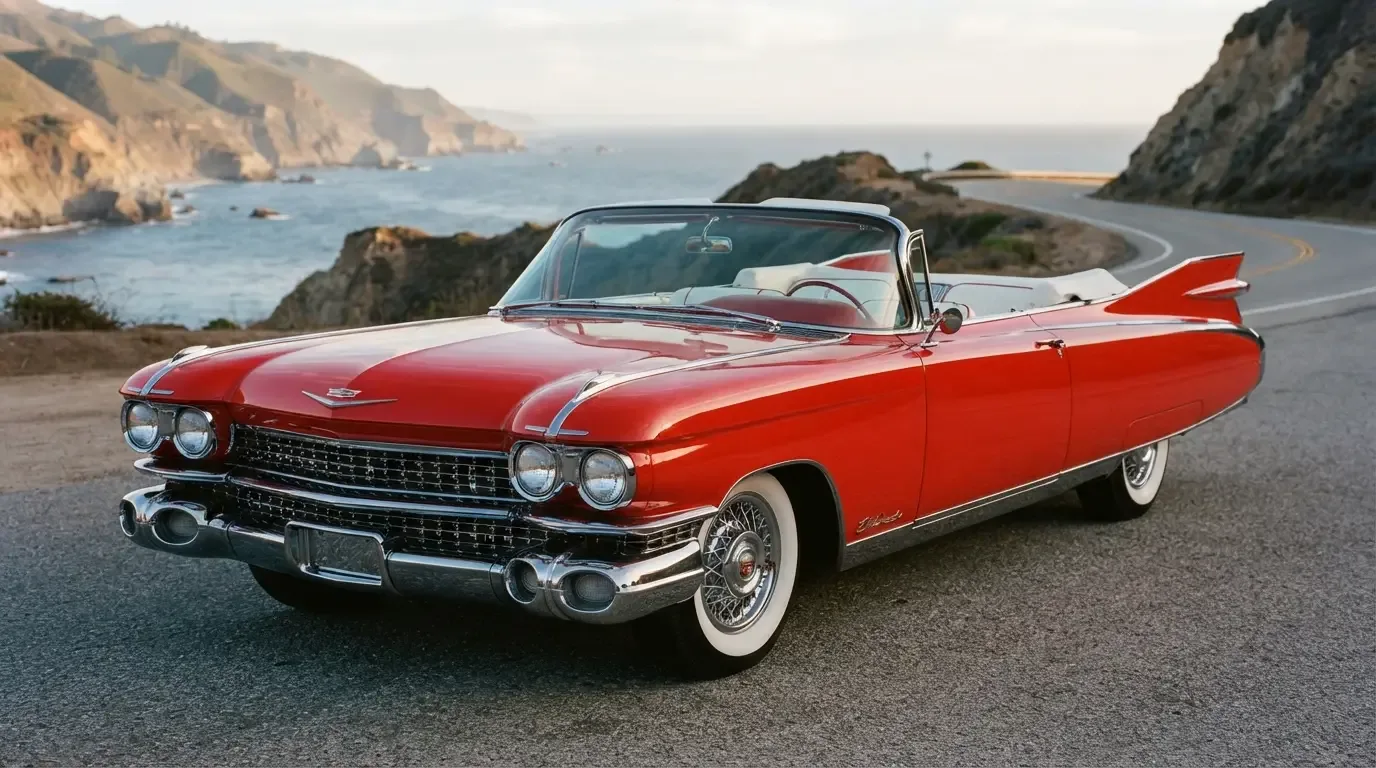
Cadillac's fins did not appear in 1959 out of nowhere. They trace back to 1948, when Cadillac stylist Franklin Hershey and his team drew inspiration from the twin-boom tail of the Lockheed P-38 Lightning fighter aircraft, and every model year afterward pushed the fin a little taller, a little sharper, a little more assertive. By 1959, under the direction of Cadillac's chief designer at the time, that decade-long argument reached its logical, uncompromising conclusion. The fins on the 1959 Eldorado stood taller than on any Cadillac before or since, capped by the dual bullet taillights that have become the single most recognizable detail in the marque's history.
What separates 1959 from the years that led up to it is restraint applied everywhere except the fin itself. The rest of the body surface is comparatively clean by the standard of the period, letting the tailfin read as a singular, dramatic gesture rather than one flourish among many. That contrast, a calm body with an emphatic tail, is a large part of the visual reason the design still photographs as confidently today as it did in period.
Scale mattered as much as style
The 1959 Eldorado was an enormous car by any measure, riding a 130-inch wheelbase and stretching about 225 inches overall, and that scale was not incidental to its impact. Post-war American prosperity had made room, quite literally, for cars that treated size as a statement of arrival, and the Eldorado sat at the top of the industry's size race in the year that race peaked. A smaller car wearing the same fins would have looked like a costume. On the Eldorado's full-size body, the fins looked inevitable.
| Detail | 1959 Eldorado |
|---|---|
| Wheelbase | 130 inches |
| Overall length | approx. 225 inches |
| Fin height | Tallest of any Cadillac model year |
| Taillight design | Dual bullet lenses set in the fin tip |
| Engine | 390 cu in V8 |
It arrived at exactly the right cultural moment
Design alone rarely explains why one car becomes iconic while a technically similar competitor fades from memory. The 1959 Eldorado landed in a year when American confidence, space-age imagery, and jet-age design language were all converging in popular culture, from television advertising to the rocket motifs showing up in furniture and architecture. Cadillac's stylists were not working in isolation. They were translating a mood that already existed in the culture into sheet metal, and the Eldorado did it more completely, and more famously, than anything else on the road.
That timing is also why the 1959 Eldorado has aged into something closer to a cultural artifact than a used car. It appears in film and photography as visual shorthand for late-1950s America in a way that competitors from Chrysler and Lincoln, who also chased fin height that year, generally do not. The Eldorado won the cultural argument as thoroughly as it won the styling one.
Two body styles, one legend
Part of what cements the 1959 Eldorado's reputation is that it was offered in both the Seville hardtop and Biarritz convertible body styles, giving the design language two distinct silhouettes to be remembered by. Neither style has fully eclipsed the other in cultural memory, which is unusual, since most iconic American cars of the era are remembered primarily in one body configuration. The Eldorado nameplate's roots go back further still, and for context on how the name reached this model year in the first place, where this started lays out that earlier history.
"When I catalogue a 1959 Eldorado for a concours field, I am not just cataloguing a car. I am cataloguing a design statement that the entire industry was reacting to within eighteen months. Very few individual model years carry that kind of weight."
- Sarah Whitfield
What competitors got wrong the same year
It helps to look at what Chrysler and Lincoln did with their own tailfins in 1959 to understand why the Eldorado's version aged better. Chrysler's fin package on some of its 1959 models pushed height without the same discipline in the taillight integration, and the result reads today as busier and less resolved. Lincoln's approach that year leaned into a squarer, more angular fin that lacked the sculptural taper Cadillac achieved. Neither competitor's design has held the same cultural staying power, and side by side comparisons at concours events consistently show the Eldorado's fin as the more considered execution, not simply the tallest one.
That comparison matters because it demonstrates the fin race was not won on height alone. Cadillac's stylists treated the taillight and the fin as one integrated form rather than two separate design problems solved independently, and that integration is precisely what a trained eye notices first when comparing period photographs of all three marques side by side. It is also why the bullet taillight itself became such a durable symbol on its own, appearing in advertising and retrospectives independent of the rest of the car.
Why the reputation has held for over sixty years
Fashions change, and plenty of once-celebrated designs from the late 1950s now read as excessive rather than confident. The 1959 Eldorado has largely escaped that fate because its exaggeration was disciplined. Every line on the car points toward the fin, and the fin itself is proportioned with more care than a casual glance suggests, tapering and angling in a way that avoids the cartoonish reading that afflicts some of its rivals from the same year. That discipline under maximalism is a genuinely rare combination in automotive design, and it is the real, underlying reason the 1959 Cadillac Eldorado still tops so many all-time lists.
For collectors evaluating the market today, that enduring reputation shows up directly in demand. Anyone curious what that looks like in practice can browse classic Eldorados on the market to see how consistently the 1959 model year commands attention relative to other years in the Eldorado's long production run, often at a meaningful premium over equally well-kept examples from surrounding years.