
The 1973 Cadillac Eldorado is the year the personal luxury coupe stopped apologizing for its size. This was the biggest Eldorado built to that point, riding on a 126.3-inch wheelbase, and it arrived in showrooms months before anyone in Detroit had heard the words "oil embargo." For one model year, the Eldorado got to be exactly what its designers wanted it to be, with no gas line outside the dealership and no federal committee yet asking hard questions about fuel economy.
Car Features
6 min read
The 1973 Eldorado: Peak Land Yacht
Before the oil embargo and before the last convertible marketing push, the 1973 Cadillac Eldorado was the biggest, most confident version of the car Detroit ever built.
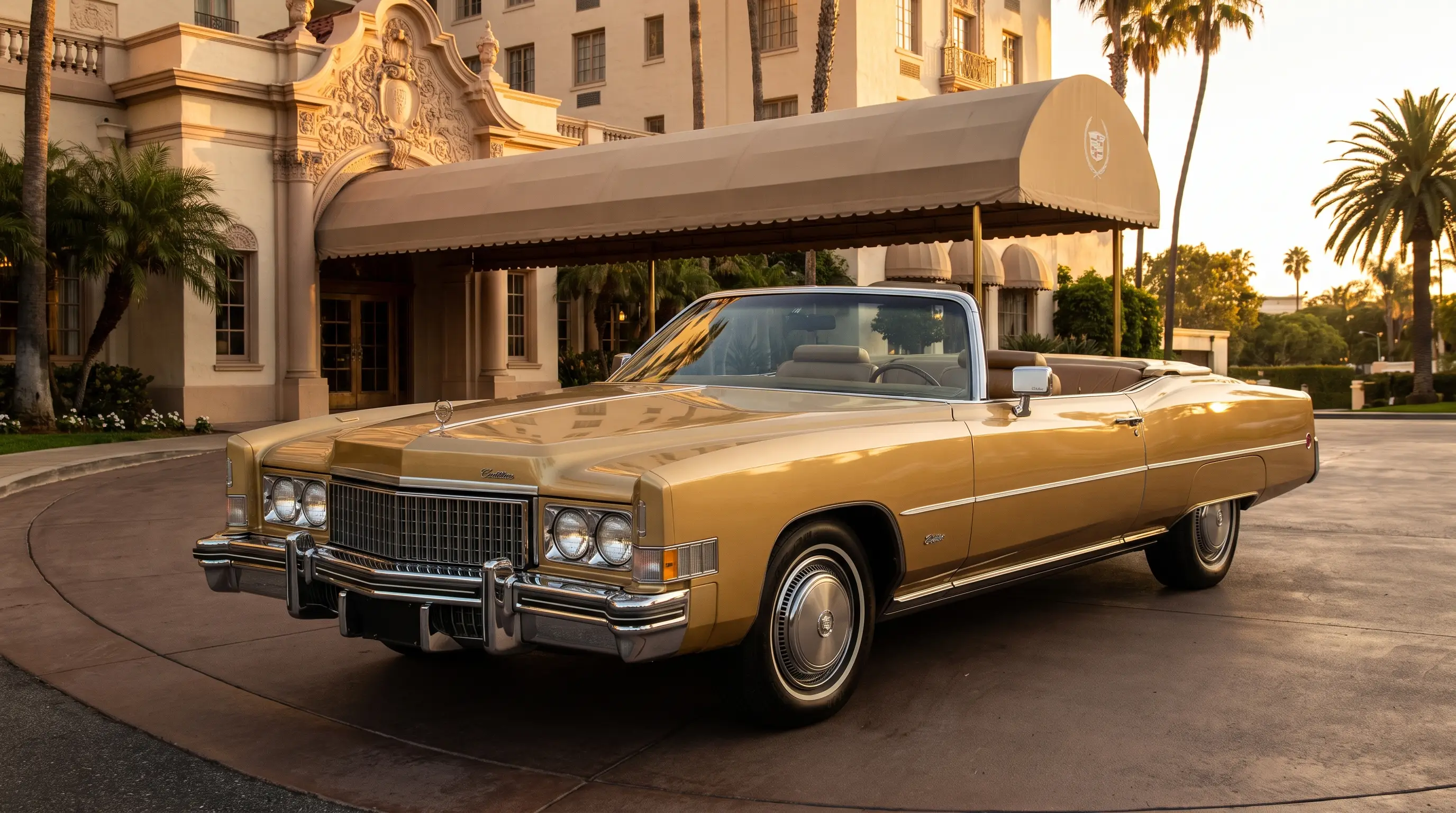
The last year before the world changed
Production records place 1973 as a peak year for the Eldorado line, with combined coupe and convertible output reaching 51,451 units for the model year, the first time Eldorado production had crossed 50,000. The convertible alone, which had returned to the Eldorado lineup in 1971 after a long absence, sold in numbers that would look almost unbelievable a few years later, with 9,315 units built for the model year against 42,136 coupes. Cadillac dealers were not begging customers to consider an Eldorado in 1973. They were racing to keep enough on the lot.
The timing mattered. By October of that year, the OPEC embargo had begun reshaping how Americans thought about a car this size, a shift covered in detail in our piece on how the oil crisis reshaped the Eldorado a couple of model years later. But the 1973 cars themselves were engineered and ordered before any of that pressure existed, which is part of why they read today as the purest expression of the land yacht idea before compromise set in.
Under that enormous hood
Every 1973 Eldorado carried Cadillac's 500 cubic inch V8, the largest passenger car engine General Motors put into regular production. Output was rated at 235 net horsepower at 4,400 rpm under the SAE's newly adopted net measurement standard, a figure that looked modest next to the old gross ratings but still moved close to two and a half tons of car with unhurried confidence. Torque, not horsepower, was the point. The 500 made 385 lb-ft, enough that the Eldorado never seemed to be working hard, whatever the load.
Cadillac paired the engine with a Turbo-Hydramatic 400 automatic and, as it had since 1967, front wheel drive. That layout was unusual for a car this large in 1973 and gave the Eldorado a flatter, wider footprint on the road than most owners expected from a Cadillac. There was no driveshaft tunnel intruding into the cabin, which meant the front seat floor was flat all the way across, a small detail that made the interior feel even bigger than the exterior already promised.
| Spec | 1973 Eldorado |
|---|---|
| Engine | 500 cu in (8.2L) OHV V8 |
| Horsepower | 235 net @ 4,400 rpm |
| Wheelbase | 126.3 in |
| Curb weight | approx. 4,966 lb |
| Convertible production | 9,315 (42,136 coupes) |
| Transmission | Turbo-Hydramatic 400, 3-speed automatic |
Styling that owed nothing to restraint
The 1973 Eldorado wore a new front end with a wider grille and larger bumpers that anticipated the federal 5 mph impact standards phasing in for 1974. Designers under Bill Mitchell kept the long hood and short rear deck proportion that had defined the E-body since 1967, but the car grew heavier chrome trim and a more vertical grille treatment than the 1971-1972 cars had carried. Opera lamps, vinyl roof options, and wire wheel covers were all available, and a fair number of buyers checked every box on the order sheet. Interior choices ran from cloth notchback seats to full leather, with Cadillac offering more than a dozen colorways across coupe and convertible bodies, and the dash retained real toggle switches and a full sweep speedometer rather than the warning light clusters that would creep into later, more emissions focused model years.
The convertible top itself was a genuine engineering achievement for the era, a fully powered mechanism that folded into a well behind the rear seat and left a clean deck line when raised. Cadillac buyers who wanted open air motoring in a full size American luxury car had exactly one place left to get it by 1973, since most of the segment's other convertibles had already been discontinued.
Why collectors overlook it
Ask most people to name a milestone Eldorado from the 1970s and they will say 1976, thanks to the marketing campaign that told buyers it was the final American convertible. The 1973 rarely comes up, despite being arguably the more honest car. It was built without the pressure of a "last chance" sales pitch, without the emissions strangling that hit later 500 V8s, and before insurance companies and fuel prices reshaped what Cadillac itself thought a flagship coupe should be.
That obscurity has kept prices for clean 1973 Eldorado convertibles well below their 1976 counterparts, even though survival rates are lower and the driving experience is arguably better, with more power on tap and a lighter emissions burden on the carburetor. The catalytic converter had not yet arrived, the compression ratios had not yet been ground down to run on unleaded fuel, and the 500 could still pull hard from a stop without the flat spot that shows up in cars built just a couple of years later. Buyers researching the model often start with where this started, the fuller account of how the Eldorado convertible got its reputation, before working backward to appreciate what came before the hype.
"Everyone chases the 1976 because of a marketing line. Pull the build sheet on a 1973 and you will usually find more engine, less smog equipment, and a lower price tag. The record just does not care what the ad copy said."
- Tom Ramirez
Finding one today
Surviving 1973 Eldorado convertibles show up at a fraction of the volume their production numbers would suggest, since many were driven hard, left outdoors, or simply used up over four decades of ownership. Rust in the lower quarters and trunk floor is the most common structural issue, and the power top mechanism is expensive to sort if it has sat unused for years. A car with documented history and a functioning top commands a real premium over a project.
For buyers who want the biggest, most confident version of the 1970s Eldorado without paying the "last convertible" tax, a well kept 1973 is often the smarter purchase. Anyone shopping the era should look at a classic Eldorado for sale alongside earlier cars like this one, since the underlying engineering across 1971 through 1976 changed less than the marketing did.
Sources and notes
Related Reading
Have a
Cadillac Eldorado
for Sale?
Reach thousands of serious classic car collectors across the US.
Sell It Here →
Are You a Classic Car Dealer?
List your full inventory and connect with targeted classic car buyers.
Join as a Dealer →
#Cadillac Eldorado
#land yacht
#1970s luxury cars
#classic cadillac
#eldorado convertible
#1973 Eldorado

About the author
Tom Ramirez
Corvette researcher and historian based in Bowling Green, Kentucky. Two decades documenting Corvette production history from original factory records.
Related Listings - Cadillac Eldorado
Comments
Be the first to comment on this article.