
Two hundred cars, one color scheme, and one date on the calendar that Cadillac was never going to let pass unmarked. As the Eldorado convertible wound down its production run in 1976, the same year the United States marked two hundred years since independence, Cadillac built a final small batch dressed specifically for the occasion. The 1976 Bicentennial Eldorado exists at the intersection of two endings, a model run and a national anniversary, and it was built to be noticed as both.
Car Features
7 min read
The 1976 Bicentennial Eldorado Edition
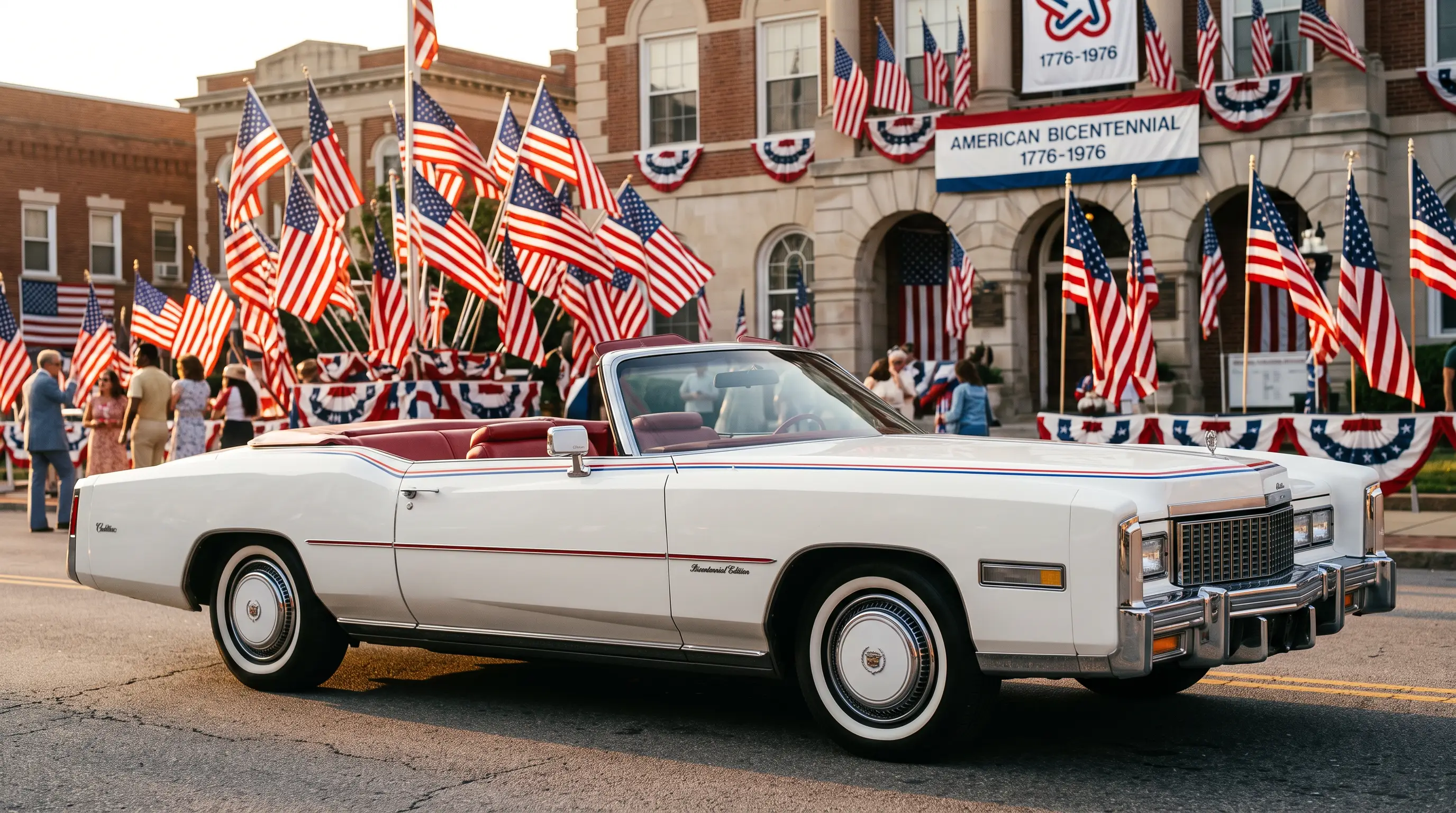
A run of 200 white, red, white, and blue trimmed Eldorados closed out convertible production in 1976, timed to the American Bicentennial and individually numbered.
What made the edition distinct
The Bicentennial cars were finished in Cotillion White with a top and interior scheme built around red, white, and blue, a deliberate, unsubtle reference to the anniversary being celebrated. Each of the 200 cars built for the edition carried an individual sequential number, typically documented on a dash plaque or console badge, tying every example to a specific place in the run. That numbering is what separates a genuine Bicentennial Eldorado from a standard white 1976 convertible dressed up after the fact, and it is the first thing a careful buyer or researcher should look for when evaluating a car claimed to be part of the edition.
Why the timing was not an accident
Cadillac's decision to close out Eldorado convertible production with a patriotic themed special edition served two purposes at once. It gave the division a marketing hook tied to a national celebration that every American newspaper and television broadcast was covering that year, and it gave the final production run of a discontinued body style a sense of occasion rather than a quiet fade out. The convertible was already being sold under the banner of being the last of its kind. Wrapping the final cars in bicentennial colors reinforced that framing, turning an ordinary end of model run production decision into something that read as a historical marker in its own right.
Reading a car's authenticity today
Because a white convertible with a colorful interior is not difficult to replicate, verifying a genuine Bicentennial edition requires more than a glance at the paint. Documentation should include the numbered plaque or its recorded number, a body tag consistent with 1976 production, and ideally a paper trail connecting the car to its original delivery. Cadillac's records from the mid 1970s survive in incomplete form, which means a researcher working through a claimed Bicentennial car often has to cross reference dealer invoices, period photographs, and owner history rather than relying on a single documented source. That kind of layered verification is standard practice for any limited edition car from this era, but it matters more here because the edition's entire premise rests on scarcity that a repaint alone can convincingly fake.
| Detail | 1976 Bicentennial Eldorado |
|---|---|
| Production | 200 units (199 sold; Cadillac retained car #200) |
| Exterior color | Cotillion White |
| Interior theme | Red, white, and blue |
| Identification | Individually numbered plaque |
"A white convertible tells you nothing on its own. A numbered plaque, a matching body tag, and a documented delivery chain tell you whether you are looking at a genuine Bicentennial car or a very convincing repaint. In this segment, the paperwork is the artifact as much as the paint is."
- Sarah Whitfield
Where the cars went at delivery
Cadillac dealers treated the Bicentennial cars as events in their own right rather than routine stock. Several were reportedly reserved for dealer principals, longtime customers, or promotional appearances tied to local bicentennial celebrations happening across the country that summer. That pattern of distribution, more ceremonial than a standard allocation, is part of why tracing an individual car's original delivery record matters so much to researchers today. A Bicentennial Eldorado that can be tied to a documented dealer event or an original owner with a clear provenance carries a different weight than one whose early history is simply unknown, even when both present identically well in current condition.
The broader context of 1976 makes this distribution pattern easier to understand. The bicentennial year produced an enormous wave of themed merchandise, commemorative products, and one-off promotional items across nearly every American industry, most of which have long since been discarded or forgotten. Cadillac's version of that impulse happened to be attached to a genuinely significant, low production automobile rather than a coin or a commemorative plate, which is a large part of why it survived as a collectible in a way most 1976 bicentennial merchandise did not.
Distinguishing genuine cars from later tributes
Because the Bicentennial color scheme proved popular and visually striking, later owners of standard white 1976 convertibles have occasionally repainted or retrimmed cars to resemble the edition without any claim to genuine production. Most of these tribute cars are presented honestly by their owners as recreations rather than originals, but a smaller number have circulated through the market with vague or misleading descriptions. A careful researcher treats any Bicentennial claim as unverified until the numbered plaque, body tag, and, ideally, delivery paperwork line up, rather than accepting a seller's description of the car's history at face value. That standard of proof is not excessive caution. It reflects how thin the line is between a genuine 200 unit production run and a well executed repaint.
Its place inside a bigger closing chapter
The Bicentennial edition did not exist in isolation. It was the final flourish on a model year that Cadillac had already built up as historically significant through its broader last convertible marketing, and understanding one requires understanding the other. Readers looking for the full context behind that closing chapter, including why Cadillac chose to end convertible production that year at all, can find it in our complete history of the 1976 model. The Bicentennial cars sit inside that story as a specific, traceable subset rather than a separate episode, built from the same convertible platform and sharing the same production line as the standard 1976 Eldorado convertibles that surrounded them.
For collectors and researchers, that context matters because it explains why a genuine Bicentennial Eldorado commands attention beyond its patriotic paint scheme. It represents both the closing weeks of a discontinued body style and a specific, deliberately small production run within that closing chapter, a combination that gives these cars a documented rarity most limited editions from the period cannot claim with the same precision. Anyone researching a specific example, or looking to add one to a collection, can start by comparing current inventory to find a classic Eldorado from the 1976 model year and work from there toward verifying its place in the run.
As with most limited editions from the period, time has not made verification easier. Original dealer records have scattered or disappeared, early owners have passed the cars through several hands without always preserving the original paperwork, and the market's growing appetite for anything bicentennial themed has created its own quiet incentive to round a story up rather than present it plainly. None of that erodes the historical significance of the genuine 200 car run. It simply means that significance now has to be proven case by case, one plaque and one body tag at a time, rather than assumed from the paint alone.
Sources and notes
- 1976 Cadillac Eldorado Bicentennial Edition - RM Sotheby's
- Red, white and blue 1976 Cadillac Eldorado Bicentennial Edition - ClassicCars.com Journal
- 1976 Cadillac Fleetwood Eldorado Bicentennial Edition - Hagerty Media
- Rare Bicentennial: 1976 Cadillac Fleetwood Eldorado Convertible - Barn Finds
- Cadillac Eldorado - Wikipedia
Related Reading
Have a
Cadillac Eldorado
for Sale?
Reach thousands of serious classic car collectors across the US.
Sell It Here →
Are You a Classic Car Dealer?
List your full inventory and connect with targeted classic car buyers.
Join as a Dealer →
#Cadillac Eldorado
#eldorado convertible
#1976 Cadillac
#Bicentennial Eldorado
#limited edition Cadillac
#Cadillac authentication

About the author
Sarah Whitfield
Third-generation classic car collector specializing in pre-war American and European coachbuilt automobiles. Researcher and concours enthusiast.
Related Listings - Cadillac Eldorado




Comments
Be the first to comment on this article.