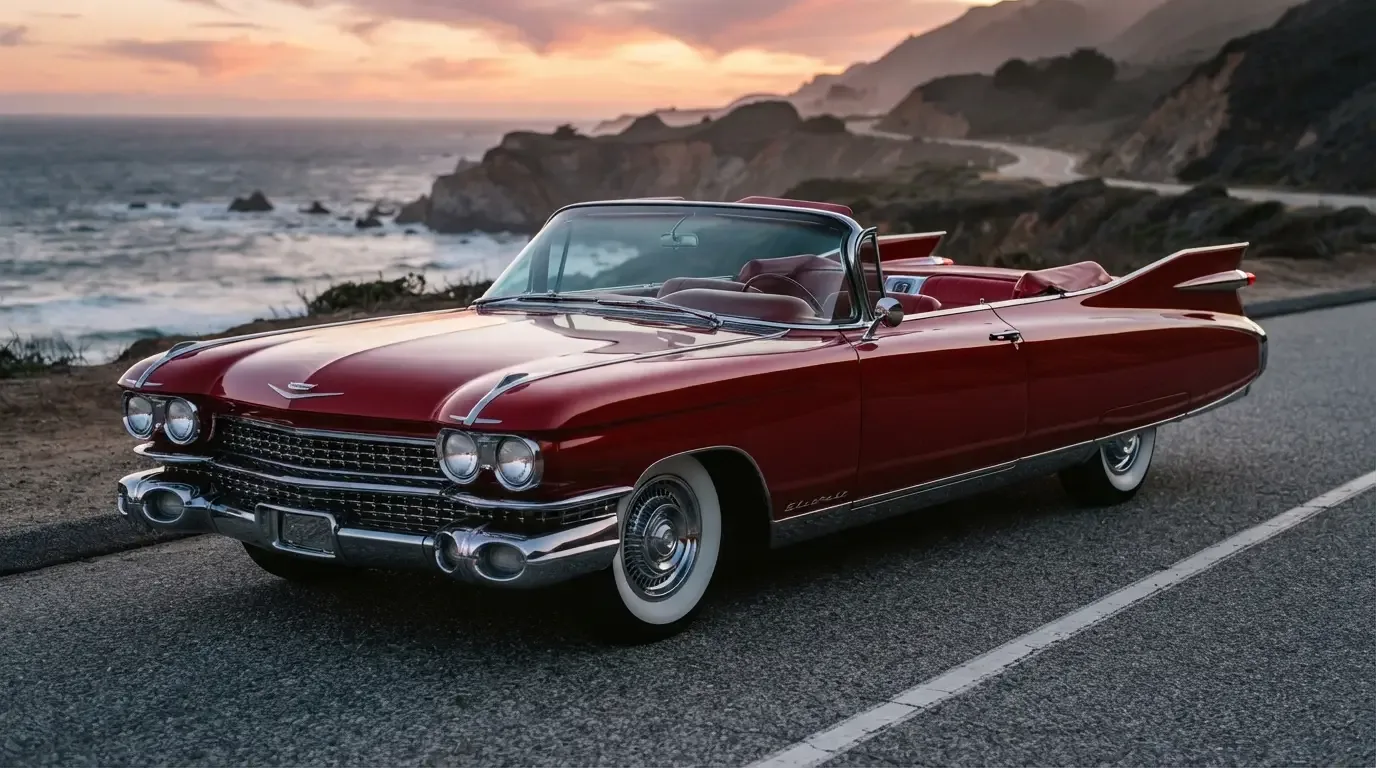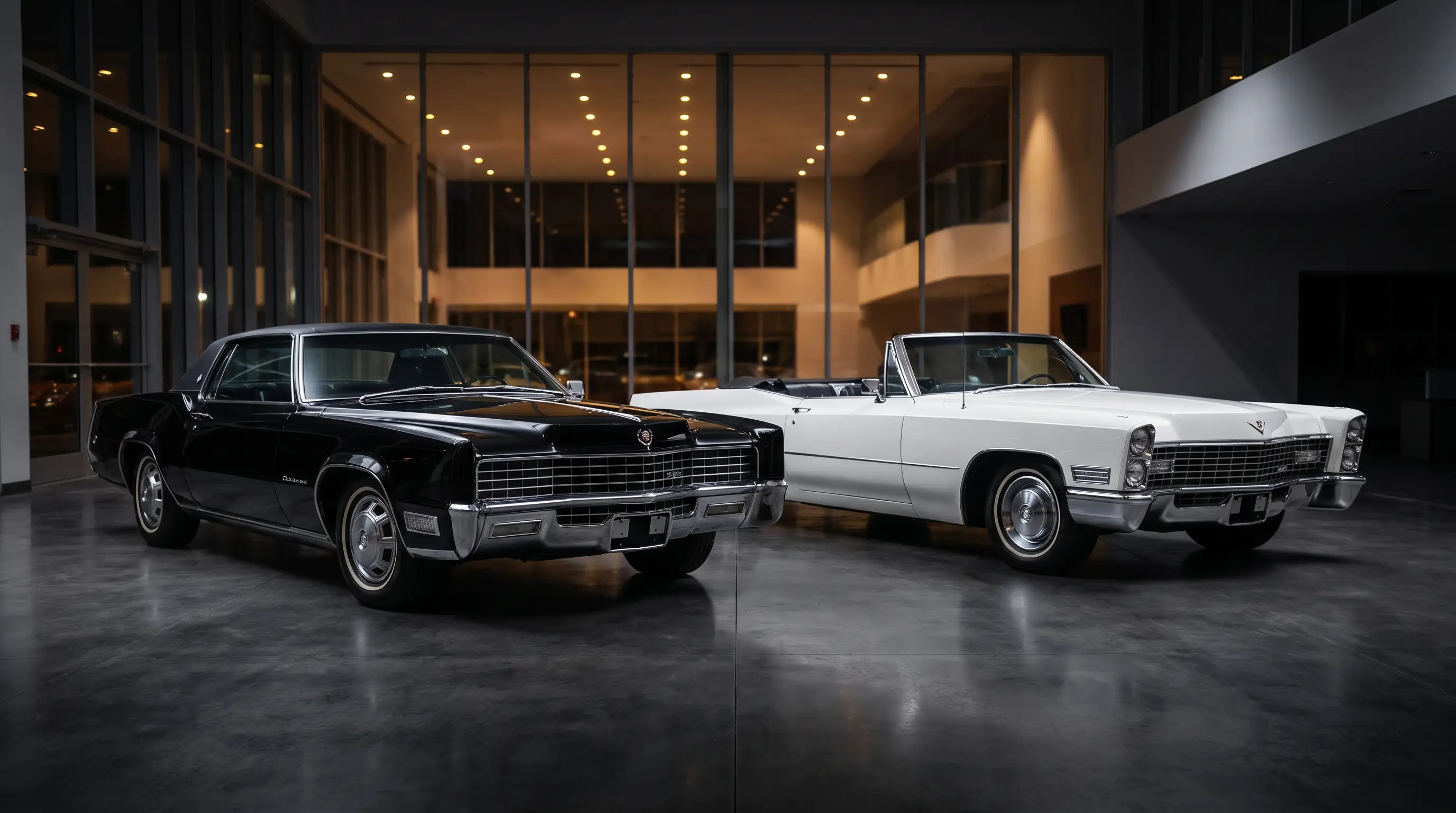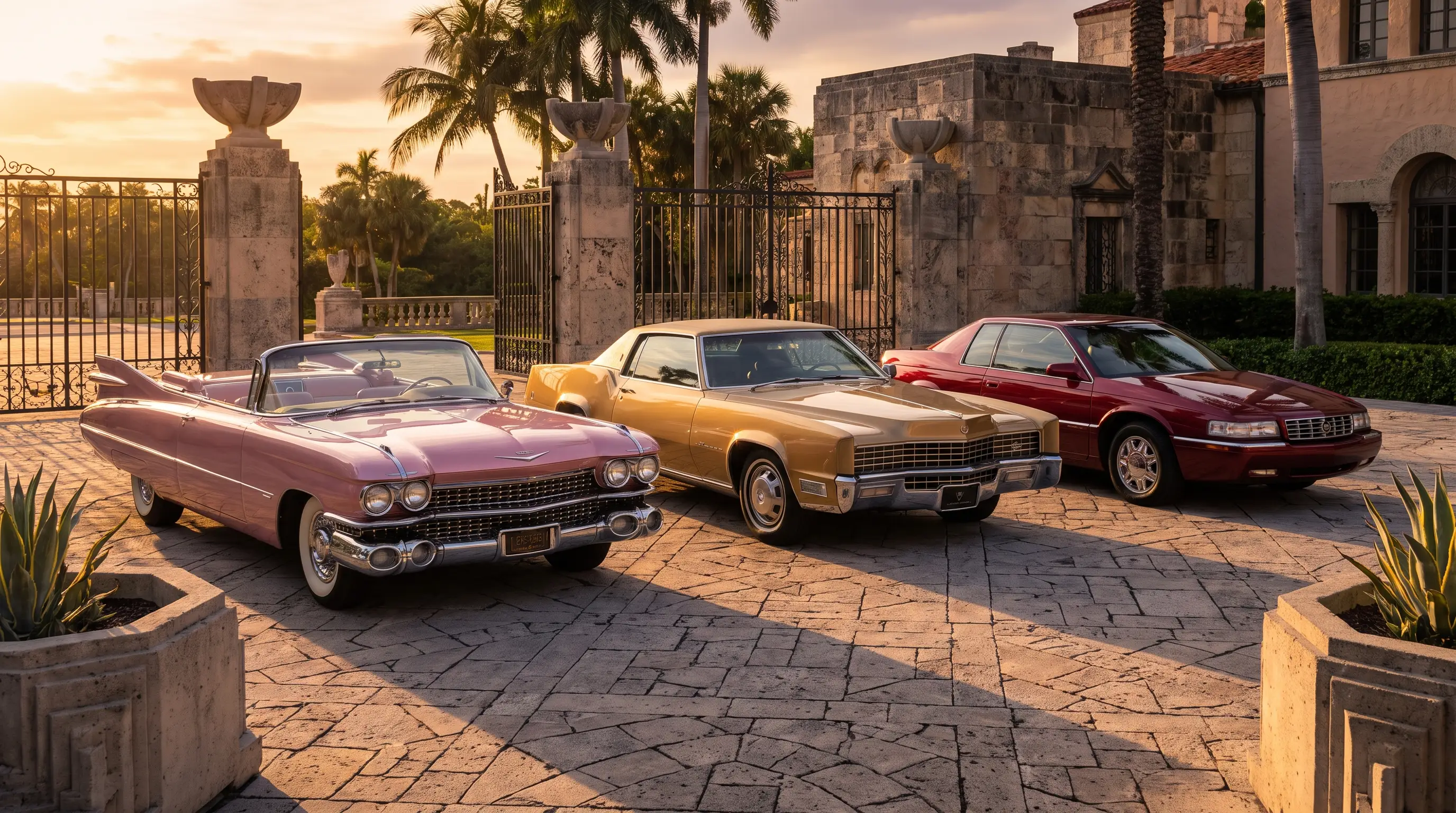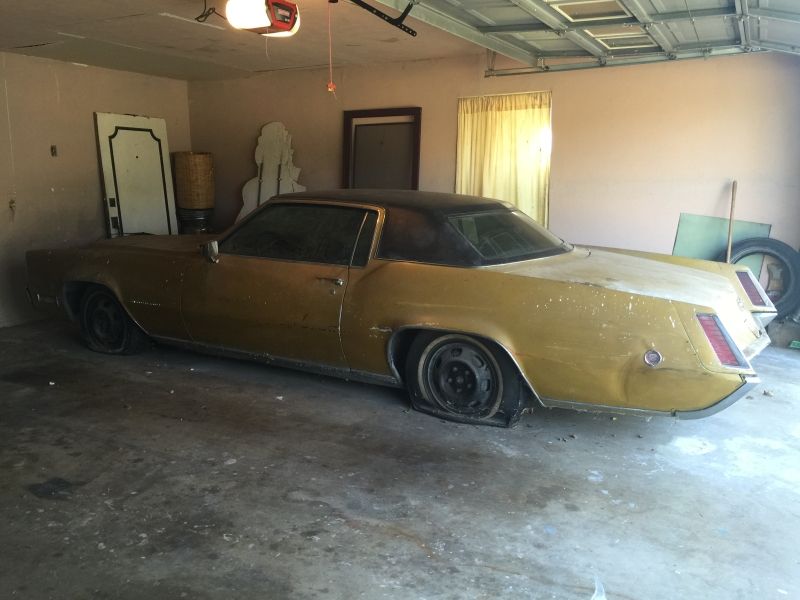
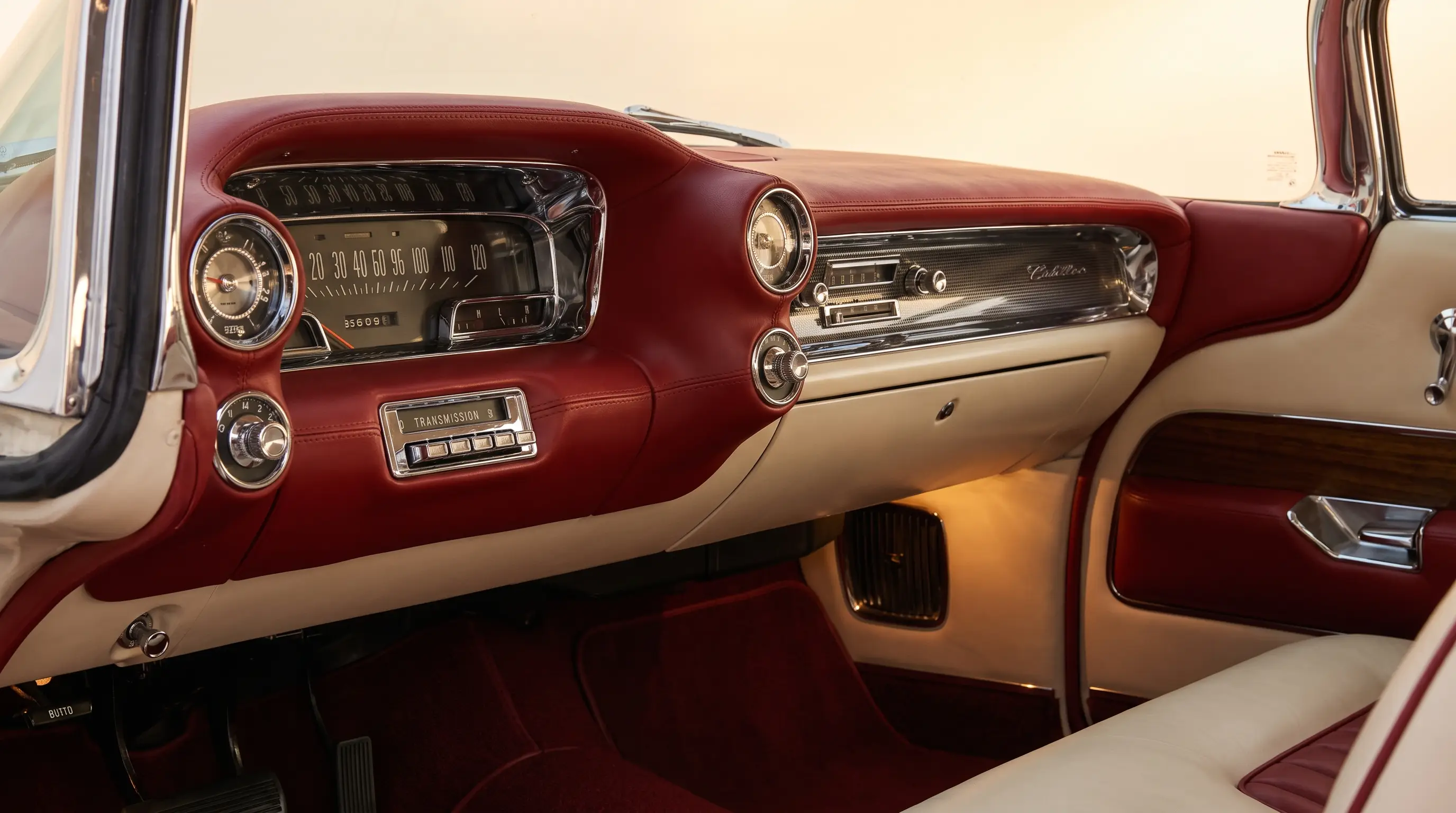
There is a particular hush that settles over a garage when someone opens a 1959 Eldorado's driver door for the first time in years. The seats get a glance. The tailfins already did their work outside. But it is the dashboard, lit by a shaft of window light, that makes people go quiet. Cadillac's designers understood something about cadillac eldorado dashboard design that a lot of manufacturers of the era did not: the instrument panel was not a functional afterthought bolted beneath the windshield. It was the room you sat in for the next decade of ownership, and it needed to feel like somewhere worth being.
The 1950s: chrome as architecture
Early Eldorado dashboards treated chrome the way a cathedral treats stone, as structure rather than decoration. The 1957 to 1958 Eldorado Brougham took this furthest, with a symmetrical dash split by a wide chrome band and gauges housed in their own jeweled clusters. Nothing about it pretended to be simple. Every knob had a matching twin, every texture had a chrome counterpart, and the whole panel read as an extension of the car's tailfin drama rather than a separate design decision made by a different team.
That era's dashboards used real metal trim rather than the plated plastic that would come to dominate later decades, which is part of why surviving examples photograph so well today and why restorers treat original dash trim as some of the hardest material to source correctly.
1967 to 1970: the personal luxury cockpit
When the Eldorado moved to front wheel drive in 1967, the dashboard changed philosophy along with the chassis. Cadillac's designers gave the new Eldorado a driver-oriented panel that curved toward the seat, a departure from the flatter, more symmetrical layouts of the tailfin years. Simulated wood trim appeared in combination with brushed metal accents, and the effect was closer to a European grand tourer than to the ornate 1950s cars that preceded it. This was the dashboard era that best matched the Eldorado's new low, long hood proportions, a cabin built to feel like command of the car rather than a display case around the driver.
The full arc of that body change, and what it meant for the car as a whole rather than just the cabin, is covered in the whole picture if you want the complete design history rather than the dashboard alone.
The land yacht dash of the 1970s
By the mid 1970s, Eldorado dashboards had grown wider and softer, matching a car that had grown wider and softer everywhere else. Padded vinyl surfaces replaced hard chrome edges, partly for style and partly for the safety regulations reshaping every American dashboard of the decade. Woodgrain trim expanded across the panel, and the instrument cluster simplified into fewer, larger gauges set behind a shallow hood. This was the Eldorado convertible era, and the dashboard's job shifted toward comfort and visual warmth rather than the crisp precision of the late 1960s cars.
Owners who drove these cars daily remember the dash less for any single design flourish and more for how much of it there was. Everything sat close, everything was padded, and the whole panel curved gently around the front seat like a piece of furniture rather than an instrument.
"You can tell exactly what decade an Eldorado dashboard is from without seeing a single badge. The chrome tells you the 1950s, the wood and brushed metal tell you the 1970s, and the digital displays tell you it stopped being subtle at all by the late 1980s."
- Nora Beckett
Part of what makes each Eldorado dashboard so recognizable is the material Cadillac chose to work with rather than any single shape. The 1950s cars leaned on real chrome plating over pot metal, heavy and cold to the touch, catching light in a way no later plastic trim ever quite managed. The 1960s brought a shift toward vacuum-formed plastics with a metallic finish, lighter and cheaper to produce but still convincing from a few feet away. By the 1970s, soft-touch vinyl padding covered most of the panel's surface, a response both to changing tastes and to federal interest in what a driver's head would hit in a collision.
Woodgrain appliques ran through nearly every decade in some form, but the quality and application changed constantly. Early appliques were often applied over metal in thin, carefully matched panels. Later decades used wider sheets of woodgrain vinyl that were faster to install and cheaper to replace, a small but telling sign of how Cadillac balanced craft against cost as the Eldorado moved from limited flagship to higher volume personal luxury coupe.
Digital gauges and the downsized 1980s cabin
The 1986 downsizing brought the biggest single change to the Eldorado dashboard in the nameplate's history. The new front drive platform came with a smaller cabin and, on certain trims, a digital instrument cluster with green and amber electronic displays that replaced the analog needles Cadillac had used since 1953. It was a striking, controversial shift. Some buyers loved the futuristic look. Others felt it traded warmth for gadgetry, and Cadillac spent the following years walking the design back toward more conventional analog gauges as the decade wore on.
The material quality of that generation's dashboard plastics has not aged as gracefully as the metal and glass of earlier decades, and it remains one of the more common restoration headaches on late 1980s Eldorados today.
The Northstar era and the final dashboard
The 1992 to 2002 Eldorado, redesigned for 1992 and joined by the Northstar V8 from the 1993 model year on, brought a softer, more rounded dashboard shape that matched the bodywork's aerodynamic curves. Cadillac leaned into driver information technology here, adding trip computers and, in later years, more sophisticated climate and audio integration than any earlier Eldorado dashboard had attempted. By the time the final 2002 Collector Series cars rolled out, the dashboard had completed a full circle from ornate 1950s showpiece to digital 1980s experiment to a quietly confident, ergonomically focused final form.
Each of these dashboards tells a story about what Cadillac believed luxury meant in that particular decade, whether that was abundance of chrome, warmth of material, or command of information. Sit in a 1958 Brougham and then a 2002 Collector Series back to back and the shift is almost hard to reconcile as the same nameplate, yet both panels were built to answer the same question about what a driver in that seat deserved to see and touch.
That question is worth asking again every time a new Eldorado owner opens that driver door for the first time, whether the car in front of them is wrapped in stainless steel and jeweled chrome or wrapped in soft vinyl and a digital display. The dashboard was never an afterthought on this car, in any decade. If any of it has you thinking about owning one of these cabins yourself, you can go find a classic Eldorado currently listed and see which era's dashboard speaks to you.