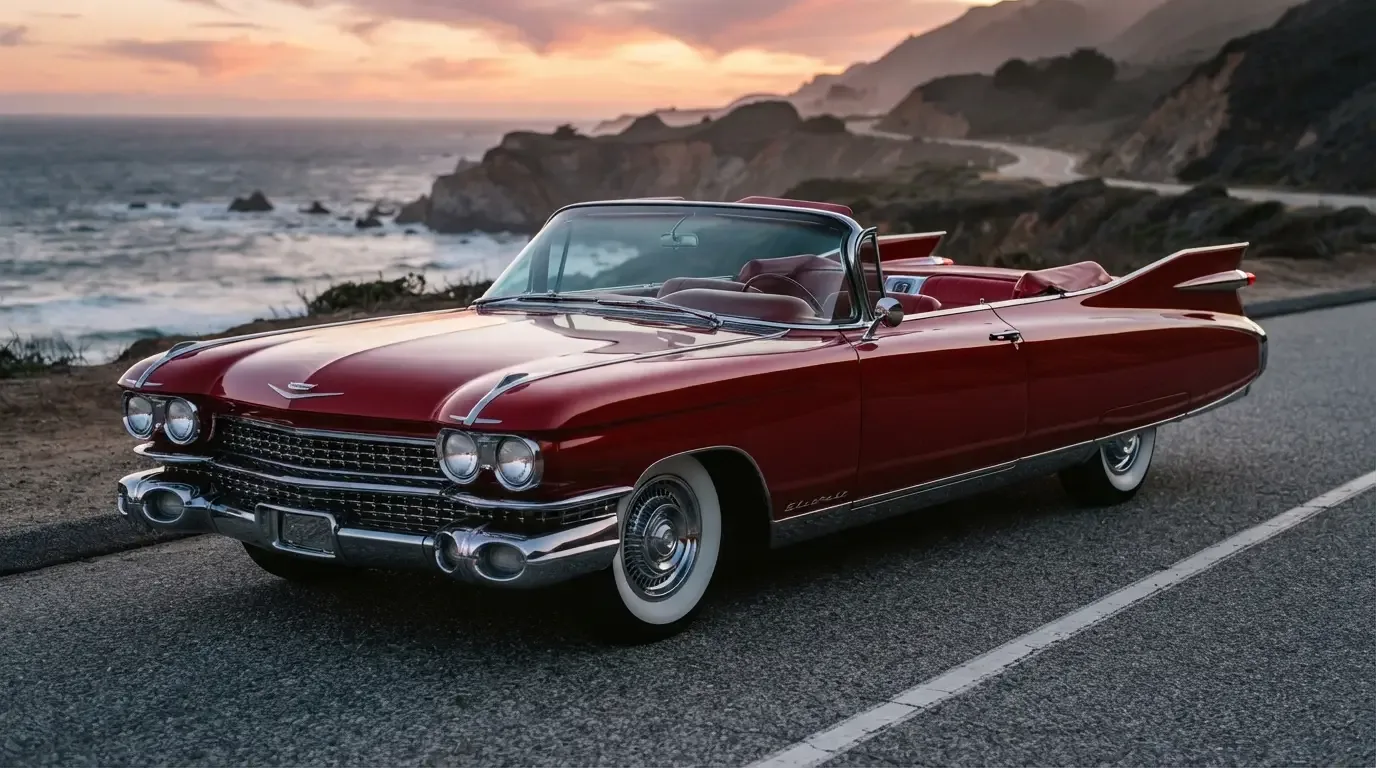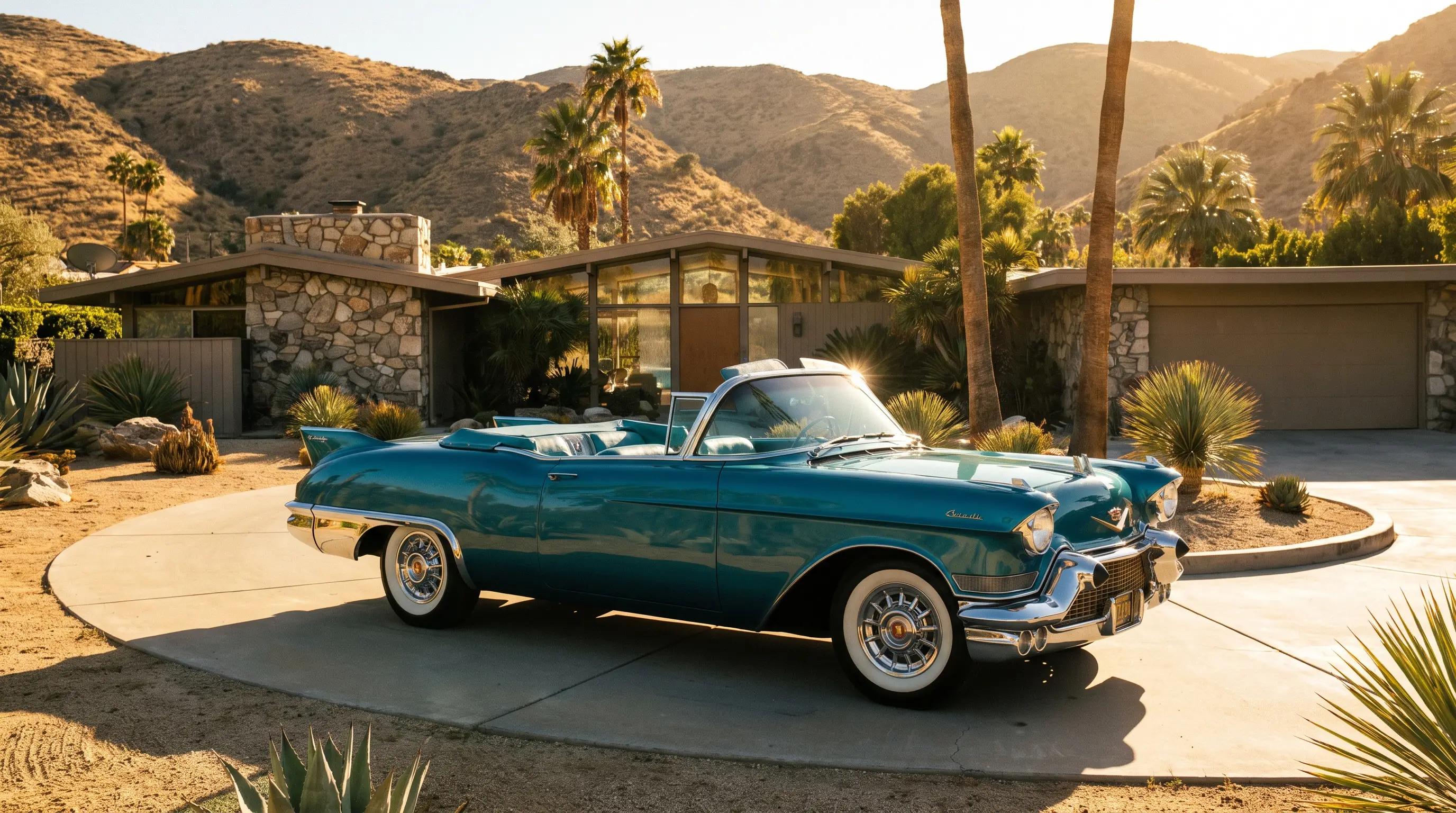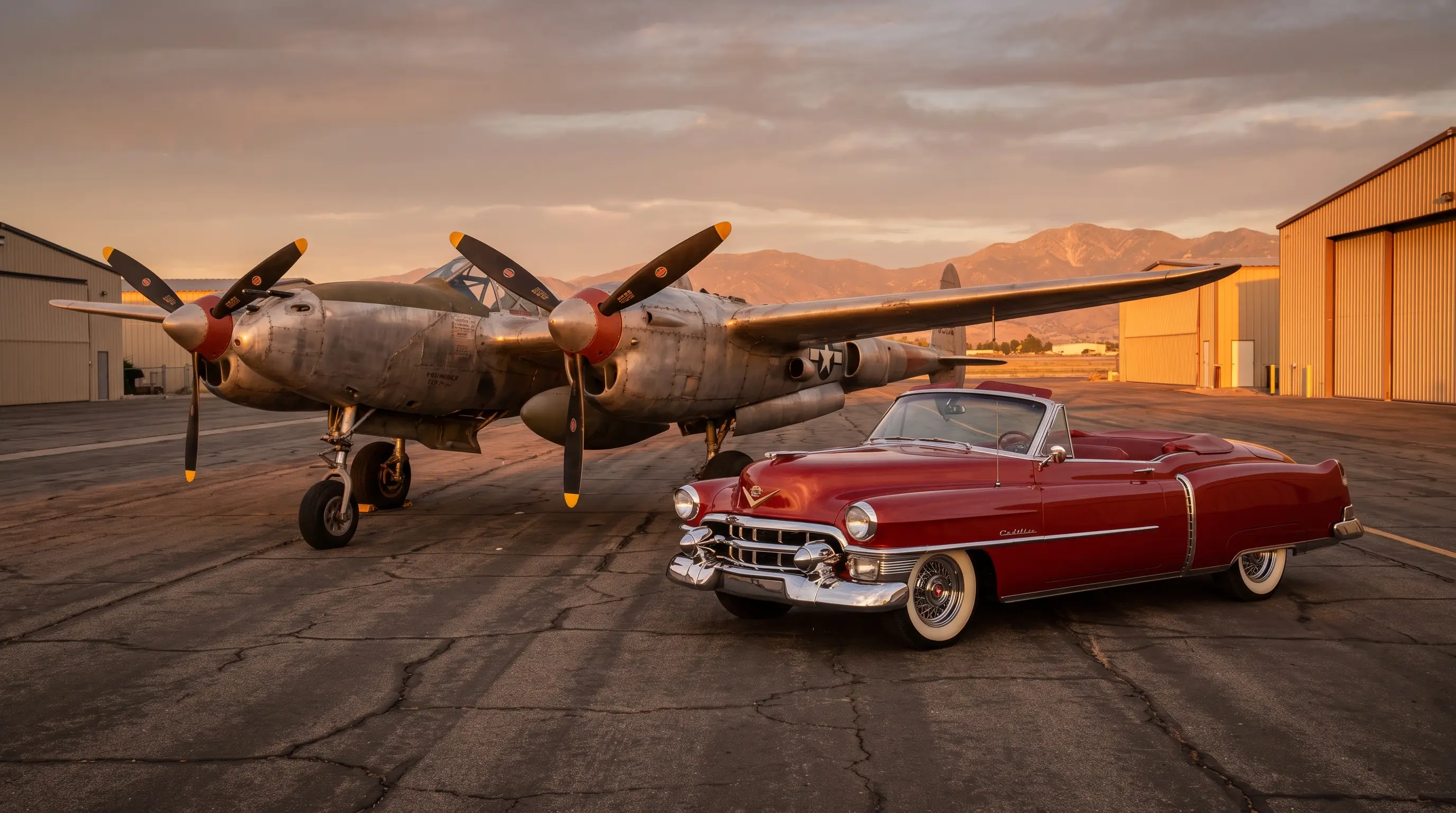
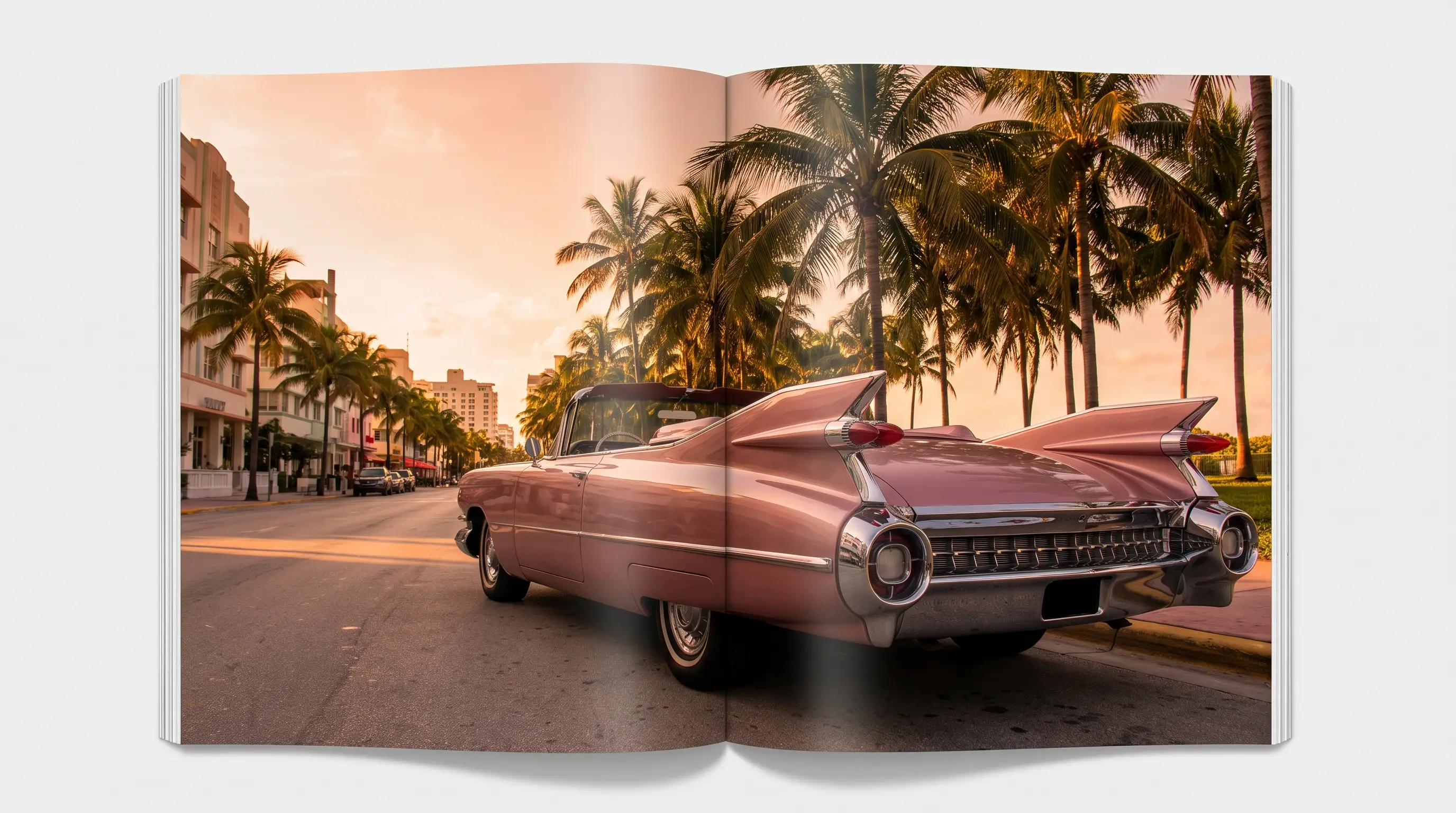
A woman in a photograph from 1959 stands beside her new Cadillac Eldorado, one hand resting on a tailfin that rises almost to her shoulder. She is smiling the way people smile when they know they are being looked at. That photograph, and thousands like it from driveways and dealership lots across the country, is the real record of the Cadillac tailfin era, a decade when a styling detail became so central to American identity that an entire industry followed where Cadillac led.
How a fighter plane became a fender
The story begins earlier than most people assume, with a 1948 Cadillac that carried the first small tailfins onto an American production car, inspired by the twin tail booms of the Lockheed P-38 fighter. It was a modest gesture at first, barely noticeable next to what would come a decade later. But the idea took hold, and each model year through the 1950s pushed the fins a little higher, a little sharper, a little more insistent that this car wanted to be seen from across a parking lot.
By the time the Eldorado joined the Cadillac lineup in 1953 as a limited halo convertible, the fins were already a signature, and the Eldorado gave Cadillac's designers a canvas with fewer commercial constraints than the mainstream models carried. Whatever experiment a stylist wanted to try, the Eldorado was often where it appeared first.
The rest of Detroit could not look away
Cadillac's fins did not stay a Cadillac trait for long. By the mid-1950s, Chrysler, Buick, and even budget-minded Chevrolet were adding their own fin treatments, chasing the same sense of forward motion and jet-age glamour that Cadillac had tapped into first. None of them, though, committed to the bit quite the way Cadillac did, and the Eldorado in particular became the measuring stick other manufacturers used when deciding how far was too far.
Chrysler's own "Forward Look" cars, including the Imperial, carried tailfins through the same years, but none of Detroit's competing fin treatments matched the sheer height and drama Cadillac reached on the 1959 Eldorado. What is not in dispute is the cultural weight the trend carried by decade's end. A tailfin was not simply a design element anymore, it was shorthand for an entire era's confidence, for a country that had come out of a war and a recession into genuine prosperity and wanted its cars to say so without any subtlety at all.
1959 and the moment it all crested
The 1959 model year is where the Cadillac tailfin era reached its absolute peak, both for the brand and for the industry it had been leading. Fin height on the Eldorado that year exceeded anything Cadillac had built before or would build again, and the car's overall visual language, chrome, length, and those soaring rear fenders, has never been matched for sheer theatrical confidence by any American production car since. People who were children in 1959 still describe seeing one parked at a curb the way they might describe seeing something from a movie rather than an ordinary automobile.
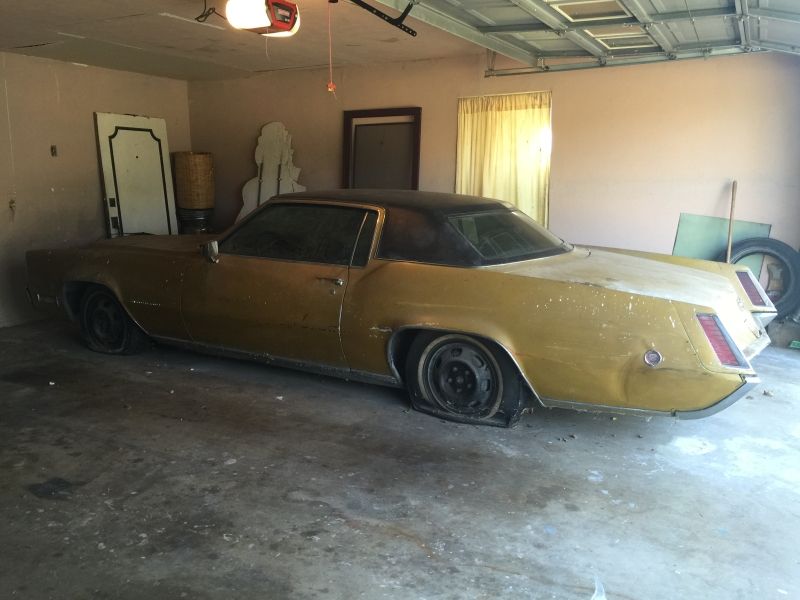
That peak did not last. Public taste, and Cadillac's own design leadership, began pulling back almost immediately. Fin height dropped noticeably by 1960, and the trend across the entire industry faded through the early 1960s as cleaner, more restrained lines came into fashion. By the time the Eldorado moved to its front-wheel drive platform in 1967, the fins were gone completely, replaced by a crisp, architectural silhouette that shared almost nothing visually with the car from eight years earlier.
"There is something almost tender about how quickly that whole aesthetic disappeared. For about a decade, an entire country agreed that a car should look like it was ready to take off, and then it just stopped being true, all at once, like a fashion that everyone silently decided together to leave behind."
- Nora Beckett
What it felt like to own one
Owners from this decade describe a particular kind of attention that came with driving an Eldorado, one that had less to do with the car's mechanical qualities and everything to do with how it looked coming down a street. Neighbors noticed. Valets noticed. A trip to the grocery store became, whether the driver wanted it or not, a small public event. That was precisely the emotional transaction Cadillac was selling with every added inch of chrome and every degree the fins swept upward, and buyers who paid the premium for an Eldorado over a standard Series 62 were paying for that reaction as much as anything mechanical underneath the hood.
Dealers of the period leaned into this directly, often parking the Eldorado convertible in the most visible spot on the lot, sometimes turntabled under showroom lighting like a piece of jewelry rather than a vehicle. That kind of presentation would look almost absurd applied to a car today, but it matched exactly how the car was designed to be experienced, as spectacle first and transportation second.
What the era left behind
The Cadillac tailfin era did not vanish without a trace. It left behind a design vocabulary that still defines how people picture 1950s America, in film, in advertising, in the postcards sold at classic car shows every summer. It also left behind a genuine engineering and marketing lesson that Cadillac carried forward, that the Eldorado worked best as a laboratory for ideas too bold for the mainstream lineup, a role the car kept playing long after the fins themselves disappeared.
The full arc of how that design language evolved, from the earliest 1948 hints through the 1959 peak and into the very different cars that followed, is covered in our complete history, which traces every generation's styling choices in sequence.
Cars from this decade survive today in numbers small enough that finding an honest, unmolested example takes real patience, and fin damage from decades of parking lot mishaps is one of the more common condition issues buyers run into. If this era speaks to you the way it speaks to so many people who grew up around it, you can find a classic Eldorado and see what survives from those years, fins and all, still turning heads exactly the way Harley Earl intended.
What strikes me most, looking back at those old photographs, is how briefly the whole thing lasted. A single decade, really only a handful of peak years inside that decade, and yet the image has outlived nearly everything else from the period. People who cannot name a single other 1959 product, a refrigerator, a television set, a kitchen appliance, can usually still picture that Eldorado's fin without much prompting. That kind of staying power is rare, and it says something about how completely Cadillac's designers understood the moment they were building for.