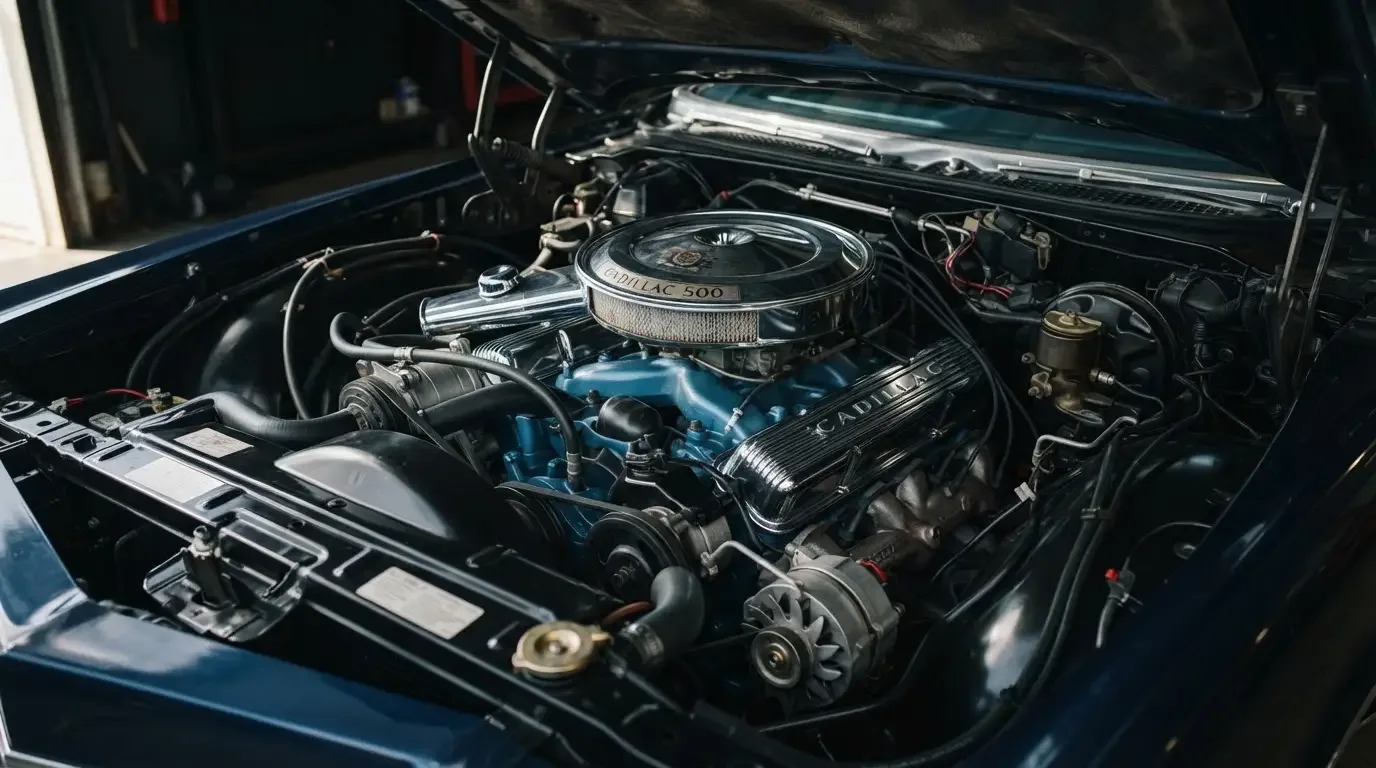
Multiple carburetors instead of one was Cadillac's answer to a question nobody else in the luxury segment was asking in the late 1950s: how much power can a big American V8 make without turning into a hot rod. The cadillac eldorado tri power setup, three two-barrel Rochester carburetors sitting atop the 365 cubic inch V8, is one of the more overlooked engineering flourishes of the entire Eldorado lineage, arriving at the exact moment the model split into two distinct cars.
The year the Eldorado became two cars
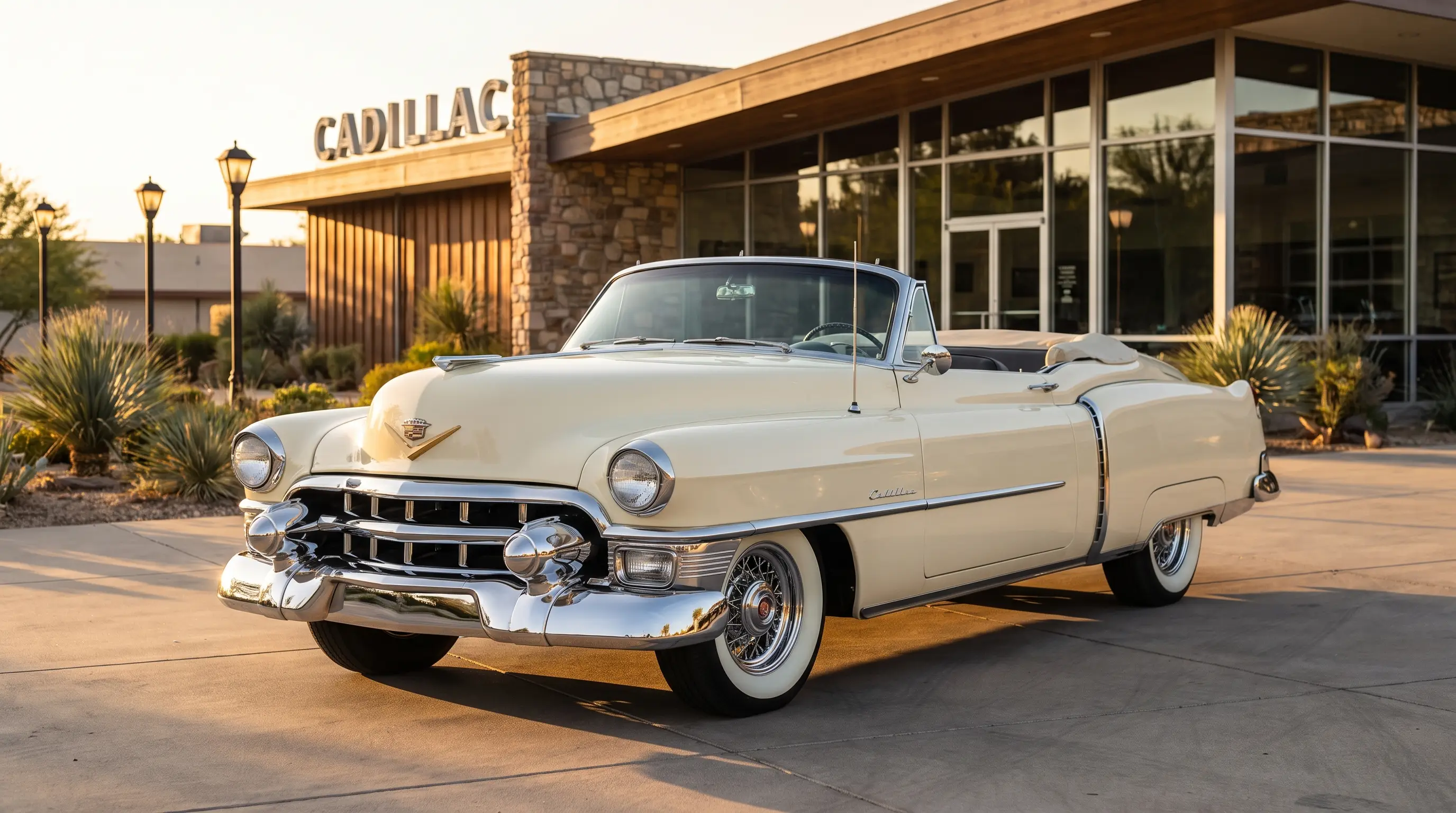
1957 was the year Cadillac split the Eldorado name across two very different products. The Eldorado Biarritz and Seville continued as flagship convertible and hardtop versions of the standard Cadillac body. The Eldorado Brougham, meanwhile, launched as an entirely separate, hand-built ultra-luxury sedan with its own stainless steel roof and four-door suicide-door layout. Both cars shared the same basic engine underneath, the 365 cubic inch V8, but the way that engine was fed set the two lines apart from the rest of Cadillac's range.
What tri-power actually meant
Tri-power referred to a carburetor setup using three two-barrel carburetors in place of the usual single four-barrel unit. The center carburetor handled normal driving, while the two outer carburetors opened progressively under harder acceleration, effectively giving the engine a much larger effective throat area when the driver actually needed it. Cadillac's Eldorado engines ran multi-carb setups across 1956 through 1958, but the specific triple two-barrel tri-power arrangement arrived on the 365 V8 for 1958, rated at 335 horsepower, a meaningful jump over the standard single four-barrel version of the same engine. The 1957 Eldorado's extra output had come from a twin four-barrel setup instead, rated at 325 horsepower, before Cadillac switched to the triple-carburetor arrangement the following year.
| Spec | 1957 Eldorado 365 V8 | 1958 Eldorado 365 Tri-Power V8 |
|---|---|---|
| Displacement | 365 cubic inches (6.0 liters) | 365 cubic inches (6.0 liters) |
| Carburetion | Twin four-barrel | Triple two-barrel Rochester |
| Horsepower | 325 | 335 |
| Available on | Eldorado Biarritz, Seville, Brougham | Eldorado Biarritz, Seville, Brougham |
Why Cadillac chose carburetors over cubic inches
Cadillac could have simply enlarged the engine further to gain power, and it eventually did exactly that in later years. But in 1957, tri-power was the more elegant solution, adding output without adding displacement, weight, or the packaging headaches of a bigger block. It also let Cadillac market genuine performance credentials without turning the Eldorado into something that competed on the same terms as a Chevrolet or Pontiac muscle package. This was still a Cadillac. The added power needed to feel like refinement, not aggression, and the smooth step-in of the outer carburetors under load delivered exactly that kind of controlled, unhurried surge.
Fuel injection stayed experimental
Cadillac did experiment with fuel injection on a 365-powered Eldorado Brougham during this era, but it never became a production option the way tri-power carburetion did. The fuel-injected test car's body was later mounted on a 1958 chassis rather than sold to a customer, and Brougham buyers who wanted more than the standard engine got there through carburetion, not injection. Tri-power stayed the performance path Cadillac actually offered across the Biarritz, Seville, and Brougham line in these years.
"Tri-power was Cadillac proving it could chase performance without losing its manners. Three carburetors instead of one, and the car still idled like a Cadillac."
- Emily Chen
How long the setup lasted
Tri-power carburetion on the Eldorado was a relatively short-lived feature, tied closely to the late 1950s Eldorado Brougham and its siblings before Cadillac moved toward larger single-carburetor engines in the 1960s as displacement climbed toward 390 and then 429 cubic inches. The triple-carb setup never returned to the Eldorado lineup in later generations, which makes surviving examples from 1957 and 1958 a distinct mechanical footnote in the model's history, a brief period where Cadillac chased extra output through induction complexity rather than sheer cubic inches.
For a broader look at how Cadillac's V8 displacement eventually did take over as the primary path to more power, the full story picks up the engine family more than a decade later at its largest point. Collectors specifically interested in these late-1950s tri-power cars can also browse classic Eldorado listings for current market availability.
Maintaining a tri-power setup
Three carburetors instead of one meant three times the linkage, three times the vacuum connections, and three times the potential points of failure for anyone keeping one of these cars running today. Getting the progressive linkage synchronized correctly, so the outer carburetors open smoothly and at the right point in the throttle travel, was a finicky job even when the cars were new, and it has not gotten easier with age. Original Rochester carburetor bodies are increasingly hard to source in good condition, which pushes some owners toward professionally rebuilt units or, in a few cases, away from tri-power entirely in favor of a simpler single carburetor conversion. That conversion, while more practical, does erase a meaningful piece of what made these specific model years distinctive.
For owners who keep the original setup intact and properly tuned, the reward is a driving experience unlike any later Eldorado. The step from the center carburetor to the outer two is noticeable in a way that a modern reader might not expect from a 1957 luxury car, a distinct second wind under hard acceleration that gives the tri-power Eldorado a personality the single-carburetor cars simply do not have.
A footnote worth remembering
Tri-power Eldorados rarely get the attention that the later 500 cubic inch cars do, but the engineering logic behind them, more power through better breathing rather than more displacement, represents a different, arguably more sophisticated approach than Cadillac would take just over a decade later. It is a reminder that the Eldorado's engine story was never a straight line toward bigger numbers. For a few years in the late 1950s, it was a story about carburetors instead.
How tri-power compared across the industry
Cadillac was not alone in experimenting with multiple carburetors in the late 1950s. Pontiac, Chevrolet, and even Chrysler ran their own tri-power and multi-carburetor setups during the same general period, mostly aimed at performance-oriented models rather than luxury cars. What set the Eldorado's application apart was the context: this was a triple-carburetor induction system installed in a car that otherwise prioritized ride comfort and cabin isolation above all else. Most tri-power setups of the era showed up in cars built to be driven hard. The Eldorado's version had to deliver the extra breathing capacity without ever feeling like it was asking the driver to work for it, which meant Cadillac's calibration leaned toward smoothness in the carburetor transition far more than a Pontiac or Chevrolet engineer chasing outright performance would have prioritized.
That distinction is part of why the Eldorado's tri-power system deserves its own place in the broader story of multi-carburetor engineering in the 1950s, rather than being lumped in as a luxury-badge copy of what performance divisions were already doing. Cadillac took a performance-oriented induction technology and re-engineered its behavior specifically for a buyer who would never describe the car as fast, only as effortless, and that recalibration is the more interesting engineering story than the carburetor count itself.