European coachbuilders were solving the same fundamental problem as their American counterparts, how to fit a hand-built body to a bare chassis, but the engineering constraints and the design priorities they worked under produced noticeably different results. Three houses in particular, Figoni et Falaschi, Saoutchik, and Pininfarina, illustrate just how differently three shops could approach the same brief.
Figoni et Falaschi: aerodynamics as a design language
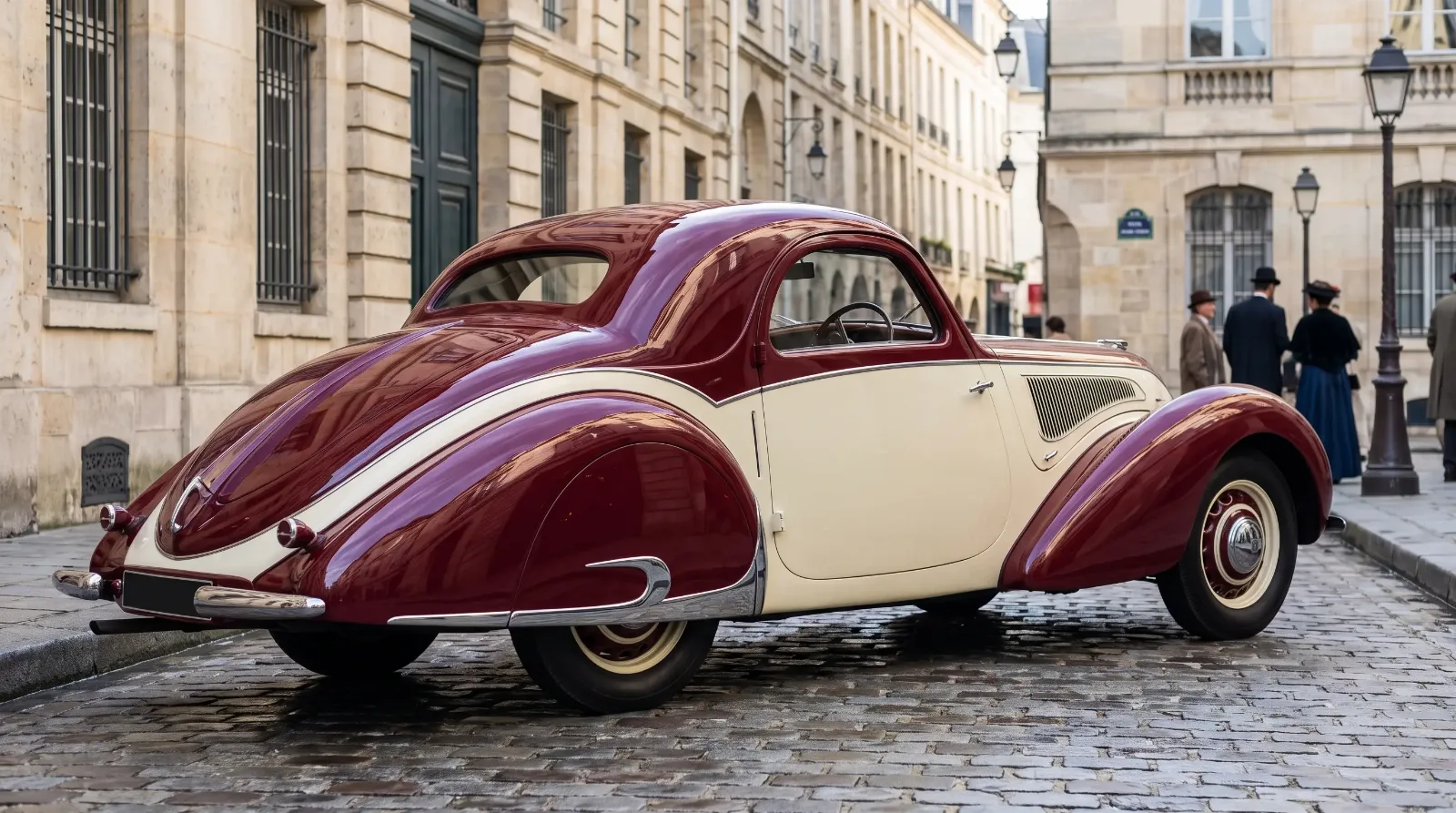
Giuseppe Figoni and Ovidio Falaschi ran a Paris shop that took the emerging science of aerodynamics and turned it into a signature visual style. Their bodies on Talbot-Lago and Delahaye chassis featured teardrop fenders and flowing, enclosed wheel arches, details that were partly functional and partly theatrical, since true aerodynamic efficiency at the speeds these road cars actually reached was a secondary concern next to the visual effect of speed. From an engineering standpoint, what's notable is how Figoni's team used compound-curved metal panels to achieve shapes that were genuinely difficult to form by hand, panels that swept in two directions at once rather than the simpler single-curve panels more common on formal bodies elsewhere.
The result earned the house a nickname among contemporaries: "Figoni et Falaschi" bodies were sometimes shortened to simply "Figoni," and the style became so distinctive that period observers could usually identify a Figoni body from a distance without checking a badge.
Saoutchik: ornamentation and scale
Jacques Saoutchik's Paris workshop took a different technical approach, favoring larger, more dramatically scaled bodies with heavier ornamentation than Figoni's more aerodynamic work. Saoutchik bodies on Delahaye, Delage, and Hispano-Suiza chassis often featured elaborate two-tone paint schemes and chrome detailing applied in ways that emphasized scale and presence over efficiency. Where Figoni's shapes suggested motion, Saoutchik's suggested weight and occasion, a car built to be looked at while stationary as much as while moving.
Constructing these bodies required close coordination between the panel formers and the trim department, since the elaborate two-tone schemes depended on panel joints landing in specific places to make the paint break lines work cleanly, a level of planning that had to happen before a single panel was hammered into shape.
Pininfarina: the transition toward industrial design
Battista "Pinin" Farina founded his Turin studio in 1930, later working on Alfa Romeo and Lancia chassis among others, and his approach differed from the French houses in an important way: Pininfarina increasingly treated coachbuilding as an exercise in industrial design rather than pure craft ornamentation, thinking about proportion, panel manufacturability, and a car's overall visual discipline in terms that anticipated how automobile styling would be approached after the war. That shift in mindset is a large part of why Pininfarina's studio survived and grew into the postwar era as a design consultancy for major manufacturers, while many of the more ornamentation-focused French houses did not make that same transition.
How these houses found their chassis partners
French coachbuilders gravitated toward Delahaye, Delage, and Talbot-Lago partly because those manufacturers actively courted the relationship, supplying rolling chassis specifically tuned for competition and exhibition use, chassis built with the expectation that a striking body would follow. Italian coachbuilders like Pininfarina worked more within a domestic industrial ecosystem, Alfa Romeo and Lancia both maintained close, ongoing relationships with Turin's design studios that went beyond a single commission and shaped how those manufacturers thought about their own future in-house styling. That's a meaningful difference from the more one-off, client-driven French model, where a single wealthy customer's specific order, not a manufacturer relationship, often set the terms of a commission.
Materials and tooling differences worth noting
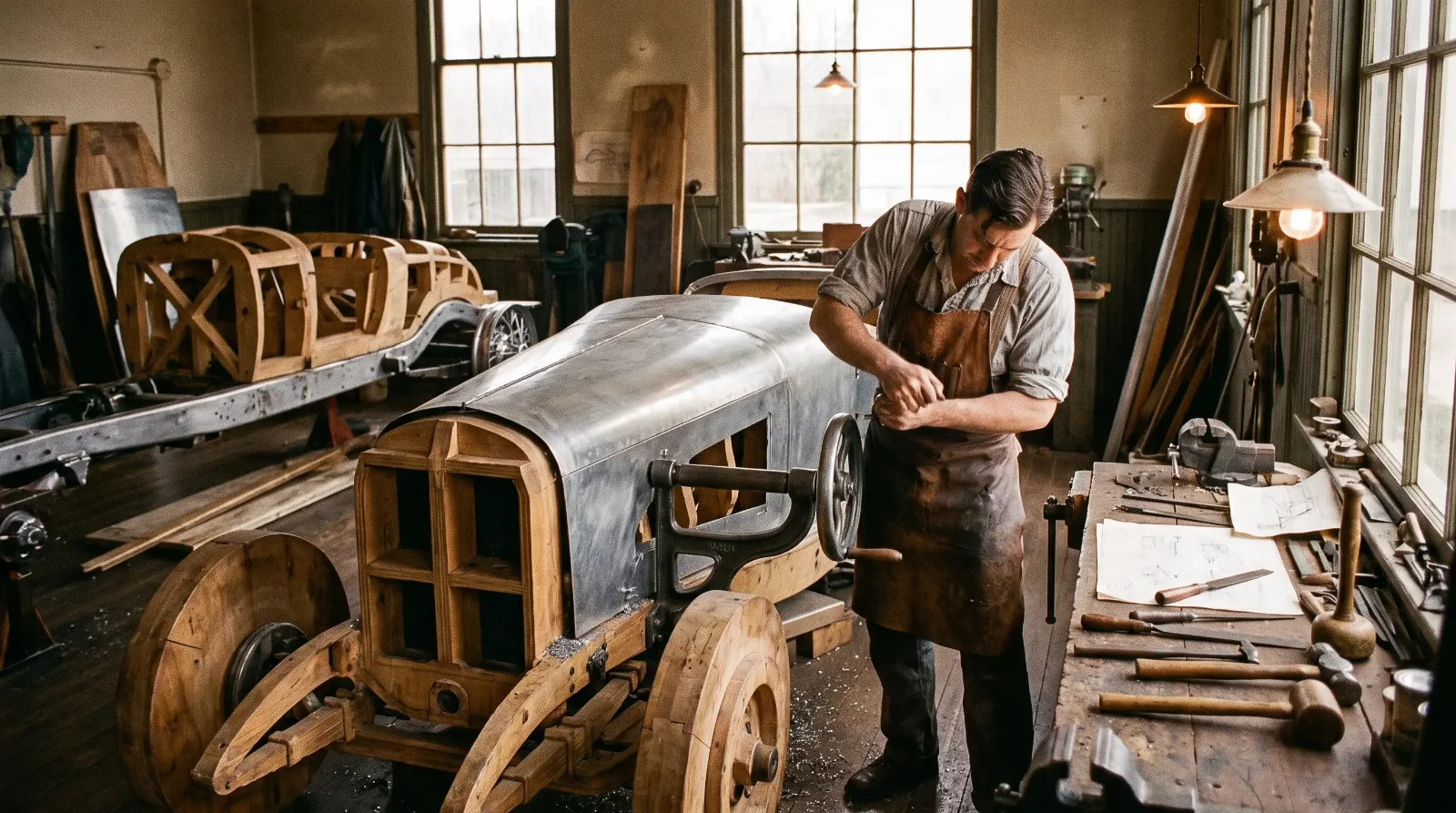
Aluminum panel work, favored by houses chasing lighter, more dramatic shapes, required different hand tools and a different set of skills than the steel panel work more common on formal, heavier bodies. Aluminum is less forgiving of repeated hammering, it work-hardens faster than steel and can crack if a panel beater overworks a section trying to chase a stubborn curve, so shops specializing in aerodynamic aluminum bodies developed techniques, English wheel work in particular, that were less commonly needed in a shop focused on straight-line formal coachwork. That specialization is a real reason certain houses became associated with certain kinds of bodies: the tooling and the trained hands did not transfer freely between styles.
This also explains why restoration of these cars today is such a specialized trade. A panel shop that can competently repair a formal steel-bodied Brunn town car is not automatically equipped to recreate a compound-curved aluminum Figoni fender, and collectors researching a restoration shop should ask specifically about experience with the materials their particular car actually uses.
Comparing the three approaches
| House | Base | Technical signature | Design priority |
|---|---|---|---|
| Figoni et Falaschi | Paris | Compound-curved teardrop panels | Visual sense of speed |
| Saoutchik | Paris | Two-tone panel joint planning | Scale and presence |
| Pininfarina | Turin | Manufacturable, disciplined proportion | Design system, not just ornament |
What strikes me most as an engineer looking back at this period is how much of the visual drama in these bodies traces back to a solvable manufacturing problem, forming metal into a compound curve, planning a paint break line around a structural seam, that these craftsmen worked out with hand tools and experience rather than any formal calculation. The failure mode was always the same risk: get the panel geometry wrong and the whole design read as clumsy rather than dramatic. The best shops simply failed at that far less often than the rest.
"A compound curve is not a stylistic flourish, it is a manufacturing decision with real consequences. Every one of these houses was making a bet about what their craftsmen could actually execute reliably, and the ones that bet correctly are the ones we still study today."
— Emily Chen
For the wider industry these houses operated within, alongside their American counterparts, the european coachbuilt cars guide is a useful next stop. To see how one specific body style, the dual-cowl phaeton, was engineered on both sides of the Atlantic, read on.