
Production ledgers do not lie, even when memory does. Ask a longtime owner how rare their 1958 Ford F100 is and you will usually get an answer shaped more by hope than by the actual paperwork. The real 1957 ford f100 production numbers tell a different, and honestly more interesting, story about how Ford built these trucks and which configurations actually left the factory in meaningful volume.
Car Features
7 min read
1957-60 F-100 Production
1957 Ford F100 production numbers explain why some configurations are common and others are genuinely rare, and why the build tag matters so much.
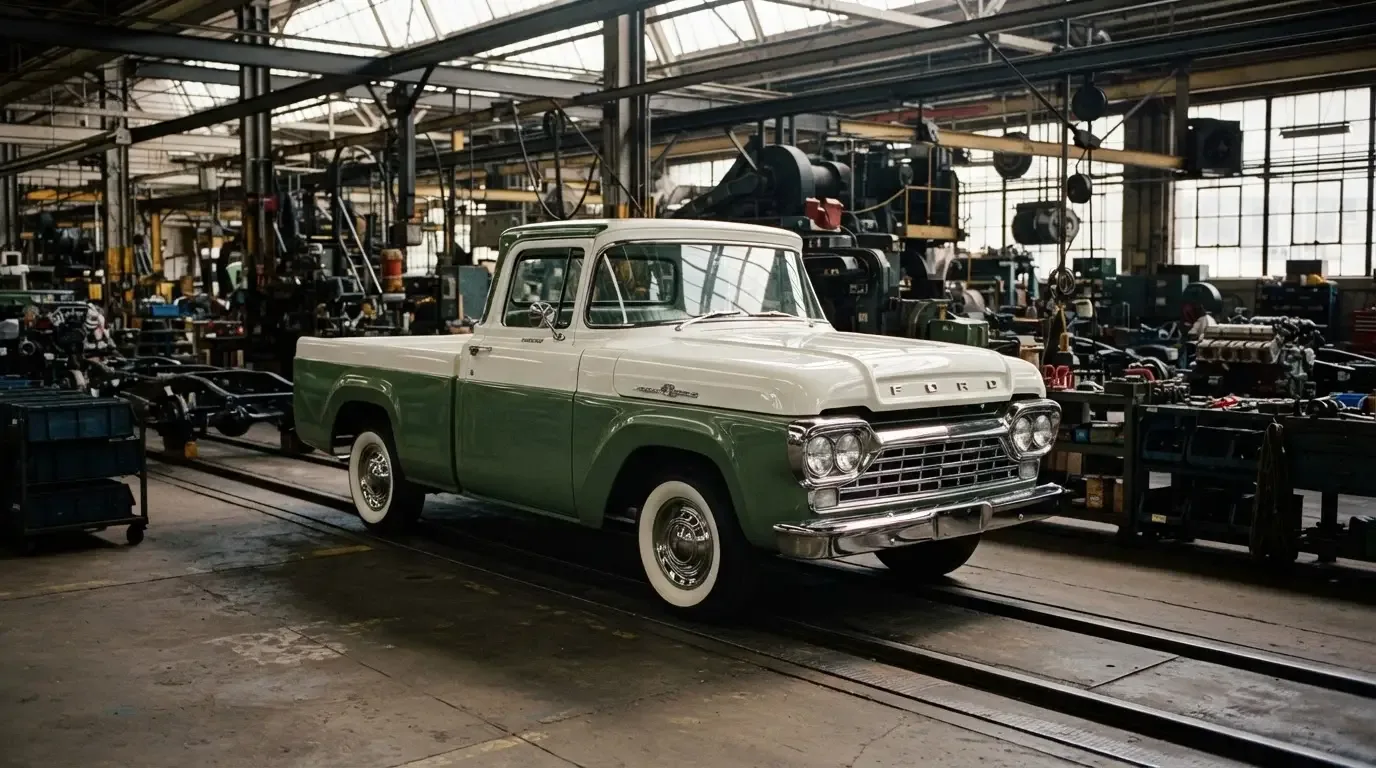
A generation built at genuine scale
These third-generation trucks were not a niche product. Ford built these in high volume across multiple plants to meet demand from a country that was rapidly motorizing its farms, its small businesses, and increasingly its suburbs. Total F-series production across the 1957 through 1960 run ran into the hundreds of thousands of units annually across all configurations, with the F-100 as the volume leader within that lineup ahead of the heavier F-250 and F-350 variants aimed at commercial buyers.
That scale matters for anyone trying to understand rarity today. A truck built by the tens of thousands is not automatically common on the road now, because decades of rust, wrecks, and simple attrition have thinned the herd dramatically. But it does mean that survivors are more plentiful, and more varied in configuration, than the folklore around any single truck sometimes suggests.
Reading a build tag correctly
Every F-100 from this era carries a body tag with coded information about the plant, the trim level, the color, and the build sequence. Decoding one properly tells you far more than a casual glance at the truck ever could, including whether the paint code matches what is currently on the body and whether the trim level matches the interior currently installed. Owners chasing accurate documentation treat this tag as close to gospel, because it is the closest thing to a birth certificate these trucks have.
Mismatches between the tag and the truck as it sits today are common and not automatically a red flag. Plenty of honest trucks were repainted or reupholstered decades ago in a different color or trim than they left the factory wearing. What matters is knowing the difference between an honest, disclosed change and a truck being represented as more original than it actually is.
What made it into most trucks, and what didn't
The base F-100 configuration, a straightforward work truck with the standard six-cylinder engine and three-speed manual transmission, accounted for the bulk of production. V8 engines were available and increasingly popular as the run progressed, but they remained the step-up option rather than the default through most of these years. Automatic transmissions, power steering, and power brakes existed on the order sheet but were genuinely uncommon options on a truck still primarily bought to work rather than to coddle its driver.
That production reality is exactly why a well-optioned truck from this era, one that actually left the factory with the V8, an automatic, and Custom Cab trim, carries real weight with collectors today. It was not the common truck. It was the truck a buyer paid extra to get, and that extra spending shows up in how the market values it now.
"People assume rarity and desirability are the same thing, and they aren't. The base six-cylinder work truck was built by the hundreds of thousands, but a documented, well-optioned survivor from that same production run is a completely different animal in terms of actual scarcity."
- Tom Ramirez
Why documentation changes everything
A truck with its original build tag intact, matched to period paperwork like a bill of sale or an original owner's manual, sits in a different category entirely from an otherwise identical truck with no paper trail. It is not just about proving originality for its own sake. It is about proving the specific story of that individual truck within a production run that built hundreds of thousands of similar vehicles.
Serious collectors increasingly treat documentation as a value driver on par with mechanical condition, and that trend has only strengthened as more of these trucks pass through major auction houses with researched, published histories attached. A truck without documentation is not worthless, but it is competing on mechanical and cosmetic merit alone, without the added weight that a verified story provides.
Assembly plants and the differences they left behind
Ford ran multiple assembly plants during this production run, and while the trucks that rolled off each line followed the same basic engineering, small differences crept in based on which plant supplied which parts and which suppliers a given region relied on. A truck built at one plant might use a slightly different hardware supplier for door latches or trim clips than a sister truck built the same month at a different facility. None of these differences were significant enough to affect how the truck drove or worked, but they matter a great deal to restorers chasing exact originality, since a part that looks correct at a glance can still be wrong for a specific plant's build.
Serious researchers track these plant-level variations the way a coin collector tracks mint marks, cross-referencing parts catalogs and surviving trucks to build a clearer picture of what actually left each facility. It is slow, patient work, and it rarely settles every question definitively, but it is the kind of detail that separates a documented, plant-correct restoration from one that merely looks right to a casual observer.
What incomplete records mean for owners today
Ford's own production records from this era were not preserved with modern archival standards in mind, and gaps exist that no amount of research has fully closed. Exact production totals broken down by every individual configuration, color, and option combination are not fully available the way they are for some later, more thoroughly documented model years, since Ford's own record-keeping combined F-Series variants in different ways across eras and much of the underlying paperwork from this period was not preserved. This is worth stating plainly rather than papering over with confident-sounding numbers that cannot actually be verified against a primary source.
What this means practically for an owner is that claims of extreme rarity for a specific configuration should be treated with healthy skepticism unless they come with real supporting documentation. A dealer or seller who cites a suspiciously precise production number for a narrow configuration, without citing where that number comes from, is more likely repeating internet folklore than quoting a verified factory record.
Related reading and where to look now
For readers interested in how production numbers connect to collectibility more broadly, a related story digs into what actually drives value across this generation beyond raw scarcity. And for the full account of how this truck came together as a design and engineering project, 1957 ford f100 history covers the redesign that made these production numbers possible in the first place.
If the numbers here have you curious what a documented survivor looks like in person, there are genuinely good examples out there right now. Checking out F-100s for sale now is a solid way to see how build tags, paperwork, and originality claims hold up against real listings rather than forum speculation.
Sources and notes
Related Reading
#production numbers
#ford f-100
#1957 Ford F100
#Task Force trucks
#build tag
#collector documentation

About the author
Tom Ramirez
Corvette researcher and historian based in Bowling Green, Kentucky. Two decades documenting Corvette production history from original factory records.
Related Listings - Ford F-100

Comments
Be the first to comment on this article.