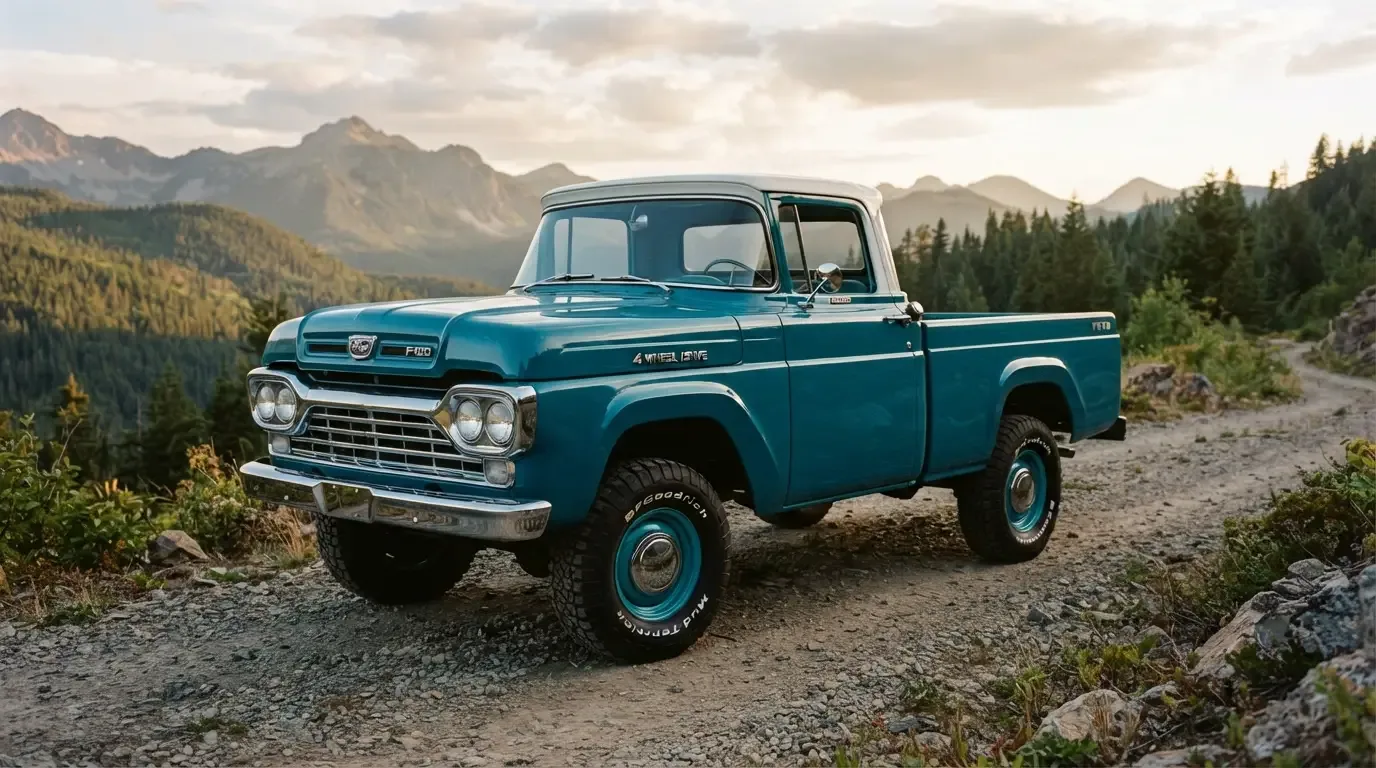
For most of the 1950s, a four-wheel-drive Ford F-100 was not something you ordered from a dealer. It was something you ordered from Marmon-Herrington, an Indianapolis firm that took a factory two-wheel-drive truck and converted it, adding a transfer case and front driving axle after the fact, outside the Ford assembly process entirely. That changed for the 1959 model year, when Ford began building and offering a factory four-wheel-drive F-100 through its own dealer network for the first time. It is a small line in the truck's production history that reshaped who could buy a serious off-highway truck and how.
The conversion era before 1959
Marmon-Herrington had been converting Ford trucks to four-wheel drive since the 1930s, primarily for military and export contracts, and by the postwar period the company had built a steady civilian business converting F-Series trucks for buyers who needed genuine off-road capability. A rancher, a utility company, or a logging outfit wanting a 4x4 F-100 in, say, 1956, would order the two-wheel-drive truck from a Ford dealer, and that truck would then be shipped to Marmon-Herrington or a licensed installer for the conversion before delivery. It worked, and it built a loyal customer base, but it added time, cost, and a second company's warranty terms into the purchase of what was supposed to be a Ford product.
This was not unique to Ford. Most American truck manufacturers relied on outside conversion houses for four-wheel drive through the 1950s, since the engineering and tooling investment for an integrated factory 4x4 line was significant relative to the size of that market segment at the time. Ford's decision to bring the capability in-house for 1959 reflected a broader shift across the industry, as demand for factory 4x4 trucks grew steadily through the decade among buyers in construction, utilities, and rural areas who wanted the capability without the added step.
What Ford's 1959 factory system offered
The 1959 factory four-wheel-drive F-100 used a two-speed transfer case and a front driving axle integrated into the truck at the point of assembly, engineered and warranted by Ford directly rather than bolted on afterward by a third party. This meant a dealer could order, stock, and sell a 4x4 F-100 the same way they ordered any other configuration, checking a box on the order form rather than arranging a separate conversion. The exact production volume of these early factory 4x4 trucks is not something readily documented in published sources, but by every account they represented a small fraction of total F-100 output that year, since most buyers still had no need for the added capability or cost.
| Era | 4x4 source | How it was ordered |
|---|---|---|
| Through 1958 | Marmon-Herrington conversion | Two-wheel-drive truck shipped for separate conversion |
| 1959 onward | Ford factory-built | Ordered directly through the dealer, built on the line |
One detail worth clarifying here: Ford's 1959 factory system was not a total break from Marmon-Herrington. The two companies had a working relationship going back years on Ford's 4x4 conversions, and Ford's factory-built system, including its Dana 44 front axle, drew on that established conversion-house engineering rather than starting from a blank sheet. What changed in 1959 was who assembled and warranted the truck, not that the underlying axle and transfer case concepts appeared out of nowhere. What is well documented is the practical outcome: after 1959, a buyer no longer needed a second company involved to drive a four-wheel-drive Ford truck off the lot.
Identifying an early factory 4x4 truck today
A genuine 1959 or 1960 factory-built 4x4 F-100 is a different animal from a later Marmon-Herrington conversion of a same-year two-wheel-drive truck, and the two are sometimes confused in casual listings. The factory trucks carry Ford's own build codes reflecting the 4x4 configuration from the point of assembly, while a conversion, even a period-correct one done shortly after purchase, was never part of Ford's own production record for that VIN. This distinction matters for collectors focused on factory-original documentation, since the two trucks tell genuinely different stories even if they end up looking similar once fenders and running gear are in place.
"The tank sticker mentality applies here just as much as it does anywhere else. A truck that is genuinely factory four-wheel-drive carries that in its own build record, not in a shop invoice from a conversion house. Knowing which one you are looking at changes what the truck actually is, historically speaking, even if it drives the same either way."
— Tom Ramirez
Why the timing lines up with a broader industry shift
Ford's move to bring four-wheel drive in-house in 1959 did not happen in isolation. Other domestic manufacturers were making similar calculations around the same period, weighing the cost of developing their own transfer case and front axle engineering against the ongoing expense and customer friction of routing trucks through an outside conversion company. Rural electrification projects, postwar highway construction into more remote terrain, and a growing population of buyers who needed genuine off-road capability for work rather than recreation all pushed steadily on that demand curve through the 1950s. By the time Ford acted, the business case had been building for years, and the company was responding to a market that had outgrown the conversion-house model rather than creating that demand from nothing.
For researchers trying to date a specific truck's four-wheel-drive components, the transition year itself deserves extra scrutiny. A truck titled as a 1959 could plausibly carry an early factory system, a late-production Marmon-Herrington conversion completed before the changeover, or in rare cases components that were serviced or replaced across that boundary during decades of working use. None of that should discourage a buyer from a truck with a murky exact history. It should simply set expectations correctly before a purchase price gets negotiated on the assumption of a clean, single-source build record that period paperwork does not always support.
Where this fits into the F-100's broader story
The move to a factory-built four-wheel-drive option arrived in the same generation that had already redrawn the truck's face with the flat hood and full-width grille a couple of years earlier. For the fuller account of how that generation came together, where this started covers the styling and structural changes Ford made across 1957 through 1960, of which the 1959 4x4 introduction was one significant but often overlooked chapter. It is a footnote in most casual histories of the truck, overshadowed by the more visible styling changes of those same years, but for buyers who actually needed a truck capable of real off-road duty, it was the more important development of the two. Those looking for a surviving example, whether factory 4x4 or a period conversion, can browse classic F-100 for sale and compare build documentation before deciding which story a given truck actually tells.