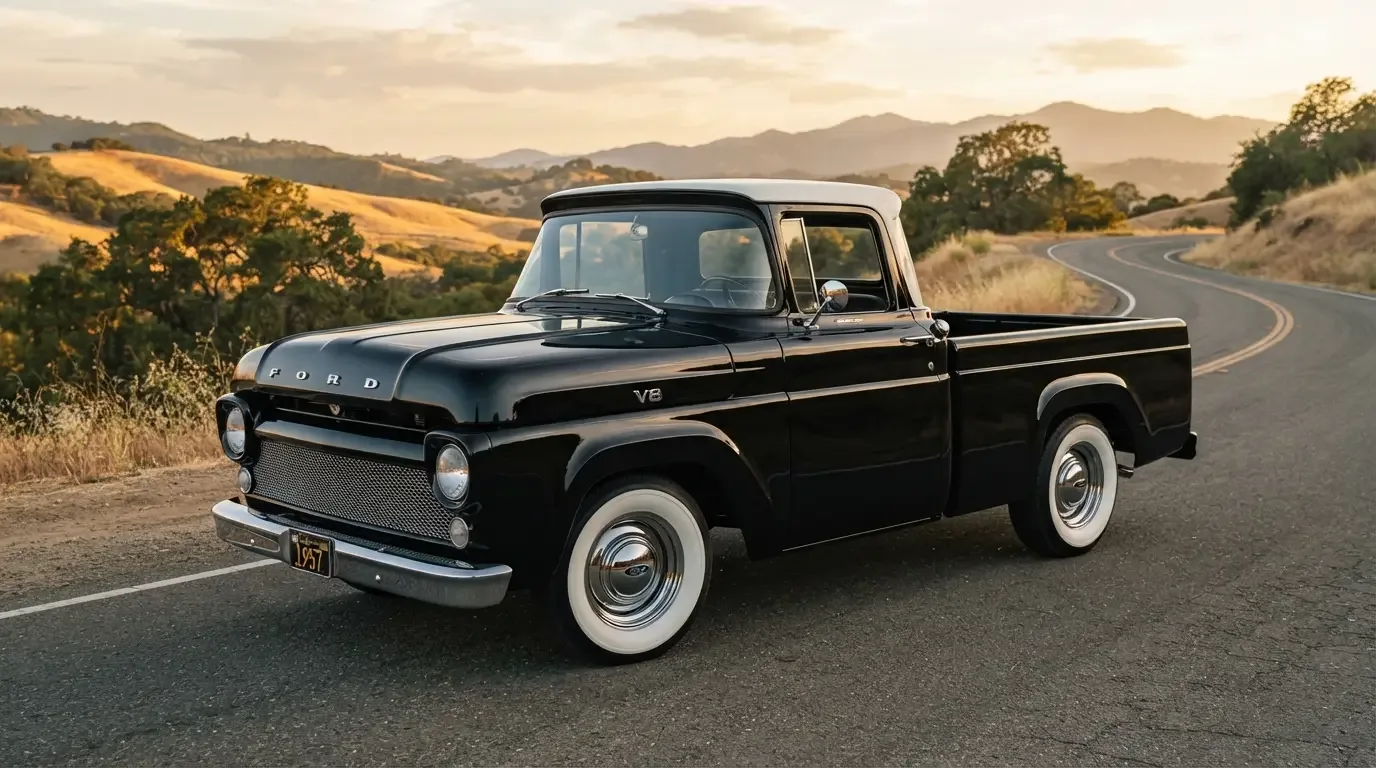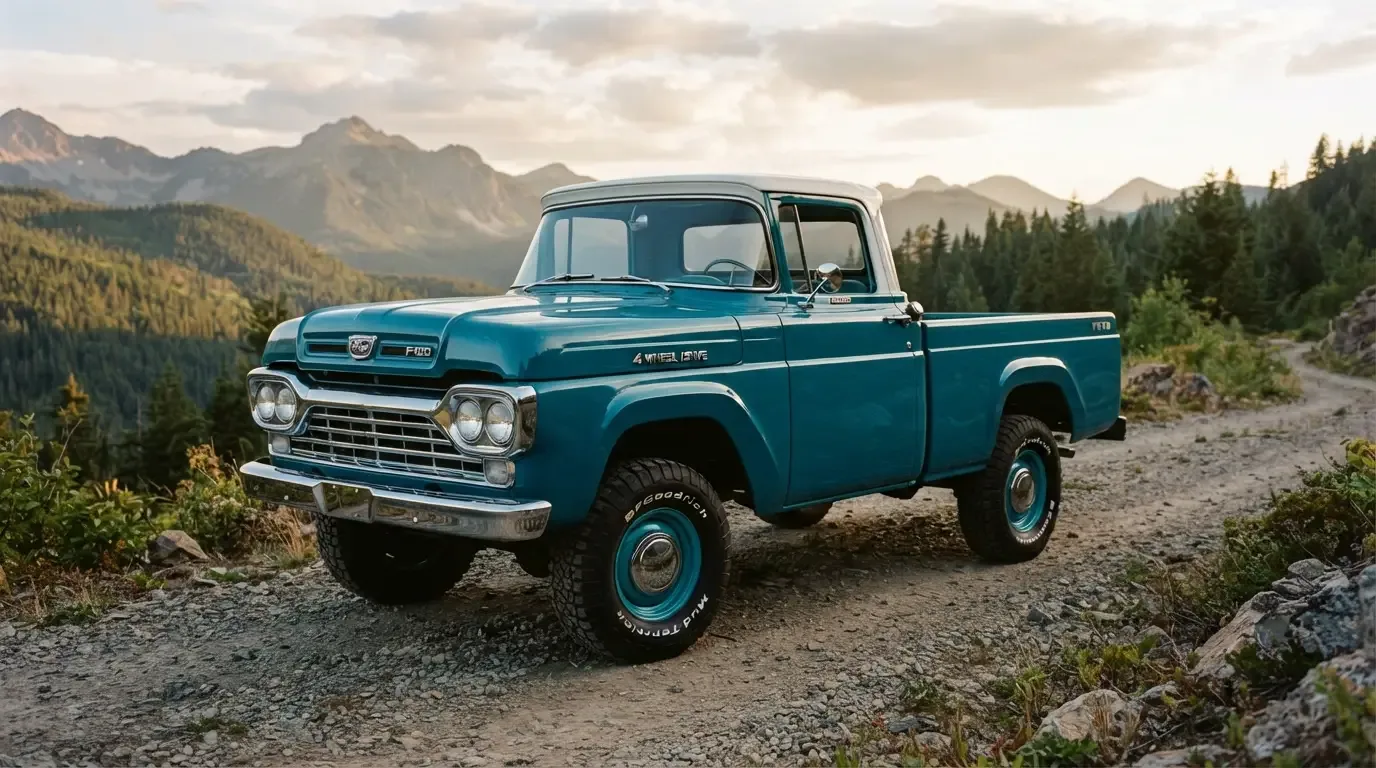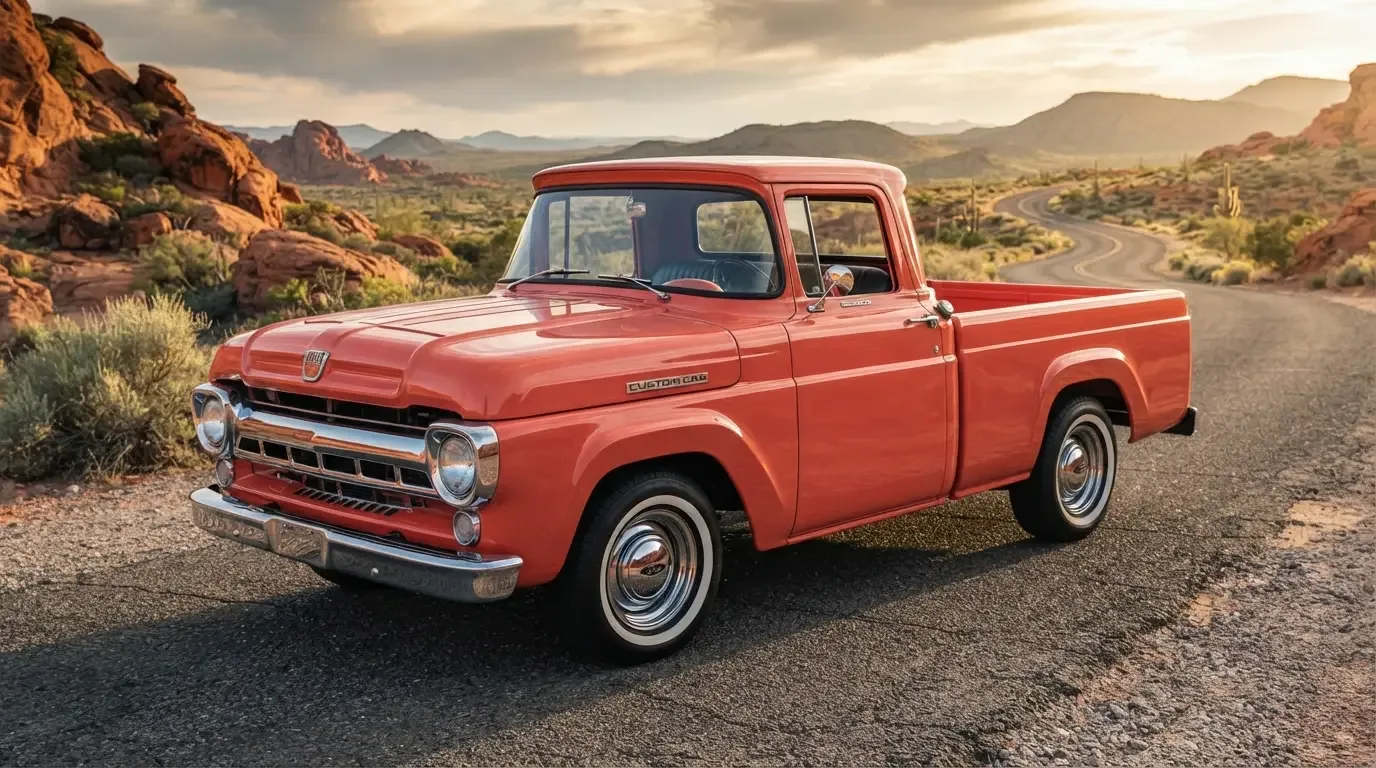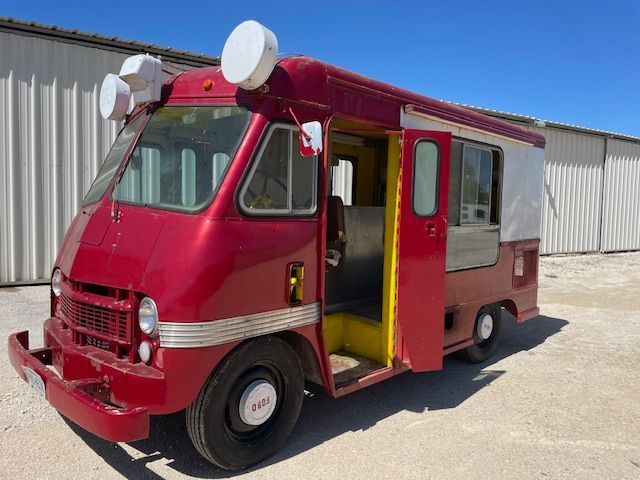
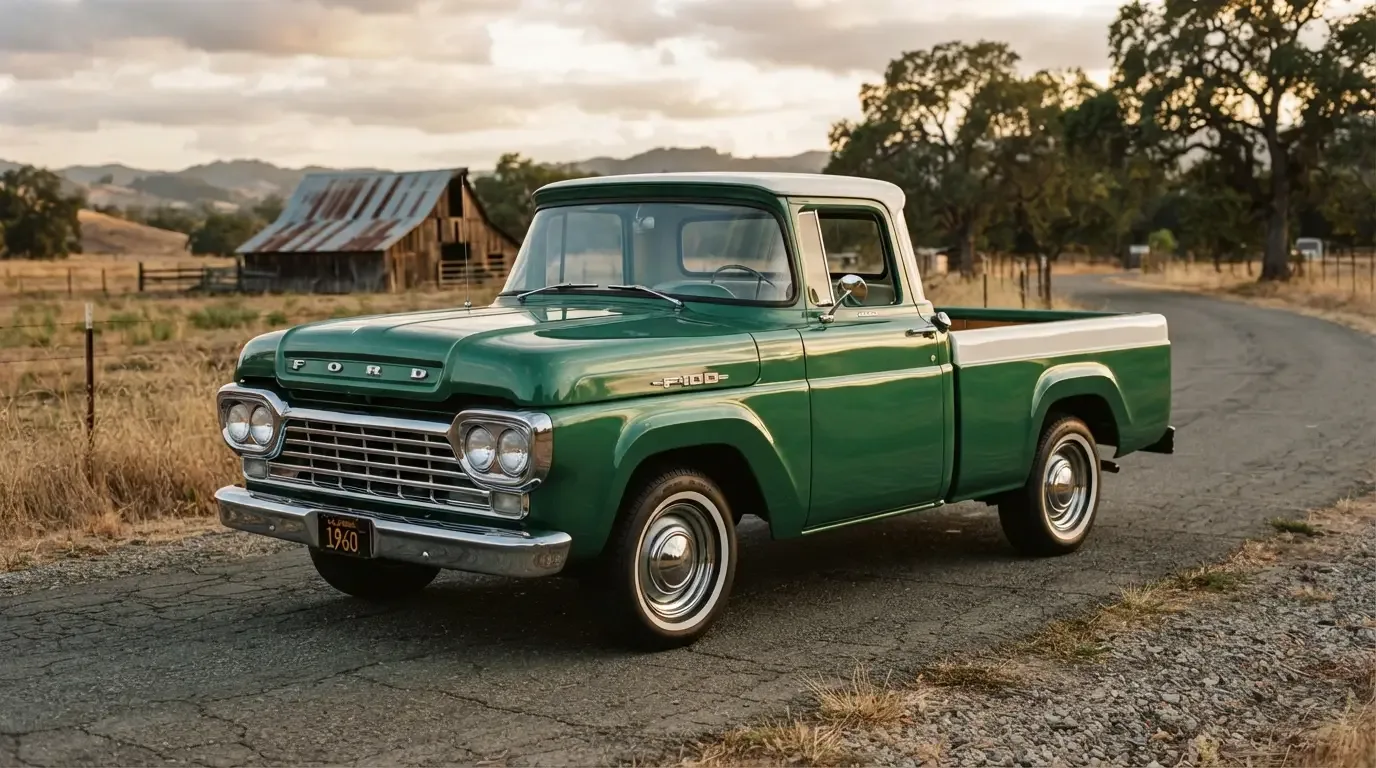
The 1960 Ford F-100 occupies an unusual place in the truck's history. It was the last model year of a design that had begun in 1957 and, though buyers standing on a dealer lot that year had no way of knowing it, the final year before Ford abandoned the entire architecture underneath it for something genuinely new. A 1960 F-100 is therefore both the most refined expression of the 1957-60 generation and, in retrospect, a closing chapter, and both of those facts matter to how the truck should be understood and valued today.
A generation reaching its final form
By 1960, the styling groundwork Ford had laid in 1957 with the flat hood and full-width front end, and continued in 1958 with the switch to quad headlights, had been refined through several rounds of trim and grille revision without any structural redesign. The 1960 truck carried forward the quad-lamp face introduced two years earlier, with grille detailing distinct enough from 1958 and 1959 to date a truck at a glance for anyone familiar with the sequence, though the underlying body and cab remained the architecture Ford had introduced at the start of the generation. This is a common pattern in mid-century Detroit product cycles: a major body introduction followed by several years of incremental trim revision before the next full redesign, and the F-100 followed that pattern closely across these four model years.
Mechanically, the 1960 F-100 sat at the end of a period during which Ford had been steadily expanding engine options across the line, offering buyers a choice between the truck's inline-six and V8 configurations depending on intended use and budget. A working buyer hauling light loads around a small operation might specify the base 223 cubic inch inline-six for its lower cost and simpler service, while a buyer wanting more capability for towing or highway driving would step up to the 292 cubic inch Y-block V8, or to one of Ford's newer FE-series big-block V8s such as the 352 for added power. Anyone researching a particular truck's originality should confirm engine codes against period documentation rather than assume a given engine matches what left the factory, since engine swaps over sixty-plus years of service use are common in this generation.
The changeover that followed
What makes 1960 significant in retrospect is what came directly after it. For 1961, Ford introduced an entirely new F-Series generation built on unibody construction for its lighter-duty trucks, a genuinely unusual engineering approach that integrated the cab and bed into a single structure rather than the traditional separate bed bolted behind a standalone cab. That experiment did not last, Ford reverted to a separate bed and cab arrangement within a few years once the practical drawbacks of a unibody truck bed, particularly the difficulty of bed misalignment after any frame flex, became apparent in the field. But the 1961 redesign closed the book on the 1957-60 body entirely, meaning the 1960 model year represents the last and most fully developed version of a shape Ford had spent four years refining before setting it aside for something new.
| Model year | Body generation status | Front-end configuration |
|---|---|---|
| 1957 | Generation introduced | Single headlight, flat hood debut |
| 1958 | Mid-cycle update | Quad headlights introduced |
| 1959 | Continued refinement | Quad headlights, minor trim revision |
| 1960 | Final year of generation | Quad headlights, final trim revision |
This context matters for how a 1960 truck should be assessed against its siblings. It is not simply "one of the 1957-60 trucks" interchangeably with the others; it is the version built with the most cumulative refinement of that specific body, after Ford had three prior model years to address whatever issues emerged in the field, and before an entirely different design philosophy took over the following year. For a collector prioritizing the most developed example of this generation's engineering and detailing, the 1960 truck has a reasonable claim to that distinction.
"There is a particular kind of car, and apparently a particular kind of truck too, that represents a design at the exact moment before the company moved on to something else entirely. The 1960 F-100 is that moment for this generation. It carries four years of small corrections, and none of the compromises of what came right after it."
— Sarah Whitfield
Production context and what survives today
The 1960 model year sat within a broader domestic truck market that was expanding steadily through the decade, as postwar suburban growth and rural highway construction both pushed demand for light and medium trucks higher year over year. Ford competed directly against Chevrolet and GMC's own updated truck lines through this period, and the pressure of that competition is part of what kept the F-100's styling under continuous, if incremental, refinement across these four model years rather than sitting static after the 1957 introduction. A truck that looked dated relative to its crosstown rivals would have cost Ford real sales, and the company clearly understood that even a work vehicle needed to keep pace visually with what buyers were seeing on car lots.
How many 1960 F-100s survive in original, unmodified condition today is difficult to state with precision, since these were working vehicles first and collectibles only decades later, and attrition through decades of daily use, rust, and simple replacement took a heavy toll long before anyone was documenting survival rates for this specific model year. What can be said with confidence is that surviving examples in solid original condition, particularly with matching trim and an unmolested front clip, command real interest from buyers specifically seeking the final and most developed year of this body style, a preference that shows up consistently in how these trucks are marketed and discussed within the collector community.
Assessing a 1960 truck today
Originality assessment on a 1960 F-100 should focus on the grille and trim details specific to that final model year, since reproduction parts and cross-generation swaps mean a truck's overall shape does not guarantee every visible detail matches what left the factory that year. The frame, cab structure, and drivetrain mounting points are shared broadly across the 1957-60 generation, which means a damaged or heavily modified 1960 truck can, in principle, carry sheet metal or components sourced from an earlier year within the same generation without an obvious mismatch to a casual inspection. Careful buyers should look at stamped date codes where present and compare them against the truck's claimed model year before treating any specific example as a fully documented 1960 original.
For the complete account of how this generation developed from its 1957 introduction through to this final model year, the full story traces the whole arc in one place. Buyers interested specifically in a 1960 example, the most refined version of this body before Ford's brief unibody experiment replaced it, can browse classic F-100 listings to see what has survived from that final model year.