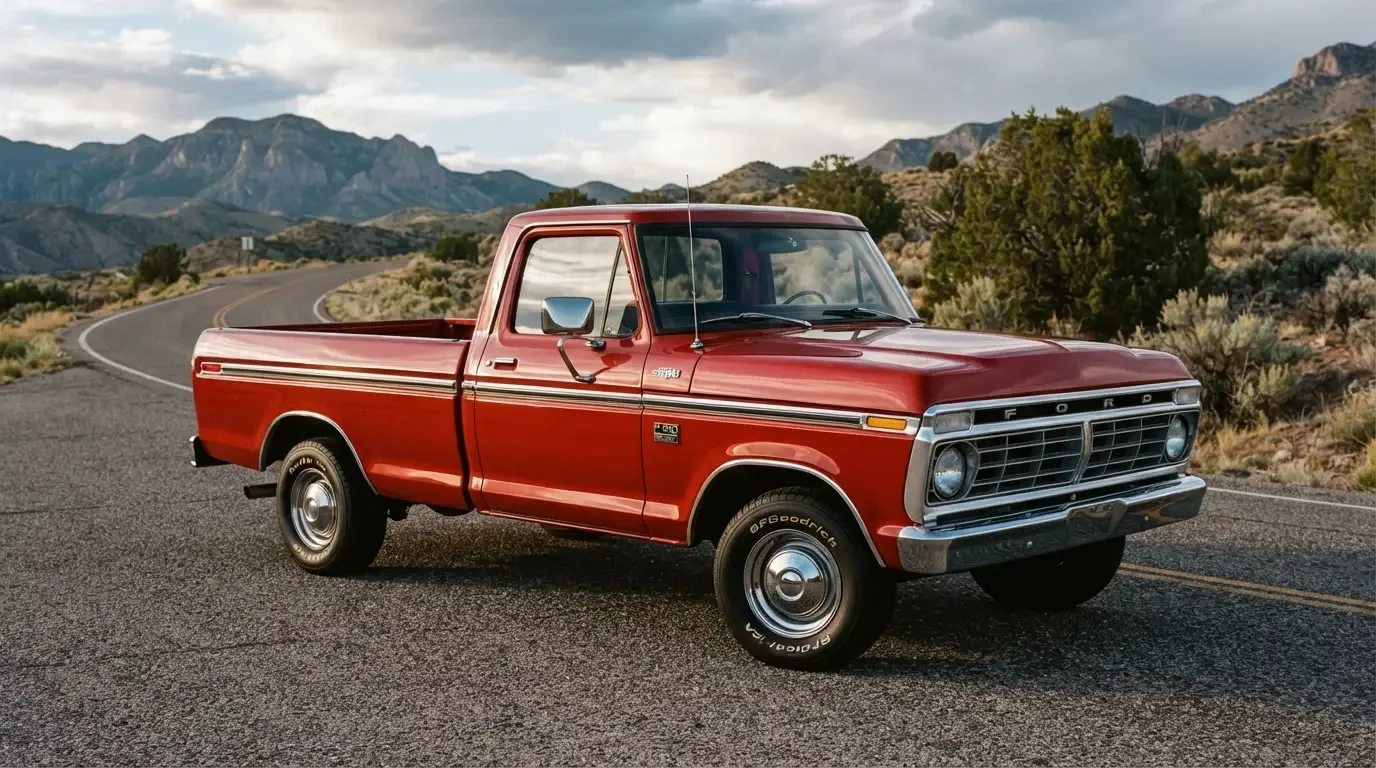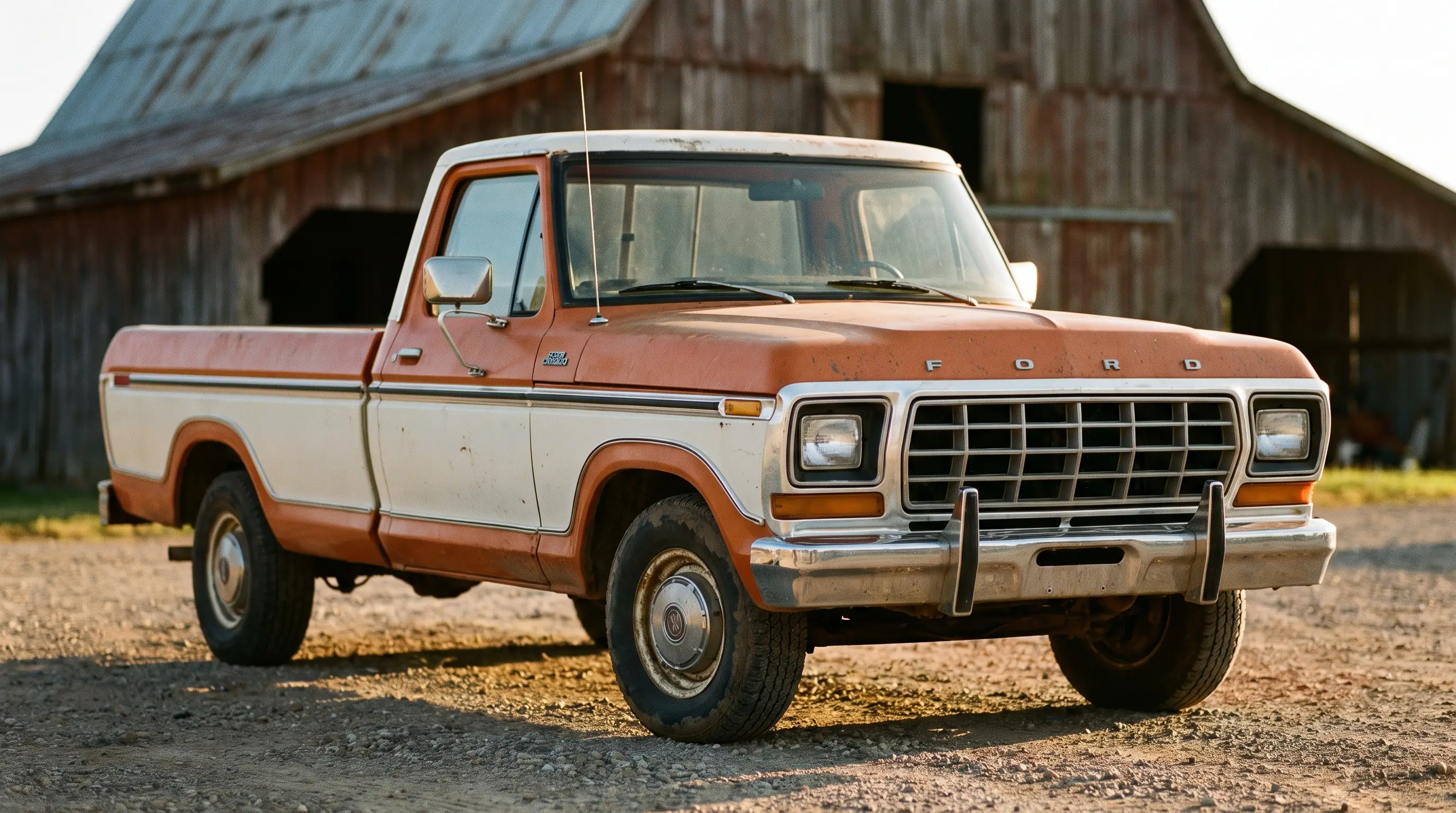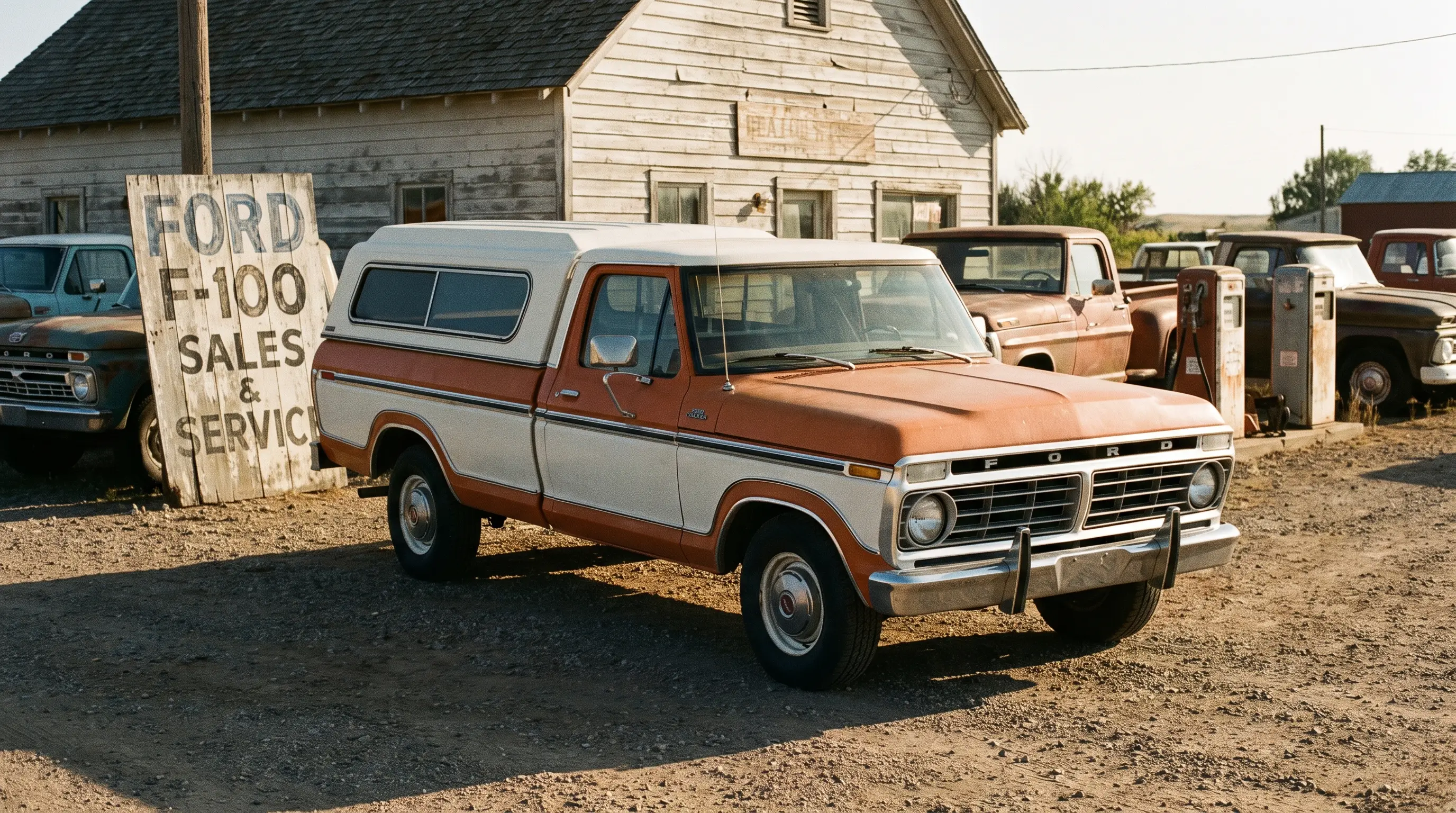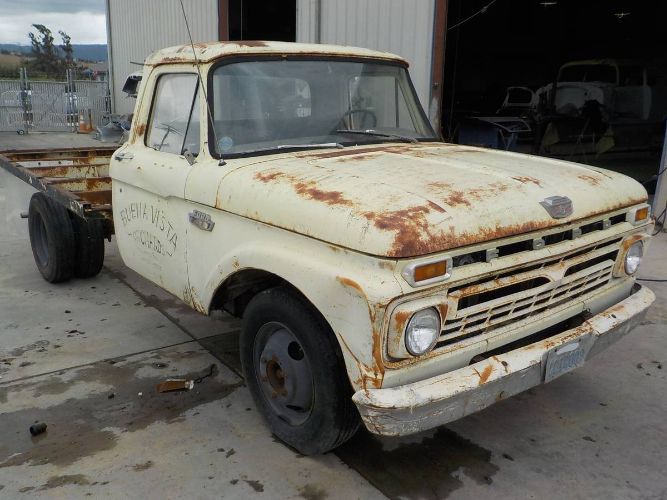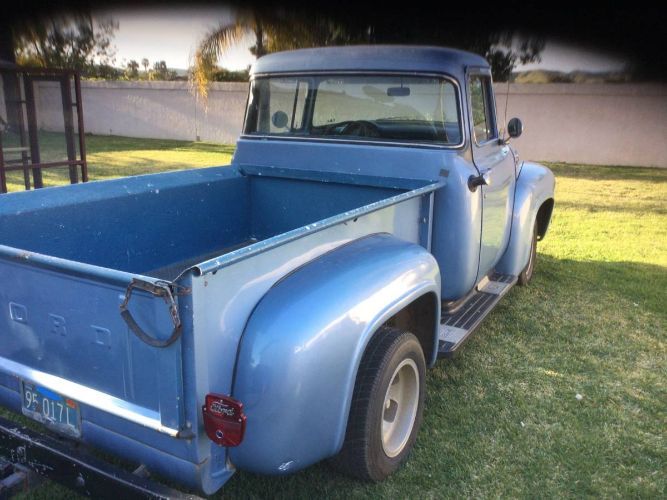
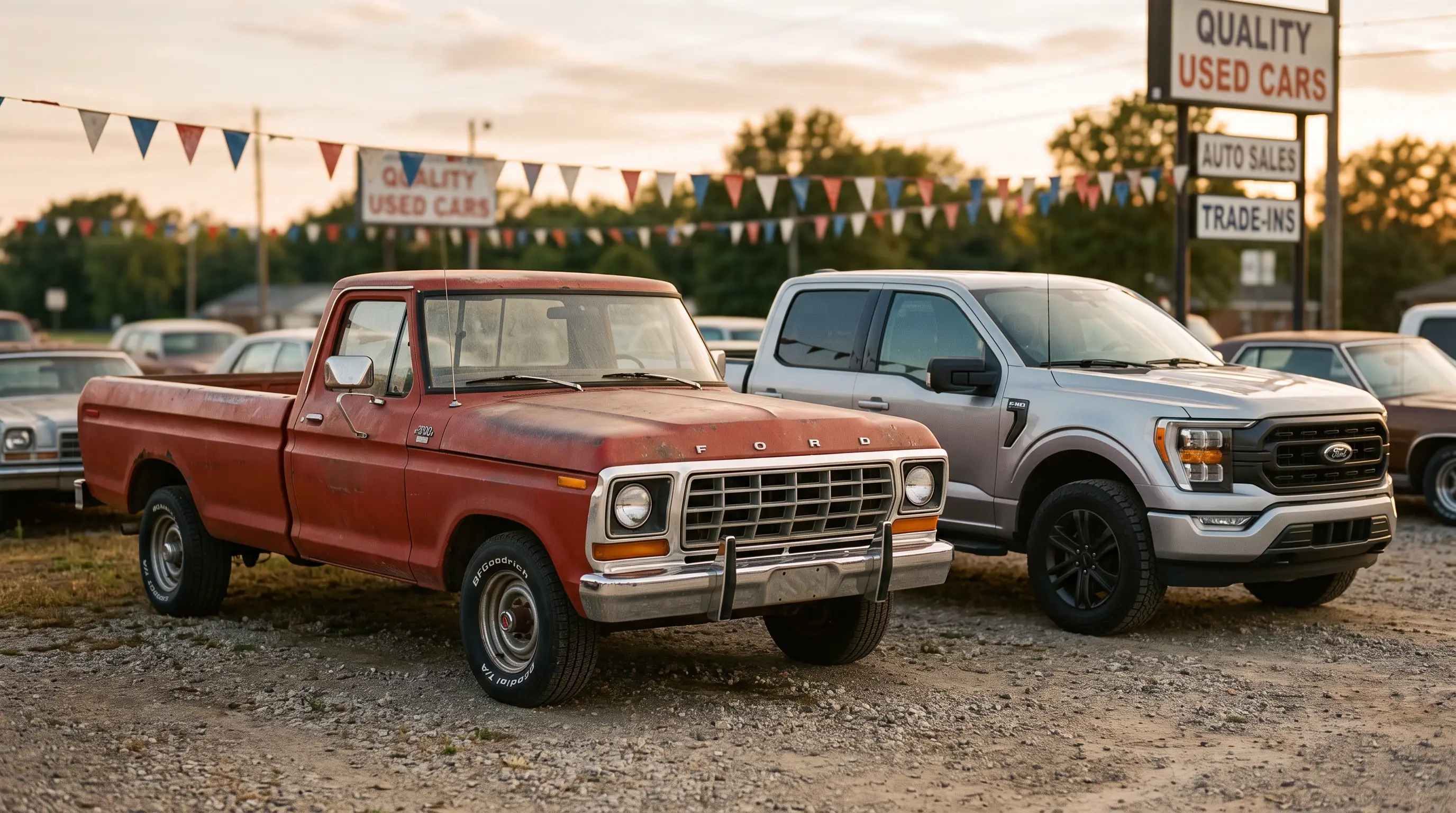
The Ford F-100 badge went out quietly, and it went out slower than most people assume. The 1979 F-100 sat on showroom floors next to its bigger F-150 and F-250 siblings, closed out the dentside body style that had defined the truck since 1973, and then kept limping along in shrinking numbers on the next-generation body for a few more years before Ford finally dropped the name for good after the 1983 model year. For a nameplate that had carried the company's half-ton truck since 1953, that long fade is a strange way to go, and it raises a fair question: why was the Ford F-100 discontinued at all when it was still selling, even in small numbers, into the early 1980s?
The last year of the dentside F-100
By 1979 the F-100 was the entry point of a truck lineup that had grown wider and more layered than anything Ford had built before it. The F-150 had arrived in 1975 as a half ton positioned just above the emissions and payload thresholds that were squeezing the F-100, and by the end of the decade the two trucks were parked side by side on the same lot, wearing the same sheet metal, sharing the same dentside body that had debuted in 1973. The only real differences were axle ratings, springs, and the badge on the tailgate. A buyer who wanted a stripped work truck could still order an F-100. A buyer who wanted a little more capability, with almost no price penalty, ordered the F-150 instead. F-150 volume pulled ahead steadily through 1978 and into 1979, while F-100 orders kept thinning, and 1979 closed out the dentside generation entirely, the last year that body style was built in either badge.
Emissions rules did the real damage
The engineering pressure came from Washington, not from the sales floor. Federal emissions standards tightened through the mid to late 1970s, and every gasoline engine Ford offered needed recalibration, smog pumps, and catalytic hardware to stay compliant. That hardware cost money and it cost horsepower, and it hit smaller trucks disproportionately hard because the F-100's lighter gross vehicle weight rating kept bumping against thresholds that triggered stricter rules. Ford's engineers found it simpler, and cheaper, to certify one half-ton truck at F-150 ratings and let the F-100 ride on borrowed componentry than to keep developing two separate emissions packages for trucks that were mechanically identical below the badge. Classic F-100 for sale listings from this era still show buyers hunting for the last of these trucks specifically because they predate some of the heavier smog equipment that followed in the 1980s.
What the F-150 offered instead
The F-150 was not a new truck bolted onto old bones. It used the same frame, the same dentside cab, and largely the same engine options as the F-100, but its gross vehicle weight rating sat just above the federal line that triggered the toughest emissions testing of the period. That let Ford keep more of the F-150's engine output usable, particularly with the 351 and 400 cubic inch V8s, at a time when smaller-displacement engines were losing power year over year to compliance hardware. For a company already juggling a fuel crisis, a growing SUV market with the Bronco, and increasing competition from Chevrolet's C/K series, consolidating around one half-ton nameplate instead of two nearly identical ones was the simpler business decision, even if it meant a name that had been on Ford trucks since 1953 spent its final years as a shrinking fleet and export option before finally disappearing after 1983.
"The F-100 did not lose a sales fight. It lost a paperwork fight. Once the F-150 could carry the same jobs at a lower certification cost, keeping both names on the books stopped making sense to anyone in Dearborn's accounting department."
- Tom Ramirez
How the badge faded out over several more years
Nothing about the change was dramatic on the factory floor in Louisville or at the Michigan Truck Plant. Line workers kept building half-ton trucks, first the dentside body through 1979 and then the next-generation body that replaced it for 1980, and the F-100 badge rode along on that new body in ever-smaller numbers rather than vanishing overnight. The paperwork simply routed more and more orders through F-150 build codes as dealers steered buyers there, and F-100 orders became a smaller slice of a run that had not shrunk nearly as much as the badge split suggested. Ford's dealer network had learned by 1978 that the price gap between an F-100 and an equivalent F-150 was thin enough that most buyers, when shown both trucks side by side, took the one with more headroom on payload and towing. A stripped work truck buyer ordering fleet vehicles by the dozen might still spec an F-100 for the marginal cost savings, but private retail buyers increasingly skipped it. That slow migration, order by order, is what actually killed the nameplate, and it took until after the 1983 model year to finish the job. There was no press release, no single announcement that this was the end. Ford simply stopped listing F-100 as an option for 1984, and the truck that had opened the company's half-ton line for over three decades quietly became F-150 exclusively.
| Model year | F-100 status | Note |
|---|---|---|
| 1975 | Available | F-150 introduced above it |
| 1977-78 | Available | Sales share shrinking against F-150 |
| 1979 | Available | Last year of the dentside body on any half-ton badge |
| 1980-83 | Available, low volume | Carried on next-generation body mostly as fleet and export orders |
| 1984 | Discontinued | F-150 becomes sole half-ton badge |
Finding a 1979 today
Collectors who track the dentside generation treat the 1979 F-100 as a specific target, not just a leftover trim from the bigger story. It is the final year of the dentside body on the F-100 badge, it carries the last of the pre-F-150-dominant build sheets, and where this started in 1973 with the dentside redesign closes out neatly on this exact model year, even though the F-100 name itself soldiered on for a few more low-volume years afterward. Survivors are less common than 1977 or 1978 trucks simply because fewer were built as buyers migrated to the F-150 in the dentside's final season. Documentation matters here more than usual. A build sheet or window sticker confirming F-100 badging, rather than a later F-150 with mismatched trim swapped on, is worth chasing down before any purchase.
What makes the 1979 truck interesting to own now is exactly what made it a hard sell new. It is the leaner, lighter-rated version of a truck platform that Ford kept building in F-150 form for decades afterward, which means parts interchange is generous even though the name on the fender is rare. That combination, common mechanicals wrapped around an uncommon badge, is why the last F-100 still draws attention from people who were not even shopping for one specifically. It is a footnote that happens to be a complete, driveable truck, and that is a better ending than most discontinued nameplates get.
Restomod builders have picked up on this quietly too. A 1979 F-100 shares enough underneath with the F-150 that runs of the same body sold for another decade that sourcing a replacement bed, glass, or trim piece is rarely the problem it is with a genuinely obscure truck. What is scarce is the badge itself and the paperwork trail behind it, which is exactly the kind of scarcity that appeals to someone who wants a truck that looks familiar to a casual observer but reads as something specific to anyone who actually knows the model history. That is the quiet appeal of the last dentside F-100. It did not go out with a bang, but it went out as a genuine end point for that body style, and end points tend to age well in this hobby.