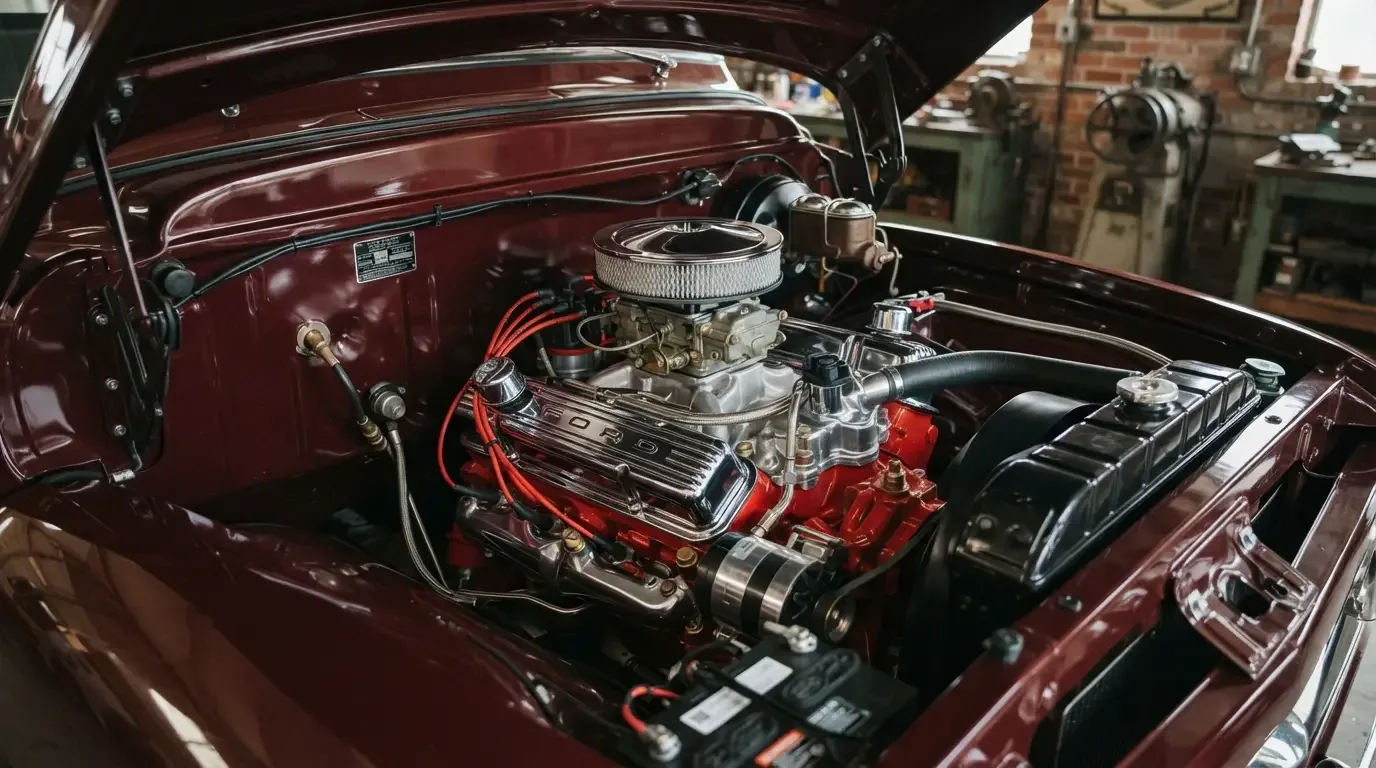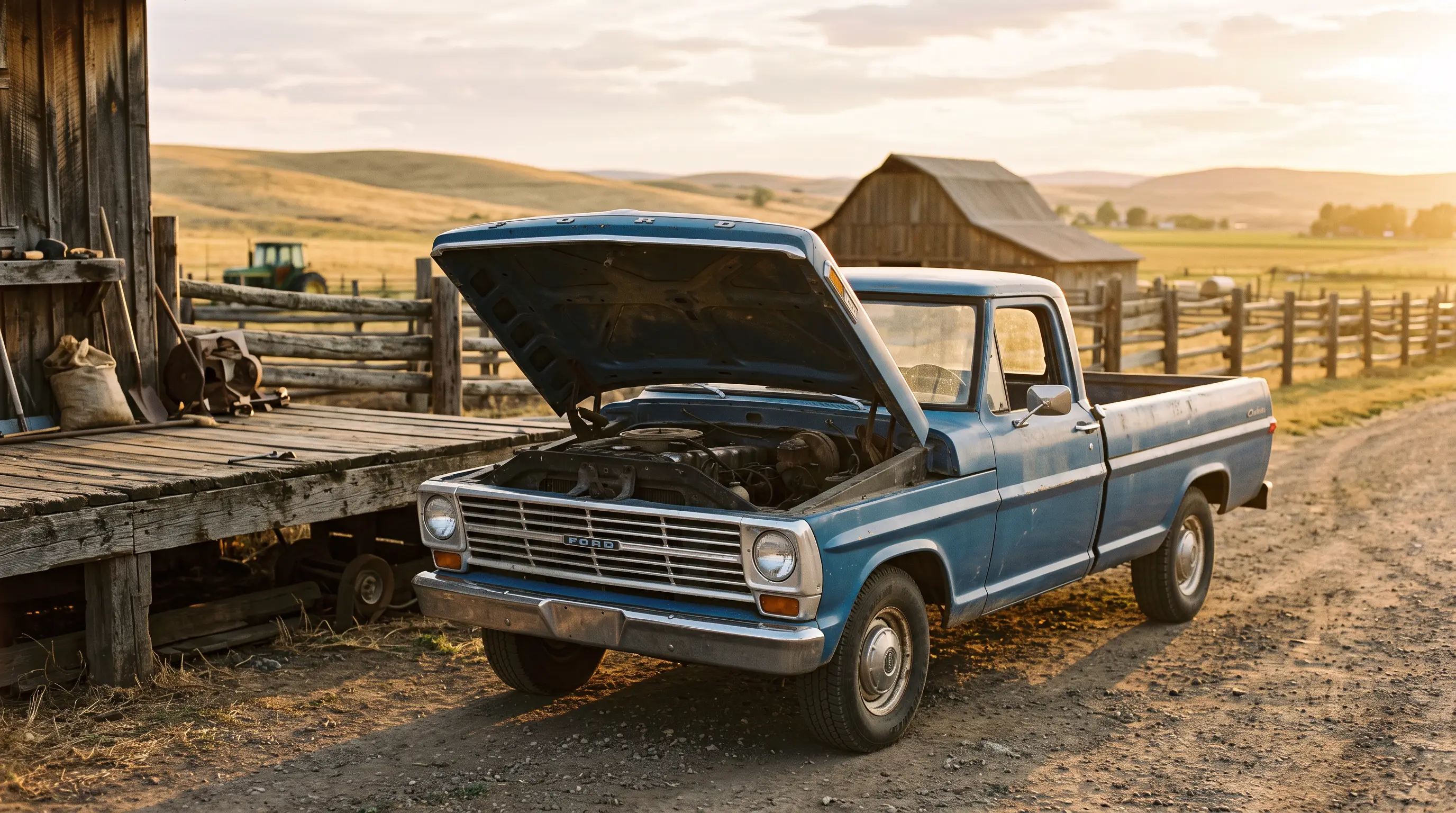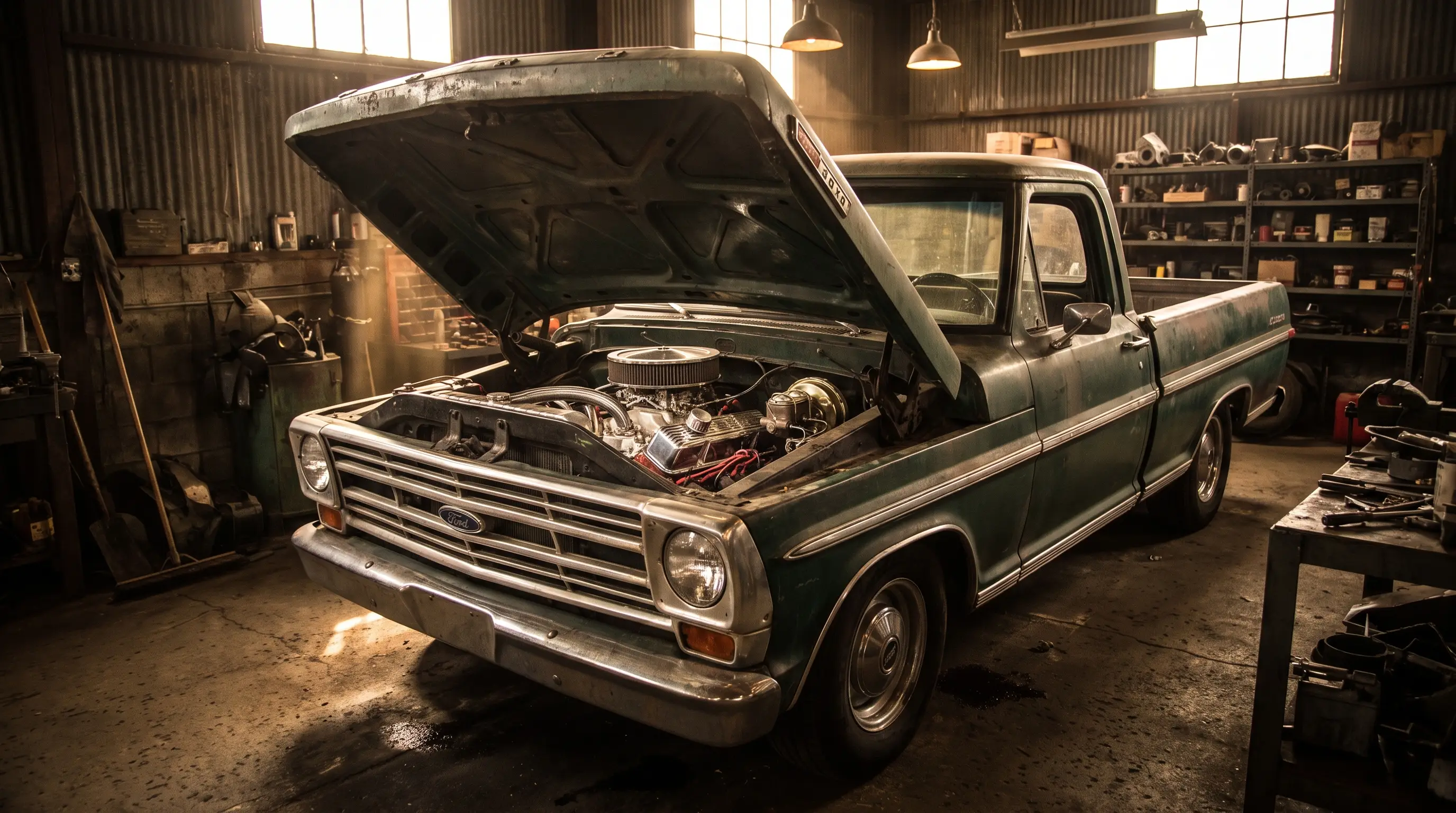
The 302 Windsor is the engine most people picture when they hear "small-block Ford," and by the time it landed in the F-100 lineup, it had already proven itself in everything from Mustangs to Broncos. In the truck, though, the 302 does a slightly different job than it does in a sports coupe. It is not chasing quarter-mile numbers. It is being asked to move a heavier vehicle, tow a trailer on occasion, and do it reliably for a decade or more. That context is worth keeping in mind whenever someone tells you the 302 F-100 is underpowered. Underpowered compared to what, and doing what job, matters more than the number on the valve covers.
Where the 302 fits in the F-100 lineup
Ford offered the F-100 with a range of V8 options through the 1960s and 1970s, and the 302 sat in the middle of that range, above the entry-level six-cylinder engines and below the larger 360 and 390 big-block options that later trucks could be ordered with. It became a common mid-tier choice for buyers who wanted V8 smoothness and a bit more passing power than a six could offer, without stepping up to the cost, weight, and thirst of a bigger engine. That middle position is exactly why so many surviving F-100s carry a 302 today. It was popular enough in period to have been ordered in real numbers, and forgiving enough as a design that a meaningful share of those engines are still running.
| Spec | 302 Windsor in the F-100 |
|---|---|
| Displacement | 302 cubic inches (5.0 liter) |
| Configuration | 90-degree V8, small-block Windsor family |
| Horsepower (period rating) | 205 hp gross / 154 hp net (late 1969-1972) |
| Typical use | Mid-tier V8 option, light to moderate towing |
| Position in lineup | Above the six-cylinder engines, below the 360/390 big-blocks |
What the numbers actually tell you
Compare the 302's output against a modern truck engine and it looks modest. Compare it against the six-cylinder engines it was sitting above in Ford's own brochure, and the picture changes. The 302 gave F-100 buyers meaningfully more power and a smoother idle than the base six, at a fraction of the weight penalty of the big-block options. That is an engineering tradeoff, not an accident, and it is the reason the 302 sold as well as it did. Ford was not trying to build the most powerful F-100 available. It was trying to build the F-100 that made the most sense for the largest number of buyers, and the 302 hit that target with some precision.
Failure modes on the 302 are well documented after decades of use in F-100s, Mustangs, and Broncos alike. Overheating from a neglected cooling system is the most common way a 302 gets damaged, followed by the kind of oil-related wear you would expect on any engine that sat unused for long stretches between owners. None of that is unique to the truck application, and none of it is a mark against the engine's underlying design. It is simply what happens to any engine when maintenance lapses for years at a time.
Why it became the default recommendation
Ask around in F-100 circles today and the 302 comes up constantly as the recommended engine for a first-time buyer, and the reasoning holds up under scrutiny. Parts support is excellent because the same basic architecture was used across so many Ford products for so many years. Diagnostic knowledge is abundant, since generations of mechanics have worked on this exact family of engine. And the power output, while not dramatic, is genuinely adequate for how most F-100 owners actually use their trucks today, which is closer to weekend driving and light hauling than to daily heavy-duty work.
"I look at the 302 the way I look at any well-documented system. It has known failure points, known fixes, and forty years of other people's mistakes to learn from. That is worth more to a buyer than another twenty horsepower from an engine nobody wants to work on."
- Emily Chen
That documentation advantage compounds over time. Every question a new owner might have about a 302 has almost certainly already been asked and answered somewhere, which is not something you can say about every engine option Ford ever put in an F-100.
Reading the whole engine picture
The 302 does not exist in isolation, and understanding why Ford positioned it where it did requires looking at the full spread of engines the company offered across F-100 production. If you want that context, read the background on how the six-cylinder and V8 options fit together across the model's history, from the entry-level engines through the largest big-blocks Ford ever installed in a half-ton truck.
Set against that full lineup, the 302's role becomes clearer. It was the answer for buyers who wanted V8 character without V8 compromise, and that answer turned out to be right often enough that it remains one of the most common engines you will find under an F-100 hood today.
How the 302 compares to its neighbors on the order sheet
Understanding the 302 also means understanding what a buyer gave up by choosing it over the alternatives. Step down to the six-cylinder and you save weight and fuel cost, but you lose the smoother idle and the passing power that made the 302 worth the extra money for so many original buyers. Step up to the 360 or 390 big-block and you gain real towing muscle, but the added weight over the front axle changes the way the truck handles, and the fuel bill grows with it. The 302 sits in the middle of that tradeoff deliberately, and decades of buyer behavior suggest Ford read that middle ground correctly. It is not the engine you pick if towing capacity is the whole point of owning the truck, and it is not the engine you pick if minimizing fuel cost is the only priority. It is the engine you pick when the truck needs to do a bit of everything reasonably well, which describes how most F-100 owners, then and now, actually use their trucks.
The 302 joined the F-100 order sheet late in 1969, after the small-block Windsor family had already proven itself in the Mustang and Fairlane, so it entered the truck lineup with a well-established design rather than a fresh, unproven one.
That middle-ground positioning also explains why the 302 shows up so often in restomod builds and daily-driven survivors alike. Builders who want a period-correct feel without hunting down a rare or fragile engine gravitate toward the 302 because it asks so little of them in return for what it delivers. It does not require special tuning knowledge, it does not demand a dedicated parts hoarder's network, and it does not punish an owner for occasional neglect the way some more finicky designs do. That combination of low demands and steady output is a large part of why the engine has such staying power in the hobby decades after Ford stopped installing it at the factory.
What this means for a buyer today
A well-sorted 302 F-100 is, for most people, the sensible entry point into the model. It offers enough power to keep up with modern traffic, a support network that makes ownership straightforward, and a reputation solid enough that resale is rarely a problem. None of that makes it the most exciting engine Ford ever built. It makes it the most rational one, and for a truck that is going to be driven rather than trailered to shows, rational tends to win. Anyone weighing that decision seriously should go look at what is actually available before forming an opinion from spec sheets alone, and a good place to start is to find a classic F-100 currently on the market.