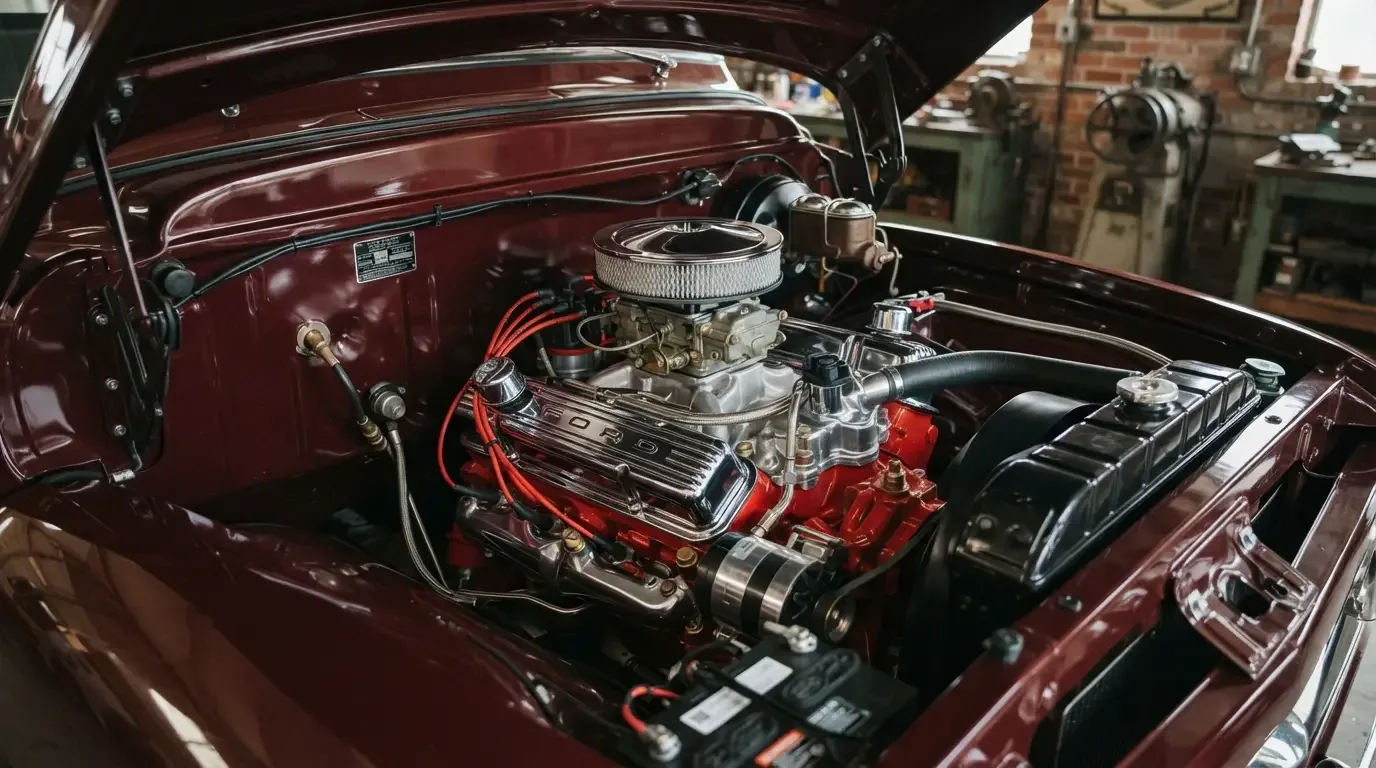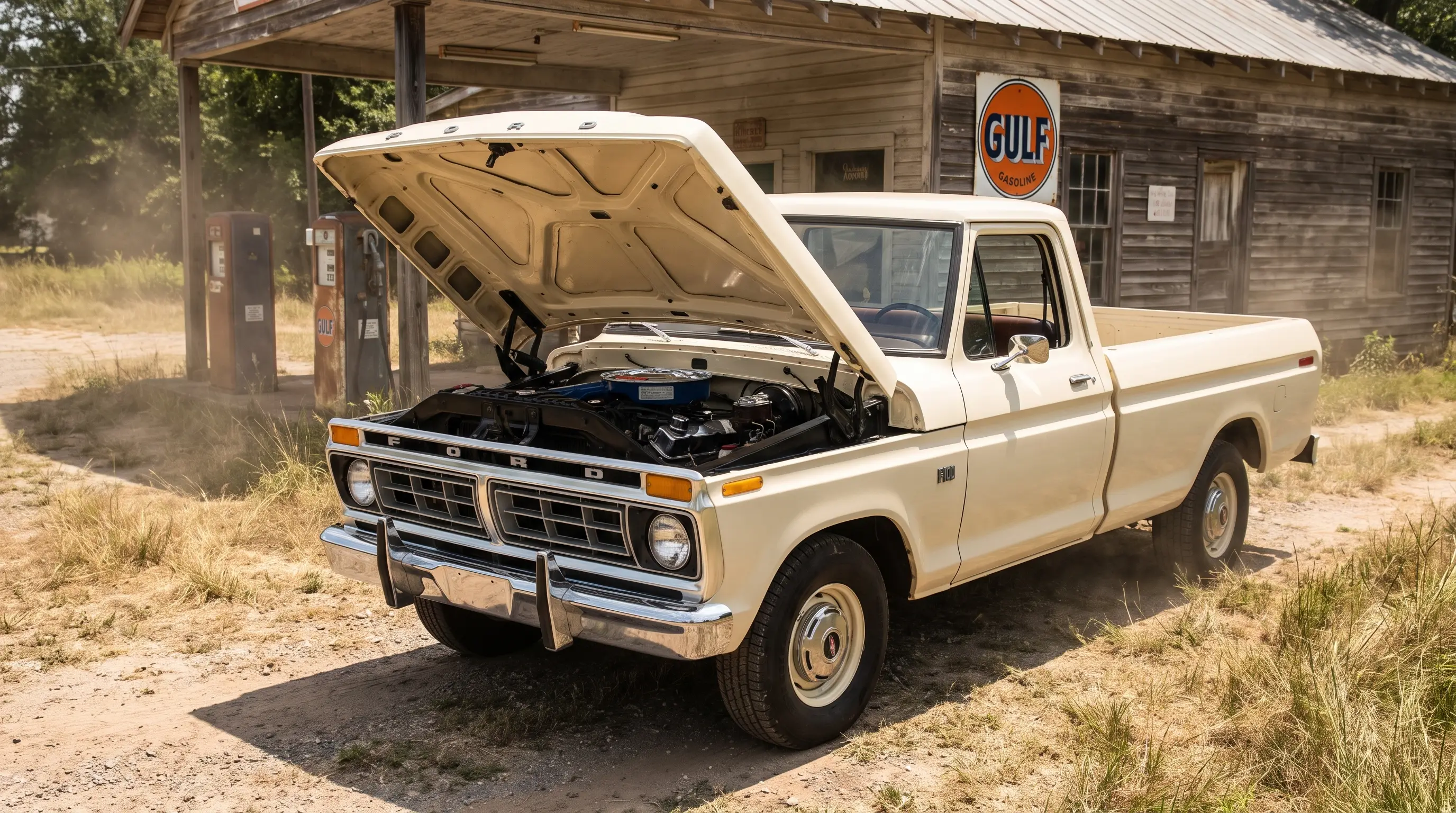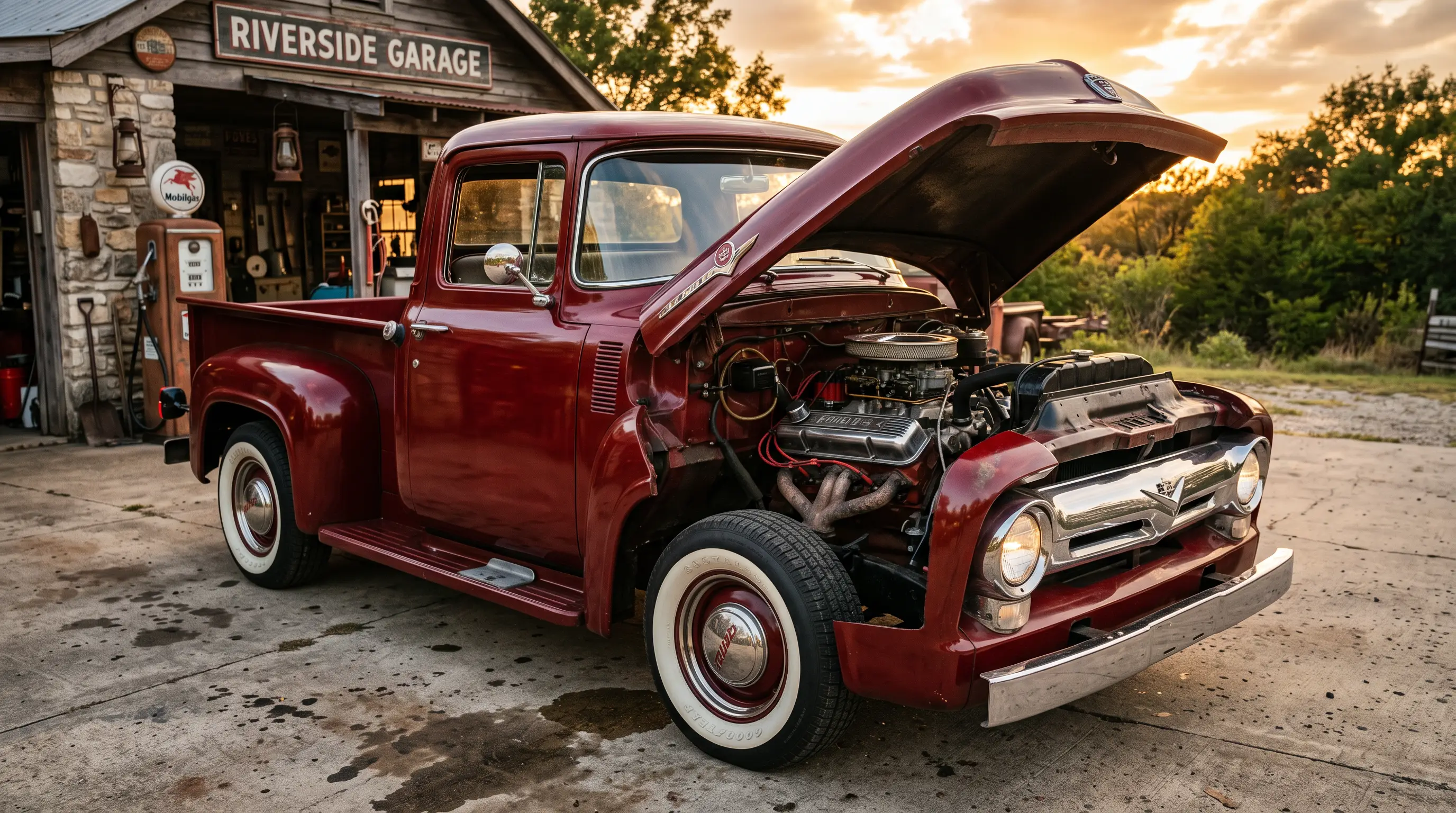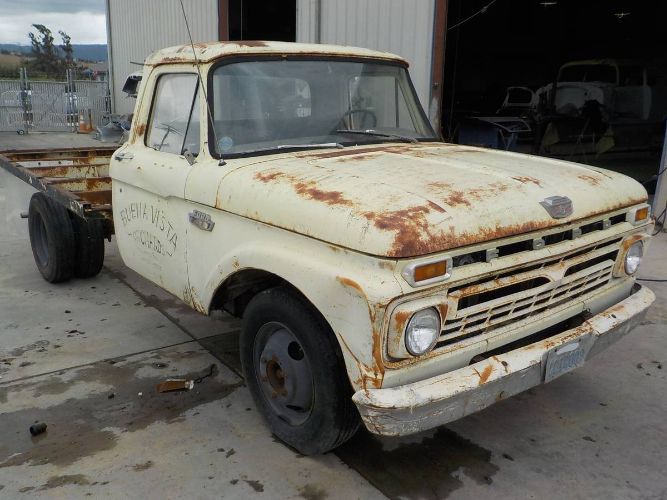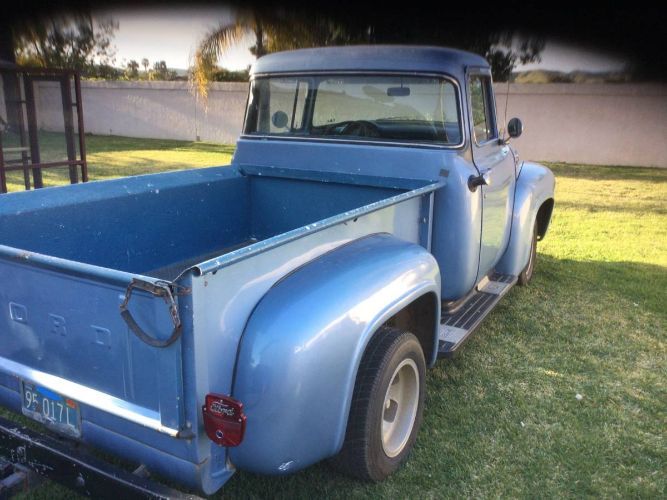
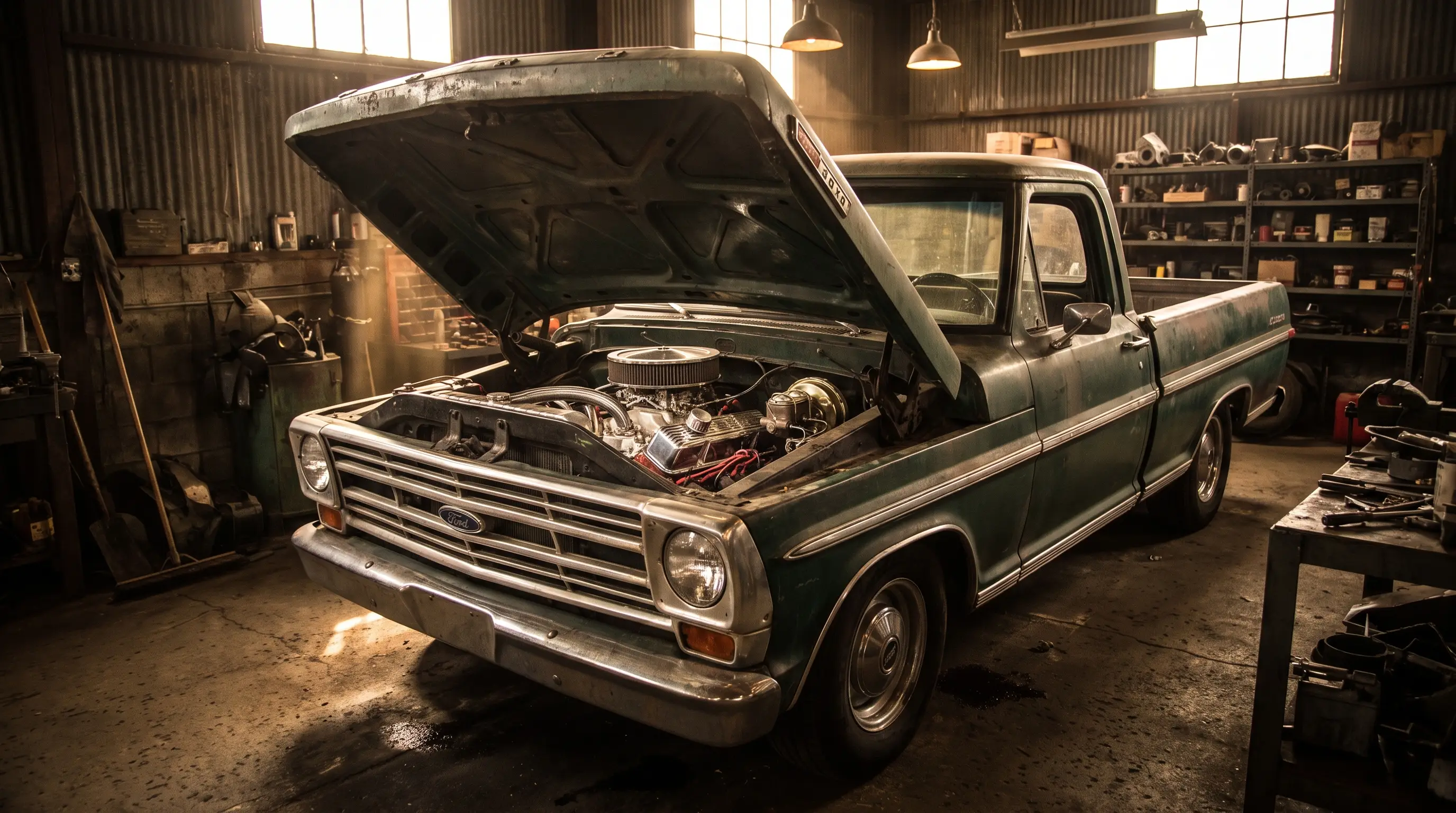
Ford put a V8 in the F-100 in 1954. That is the short version. The longer version covers three decades, at least six distinct V8 families, and a steady climb in displacement that tracked exactly what American buyers wanted from a half-ton truck. The Ford F-100 V8 story is not complicated. It is a company chasing torque, then chasing displacement, then chasing both at once as trucks got heavier and buyers got greedier about towing capacity.
1954: the Y-block starts it
The first V8 F-100 buyers could order came from Ford's Y-block family, named for the deep skirt that made the block look like a Y in cross-section when you looked at it end-on. It was not a big engine by later standards. It did the job it needed to do: give F-100 buyers an alternative to the standard six, with more power and a smoother idle. That was the whole pitch. Nobody was racing these trucks. They were hauling lumber and feed, and the Y-block did that fine.
The Y-block stuck around through the 1950s and into the early 1960s before Ford moved on to newer designs. It is not the engine most collectors chase today, but it is the one that started the whole conversation about V8 power in a Ford half-ton.
The small-block era takes over
Ford's small-block V8 family, the Windsor engines, showed up through the 1960s in a range of displacements, eventually including the 289 and then the 302 that became such a common F-100 engine. These were lighter, more modern designs than the Y-block, and they gave buyers a real choice: enough power for daily use without the weight and fuel bill of a bigger engine. The 302 in particular became a volume seller, and it stayed in the F-100 lineup for years because it worked. Simple as that.
| Era | V8 Family | Typical Displacement |
|---|---|---|
| 1954-1964 | Y-block | 239-292 cubic inches |
| 1960s-1970s | Windsor small-block | 289-302 cubic inches |
| 1960s-1970s | FE big-block | 352-390 cubic inches |
| 1970s | 335-series | 351-400 cubic inches |
Bigger trucks meant bigger blocks
As F-100s got heavier and buyers started towing more, Ford answered with the FE big-block family, engines that had already proven themselves in Ford's cars and were scaled up for truck duty. The 352 and 390 both saw service in F-100s through the 1960s and into the 1970s, giving buyers real towing muscle when the small-block V8s were not enough. These are not subtle engines. They are heavy, they drink fuel, and they exist because Ford's customers kept asking for more capability than the small-blocks could deliver.
The pattern here is not complicated. Buyers wanted more capacity. Ford built bigger engines. Repeat that cycle for twenty years and you get the V8 lineup the F-100 ended up with by the time production wound down.
"People want to make this complicated. It is not. Ford built a small V8, then a bigger V8, then a bigger V8 than that, because trucks kept getting heavier and customers kept asking for more. That is the whole history in one sentence."
- Dan Reeves
The 351 and the last generation
By the 1970s, Ford's 335-series engines, including the 351 Cleveland and 351 Windsor variants, gave F-100 buyers a mid-size V8 option that split the difference between the small-block and the big FE engines. This was Ford refining the formula rather than reinventing it. The company had already learned what buyers wanted from twenty years of F-100 V8 sales data: enough power to tow without the fuel penalty of the biggest engines available. The 351 hit that mark for a lot of buyers in the final years before the F-100 nameplate itself was phased out in favor of the F-150.
What actually changed and what did not
Here is the number that matters. Across three decades of F-100 production, displacement roughly doubled from the earliest Y-block options to the largest engines available by the 1970s. That is not a coincidence and it is not marketing. It reflects a real, measurable increase in what buyers expected a half-ton truck to be capable of, and Ford's engine lineup is essentially a paper trail of that shift.
What did not change is simpler. Every generation of F-100 V8 was built to the same basic brief: reliable power, reasonable cost, and an engine that a dealership mechanic anywhere in the country could service without special tools. Ford never chased exotic engineering in this truck. It chased what worked, over and over, for thirty years.
For the full breakdown of every engine Ford offered in the F-100, six-cylinder included, the whole picture covers the complete lineup in one place rather than the V8-only slice covered here.
What the swap culture says about the original lineup
Modern restomod builders often drop later, more powerful V8s into older F-100 bodies, and that trend, while a separate topic from the factory history itself, says something interesting about how the original lineup is remembered. Builders reach for bigger displacement and modern fuel injection because they want the truck to feel the way period buyers wished it felt, only with decades of engineering progress behind it. That impulse traces directly back to the same demand pattern that pushed Ford from the Y-block to the FE big-block in the first place: owners wanting more capability than the factory originally delivered. The culture around these builds is its own story, separate from stock originality, but it did not appear out of nowhere. It is a continuation of the exact demand curve that shaped the factory engine lineup for three decades.
None of that changes how a buyer should evaluate a numbers-matching original truck. A stock Y-block or small-block F-100 has its own value proposition, tied to history and originality rather than outright capability, and that value only holds if the engine bay actually matches what left the factory. Knowing the real progression, generation by generation, is what lets a buyer tell the difference between a well-preserved original and a truck that has quietly picked up a later engine somewhere along the way.
Buying into the history
None of this history matters much if you cannot find a truck to put it into context. The good news is that examples from every era of the V8 story, from early small-blocks to the last of the big FE engines, still turn up on the market with some regularity. Anyone serious about picking the right F-100 V8 for their own truck should go look at real inventory rather than theorize from spec sheets, and that starts with a look at who has trucks to shop classic F-100 listings right now.
Take the time to match the year of a prospective truck against the engine options that were actually available that year before falling for a listing description. The V8 story spans three decades and six or more distinct engine families, and not every combination described in a casual ad matches what Ford actually built. A little cross-referencing against the production record saves buyers from paying a premium for a combination that never left the factory that way.