
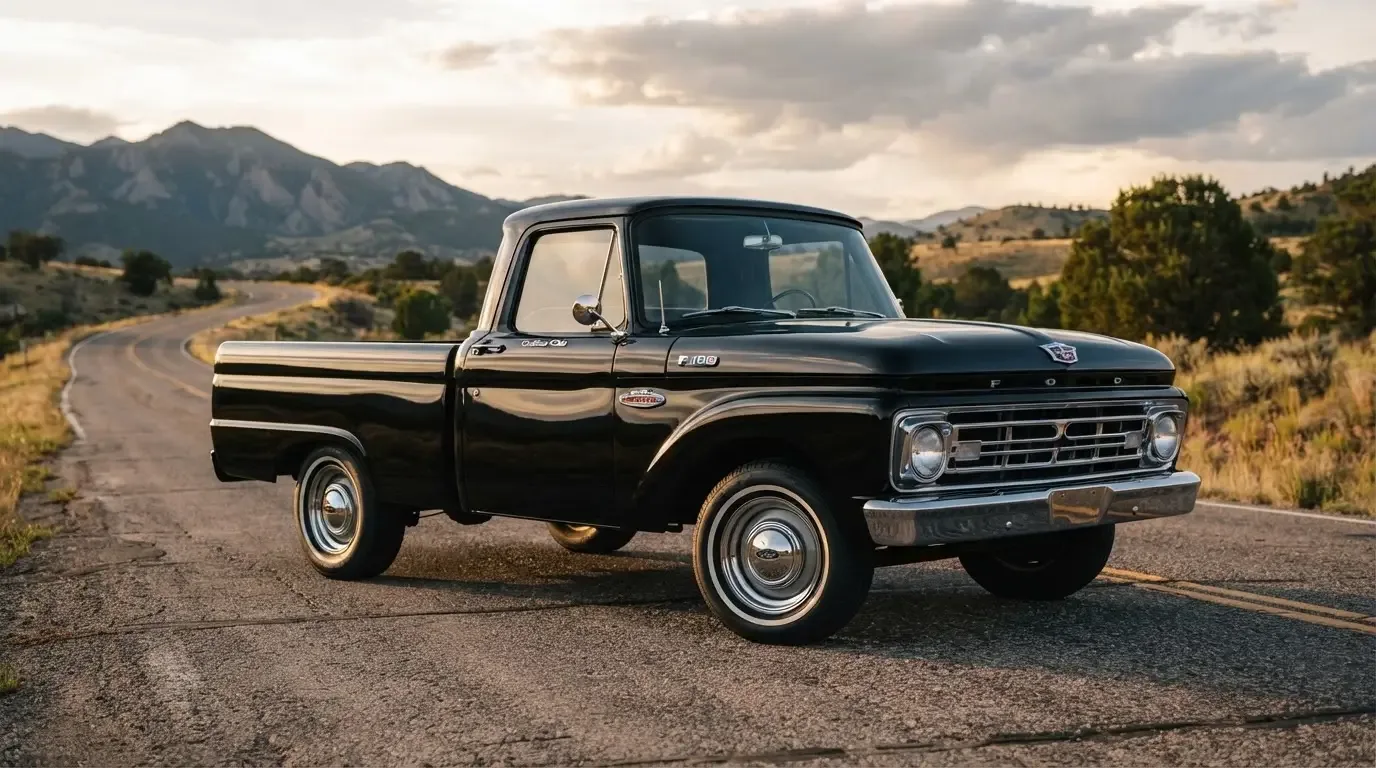
There is a fellow at our monthly cruise-in who still tows a vintage slide-in camper behind, sometimes on top of, his 1966 Ford F-100, and he tells the same story every summer like it is the first time any of us have heard it. His father bought the truck new specifically because it wore the Camper Special badge, and fifty-some years later that badge is still the reason the family keeps the truck instead of trading it in for something newer. That kind of loyalty does not happen by accident, and it says something real about what Ford built when it created the Camper Special package.
Car Features
7 min read
The F-100 Camper Special
The Ford F-100 Camper Special package answered the rise of slide-in truck campers with heavier springs, extended mirrors, and camper wiring.

A package built around a very specific problem
By the mid-1960s, slide-in truck campers had become a genuine consumer trend, giving families a way to travel and camp without towing a separate trailer. The trouble was that a standard half-ton F-100 was not really engineered to carry that kind of top-heavy weight sitting directly over the rear axle and hanging out past the cab. Ford's answer was the Camper Special package, a factory option that beefed up the truck specifically for that job rather than leaving owners to figure it out with aftermarket parts and guesswork.
What actually came with the package
The Camper Special option added heavy-duty front and rear springs to handle the concentrated weight of a mounted camper, along with extended, western-style rearview mirrors so the driver could actually see around a camper box that often extended well past the cab's natural sightlines. The package typically bundled a higher-capacity alternator, extra cooling capacity for the radiator, a heavier-duty battery, and gauges for oil pressure and amperage so an owner could keep an eye on a truck working harder than stock. Many trucks also came with camper-specific wiring, giving owners a straightforward way to run lights and accessories on the camper unit without splicing into the truck's harness themselves. It was a modest list of changes on paper, but each one addressed a real, specific failure point that camper owners without the package regularly ran into, from sagging rear ends to blind-spot near misses on the highway.
Why club members still hunt for these trucks
Inside our club, Camper Special trucks carry a certain reputation. They tend to have survived harder, more purposeful use than a truck that spent its life running light errands, and that use often meant better maintenance, since a family depending on the truck for a summer trip every year had every incentive to keep it running right. At the same time, that same heavy use means buyers need to look closely for wear in the rear suspension and frame, areas that took the brunt of the load these trucks were built to carry. A well-kept Camper Special is a genuinely appealing find, but a neglected one wore out in exactly the places you would expect a heavily loaded work truck to wear out.
These trucks sit within the same broader story as the rest of the 1961 to 1966 generation, sharing the slab-side cab and, in later years, the Twin I-Beam front suspension that came in for 1965. Anyone wanting the fuller picture of how this generation developed should read the background on the years surrounding the Camper Special's introduction.
"I've heard the same story from three different members over the years, different truck, different family, same shape of memory. Somebody's dad bought a Camper Special specifically to take the kids camping, and forty years later somebody's kid still owns it. That's not nostalgia talking, that's just what these trucks were built to do."
- Wayne Coburn
The camping boom that made the package necessary
The broader context here matters as much as the truck itself. Postwar prosperity and an expanding interstate highway system had turned family camping into a mainstream pursuit by the early 1960s, and slide-in campers offered a middle ground between roughing it in a tent and towing a full travel trailer. A family could load up a camper unit over a weekend, drive it to a state park, and be home by Sunday night without the hassle of backing a trailer into a tight campsite. Ford recognized that trend early and built the Camper Special specifically to serve it, rather than waiting for owners to figure out the hard way that a stock half-ton truck needed help carrying that kind of load safely.
What to ask when you find one
If you come across a truck badged as a Camper Special today, the first question is always documentation. Original build sheets or dealer invoices confirming the package were installed at the factory carry real weight with serious collectors, since the badge alone can be swapped onto a truck that never actually carried the option. Beyond paperwork, look at the rear spring pack and frame around the bed mounting points for signs of the heavier use these trucks typically saw, and ask sellers directly whether the truck ever carried a camper regularly, since that history tells you a lot about what kind of wear to expect even on a truck that looks clean on the surface.
For club members and casual collectors alike, the appeal of the Camper Special is not really about horsepower or trim level. It is about what the package represents, a truck built with a family's actual plans in mind rather than an abstract sales category. That is worth remembering the next time you spot one among the find a classic F-100 listings, badge intact, ready for one more summer's worth of stories.
Stories that outlast the truck itself
What keeps me coming back to this particular chapter of F-100 history is how consistently the same emotional shape repeats across different families and different regions of the country. Someone always remembers the specific national park, the specific summer, the specific breakdown on the side of a highway that turned into a story told at every family gathering afterward. The Camper Special did not create those memories on its own, obviously, a family still had to load up and go, but Ford built a truck that made those trips reliable enough to actually happen year after year rather than remaining a once-tried, never-repeated experiment. That reliability is easy to overlook when you are cataloging spring rates and mirror extensions, but it is really the whole point of the package.
Club gatherings built around this generation of F-100 still draw out these stories more than almost any other topic, more even than engine swaps or restoration debates. Ask a room full of owners about their Camper Special trucks specifically and you will get more volunteered family history than technical detail, which tells you plenty about what this particular option actually meant to the people who paid extra for it back when the truck was new.
Sources and notes
Related Reading
Have a
Ford F-100
for Sale?
Reach thousands of serious classic car collectors across the US.
Sell It Here →
Are You a Classic Car Dealer?
List your full inventory and connect with targeted classic car buyers.
Join as a Dealer →

About the author
Wayne Coburn
Longtime Corvette owner, judge and club figure who knows the cars, the records and the people behind them.
Related Listings - Ford F-100
Comments
Be the first to comment on this article.