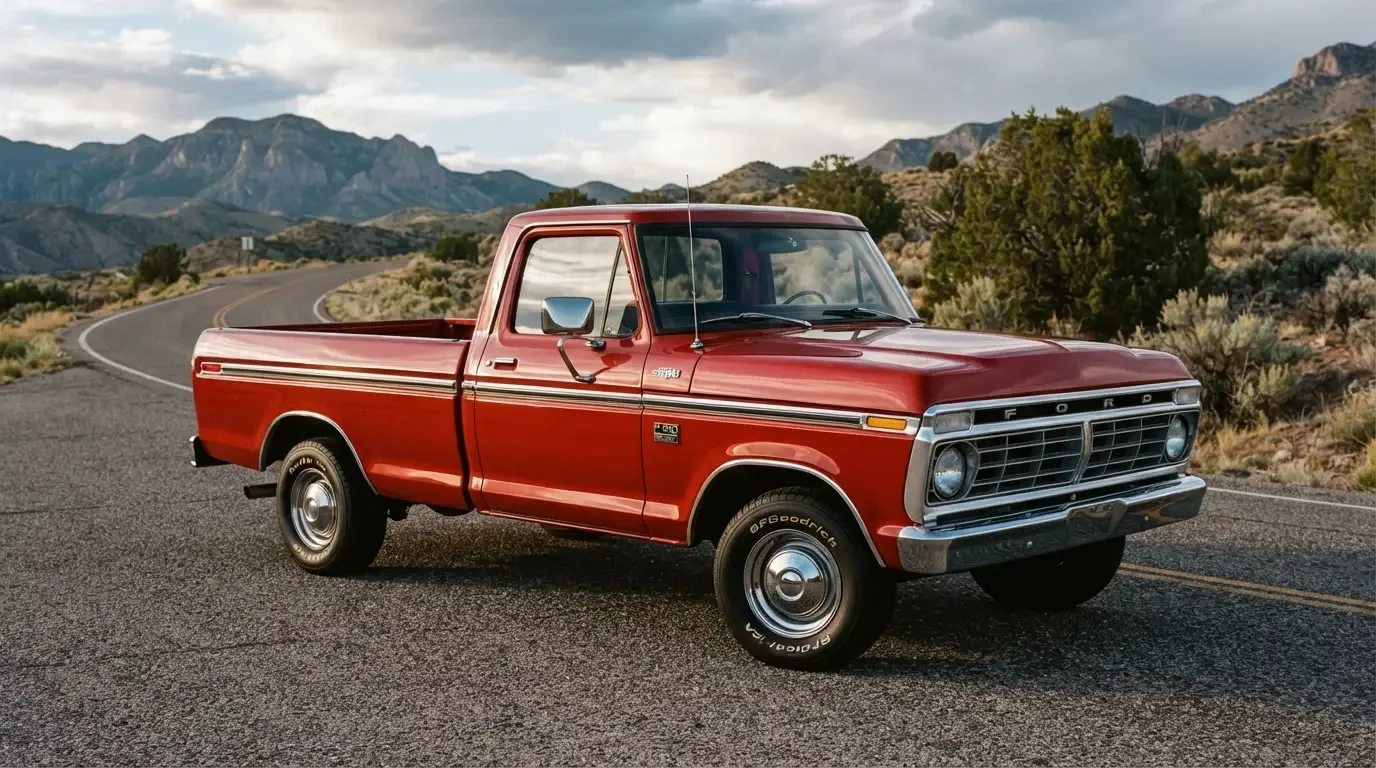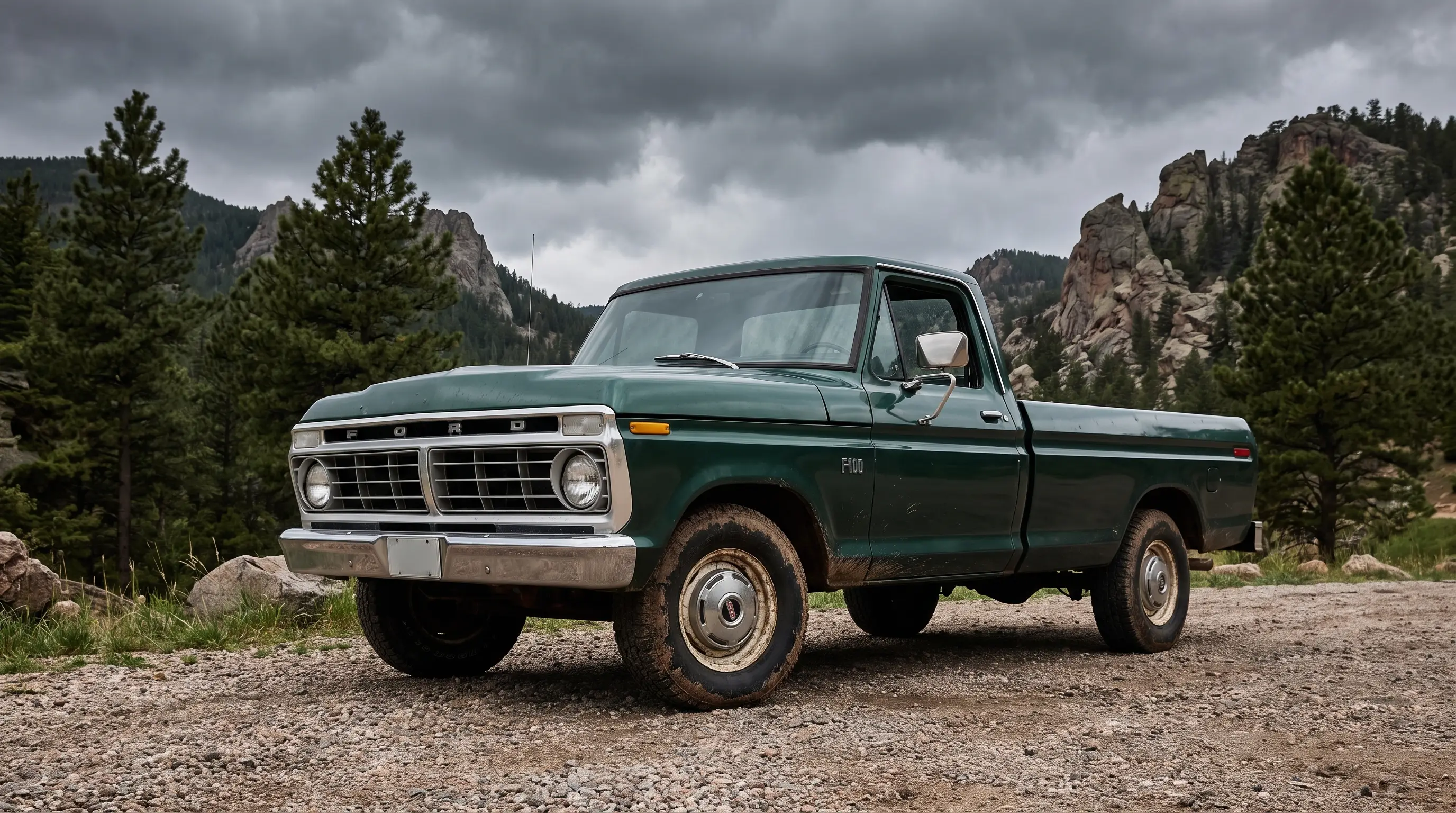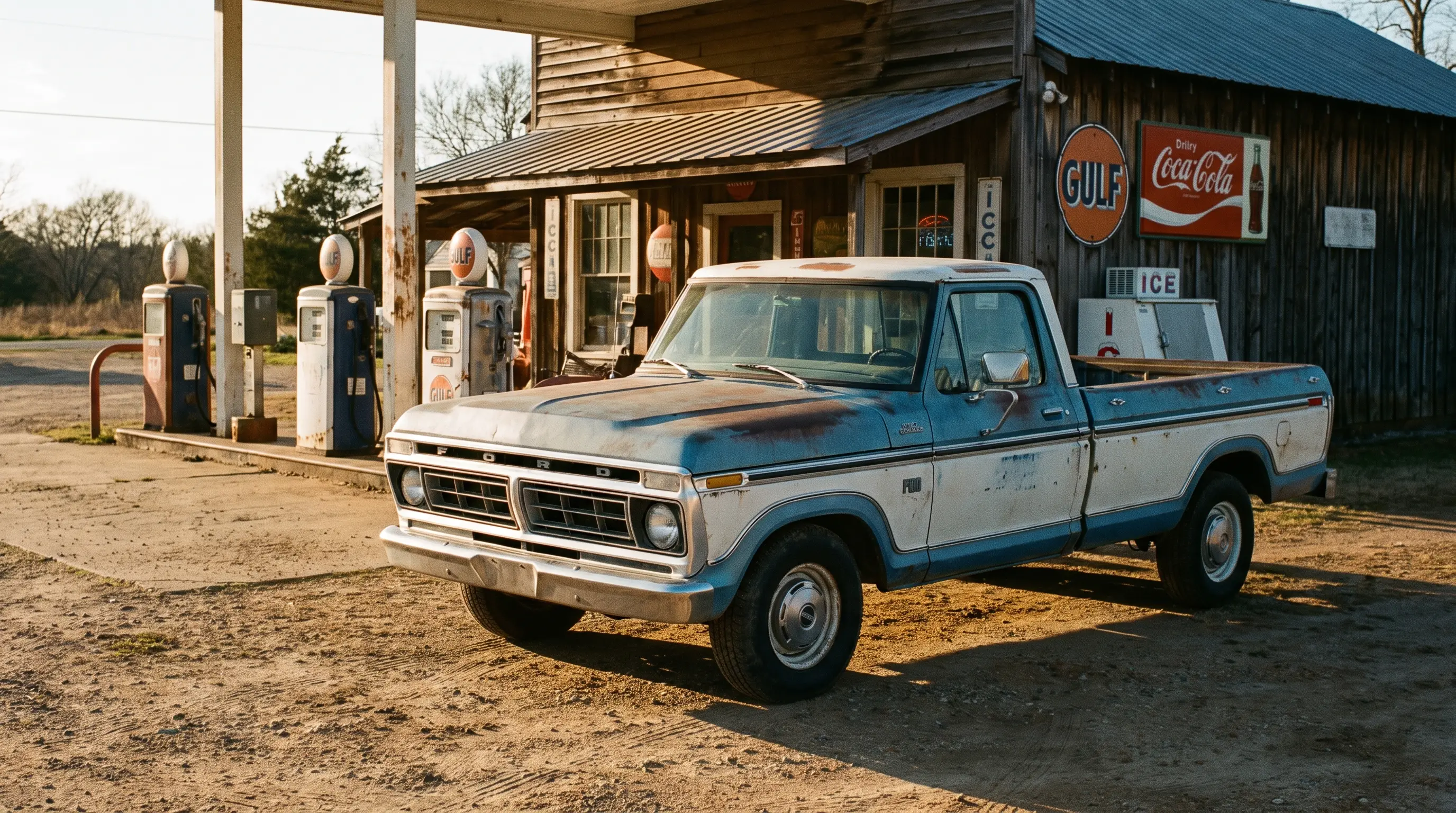
I was leaning against a 1976 F-100 at a club meet a few summers back, coffee in one hand, when a new member walked up and asked the question I have heard more times than I can count. Why do you all call these things Dentsides? He figured there had to be some famous story behind it, some factory recall or a batch of trucks that came off the line dinged up. The Ford F100 Dentside meaning is a lot simpler than that, and honestly, that is what makes it a good story.
I told him the same thing I am about to tell you. Run your hand down the side of any 1973 through 1979 F-100, and you will feel it before I finish explaining it.
The crease that started it all
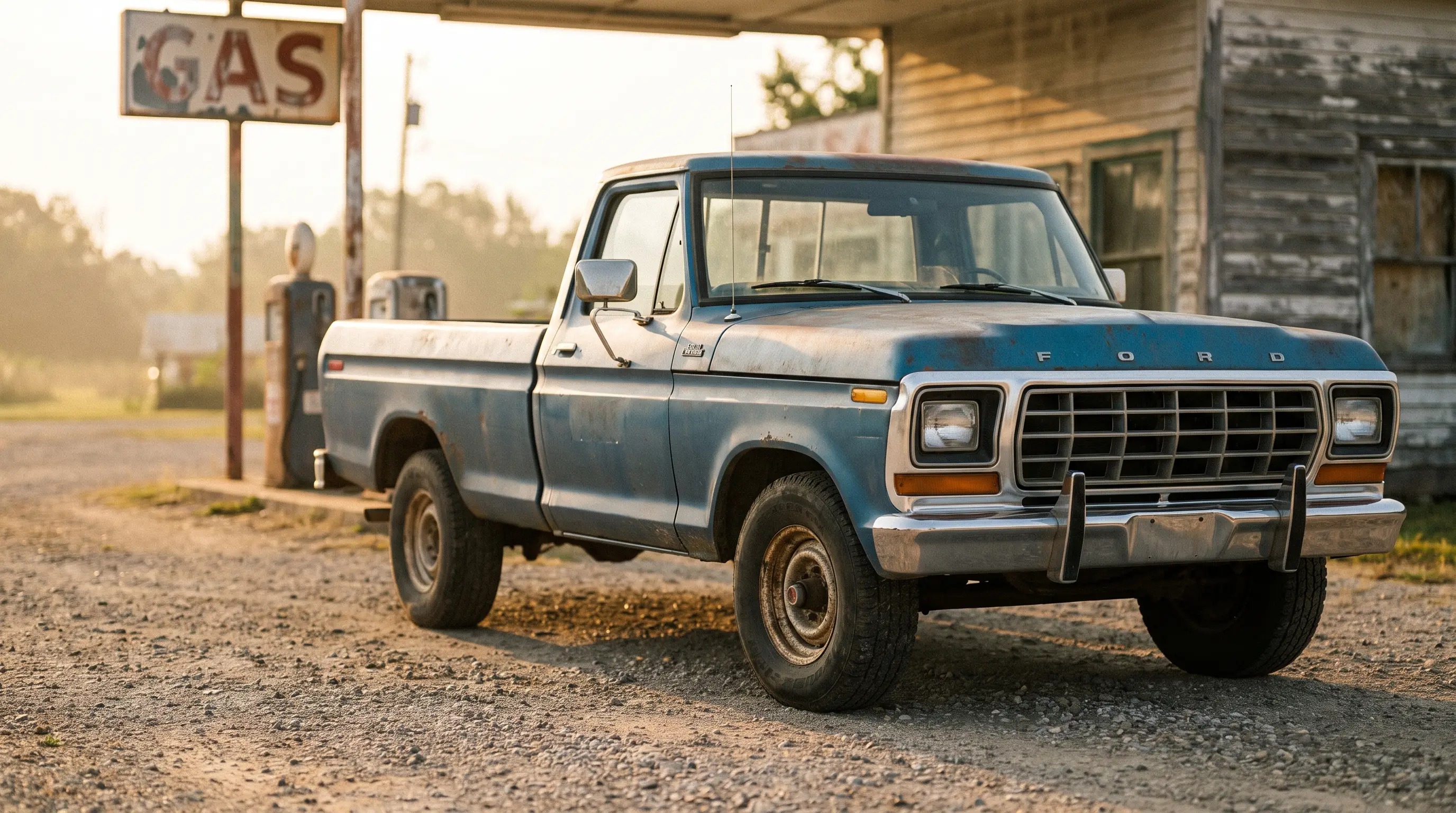
There is a long, deliberate character line pressed into the door and bed of every truck from this generation, running from front to back like a shallow groove. It was a factory styling element, not damage, but the first time most people see it up close, their brain reads it as a dent that should have been fixed. Owners started calling the trucks Dentsides informally, among themselves, long before Ford or any magazine made it official. For the fuller design story behind this generation, our our complete history feature walks through how the whole body style came together.
What I love about this name is that it came from the community, not from a marketing department. Nobody at Ford ever called these trucks Dentsides in a brochure. The name spread through owners talking to owners, at swap meets, in parts store parking lots, in the pages of club newsletters typed up on somebody's kitchen table. That is how a real nickname earns its staying power. It survives because people keep using it, not because a company printed it somewhere.
How the name spread through the club circuit
I have been going to Ford truck meets for longer than I care to admit, and I can tell you the Dentside name really took hold once regional clubs started forming around this specific generation in the years after production ended. Before that, people mostly just called them by model year, a seventy-five or a seventy-eight. Once enough owners started using Dentside as shorthand at shows, it stuck fast, and now you will not find a serious F-100 club anywhere in the country where the term needs explaining.
There is a funny wrinkle to the story too. A few old-timers I know insist the name predates the club scene entirely, that guys were calling them Dentsides on job sites back when the trucks were still just work vehicles, years before anyone thought to restore one. I cannot prove that either way, and honestly I like that the origin has a little mystery to it. Not everything worth knowing comes with a clean paper trail.
What the documentation does confirm is that the crease itself was an intentional Ford styling decision for the 1973 redesign, not an accident or a manufacturing quirk. Ford's designers wanted a bolder, more sculpted body line than the smoother fifth-generation trucks had carried, and that crease was the signature they landed on. The nickname just gave a name to something Ford built on purpose.
| Detail | Dentside naming history |
|---|---|
| Feature | Long factory character line along door and bed panels |
| Origin | Owner and enthusiast nickname, not an official Ford term |
| Applies to | Sixth generation F-100, 1973 to 1979 |
| How it spread | Club meets, swap meets, and owner newsletters |
"Every club has a member who can tell you exactly when they first heard the name Dentside, and every one of those stories is a little different. That is what makes it feel like ours instead of something a marketing department handed us."
- Wayne Coburn
How to spot a real Dentside crease versus a fake
New buyers sometimes get nervous asking whether a truck advertised as a Dentside actually is one, and the honest answer is that it is one of the easiest things in this hobby to verify with your own eyes. The character line runs the full length of the door and continues into the bed panel, a single continuous feature rather than something added or patched in later. If a truck from this era does not have it, you are simply not looking at a genuine sixth-generation body panel, whether through a replacement part or a mismatched swap.
I tell newer club members to check the crease alignment between the door and the bed side while they are at it. On an unmolested truck, the line should carry through cleanly from one panel to the next. Any gap or mismatch there usually means a replacement panel was fitted at some point, which is not automatically a dealbreaker but is worth knowing before you settle on a price. It is a small thing, but small things are exactly what separates a casual buyer from someone who actually knows this generation.
Why the name matters more than it seems
A nickname that comes from the people who actually own and drive the trucks carries a different weight than one stamped on a brochure. Dentside tells you something true about the truck, that distinctive crease, and it tells you something true about the community around it, that this generation earned its identity through decades of owners talking to each other rather than through advertising. Newer members hearing the story for the first time usually end up running their own hand down the nearest door within about thirty seconds, and that little moment of discovery is part of why the story keeps getting retold at every meet I go to.
If the story has you curious enough to go feel that crease for yourself, you can find a classic F-100 and see the Dentside body style in person. Once you have run your hand along one, you will understand exactly why the name never needed a committee to approve it. It just made sense, and it stuck.
I still think about that new member at the meet, coffee going cold while I explained something that took him thirty seconds to understand once his hand found the panel line himself. That is the whole appeal of a nickname built by owners instead of handed down from a marketing office. It does not need defending or footnotes. You just touch the truck, and the name explains itself. Every generation of Ford truck has its own story like this hiding in plain sight, and the Dentside crease might be the best one in the whole lineup, precisely because it belongs to us and not to Dearborn.
Sources and notes
- Ford F-Series (sixth generation) - Wikipedia
- Bumpside vs. Dentside: Which Classic Ford Truck Design Reigns Supreme - Velocity Restorations
- Ford F-100 Dentside vs Bumpside - CJ Pony Parts
- 1973-1979 Ford F-100 (Dentside, 6th Gen) - fordf100s.com
- Complete History of the Ford F-Series Trucks (1948-1979) - Street Trucks