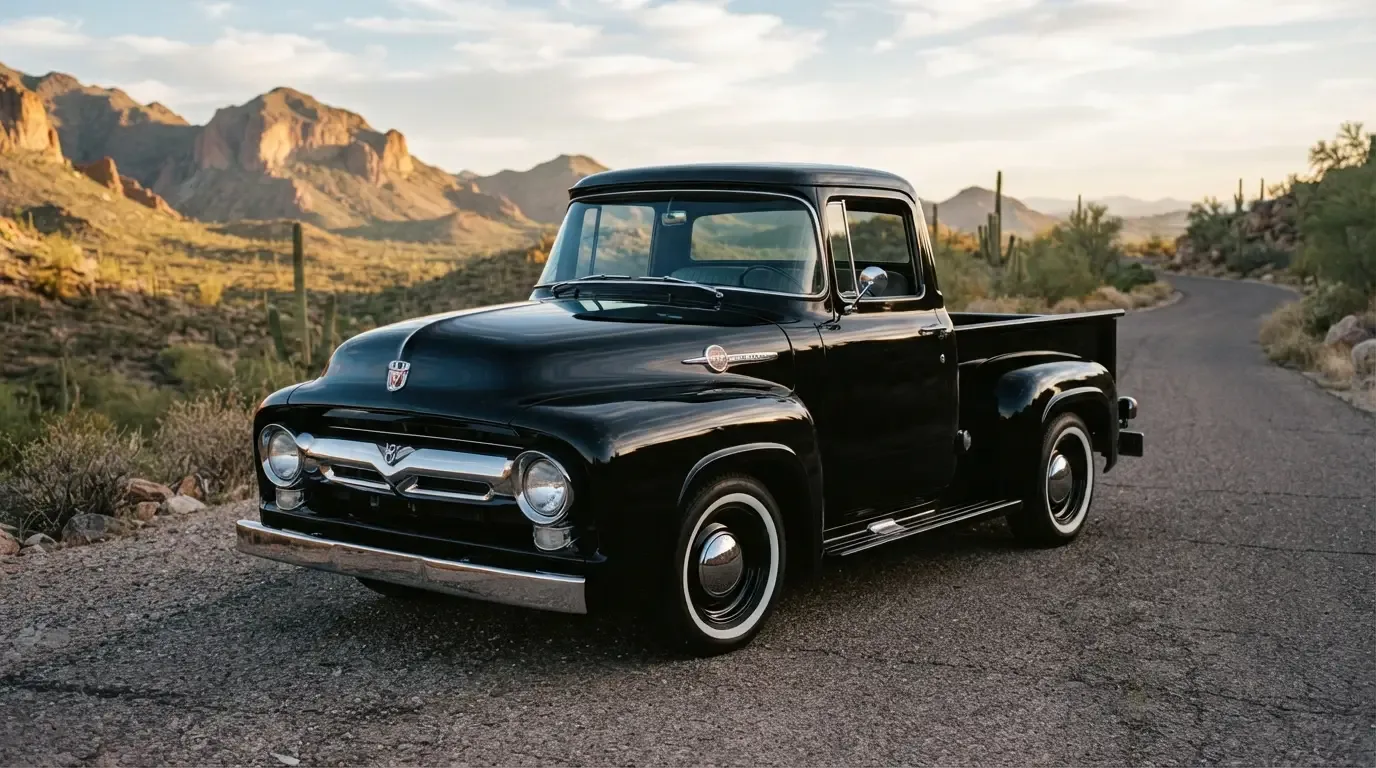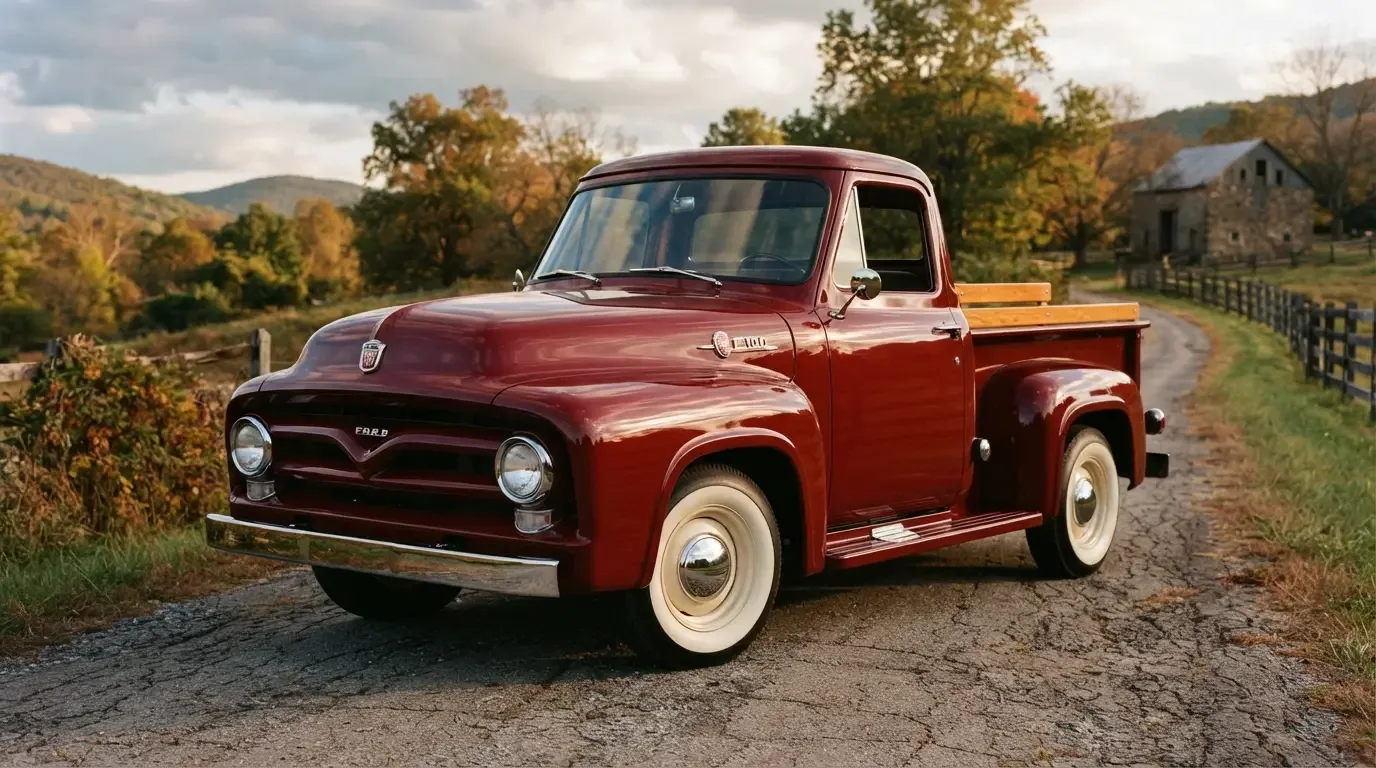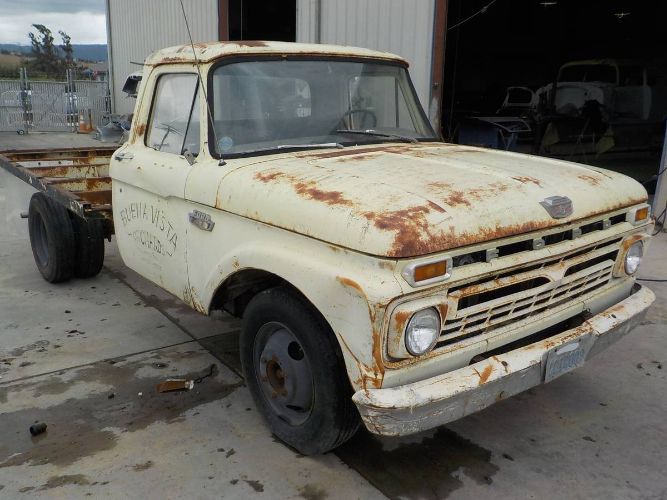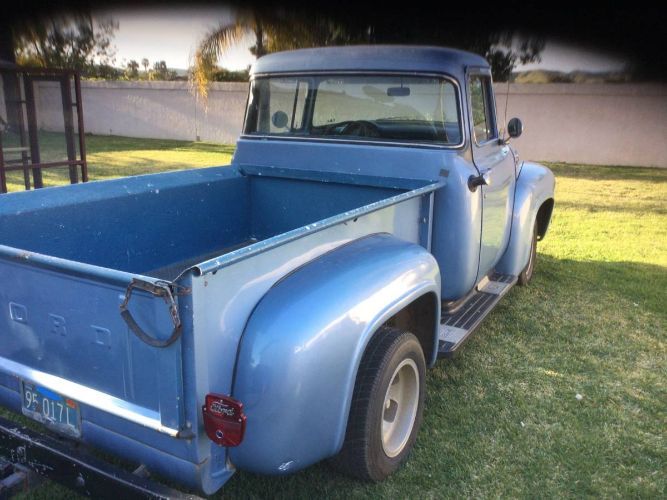
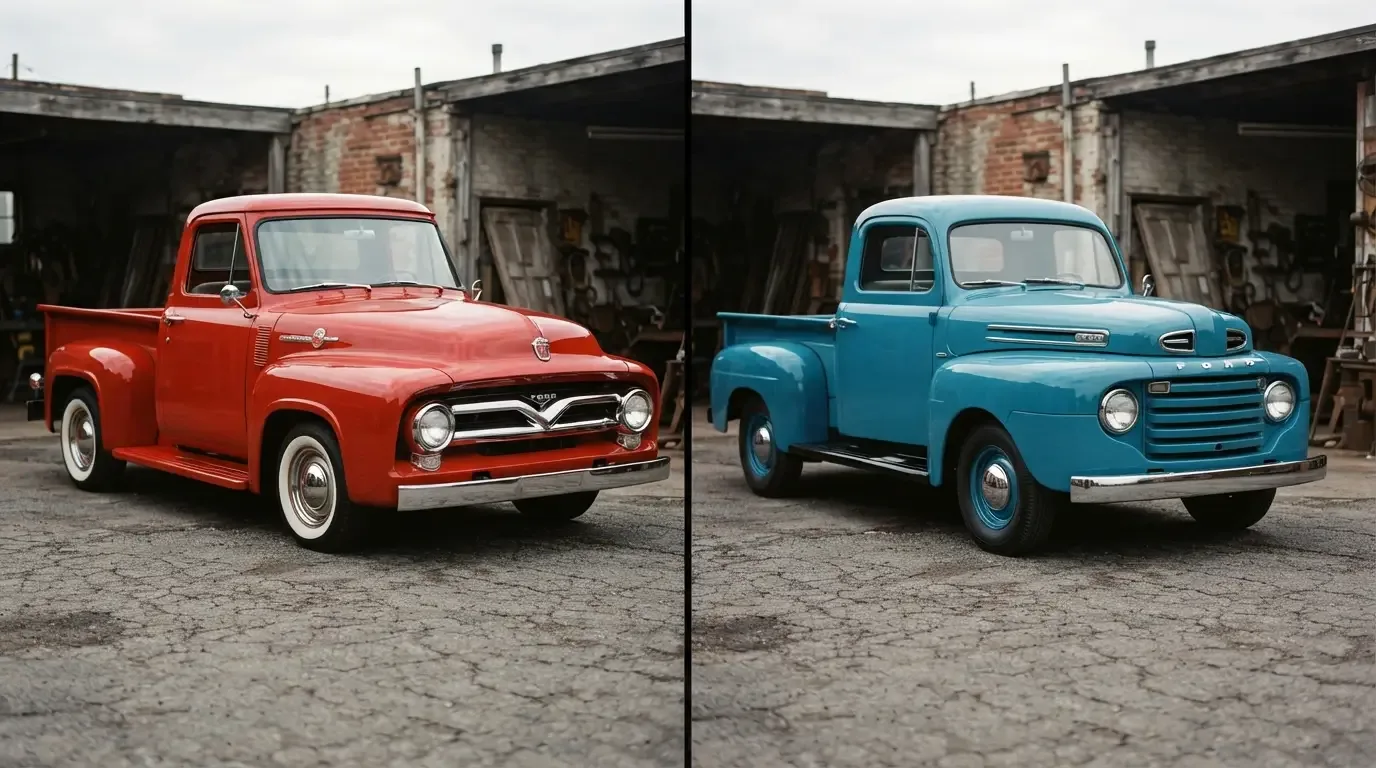
I know a guy at our club who spent an entire meeting arguing that his 1952 F-1 and his buddy's 1953 F-100 were basically the same truck with different badges. He lost that argument fast, and not because anyone wanted to be difficult about it. The moment you park an F-1 next to a ford f-1 vs f-100 comparison truck, the differences jump out at you before you even open a door. Ford didn't just rename the truck in 1953. It rebuilt it.
More than a badge swap
The easiest way to explain it at a cruise night is this: the F-1 was a truck designed right after the war, when steel was still tight and Ford was mostly refining prewar ideas. The F-100 was designed for a country that had money again, wanted comfort, and expected its trucks to keep up with newer cars on the road. Ford widened the cab, lowered the frame, grew the windshield, and reworked the dash. Sit in both and you feel it instantly. The F-1 feels like a tool. The F-100 feels like a vehicle somebody actually thought about from the driver's seat outward.
Our club's old-timers like to point out that Ford didn't stop at cosmetics either. The whole naming system changed at the same time. Gone were the F-1, F-2 and F-3 designations. In their place came F-100, F-250 and F-350, a numbering scheme tied loosely to payload rating that, frankly, is still recognizable on trucks built seventy years later. That's not a small thing. Ford picked a naming convention in 1953 and basically never let it go.
The frame and suspension nobody talks about
Everybody at a car show wants to talk about the grille and the cab, and fair enough, those are the parts you can see from across the parking lot. But the frame changes mattered just as much to anyone who actually drove these trucks daily. Ford dropped the frame rails several inches lower than the F-1's, which brought the whole cab and bed down with it. That lower stance made loading easier, cut down on that top-heavy feeling the F-1 had over rough roads, and gave the F-100 a planted look that photographs better even sixty years later.
Steering geometry and front suspension tuning were refined too, though Ford saved the bigger suspension leap, the switch to ball joints, for a couple of years later. In 1953 the changes were more about proportion and comfort than mechanical innovation, and that's exactly what buyers wanted after years of driving trucks that felt like leftovers from before the war.
What stayed the same, at least for a year
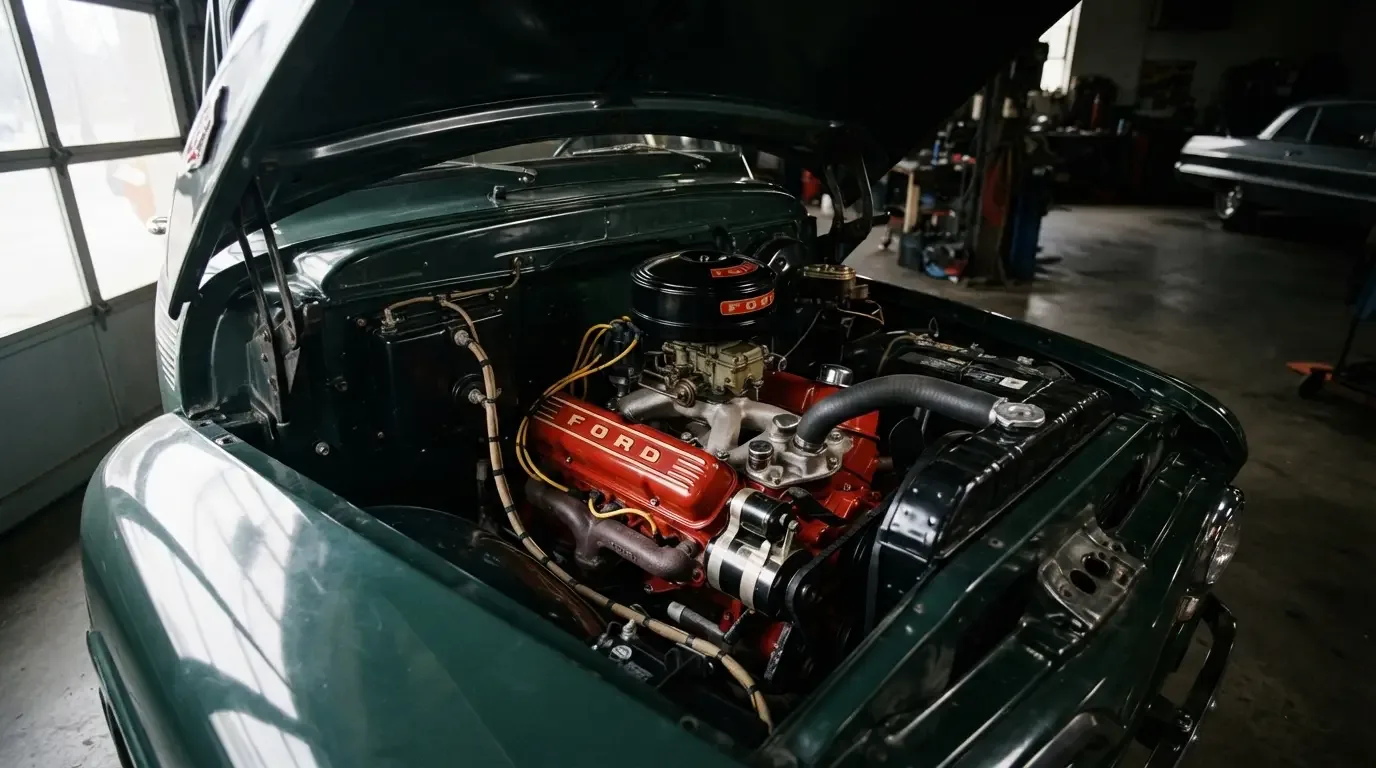
Here's the part that trips people up. Under the hood, 1953 was still mostly F-1 business as usual. The six-cylinder engine carried over with modest tweaks, and Ford's old flathead V8 remained the top engine option for one more year before the overhead-valve Y-block replaced it. So if you're standing in front of a 1953 truck arguing about how different it is from an F-1, the honest answer is: everywhere except the engine bay. That distinction matters to people chasing a specific combination, because a 1953 F-100 with the flathead is its own little pocket of history, a truck wearing the new body with the old heart, for exactly one model year.
For the fuller account of how Ford kept refining the platform after this handoff year, right through the 1956 model, our complete history covers the whole arc in one place.
"Every club has that one guy who insists the badge change was cosmetic. Put him behind the wheel of an F-1 for twenty minutes, then a 1953 F-100, and watch him go quiet. Some arguments settle themselves once your back stops hurting."
- Wayne Coburn
Why the change mattered for owners then and now
Back in 1953, the shift meant a truck that farmers and tradesmen could drive to town without feeling like they'd stepped out of a time machine. For owners today, the F-1 to F-100 transition means something a little different. It's the dividing line between two eras of parts, two eras of styling cues, and honestly, two eras of respect at a show. Plenty of F-1 owners will tell you their trucks have more character precisely because they're rougher, more basic, closer to the original postwar idea of what a truck should be. F-100 owners tend to argue their trucks are simply more livable, more comfortable, and every bit as honest a piece of history.
Both camps are right, honestly. That's the fun of it. The 1953 change didn't erase what came before, it built a new chapter next to it. And if that chapter has you thinking about picking one up yourself, you can always find a classic F-100 and see what's out there.
What our club sees when trucks show up side by side
We get maybe half a dozen F-1s at any given cruise night, usually parked deliberately near a run of F-100s so people can walk the line and compare for themselves. The F-1 owners tend to talk about simplicity, easier fixes, fewer things that can go wrong on the side of the road. There's real truth in that. The F-1's mechanicals are about as straightforward as postwar trucks get, and a lot of owners like knowing they can sort out most problems with basic tools and a Saturday afternoon.
F-100 owners counter with the drive itself, and honestly, they've got the stronger argument there. Take one of these trucks on a two-hour drive to a regional show and the difference in fatigue is not subtle. The wider cab means your elbow isn't jammed against the door, the lower stance means less body roll in the corners, and the taller windshield means you're not squinting through a letterbox opening trying to see road signs. Both trucks get you there. Only one of them lets you enjoy the trip.
The parts hunt tells its own story
Ask anyone who has actually sourced parts for both trucks and you'll hear the same pattern. F-1 parts, especially trim and interior pieces, have gotten scarcer over the years simply because fewer of these trucks survived in restorable condition compared to the F-100 generation that followed. F-100 parts benefit from a longer production run and a body style that stayed close enough to 1954 through 1956 trucks that reproduction suppliers have found it worthwhile to tool up replacement panels and trim. That's not a knock on the F-1. It's just a practical reality that shapes which truck makes more sense as a first restoration project for somebody without deep connections in the swap-meet circuit.
A debate that never really ends
My buddy still brings up his F-1 versus F-100 argument every so often, mostly to get a rise out of people now that he knows he's wrong. That's fine by me. Trucks like these are conversation starters first and transportation second at this point, and there's nothing wrong with a friendly disagreement that ends with everyone walking around both trucks one more time, pointing at the same six inches of frame height and nodding like they just discovered it themselves.