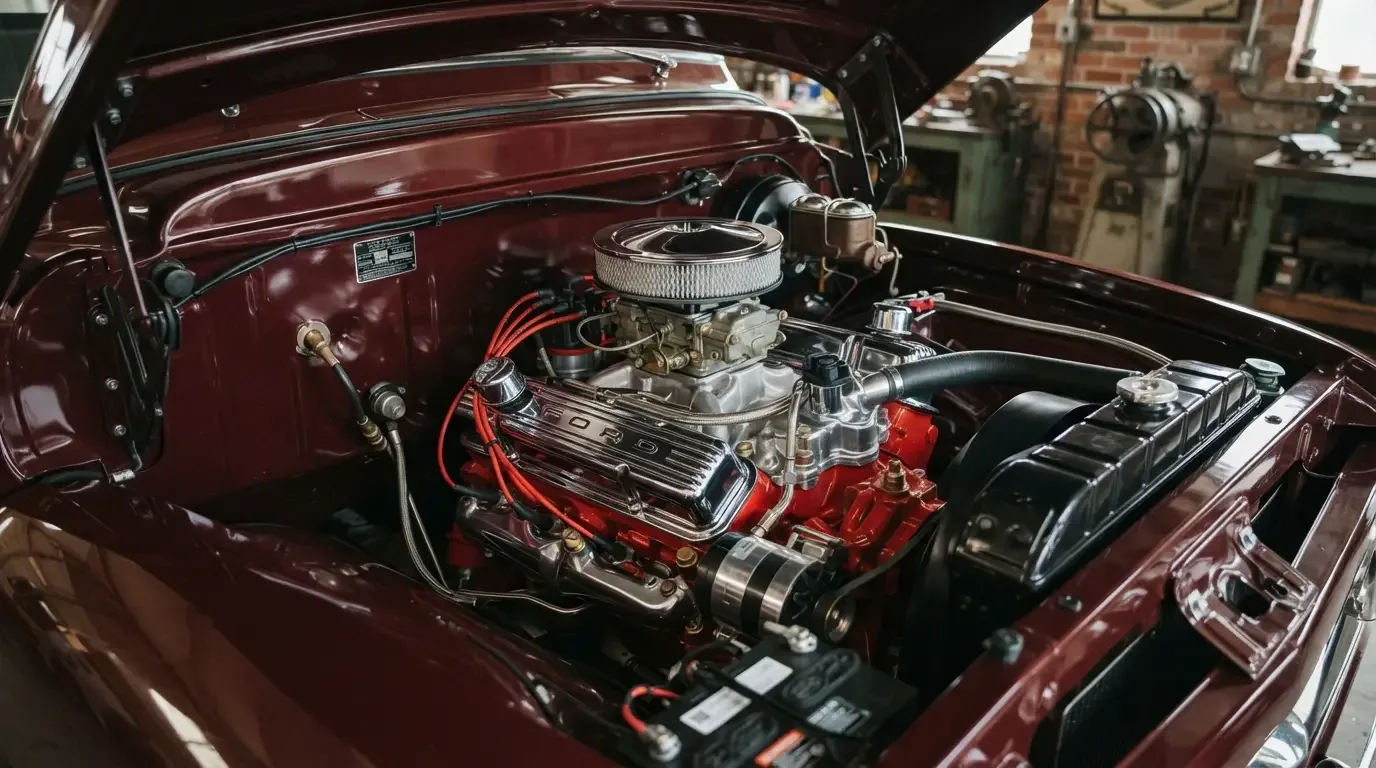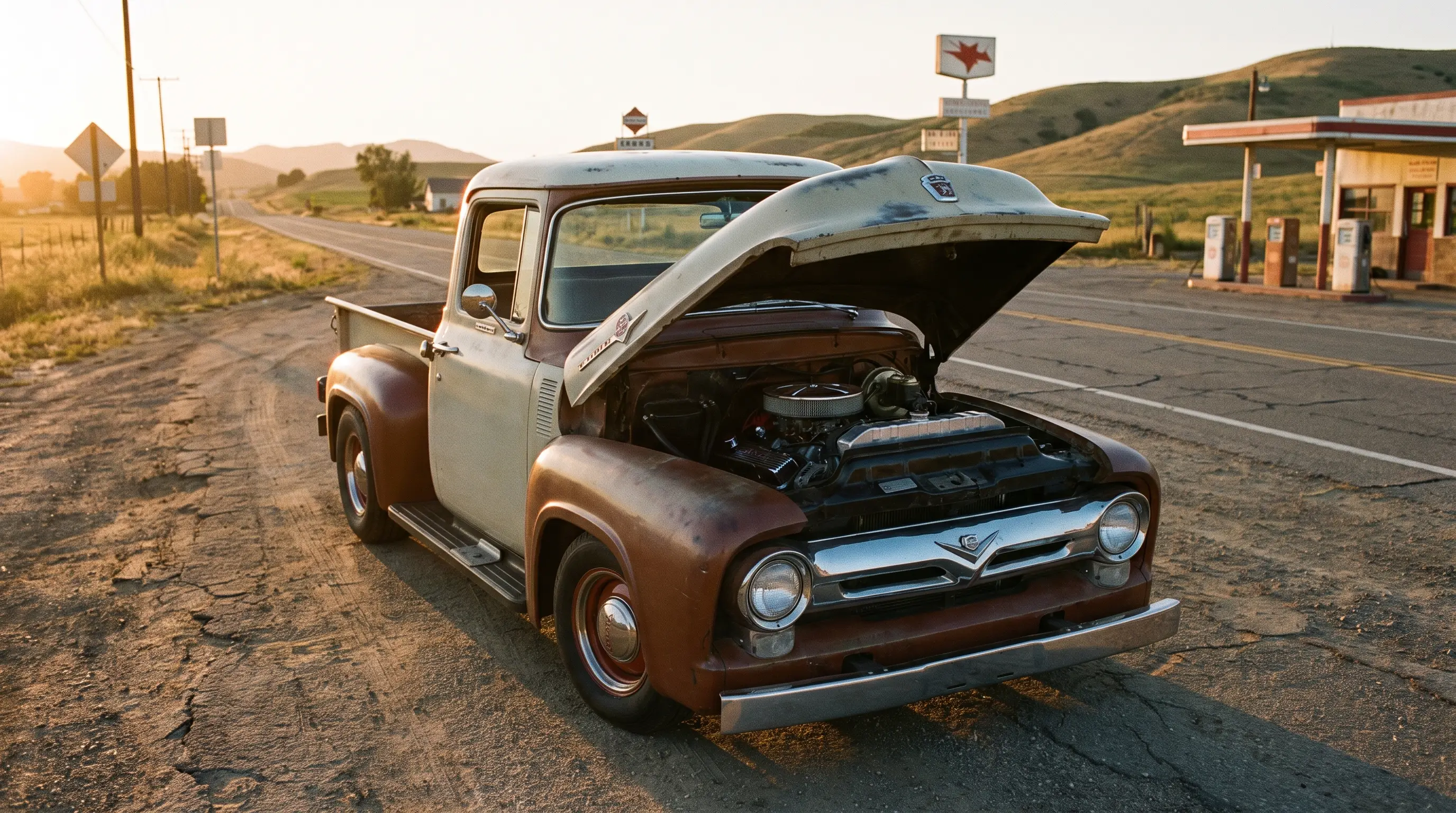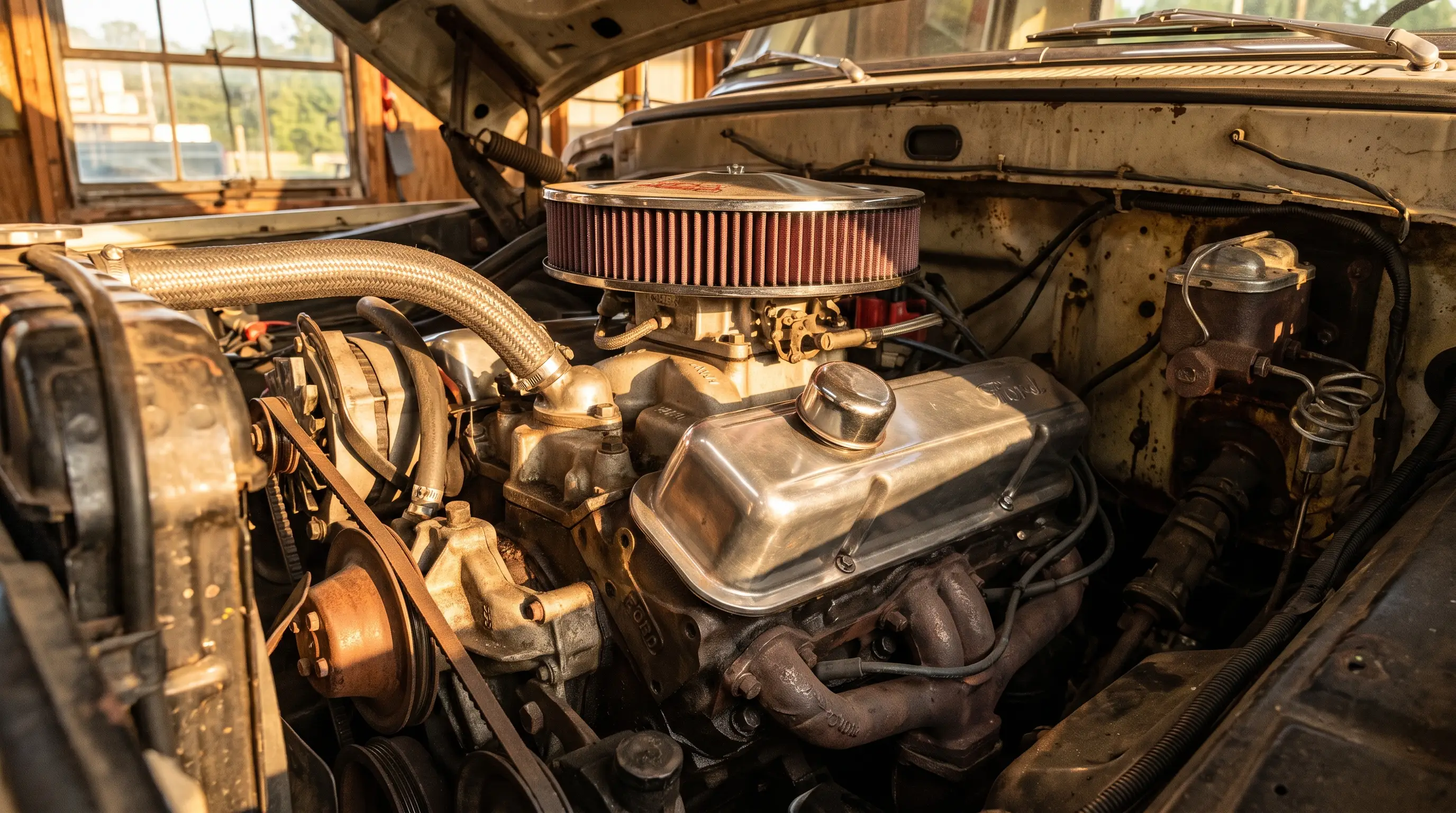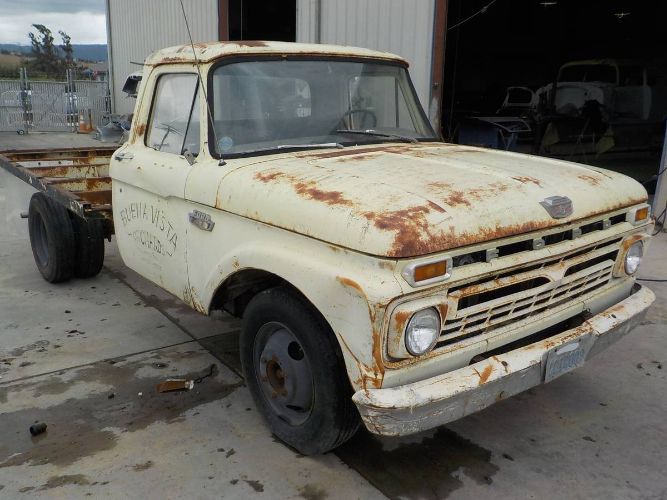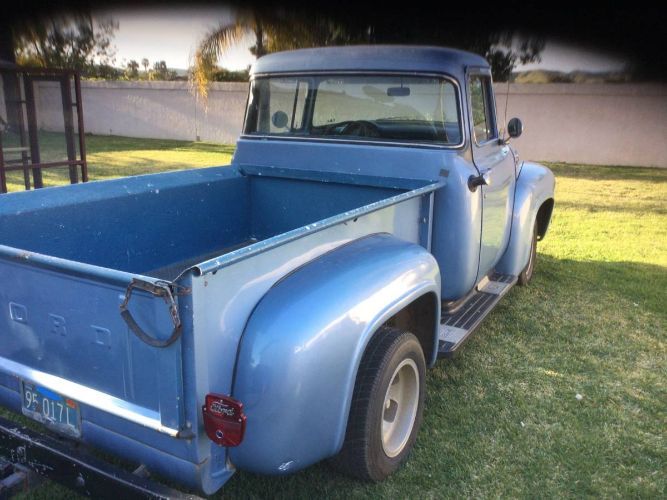

The Ford F100 flathead V8 is the engine that made the F-Series a truck people wanted, not just a truck people needed. It launched with the F-1 in 1948 and stayed in the lineup into the mid-1950s, and it earned a reputation the six-cylinder never got close to. Here is why it mattered, told with the numbers instead of the mythology.
The number that started it all: 239 cubic inches
Ford's flathead V8 arrived in truck form displacing 239 cubic inches, producing right around 100 horsepower at 3,600 rpm in its early truck tune. That is not a big number by any later standard. In 1948, it was a genuine leap over the four-cylinder and six-cylinder trucks most competitors were still selling. Ford had put a V8 into an affordable passenger car back in 1932, and by the time the F-1 launched, the company had over a decade of production experience with the engine family behind it. That head start mattered. Competitors were still catching up.
Why "flathead" is not an insult
A flathead engine puts the valves in the block instead of the cylinder head, which is simpler and cheaper to build than an overhead-valve design. Critics point out it breathes worse and revs lower as a result. That is true, and it is also beside the point for a work truck. Torque low in the rev range, not top-end horsepower, is what moves a loaded truck away from a stop sign, and the flathead V8 delivered exactly that. Farmers and tradesmen did not care about a redline. They cared about pulling a loaded trailer up a grade without stalling, and the engine did that job reliably for years at a time.
The rivalry that mattered more than the horsepower number
Buyers in 1948 had a real choice between the flathead V8 and Ford's own inline six, and plenty chose the six for its simplicity and lower fuel cost. The V8 won a different customer: the one hauling heavier loads, working longer routes, or simply wanting the truck with a little more presence at the feed store. That split between six-cylinder practicality and V8 muscle became a defining pattern for the F-Series, one that repeated itself for decades as engine options multiplied.
"Forget the horsepower number. What matters is that a flathead V8 truck could out-pull a six-cylinder truck at the exact moment it mattered, loaded and uphill."
- Dan Reeves
The hot rod world got there first
Long before truck collectors cared about the flathead V8, hot rodders had already claimed it. The same block that pulled a loaded F-1 up a grade also powered a huge share of early hot rods and dry lakes racers, because it was cheap, plentiful, and endlessly modifiable with speed parts that were already on the market by the late 1940s. That dual identity, work engine by day and racer's platform by choice, gave the flathead a cultural footprint that outlasted its production run by decades. It is one of the rare engines that shows up equally in truck history books and hot rod history books, and both stories are legitimate.
That crossover appeal still shapes the market today. A numbers-matching flathead truck attracts interest from two different buyer pools at once: F-Series purists chasing an unmodified early truck, and hot rod historians who want an example of the platform that shaped an entire speed parts industry. Competition between those two groups is part of why prices on clean, original examples have moved as fast as they have.
Heat management was the real weak point
The flathead's exhaust-through-the-block design was clever for its time, but it also meant the engine ran hotter than a comparable overhead-valve design, especially under sustained load. Truck duty, towing, hauling, idling at a job site, exposed that weakness more than passenger car use ever did. Owners who kept the cooling system in good order rarely had trouble. Owners who neglected it paid for it in warped heads and blown gaskets. That maintenance reality is part of why so few flathead trucks survived in original form long enough to become collectible: many simply got the engine swapped out the first time it gave real trouble, long before anyone thought of the truck as a future classic.
What replaced it, and why
By the mid-1950s, Ford moved to overhead-valve V8 designs that solved the flathead's breathing and cooling limitations while keeping the low-end torque character buyers had come to expect. The flathead did not disappear because it failed. It disappeared because engineering caught up and offered the same strengths without the same weaknesses. That is a normal, unremarkable end for an engine that did its job well for the better part of a decade.
The number that matters today: survival rate
Original flathead-powered F-1 and early F-100 trucks are scarce now. Most that survived had the engine swapped out decades ago for something with more parts availability and easier maintenance, which makes a numbers-matching flathead truck a genuinely rare find rather than a common one dressed up as rare. That scarcity is climbing in value faster than the broader early F-Series market, because collectors increasingly want the engine that started the whole story, not just the body style.
For the complete arc of how Ford's truck engines evolved from this starting point all the way through the end of the F-100 era, read ford f100 engines history. The Y-block that eventually replaced the flathead has its own story worth knowing too, covered in a related story.
Reading a listing that claims "flathead V8"
Anyone shopping for an early F-1 or F-100 advertised with its original flathead V8 should verify the claim rather than take the listing at its word. Engine tags, casting numbers, and any surviving build documentation are the only reliable way to confirm originality, since the flathead was swapped so often over the decades that a plausible-looking engine bay does not guarantee a matching-numbers engine underneath it. A seller who cannot produce documentation is not necessarily lying, but the price should reflect that uncertainty rather than assume the best case. When in doubt, budget for an inspection by someone who knows early Ford truck engines specifically, not a generalist mechanic, because the visual differences between a correct flathead build and a later substitute are easy to miss without that background.
Bottom line
The flathead V8 was not the fastest or most refined engine Ford ever built. It was the first V8 truck buyers could count on, and that first-mover position is exactly why it still matters. A numbers-matching example is worth chasing for anyone serious about early F-Series history. For everyone else, plenty of clean early trucks and their descendants are worth a look right now among current F-100s for sale now.