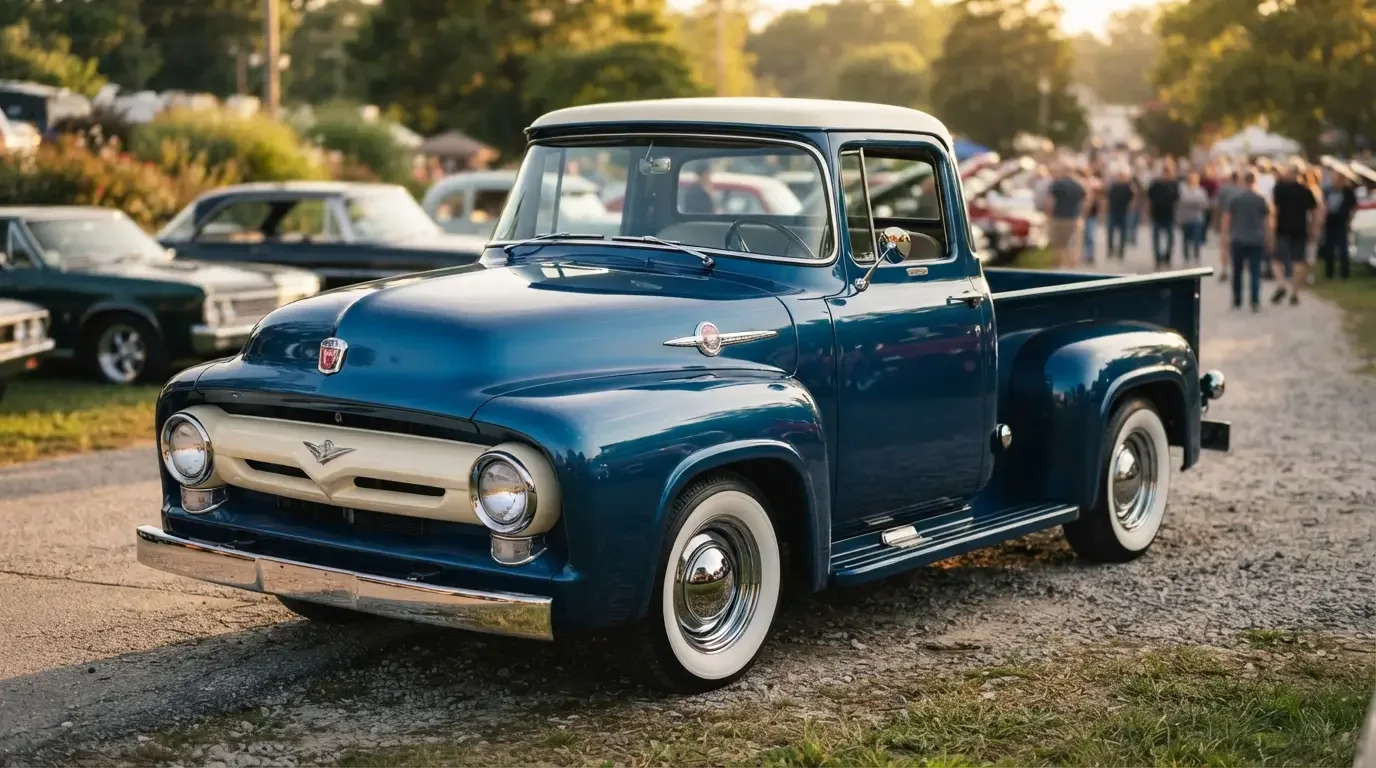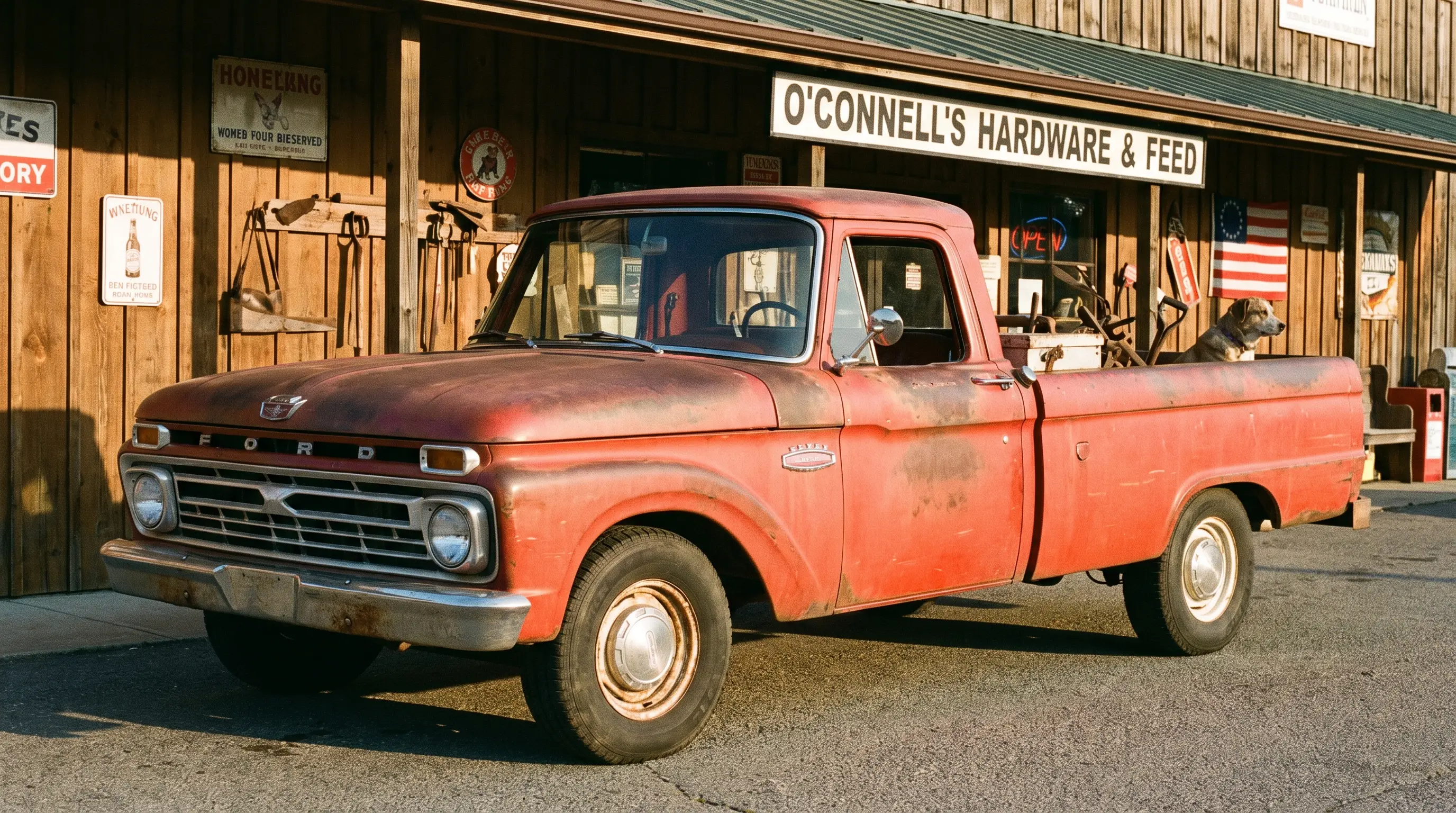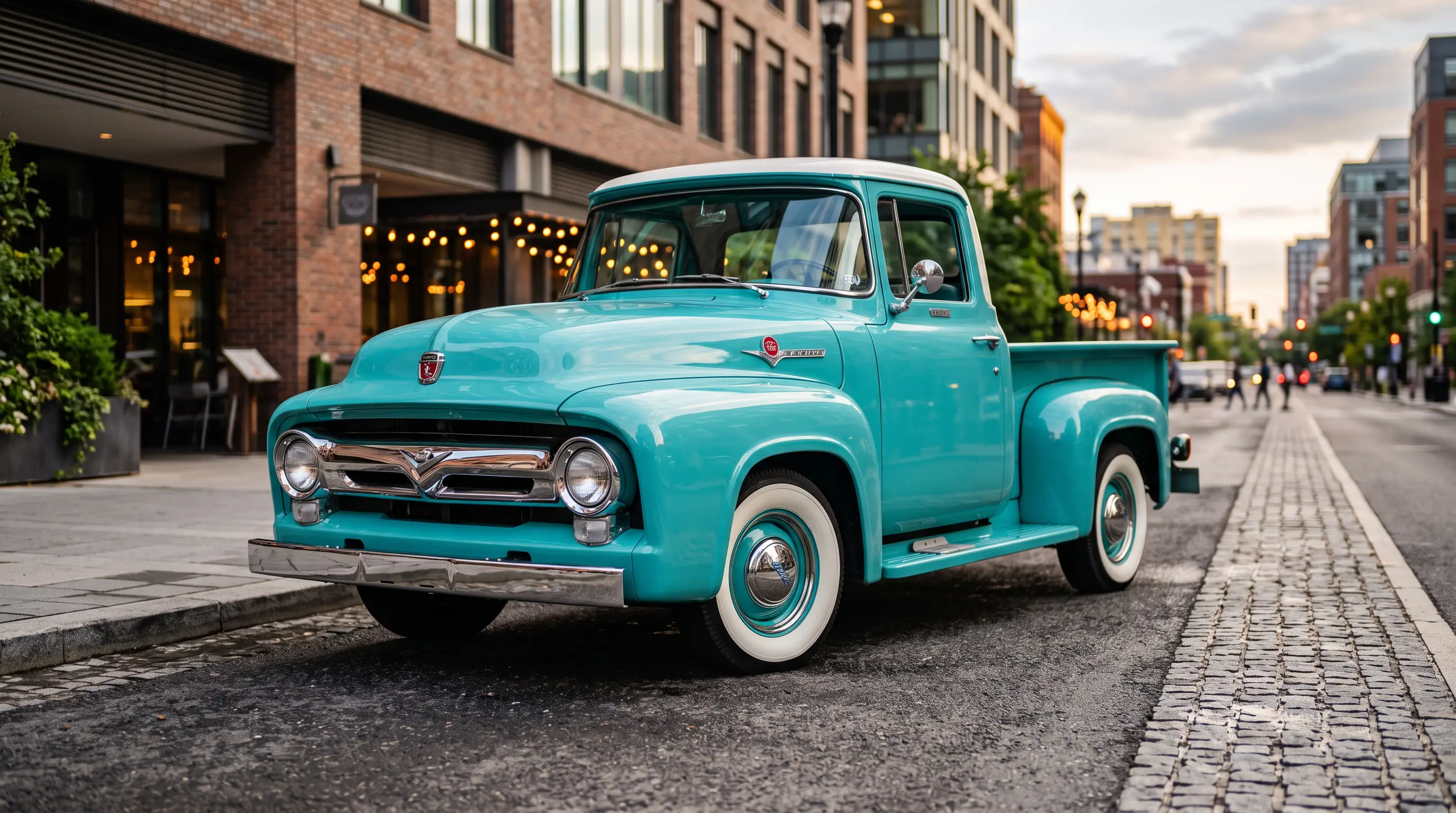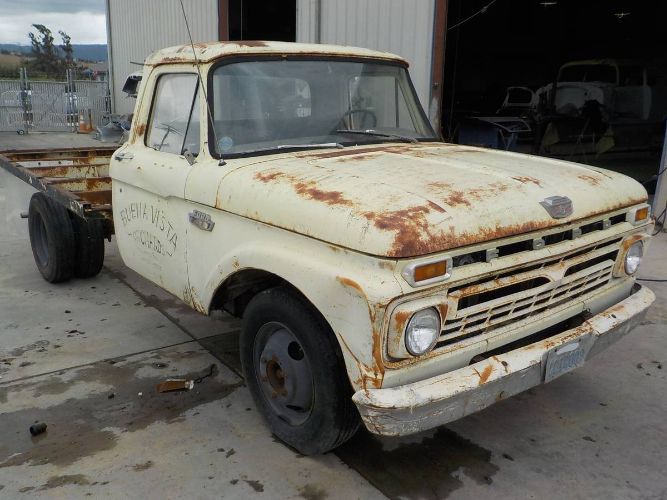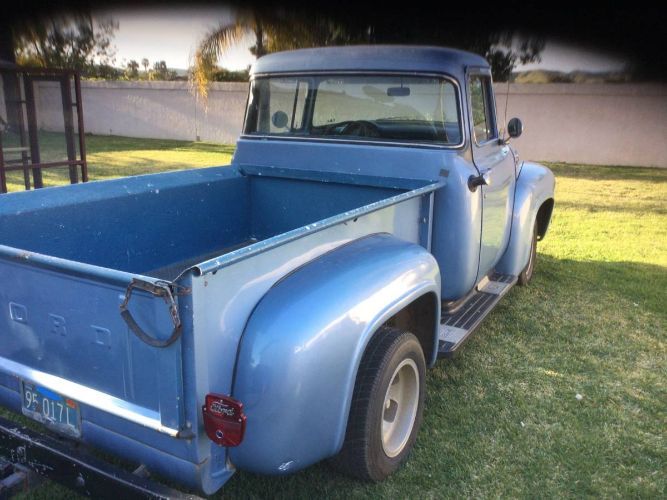
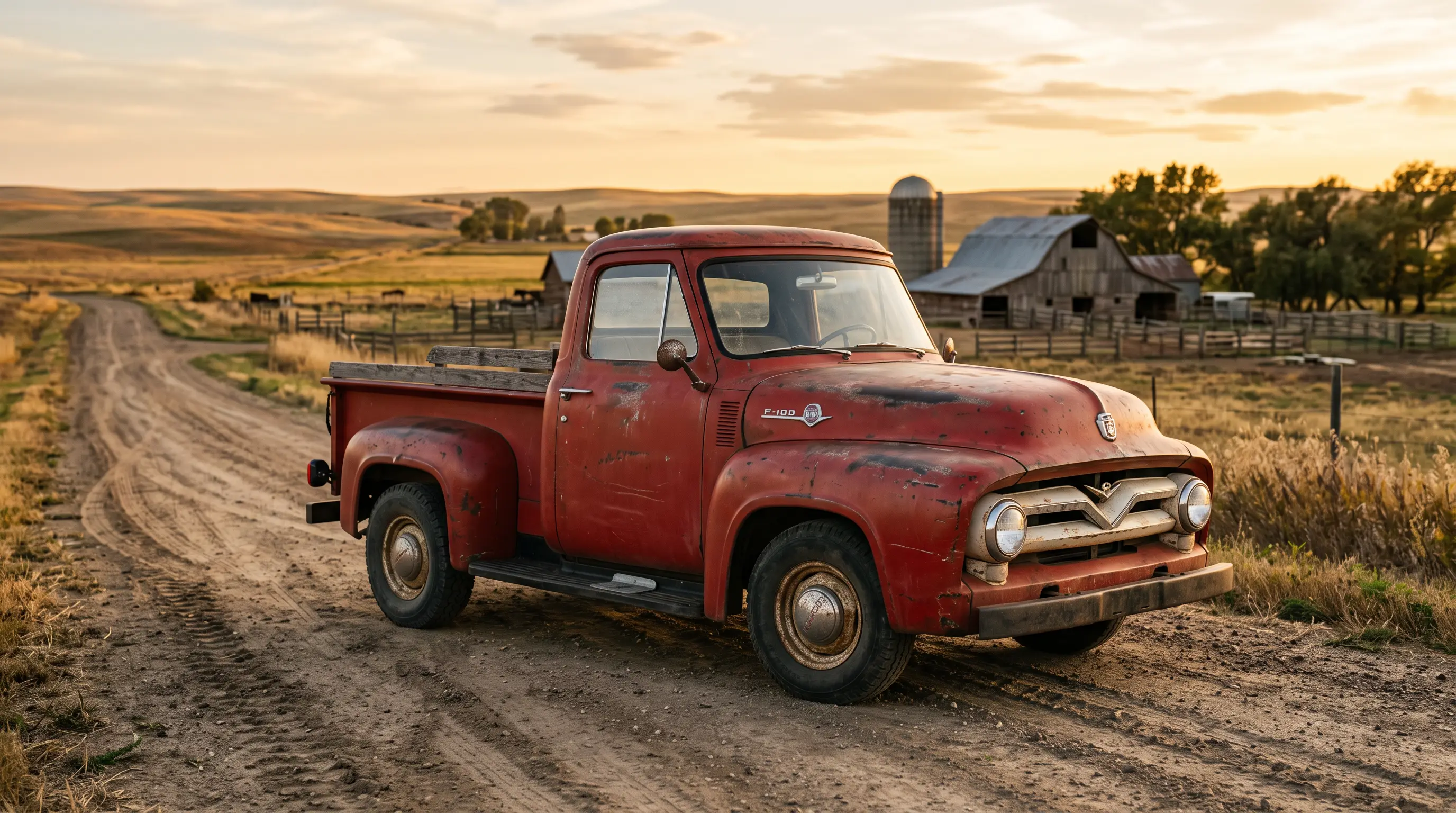
There is a fellow at our club's spring meet who has owned the same 1966 Ford F-100 since 1979. He bought it used, drove it to work for a decade, parked it under a tarp for another decade, and then dragged it back out and finished what he started. That truck has outlived two of his cars, one marriage, and by his own count four different attempts to sell it that he backed out of at the last minute. Ask him what the Ford F-100 legacy means and he will not talk about horsepower. He will talk about the tarp.
A truck that was never meant to be a legend
Ford built the F-100 to be ordinary. Introduced for 1953 as part of the all-new F-Series lineup that replaced the postwar F-1, the F-100 was the half-ton workhorse, the truck a plumber or a rancher bought because it did the job and didn't ask for much in return. Nobody at Ford was designing a future collectible. They were designing a tool. The 1953 restyle gave the cab a wider, lower stance and put the headlights into the fenders for the first time, small changes that made the truck look modern for its era without pretending to be anything fancier than a work vehicle.
That lack of pretense is exactly what let the F-100 earn its legacy honestly. It did not arrive with a marketing campaign built around glamour. It arrived to work, and it worked for millions of owners across three and a half decades of production, from the F-1 badge in 1948 through the final F-100s built in 1983, by which point Ford had already shifted focus toward the F-150 as the volume half-ton.
Generations that each left a mark
The second generation, 1957 through 1960, brought the Styleside bed, a flat-sided cargo box that finally sat flush with the cab rather than stepping out past the fenders like the old Flareside. That single change altered how a pickup could look, and Styleside beds became the template most other manufacturers eventually copied. The third generation, 1961 through 1966, introduced a unibody design for a few years where the cab and bed were welded into a single structure, an experiment Ford abandoned once owners started loading beds heavier than the design anticipated and twisting the frame.
By the fourth generation, 1967 through 1972, the F-100 had grown into the truck most people picture when they hear the name: a longer hood, a wider cab, and the option of the Ranger trim that pushed interior comfort further than any half-ton had gone before. The fifth generation, 1973 through 1979, kept expanding on that comfort push while quietly becoming the last distinct body style of the F-100 name, since Ford discontinued the F-100 designation entirely after 1983, folding what remained of the badge into a shared body with the F-150.
"Every truck club has a guy who never sold his. That guy is the reason the legacy exists at all, because he kept the parts, kept the knowledge, and kept showing up."
- Wayne Coburn
Legacy measured in numbers Ford didn't expect to matter
Production figures from the era were not tracked with an eye toward future collectibility, Ford was counting units sold, not units that would still be running fifty years later. But the sheer volume built across the F-100's run means survivors were never rare in the way a limited-production sports car is rare. What is rare now is condition. A truck that spent decades doing exactly what it was built for, hauling feed, plowing snow, running a work crew around a job site, does not usually survive in showroom shape. The ones that did survive well are the ones somebody decided, at some point, were worth keeping past their working life.
| Generation | Years | Signature Change |
|---|---|---|
| First (F-1 to F-100) | 1948-1956 | Introduced Styleside option late in the run |
| Second | 1957-1960 | Full-width Styleside bed becomes standard design language |
| Third | 1961-1966 | Brief unibody experiment, later reversed |
| Fourth | 1967-1972 | Ranger trim, wider cab, longer hood |
| Fifth | 1973-1979 | Final distinct body style; nameplate continued through 1983 |
Why the legacy keeps growing instead of fading
Most working vehicles from the 1950s and 1960s did not survive long enough to become collectible, they were used hard and scrapped when repair costs exceeded their value. The F-100 avoided that fate partly through Ford's reputation for durable simple mechanicals, and partly through pure numbers. Enough of them survived in enough regions of the country that when the classic truck market began forming in earnest during the 1990s, there was already a supply of F-100s sitting in barns and back lots waiting to be noticed.
That supply fed a restoration culture, and the restoration culture fed a collector market, and the collector market is what turned an ordinary work truck into something people now describe with the word legacy. None of that was planned by anyone at Ford. It happened because the truck was good enough at its original job that people kept it around long after the job ended.
Where the story goes next
The Ford F-100 legacy today lives in three overlapping worlds: the originality-first collectors chasing numbers-matching trucks, the restomod builders reimagining the shape with modern drivetrains, and the daily-driver crowd who just like owning something simple enough to fix themselves. Anyone digging deeper into how those worlds connect can find our complete history of the collecting side, and readers who want to keep exploring the truck's cultural footprint have plenty more ground to cover. For those ready to own a piece of it, there are usually a few classic F-100 for sale worth a look at any given time.
My friend with the tarp truck did not set out to preserve a legacy. He just didn't sell his truck. Multiply that by tens of thousands of owners over seventy years and you get the F-100's legacy in a nutshell: not a plan, just persistence.
What the legacy looks like from inside a club
Club membership rolls tell part of this story better than any sales figure could. Regional F-100 clubs that started decades ago with a handful of original owners trading parts and advice now count members who never owned the truck new, who joined specifically because they wanted access to the accumulated knowledge those original owners built up over a lifetime of ownership. That transfer of knowledge from one generation of owners to the next is arguably as important to the truck's legacy as any specific model year or engine option, because it is what keeps a fifty-year-old truck fixable rather than just admirable from a distance.
Meets and swap gatherings function as the connective tissue here. A newer owner struggling with an electrical gremlin or a sourcing question for a hard-to-find trim piece can usually find someone at a regional gathering who solved that exact problem years earlier. That kind of informal mentorship rarely gets written down anywhere, yet it has kept far more F-100s on the road than any factory service manual ever could on its own.
A legacy still being written
It would be easy to treat the Ford F-100 legacy as a closed chapter, something that finished when the last F-100 rolled off the line in 1983 and Ford moved on to the F-150 as its only half-ton badge. The ownership community does not see it that way. Every restoration finished, every barn find pulled out and recommissioned, every teenager who inherits a grandparent's truck and decides to keep it running adds another line to a story that started as nothing more than a practical work vehicle and became something people actively choose to preserve, at real personal cost, decades after the truck's original job ended.