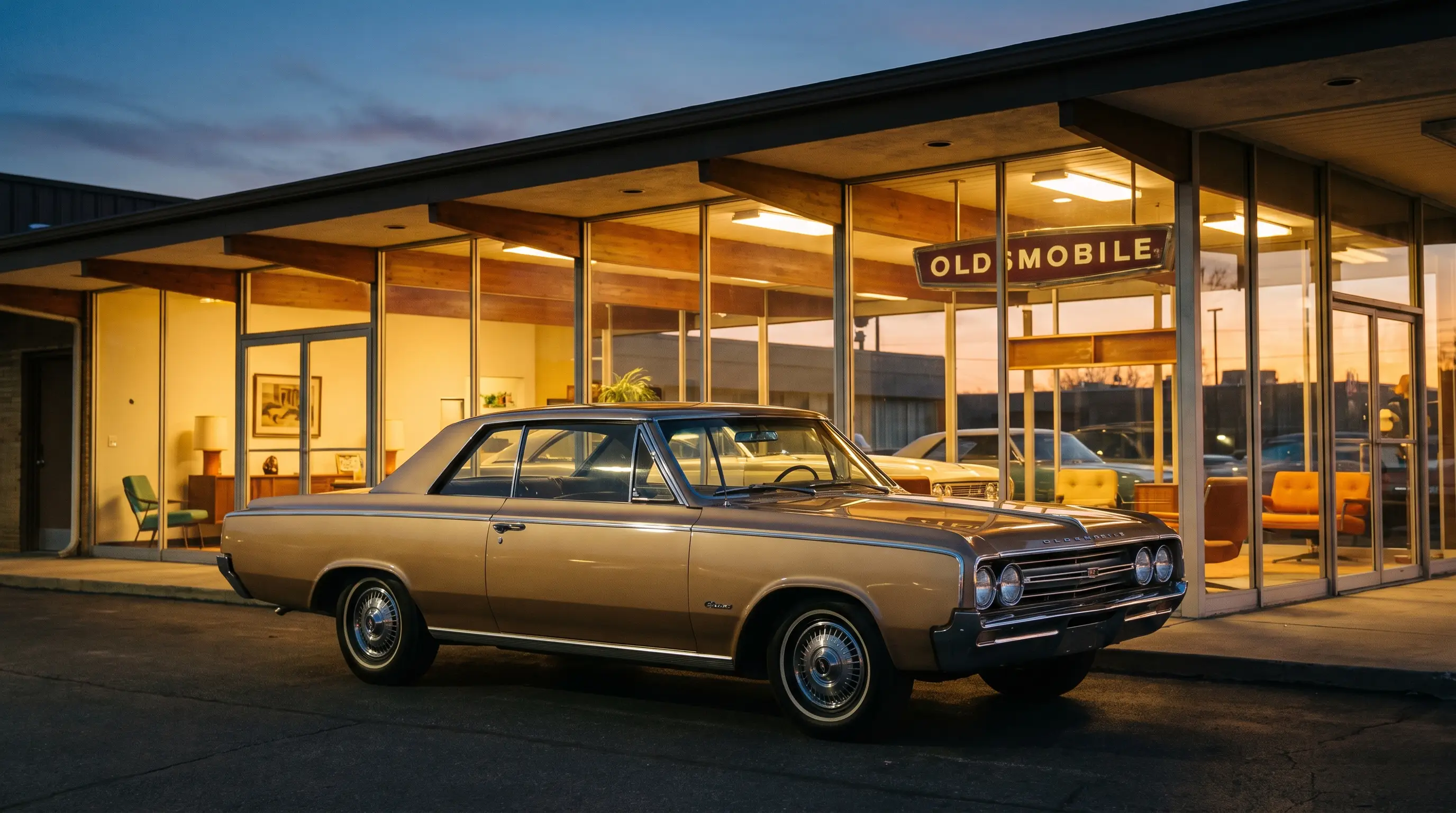
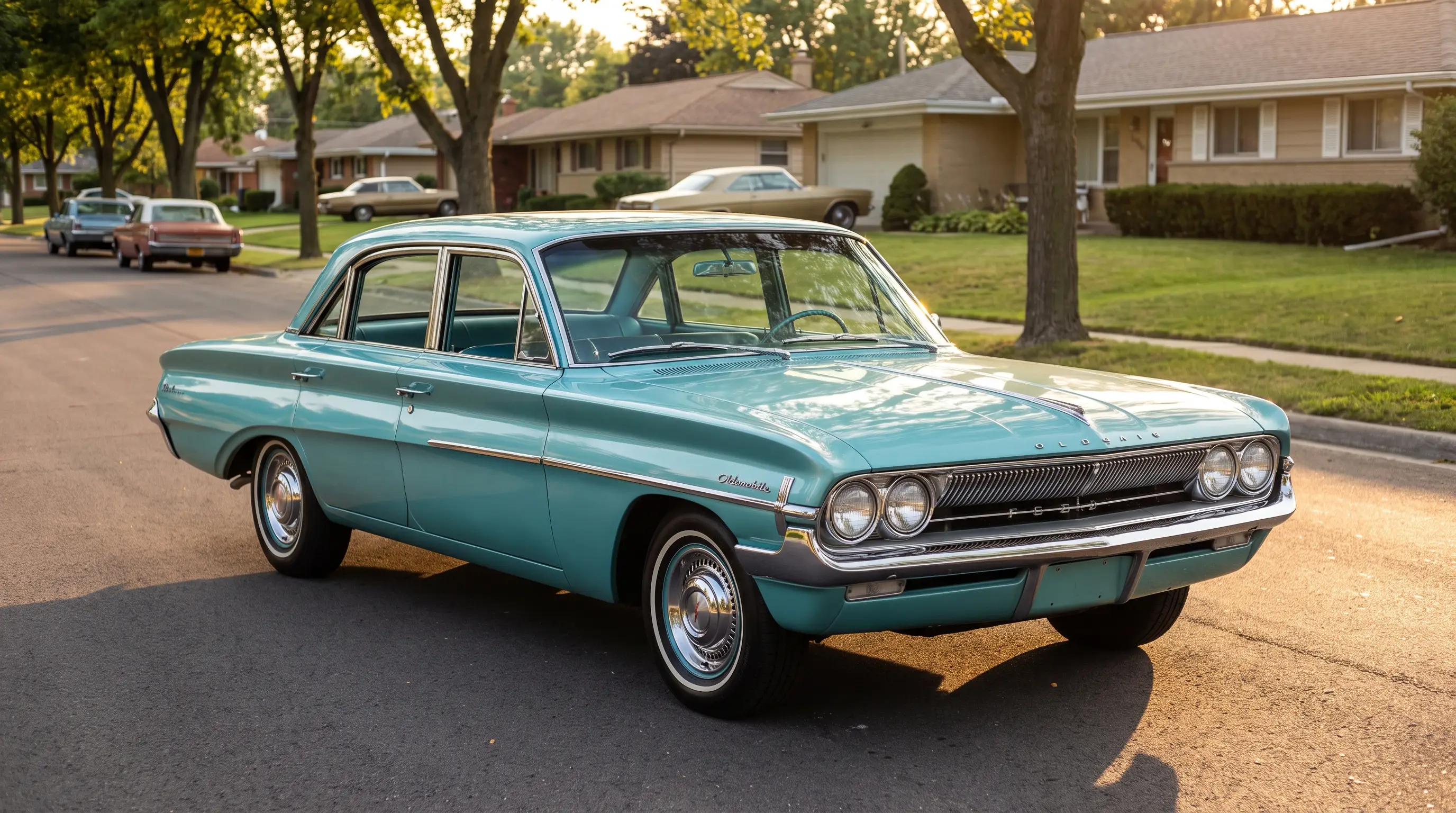
The tank sticker on a 1961 Oldsmobile F-85 does not read like the record of a muscle car, and it should not, because that is not what this car was built to be. It reads like the record of a compact, built at a moment when Oldsmobile was betting a piece of its future on smaller, lighter cars rather than bigger ones. The 1961 F-85 matters to Cutlass history not because it was fast, but because the Cutlass name started here, as a trim package on a car that had almost nothing else in common with the muscle-era machines that would eventually carry it.
Why Oldsmobile built a compact in 1961
General Motors entered the 1960 model year with a coordinated response to the import compacts and Studebaker's Lark: Chevrolet's Corvair, Pontiac's Tempest, Buick's Special, and Oldsmobile's F-85. All four shared GM's new Y-body platform, a unibody design considerably smaller than Oldsmobile's full-size cars. The F-85 arrived for the 1961 model year with a wheelbase of 112 inches and a curb weight low enough that a modest V8 felt genuinely quick in it. This was Oldsmobile hedging against a market that, for a few years, looked like it might actually shrink.
It is worth being precise about what "compact" meant inside Oldsmobile's lineup at the time, because the division had never built anything this small in the postwar era. The F-85 sat well below the full-size 88 and 98 series in every dimension, and Oldsmobile's engineering team treated it as a genuinely separate design exercise rather than a shrunken full-size car. The unibody construction alone was a departure from the body-on-frame approach Oldsmobile used everywhere else in its 1961 catalog.
Cutlass entered this lineup in 1961 as the top trim level of the F-85, not as a separate model. It carried bucket seats, additional brightwork, and, depending on the exact build, access to the division's new aluminum V8. The name would not become its own model line until 1964, but the badge on a 1961 car already signaled the better-equipped end of the compact range.
The distinction between a base F-85 and a Cutlass-trim car mattered to the original buyer in ways that are easy to overlook now. A base car was a practical compact aimed at a family trading down from a full-size Oldsmobile or up from a Rambler. The Cutlass trim was pitched at a buyer who wanted the smaller footprint but was not willing to give up bucket seats, brightwork, and a car that felt finished rather than stripped down. That positioning, a smaller car that still felt like a proper Oldsmobile inside, is the thread that carries all the way through to the badge's later performance identity.
The engine that made the F-85 interesting
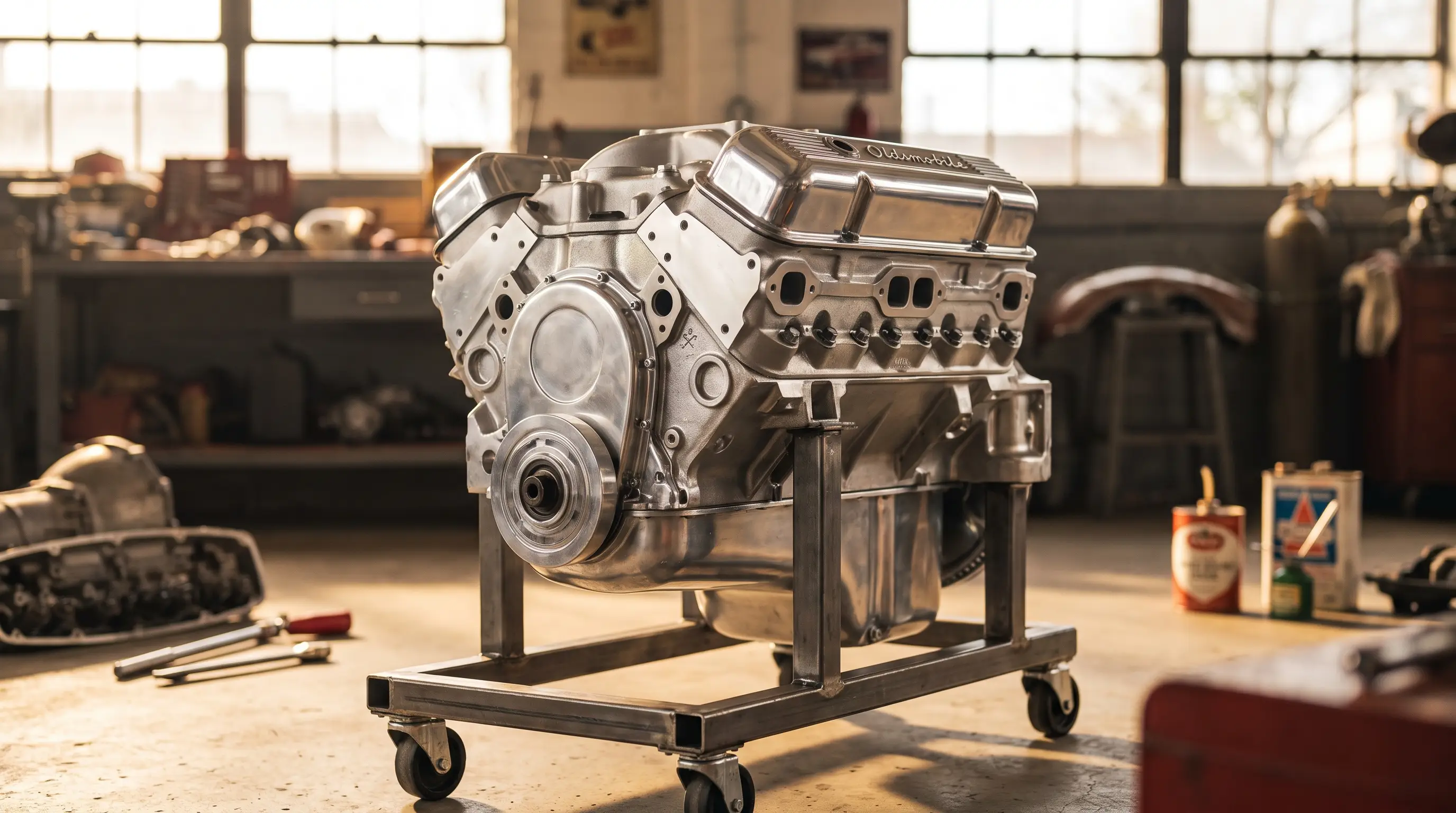
What separates the 1961 F-85 from a forgettable compact is what Oldsmobile put under the hood. The division's new aluminum block 215 cubic inch V8 was standard or optional depending on trim and gave the F-85 a power-to-weight case that the Corvair's six-cylinder simply could not match. Factory output figures for the naturally aspirated 215 in this application ran from 155 horsepower for the standard two-barrel, 8.75:1-compression version up to 185 horsepower for the four-barrel, 10.25:1-compression Power Pack option available on Cutlass-trim cars. For a car this light, that was enough to make the F-85 and its Cutlass trim feel like something more than a shrunken family sedan.
Contemporary road tests from 1961 consistently noted that the F-85 felt quicker than its modest displacement suggested, and the reason was simple weight math rather than any exotic tuning. An aluminum block V8 in a unibody compact produced a power-to-weight ratio that most full-size Oldsmobile buyers had never experienced in anything but the division's larger, heavier cars running much bigger engines. That gap between expectation and actual performance is a big part of why the Cutlass trim built a following even before the badge meant anything close to what it would mean by the late 1960s.
A related deep-dive covers that aluminum V8 in full, including why Oldsmobile abandoned it within a few years and where its tooling eventually ended up. The short version for F-85 purposes: this engine, more than anything else, is why the 1961 compact deserves a place in the muscle-era Cutlass conversation at all, even though it predates that era by half a decade.
Documentation and what the records actually show
Factory build records from this period identify F-85 and Cutlass trim production by body style and engine code, and the surviving paperwork on 1961 cars is thinner than what collectors expect from later muscle-era Cutlass models, simply because nobody was archiving compact car build sheets with an eye toward future collectibility. Anyone chasing a documented, numbers-correct 1961 Cutlass-trim F-85 today needs to lean on Oldsmobile club registries and NCRS-adjacent research groups rather than assuming a dealer invoice or window sticker survived. Total 1961 F-85 production across all body styles ran to roughly 80,000 units, but Oldsmobile's surviving records do not cleanly separate that figure by Cutlass trim, so a precise Cutlass-specific count should not be treated as settled.
This is a case where patience with the research matters more than it does on a well-documented muscle-era car. The 1961 F-85 was a mainstream product in its day, not a limited-run performance special, so nobody at the factory or at the dealership had any reason to preserve records with future collectors in mind. That makes club registry work, matching casting numbers on the block to Oldsmobile's known 1961 codes, and cross-referencing surviving dealer literature the only reliable path to a confidently documented car.
| Spec | 1961 Oldsmobile F-85 / Cutlass trim |
|---|---|
| Platform | GM Y-body unibody, shared with Tempest, Special, Corvair |
| Standard engine | 3.5L (215 cu in) aluminum V8, optional on base trims |
| Body styles | Two-door and four-door sedan, station wagon variants |
| Cutlass positioning | Top trim level, bucket seats and added brightwork |
"People want the 1961 F-85 to be a muscle car in miniature, and it isn't one. What it is, is the paper trail that explains why the Cutlass name existed at all before anyone attached a big engine to it."
— Tom Ramirez
Why this year still matters to Cutlass collectors
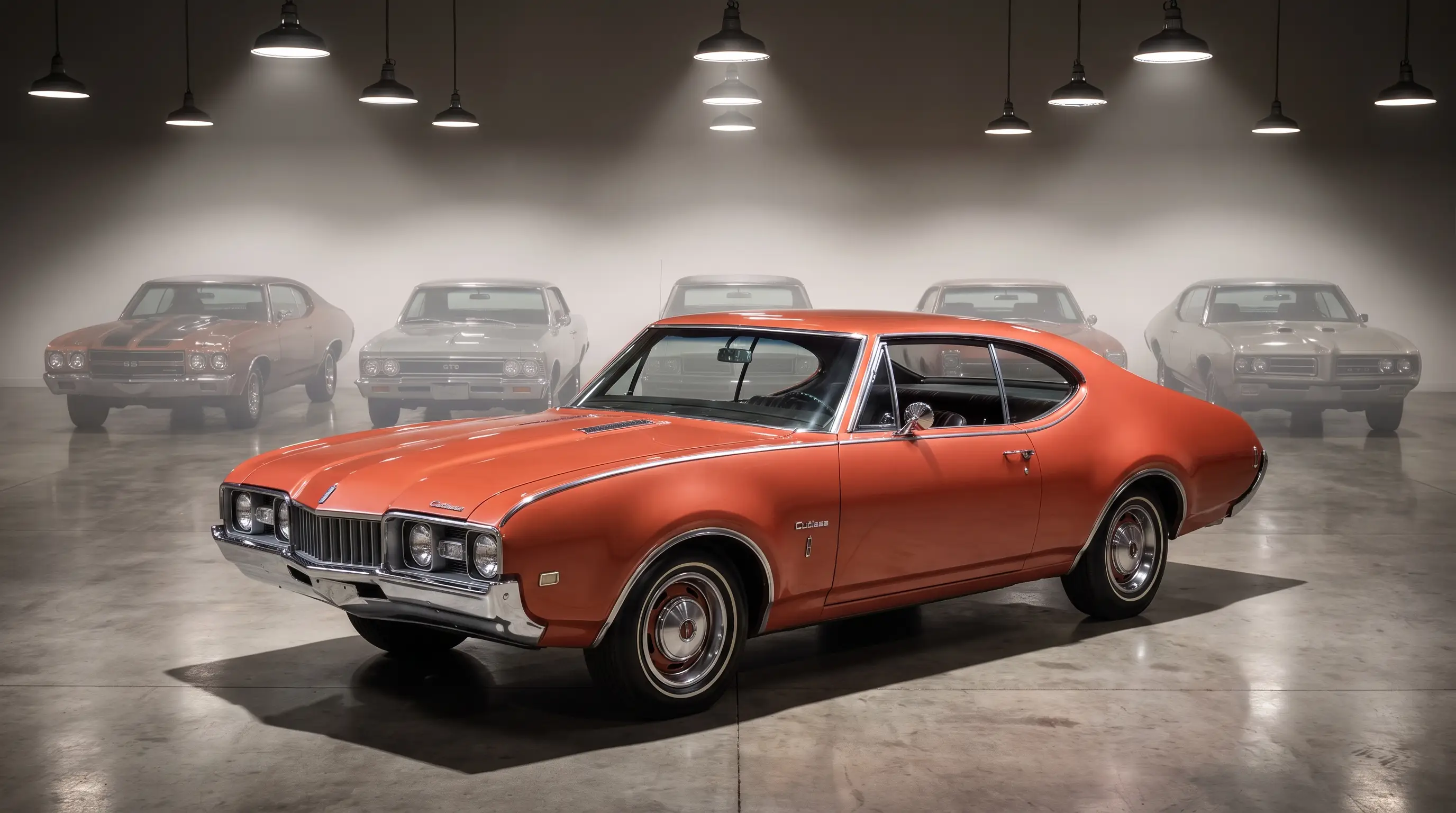
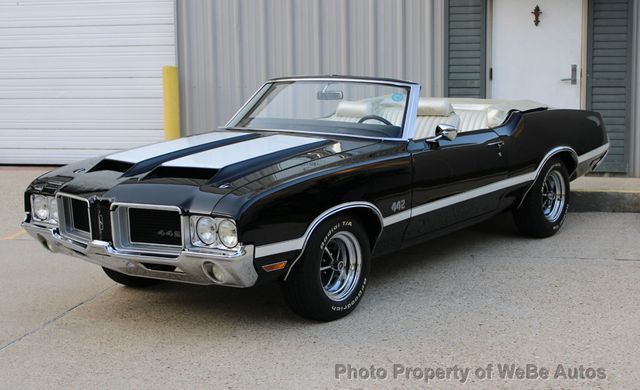
Collectors who focus exclusively on the mid and late 1960s Cutlass Supreme and 442 cars sometimes treat 1961 as a footnote, but the compact F-85 is the reason the badge existed to inherit that later performance identity. Without the trim-level Cutlass on a Y-body compact, there is no name sitting on the shelf in 1964 for Oldsmobile to promote to its own model line. Our Classic Cars Arena feature traces that full arc from compact trim package to the performance nameplate collectors chase today, and the 1961 F-85 is where that record properly begins.