
Picture a reader in the spring of 1936, turning the pages of The New Yorker and finding a long, affectionate goodbye to a car that had stopped coming off the line nine years earlier. The essay was called "Farewell, My Lovely!" and the byline read "Lee Strout White." The farewell my lovely Model T essay, as collectors tend to call it now, did something unusual for a magazine piece about a machine: it treated the Ford as a member of the family who had just left the house for good.
Car Features
8 min read
Farewell, My Lovely: The 1936 New Yorker Essay on the Model T
In May 1936 The New Yorker ran a fond goodbye to the Model T under the byline Lee Strout White. Who wrote it, and why it still lands.
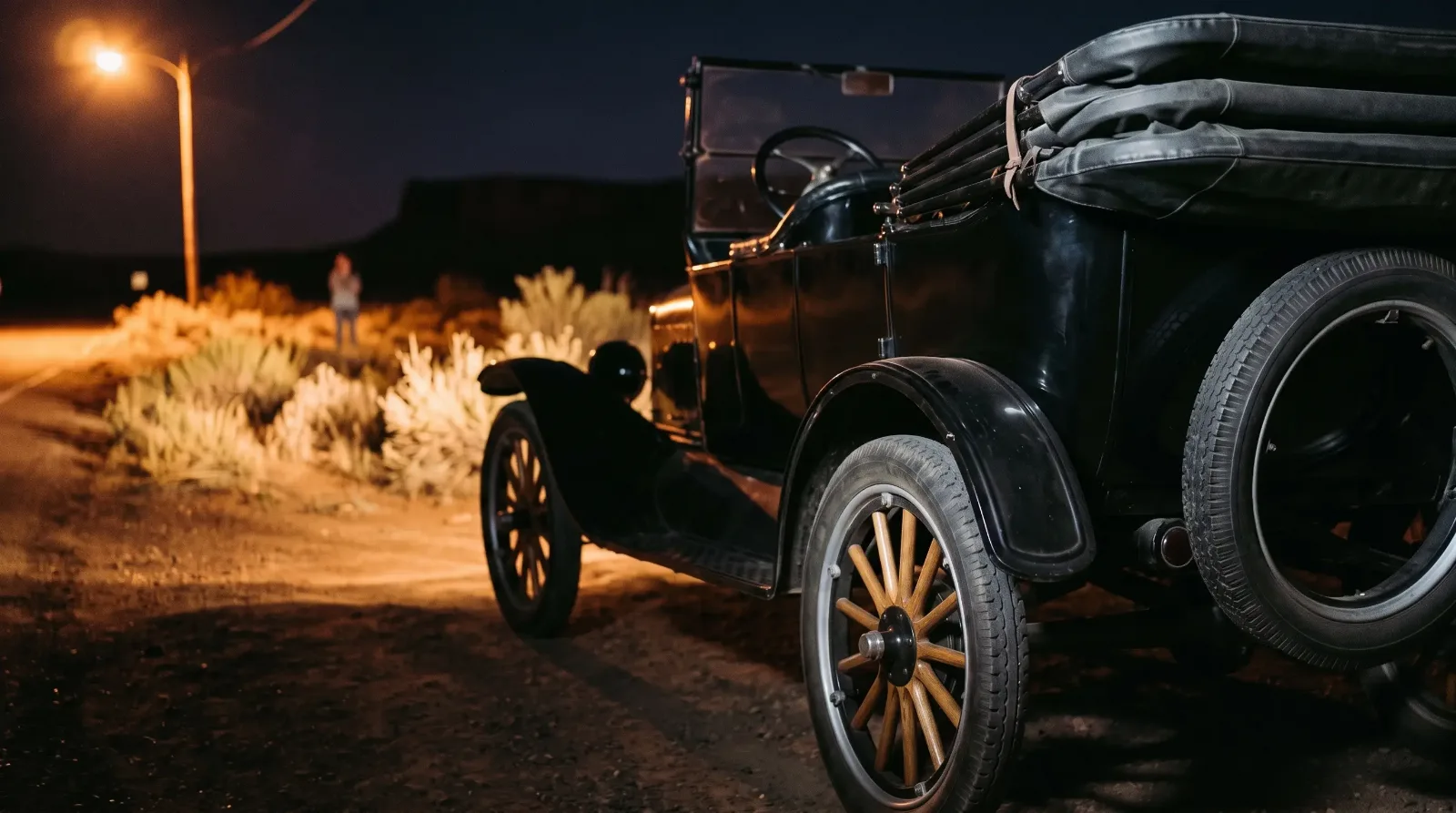
That tone is the reason the essay still circulates. It arrived after the Model T had already become folklore, after the jokes, the songs and the name. If you want the roots of the name itself, start with why Americans called it Tin Lizzie. This article stays with one piece of writing: who wrote it, when it ran, and why a farewell to a cheap black car reads like a farewell to a whole way of living.
What ran in The New Yorker on May 16, 1936
The essay appeared in the May 16, 1936 issue. By then the last American Model T was long gone. Henry and Edsel Ford had driven the 15 millionth car off the Highland Park line on May 26, 1927, and the last Model T built anywhere left the Cork plant in Ireland that December. Ford had made a ceremony of the 15 millionth car, and the count was the point. So the essay was not news. It was memory, written at a distance of almost a decade, by people who had driven the car when it was simply the car everyone had.
The piece moves through the experience of owning a Model T rather than its history. It dwells on the strange driving controls, the noises, the small rituals of starting and stopping, and the stream of add-on gadgets owners bought to fix what Ford had left out, the sort of thing sold by mail order alongside replacement axles and tops. It is funny, but the humor sits on top of real fondness. That combination is what separates it from the gag books and vaudeville lines that had mocked the car in its own lifetime.
| Item | Detail |
|---|---|
| Title as published | "Farewell, My Lovely!" |
| Magazine and date | The New Yorker, May 16, 1936 |
| Byline | "Lee Strout White" |
| Writers behind the byline | E.B. White and Richard L. Strout |
| Illustration | Spot art by Constantin Alajalov |
| Later title | "Farewell to Model T," later credited to E.B. White alone |
| Time since last US Model T | Nine years (Highland Park stopped on May 26, 1927; branch plants finished days later) |
Two writers, one name: Lee Strout White
The byline was a blend. "Lee Strout White" stitched together Richard Lee Strout and E.B. White. According to the magazine's own later account, Strout was the one who first sent a Model T manuscript to the editor, Harold Ross. What happened next is not settled. Nobody can say for certain whether White rewrote Strout's draft line by line or simply took it as the spark for something of his own.
Strout was not a humorist by trade. Born March 14, 1898, in Cohoes, New York, he spent his working life as a Washington correspondent for the Christian Science Monitor, from the early 1920s until 1984, and for four decades he also wrote the "TRB from Washington" column for the New Republic, from 1943 to 1983. He died on August 19, 1990. A man who spent about sixty years as a newspaper correspondent left one of his most lasting marks in a comic goodbye to a Ford.
White's name carried the piece forward. The essay soon came out again as a small book titled "Farewell to Model T"; a library record lists a second impression from G.P. Putnam's Sons in November 1936. Over the following decades the credit narrowed to White alone, and the 2003 Little Bookroom edition, which pairs it with his later Model T road-trip essay "From Sea to Shining Sea," carries only his name. The shared byline is the original, and it is the honest one.
"I like the blended byline more every time I look at it. Two men who had both fought the same car on the same cold mornings, folded into one invented name. It feels right that nobody owns the Model T, not even its eulogy."
Nora Beckett
A car remembered through the hands and feet
What the essay understood was that the Model T lived in the body. Drivers did not remember horsepower. They remembered their left foot.
The Ford Manual described a system nothing else on the road copied. Three pedals sat on the floor. The left one, pressed down, gave low gear; held halfway, it gave neutral; let all the way out, with the hand lever forward, it gave high. The center pedal was reverse. The right pedal worked a band inside the transmission and was the main brake, because the foot brake never touched the wheels at all; only the hand lever worked small drums at the rear. The throttle was a hand lever on the steering wheel, and a floor lever handled the parking brake and neutral.
A generation learned to drive on that arrangement, and then, in a few short years, the rest of the world moved on to clutch, brake and gas pedal. By 1936 a Model T driver was holding knowledge that had stopped being useful. That is the quiet sadness under the jokes in the essay. It is a goodbye to the car, and also to the skill.
Why the farewell my lovely Model T essay outlived its moment
Plenty of writers poked fun at the Model T while it was being built. Comedians had the car falling apart on stage and on screen; the slapstick version of the Ford is a story of its own, told in this piece. Those jokes depended on the car being everywhere. They were aimed at the neighbor's Ford, the one rattling past the window.
"Farewell, My Lovely!" works the other way. It speaks about a car that is disappearing. The rattles are no longer an irritation; they are something you miss. The essay turns a mass-produced object, some 15 million of them, into something personal, a single car with a single owner who knew all its moods.
That shift, from joke to elegy, is why the piece kept being reprinted long after the cars themselves went to scrapyards and barns, as recently as a 2003 hardcover. It also set a template. Later writers who wanted to talk about an old car with feeling, rather than nostalgia for its own sake, found a model in the way this essay balanced laughter and loss. For the wider shelf of fiction and memoir the Ford inspired, see the Model T in books.
The title itself helped. "Farewell, My Lovely!" sounds like a line from a love letter. Calling a farm-tough, pedal-shifted Ford "lovely" was a joke and a confession in the same breath, and readers heard both.
Reading it in 2026
Ninety years on, the essay asks something different of its readers. Few people alive today learned to drive on a planetary transmission, and the gadgets it pokes fun at are period curiosities now. Read cold, some of its references need a footnote.
But the feeling does not. Anyone who has kept an old car running past the point of good sense knows the mix of irritation and loyalty the essay describes. Owners of surviving Model Ts still talk about their cars as individuals with tempers, and still trade the small mechanical tricks that keep one going. The vocabulary changed. The relationship did not.
There is also a lesson in the byline for anyone who writes about cars. The record shows two men, a manuscript and an editor, and then a single name that hid the collaboration for years. The credit drifted toward the more famous writer. The honest version, Lee Strout White, is still the one printed on May 16, 1936.
It is worth finding a copy and reading it with a Model T owner nearby. Watch for the moment they stop smiling at the jokes and start nodding.
Sources and notes
- A Flivver Farewell (New Yorker State of Mind): the May 16, 1936 issue, byline and Alajalov spot art
- Sonderbooks review of Farewell to Model T and From Sea to Shining Sea (Little Bookroom, 2003)
- Richard L. Strout (Wikipedia)
- Last day of Model T production at Ford, May 26, 1927 (History.com)
- Ford Manual for Owners and Operators of Ford Cars (Project Gutenberg)
- Ford Model T (Wikipedia)
Related Reading
Have a
Ford Model T
for Sale?
Reach thousands of serious classic car collectors across the US.
Sell It Here →
Selling a classic? Here's how: the best sites to sell a classic car
Are You a Classic Car Dealer?
List your full inventory and connect with targeted classic car buyers.
Join as a Dealer →

About the author
Nora Beckett
Automotive features writer and photographer who tells the human stories behind the cars, from show fields to cross-country road trips.
Related Listings - Ford Model T
Comments
Be the first to comment on this article.