
A traffic jam on a country road, two sailors on shore leave, and a little black Ford with nowhere to go. In Two Tars, released in 1928, Stan Laurel and Oliver Hardy get out of that jam the only way a slapstick comedy allows: they drive their Model T into a railroad tunnel, and it comes out the far side squashed sideways and still running. That single gag explains most of what you need to know about Model T silent movies. The car was everywhere, it was cheap, it was tough, and audiences already loved to laugh at it. Comedians simply took the joke the country was telling and put it on film.
Car Features
7 min read
The Model T in Slapstick Comedy: Laurel and Hardy and the Silent Era
Squashed in a tunnel, sunk in a puddle, crushed by streetcars: how the Model T became slapstick's favorite car, from Two Tars to Hog Wild.
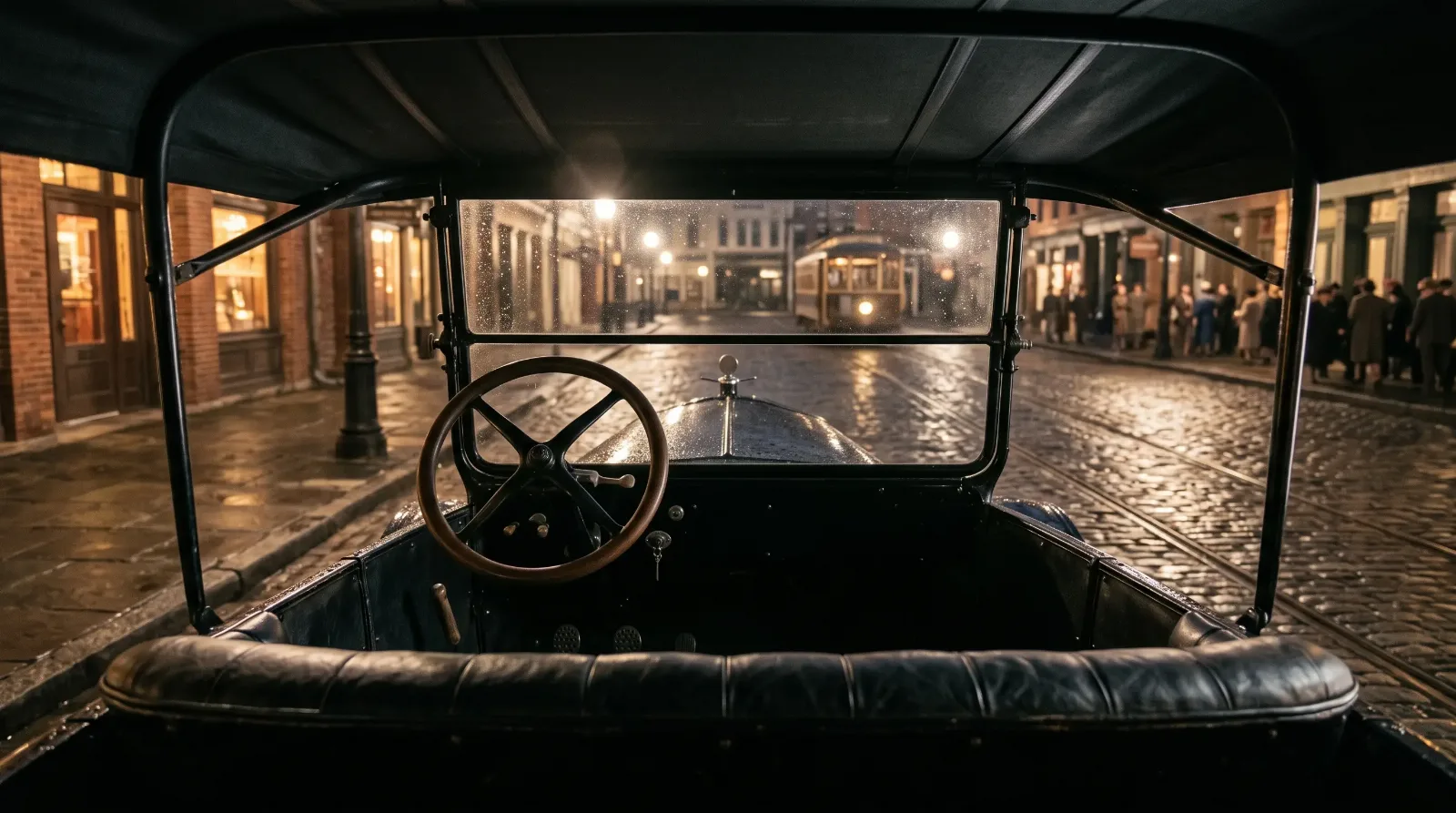
This piece looks at why the Ford became the favorite prop of screen comedy, which Laurel and Hardy films used it, and where the record gets thin. If you want the backstory of the nickname itself, start with the Tin Lizzie legend; here the focus stays on the camera and the pratfall.
Why comedians reached for a Model T
Comedy needs an object the audience recognizes in half a second. By the 1920s the Model T was that object. Ford built more than 15 million of them between 1908 and 1927, and the runabout's price fell from $825 in 1909 to $260 in 1925. A car that cheap was a car the people in the seats had owned, borrowed, cranked, cursed and pushed out of a ditch. When a Ford fell apart on screen, nobody in the house needed it explained.
Price mattered behind the camera too. A gag that ends with a car flattened, sunk or sawn in half needs a car you can afford to lose, and the Model T kept getting cheaper as the years went on. It was also simple, and parts were sold everywhere, so a studio could keep a few running without trouble.
Then there was the reputation. The car was already the butt of postcards and joke books, the rattling tin can that somehow kept going. Screen comedy turned that idea into motion. The Ford could be bent, dunked and battered, then shudder back to life, which is exactly the kind of indestructible underdog slapstick is built on.
The Keystone Cops and the silent era: what we can say
Ask most people to picture early film comedy and they see the Keystone Cops piling into a car and careering around a corner. Mack Sennett's Keystone Film Company produced those chases, and the Cops ran in its films from 1912 to 1917, starting with Hoffmeyer's Legacy and taking off with The Bangville Police in 1913. Histories of the era place the Model T in films with Buster Keaton, with Harold Lloyd, and in pictures involving the Keystone Cops.
Here is the honest limit. No source I could find ties a specific, named Keystone Cops film to a Model T, and nobody has documented which makes Sennett's studio actually kept on the lot. It is easy to assume every jalopy in a Keystone chase was a Ford, given how common the car was. Assuming is not the same as knowing, and the record does not name titles. The same caution applies to Keaton and Lloyd: the Model T turns up in their era of comedy, but this article will not hang the car on a particular reel without a source that says so.
What can be said with confidence is the pattern. Silent comedy ran on physical action, and the automobile was the newest, fastest, most breakable thing in American life. The Model T was the car most people knew, so it became the car comedians broke.
Laurel and Hardy: the Model T films
The clearest Model T comedy on record belongs to Laurel and Hardy, working for producer Hal Roach. Their Ford gags span the last silent years and the first talkies, and the line between the two matters for anyone who wants to call these films silent.
| Film | Year | Silent or sound | The Model T gag |
|---|---|---|---|
| Two Tars | 1928 | Silent | The pair flee a traffic jam into a railroad tunnel; the car comes out squashed sideways but running |
| Big Business | 1929 | Silent | They sell Christmas trees from a Model T truck; an angry neighbor wrecks their car |
| A Perfect Day | 1929 | Sound (their third talkie) | The loaded Model T sinks into a puddle with the boys and their passengers aboard |
| Hog Wild | 1930 | Sound | Hardy rides a ladder on the car fitting a radio aerial while Laurel drives off; the car ends up crushed between two streetcars |
Two Tars came out on November 3, 1928, through MGM, directed by James Parrott. Its car battle was shot on location in Santa Monica, on a road now called Centinela Avenue, and the film survives. One caution: the plot summaries describe the tunnel car without naming its make, so the identification as a Model T rests on what viewers see rather than on a studio record.
Big Business, from 1929, is the other true silent in the group. The Christmas tree business runs from a Model T truck, and the slow, polite escalation of destruction between the boys and their customer ends with their car in pieces.
"Watch Big Business with the sound off, the way it was made, and notice how much of the joke is the car. Nobody wrecks a Rolls-Royce for laughs. You wreck the thing everybody in the audience drove to the theater."
Patrick Walsh
When the talkies arrived, the Ford came along
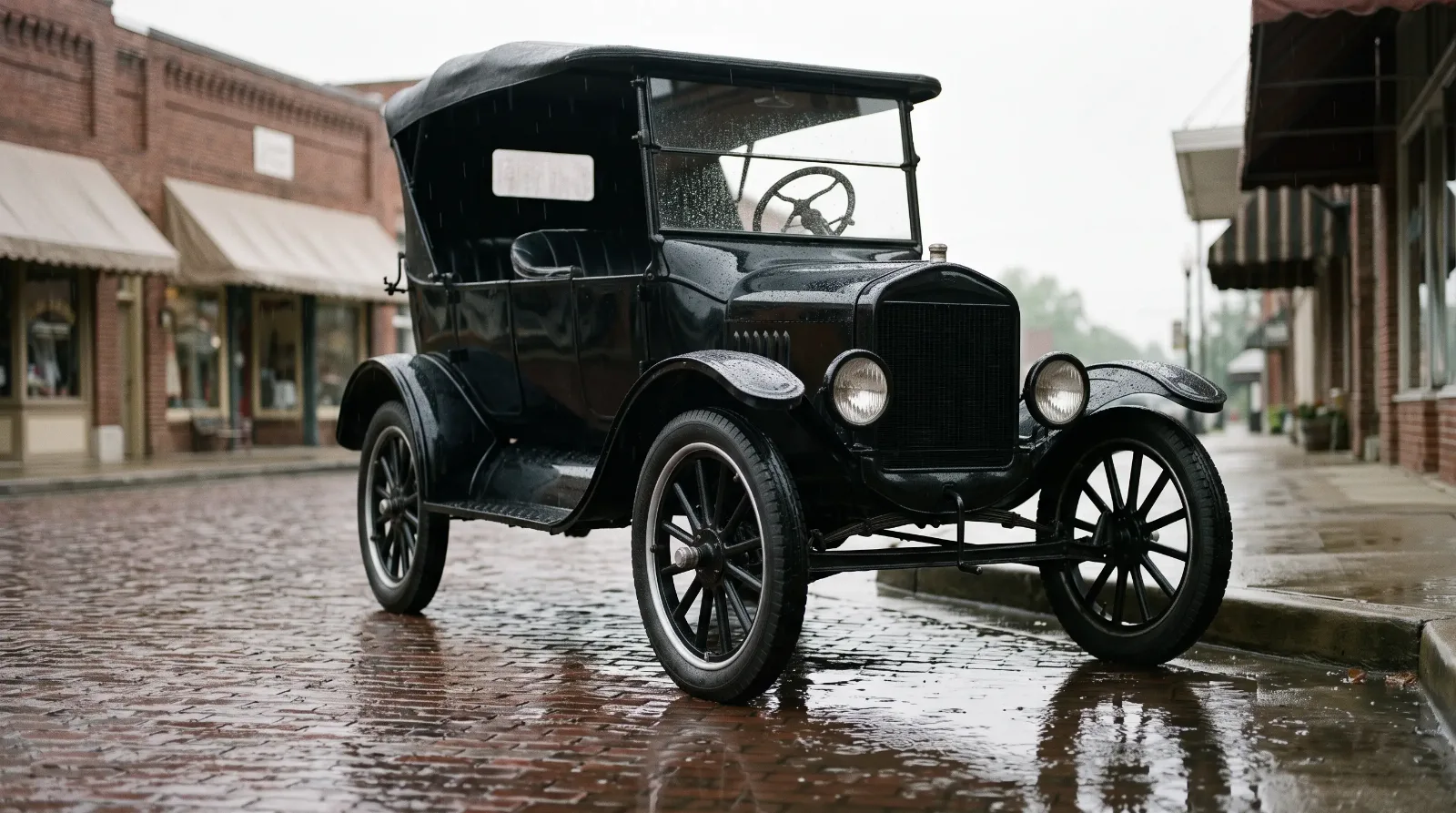
A Perfect Day and Hog Wild are often lumped in with the silent comedies because the gags feel the same. They are sound films. A Perfect Day was Laurel and Hardy's third talkie, and its slow-motion disaster of a family outing ends with the Model T sinking into a puddle that turns out to be much deeper than it looked. Hog Wild, from 1930, gives the car one of its most famous screen deaths: Hardy is perched on a ladder on top of the Ford, trying to put up a radio aerial, when Laurel drives off, and the trip ends with the car pinched between two streetcars.
The Hog Wild car later had a life of its own. A crumpled Model T touring car, described as a 1922, was once shown at the Petersen Automotive Museum as the film car. Fans still argue about its exact year and whether it is the original or a later prop, so treat that story as a good one rather than a settled one.
By 1930 the Model T was already out of production, replaced on the showroom floor by the Model A. That timing helps explain the joke. A three-year-old Ford in 1930 was not new and not fashionable; it was the sort of car two hapless men would own, and the audience knew exactly how it felt to ride in one.
Why the slapstick Ford still works
Screen comedy did something the jokes and songs could not. It showed the Model T taking abuse in real time and coming back for more, and that image stuck. Every later film that uses an old Ford as a punchline, from the flying car in The Absent-Minded Professor onward, borrows from it.
For anyone who owns or drives a Model T today, the films are also a record. They show period roads, period traffic and cars being driven hard by people who used them every day, even if the stunts were staged. Watching Two Tars or Big Business is a fair way to see how ordinary the car once was.
The Ford's film career did not end with the T. Its successor picked up the role in the gangster pictures and Depression dramas that followed, and you can follow that thread with the Model A on screen. But the pratfall, the squashed car still sputtering out of the tunnel, belongs to the Model T.
Sources and notes
- Ford Motor Company press release on the Model T in film, July 2008 (archived copy)
- Two Tars (1928), release, director and Santa Monica locations
- ClassicCars.com Journal: Hog Wild and the Petersen Museum Model T
- Keystone Cops: Mack Sennett's films, 1912 to 1917
- D23: the flying Model T from The Absent-Minded Professor
Related Reading
Have a
Ford Model T
for Sale?
Reach thousands of serious classic car collectors across the US.
Sell It Here →
Selling a classic? Here's how: sell my classic car
Are You a Classic Car Dealer?
List your full inventory and connect with targeted classic car buyers.
Join as a Dealer →
#automotive history
#cars in movies
#ford model t
#Tin Lizzie
#Laurel and Hardy
#Silent film
#Slapstick comedy

About the author
Patrick Walsh
Automotive journalist covering classic car shows, events, and the enthusiast community across North America.
Related Listings - Ford Model T
Comments
Be the first to comment on this article.