
The lot fills before the coffee does. By seven in the morning there are already forty Firebirds parked in loose rows behind a diner off the interstate, hoods up, folding chairs out, someone's radio playing low enough that it doesn't compete with the engines idling nearby. A man in his seventies is showing a teenager, who is not his grandson but might as well be, how to read a build tag riveted under the hood. This is what firebird clubs actually look like on a given Saturday, not a showroom, not a museum, just a parking lot that has quietly become sacred ground for a few hours.
Car Features
6 min read
Firebird Fandom and Clubs
Inside the parking lot meets, VIN registries, and decades-old friendships that keep Firebird clubs running long after the cars change hands.
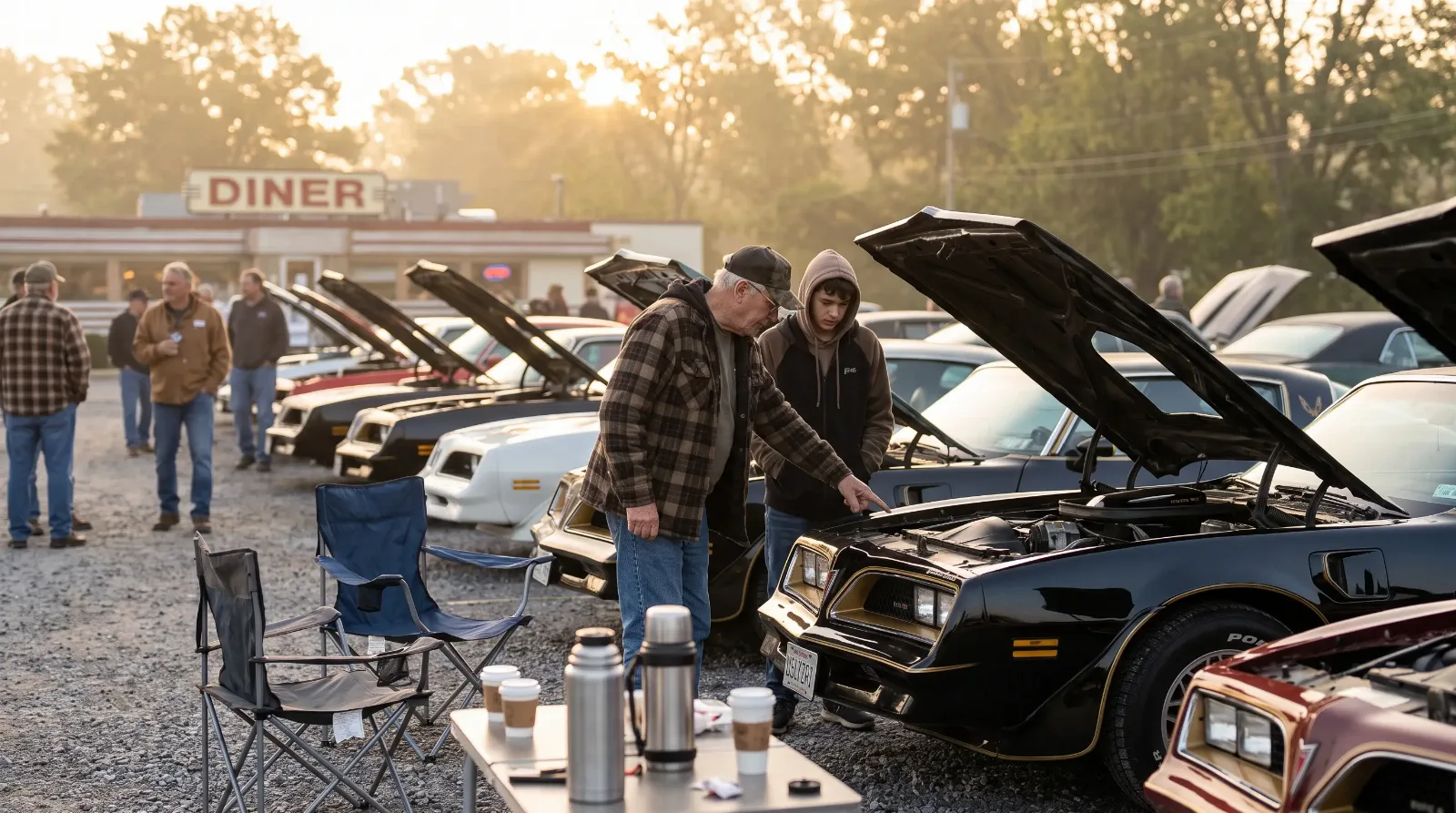
A parking lot full of birds
Nobody sent out invitations for this. Word traveled through a phone tree that turned into a group text that turned into a private social media group, and now it happens most months without anyone officially organizing it. The cars range from a rough driver with primer spots to a trailer queen that has not seen rain since its last repaint. Nobody cares which is which. The owner of the primer car gets asked as many questions as the owner of the trailer queen, sometimes more, because his car has stories that the perfect one does not.
This is the texture that gets lost when people talk about the Firebird only in terms of horsepower and trim codes. The car built a following, yes, but the following built something back: a habit of showing up, a language of shared knowledge, a reason for strangers to spend a Saturday morning standing in a parking lot together.
How the clubs actually started
Regional Firebird and Trans Am clubs began forming not long after the car itself hit the road, but the real growth came later, once the second-generation cars had become the objects of nostalgia rather than just new purchases. Owners who had bought the car new in the late 1970s found each other again a decade or two later, this time not as strangers at a dealership but as people trying to source a correct interior panel or figure out why a numbers-matching engine had the wrong casting date.
What started as practical, parts-and-knowledge networks slowly became something warmer. Newsletters turned into meets. Meets turned into annual gatherings that some families now plan vacations around. A woman I spoke with at one such gathering told me she had been attending the same regional show for eleven summers, and that she now knew more people through that show than through her actual neighborhood.
What membership actually means
Joining a club is rarely about the dues, which are usually modest, or the newsletter, which some members admit they barely read. It is about having somewhere to bring a question that only makes sense to people who already understand why it matters. Where did the correct decal supplier go. Is this trim tag original or reproduced. Does anyone remember which years got the honeycomb wheels standard and which years made you pay extra.
Those questions sound small from the outside. Inside the club, they are the connective tissue. Someone always knows the answer, or knows someone who does, and that chain of shared expertise is what keeps a person renewing a membership year after year long after they've stopped needing much from the car itself.
The digital campfire
Online forums did not replace the parking lot meets. They extended them into the hours when the lot is empty and everyone is home, staring at a half-finished restoration project under a shop light. A forum thread about a stubborn wiring issue can run for years, picked up by new members who find it through a search engine long after the original poster solved their problem and moved on.
What's notable is how much of that history the community has carried forward from before the internet existed at all. The habits of the newsletter era, the patience of explaining something thoroughly rather than dismissively, seem to have survived the move online in a way that a lot of enthusiast communities did not manage. Part of that is generational overlap. The people who started the phone trees in the 1980s are often the same people moderating the forums now, and they brought their manners with them.
"I asked one club veteran why he still drove four hours to a meet every spring instead of just posting pictures online. He looked at me like the question answered itself. Some things you have to smell and hear, he said. A photo doesn't tell you if the exhaust note is right."
Nora Beckett
That instinct, the pull toward gathering in person even when a screen would be easier, runs through how Hollywood made it a star in a way that is easy to underestimate. A car that became famous on screen still needed real people, standing in real parking lots, to keep its story going for fifty years afterward.
Why the community outlives any single car
Cars get sold. Cars get wrecked, restored, sold again. What does not change hands nearly as often is the person who shows up. Club rosters are full of names that have owned three, four, five different Firebirds over the decades, each one traded or lost to circumstance, and each time the same person turns up at the next meet with a new car and the same old questions.
That continuity is the real inheritance here, more than any single trim package or engine option. The parking lot fills every month not because of what is parked in it, but because of who keeps showing up to stand next to it. For a fuller sense of the cultural moment that first pulled so many of these people into the hobby, a related deep-dive is worth the read.
Sources and notes
Related Reading
Have a
Pontiac Firebird
for Sale?
Reach thousands of serious classic car collectors across the US.
Sell It Here →
Are You a Classic Car Dealer?
List your full inventory and connect with targeted classic car buyers.
Join as a Dealer →

About the author
Nora Beckett
Automotive features writer and photographer who tells the human stories behind the cars, from show fields to cross-country road trips.
Related Listings - Pontiac Firebird




Comments
Be the first to comment on this article.