
The Pontiac Firebird Formula 455 sounds simple on paper. Take a Firebird, add the Formula package, drop in the big 455 cubic inch V8. I have pulled apart enough of these over the years to tell you it is not that simple, and that gap between the badge and the reality is exactly why the car still matters to people who actually turn wrenches instead of just admiring the hood scoops.
Car Features
6 min read
The Formula 455
The Firebird Formula 455 traded flash for substance, and the Super Duty version built in 1973 and 1974 is the one worth chasing today.
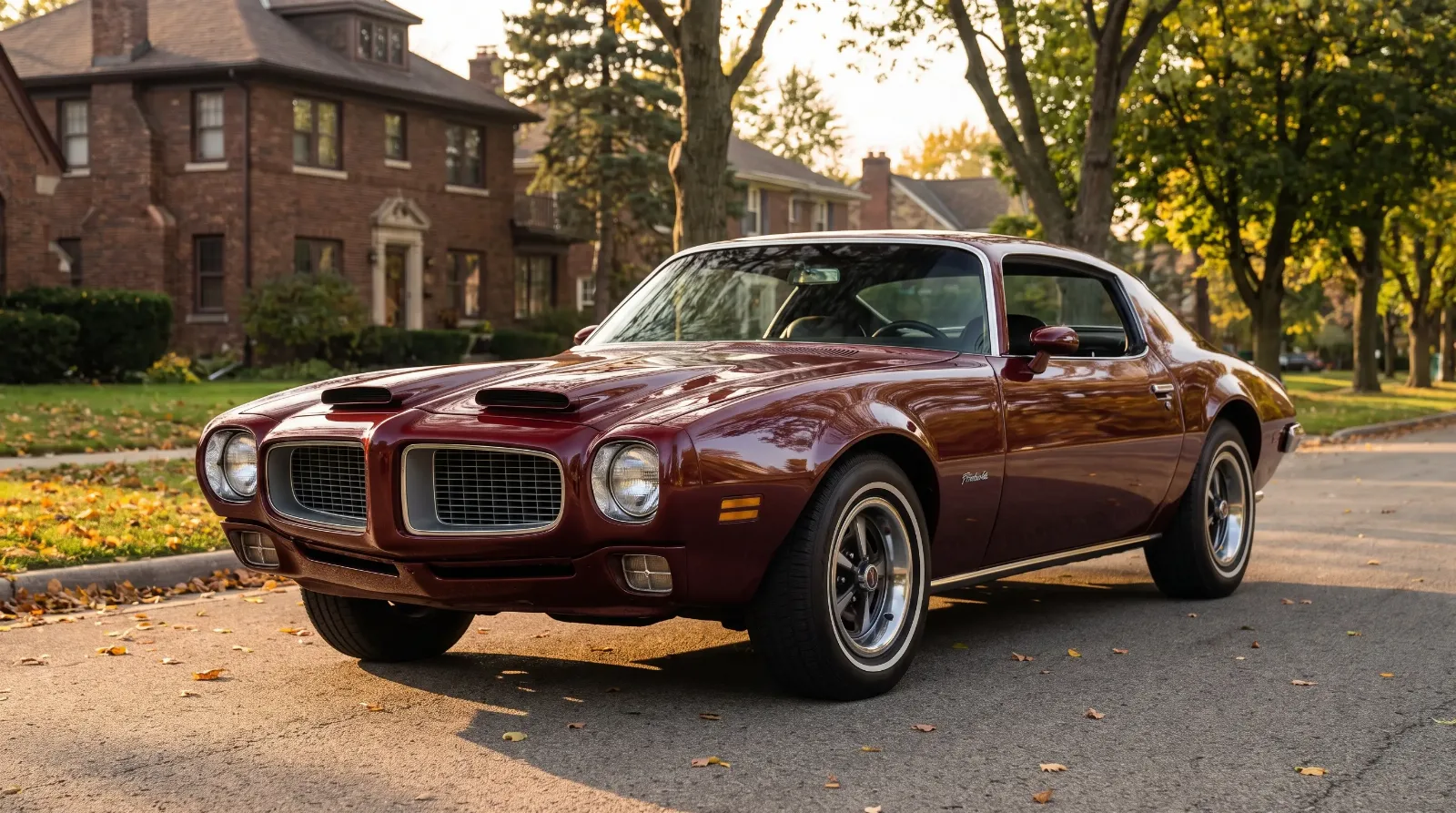
The Formula trim showed up on the second-generation Firebird for the 1970 model year, sitting between the base car and the Trans Am. It was Pontiac's answer for buyers who wanted the mechanical substance of a Trans Am without paying for the shaker scoop, the spoilers, or the insurance company's attention. The dual-scoop hood was the giveaway. Everything under it is where the real story lives.
Where the Formula sat in the lineup
Pontiac built the Formula as a driver's car first. No rear spoiler, no big decal package, none of the visual noise that made a Trans Am a target for every cop on Woodward Avenue. What you got instead was the choice of Pontiac's serious engines: the 350, the 400, and eventually the 455, all wrapped in a body that did not announce itself. That was the point. A lot of guys who actually raced these things on the street preferred it that way.
I have talked to owners who bought Formulas new specifically because the Trans Am drew too much attention from the wrong people. That is not nostalgia talking. That is how these cars were actually used.
The 455, year by year
The 455 did not arrive with the Formula's debut. For 1970 the top engine was the 400. The 455 became available across the Firebird line starting in 1971, and that is when the Formula 455 designation starts meaning something specific to collectors and buyers today. The engine grew from Pontiac's 400 block architecture, sharing the bore spacing and a lot of the basic design, but with more stroke and more displacement to work with.
1971 through 1972 versions ran higher compression than what came after. The industry-wide switch to SAE net horsepower ratings in 1972 muddies a lot of comparisons, and I would tell any buyer to be skeptical of a spec sheet that quotes gross horsepower next to a later net figure like they are the same thing. They are not, and the actual difference in output year to year is smaller than the raw numbers suggest once you correct for it.
| Model year | 455 variant | Approx. output | Notes |
|---|---|---|---|
| 1971 | 455 (standard, L75) | 325 hp gross | Last year of gross ratings |
| 1971 | 455 H.O. | 335 hp gross | Round-port heads, dual exhaust |
| 1972 | 455 H.O. | 300 hp net | First year of SAE net figures |
| 1973 to 1974 | Super Duty 455 | 290 to 310 hp net | Four-bolt mains, forged crank |
| 1975 to 1976 | 455 | 200 hp net | Catalytic converter, lower compression |
By 1976 the 455 was on its way out entirely, choked down by emissions equipment and compression ratios that would have looked embarrassing five years earlier. Pontiac pulled the plug on the big-block Firebird after that model year, and the Formula moved on with smaller displacement engines afterward. Anyone researching the full arc of the trim should read the Formula story for how the package evolved once the 455 was gone.
The Super Duty 455, the one worth chasing
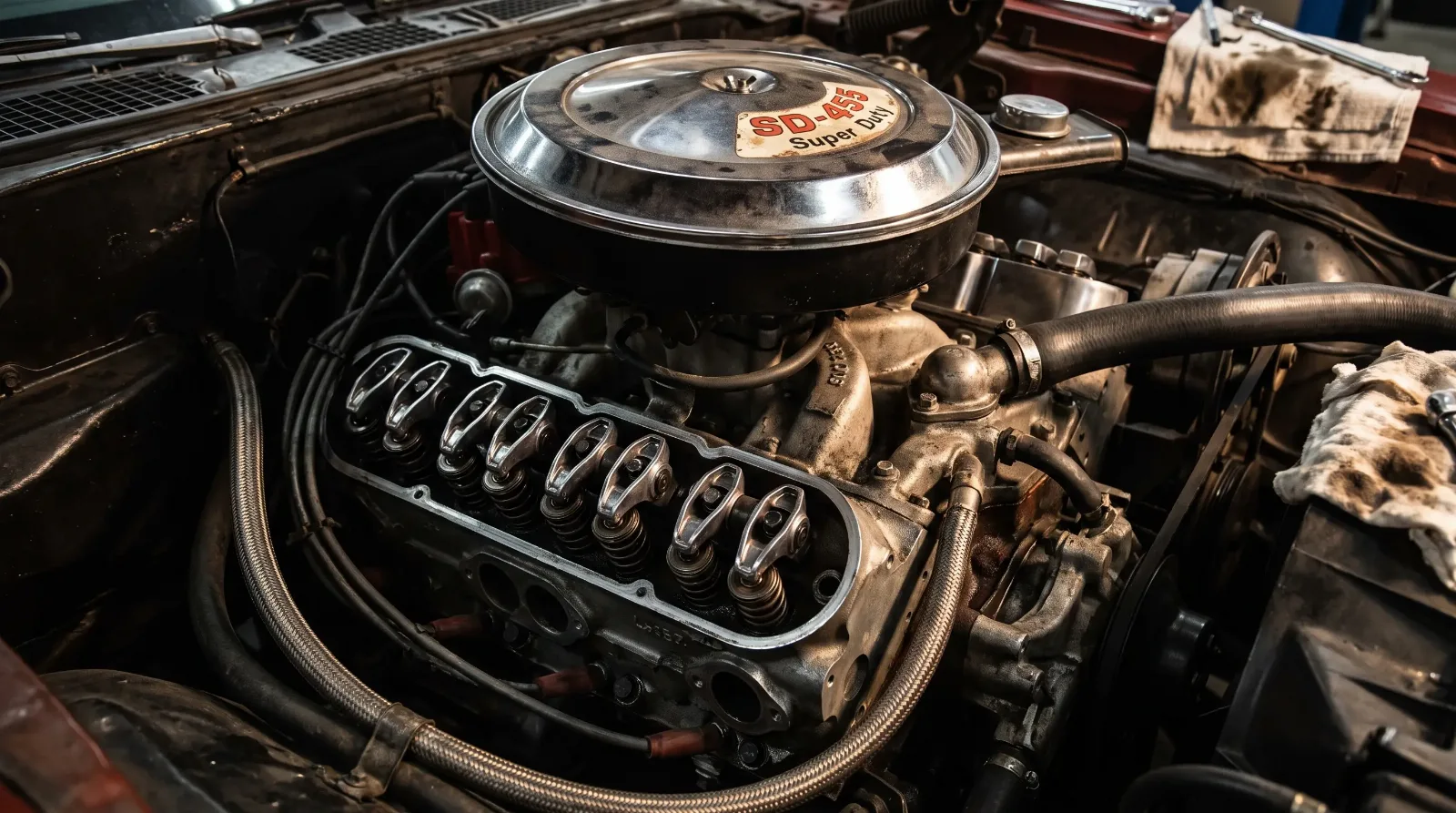
If you are shopping for a Formula 455 and money is not the only concern, the Super Duty version from 1973 and 1974 is the one to find. Pontiac built the SD-455 with four-bolt main bearing caps, a forged crankshaft, round exhaust port heads, and a mechanical fuel pump setup that could actually feed the thing under load. It was a genuine performance engine built during a period when most of Detroit had already surrendered to emissions regulations.
The catch is that very few were built, and even fewer survive with the original block, the correct heads, and documentation that ties them together. I have seen more than one "Super Duty" Formula that turned out to be a regular 455 with an SD air cleaner decal on top. The block casting number is not optional information. Learn it before you shop.
What to check before you buy one
Start with the block. The 455 casting numbers and the date code need to line up with the car's build sheet or a documented production window, not just "look right" to a seller who wants a quick sale. Second, check the heads. Round-port versus D-port heads changed the breathing characteristics significantly, and a swapped set of heads is common enough that you should assume it happened until you confirm otherwise.
Rust is the third item, and it is not glamorous but it is the one that costs the most to fix properly. Trunk floors, frame rails near the rear leaf spring mounts, and the lower cowl are the spots I check first on any second-gen Firebird regardless of engine. A numbers-matching 455 sitting in a rotted shell is not a bargain. It is a restoration project wearing a for-sale sign.
"A correct 455 block is worth having someone verify before you write a check. I have seen too many casting numbers that tell a different story than the seller's description."
Mike Sullivan
Living with one today
A Formula 455 in decent driving condition is not a garage queen by nature. These were built as drivers, and the ones that survive in the best mechanical shape are usually the ones that got used and maintained rather than parked and forgotten. Parts support for the 400/455 block family is solid. Reproduction and NOS parts exist for most of what wears out, and the aftermarket has kept up with everything from gaskets to correct-style exhaust manifolds.
What is harder to find is a car that has not been "improved" somewhere along the way. Carburetor swaps, non-original intake manifolds, and disc brake conversions done with mismatched parts are common on cars that spent decades as daily transportation before anyone cared about originality. None of that makes a car unusable. It just means you need to know what you are looking at before you decide what it is worth to you. For a different perspective on how these cars get valued against their flashier Trans Am siblings, another angle is worth reading before you set a budget.
Sources and notes
- Automobile Catalog: 1971 Firebird Formula 455 H.O. specs
- Automobile Catalog: 1972 Firebird Formula 455 H.O. specs
- Horsepower Memories: 1973-1974 Firebird and Trans Am Super Duty
- CarBuzz: Pontiac's 455 Super Duty
- DrivingLine: The Pontiac 455 V8, the last big block
- Wikipedia: Pontiac Firebird (second generation)
Related Reading
Have a
Pontiac Firebird
for Sale?
Reach thousands of serious classic car collectors across the US.
Sell It Here →
Are You a Classic Car Dealer?
List your full inventory and connect with targeted classic car buyers.
Join as a Dealer →

About the author
Mike Sullivan
Detroit-area muscle car enthusiast and restoration specialist with three decades of hands-on experience working on American iron.
Related Listings - Pontiac Firebird
Comments
Be the first to comment on this article.